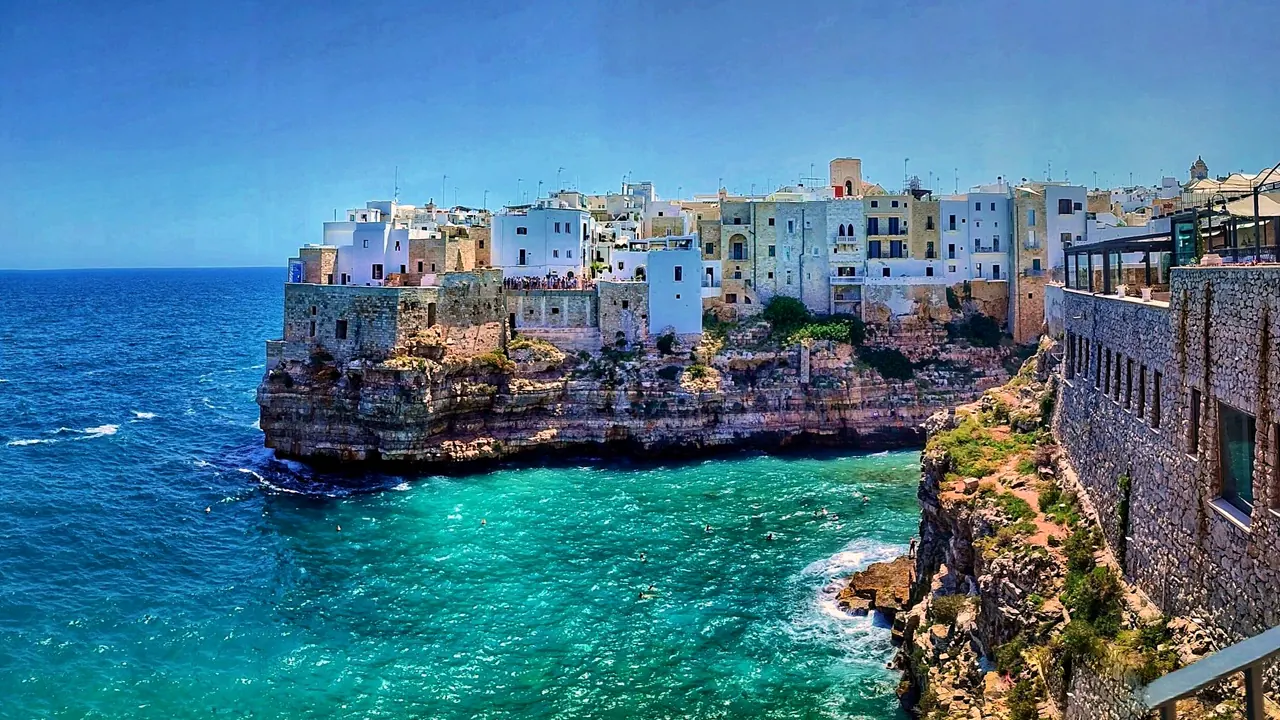
Photos: Puglia by Acquario51, CC BY-SA 4.0, cropped.
Korčula or Puglia?
Our verdict in twelve categories, each scored against the same fixed benchmark cities, and the climate month by month, so you can choose for your trip.
Choose Korčula for
Korčula does not lead in any category we score.
Korčula is the better pick for a small, contained island week where you hardly plan anything. You swim in clear pebble coves, take a taxi boat out to the islets, walk the walled old town in an evening and drink the island's own whites at the cellar door. It suits couples and slow travellers who want one base, little driving and quiet nights, and who are happy to give up variety for that calm.
Choose Puglia for
- food and drink
- nightlife
- live music and the arts
Puglia gives you a much broader trip. You get long sandy beaches as well as rocky coves, cooking that is a reason to come in itself, baroque Lecce, the trulli and a string of small towns to drive between. Families, food lovers and anyone who wants some life after dark will find more here, as long as they hire a car and accept that the region is too long to see from a single base.
Scoreboard
Twelve categories on one fixed scale from 0 to 100. The shaded stretch is the gap between the two.
Your match
Pick a travel style or drag the sliders, and both match scores follow your weighting.
Has no clear advantage with the weighting you have chosen.
Wins on food and drink and nightlife with your weighting.
What matters to you?
Category by category
What the scores mean for a trip.
Beaches & swimming
Korčula's swimming is excellent but mostly rocky. Most of its coast is pebble coves under pine, real sand is limited to Pržina and Bilin Žal near Lumbarda, and the clearest water is at places like Pupnatska Luka or off the flat rocks of Badija. The coves are small and fill early in summer.
Puglia gives you more coast and more kinds of it. In the Salento, long pale Ionian sands with shallow turquoise water run from Porto Cesareo to Pescoluse, while the Adriatic side has limestone coves at Polignano and sea stacks at Torre dell'Orso, and the Gargano adds sea caves. In August you will find paid lidos on the busiest stretches, but there is always more shore to try.
Food & drink
Korčula's food is plain Dalmatian cooking: grilled fish, black risotto and dishes slow-cooked under the peka bell, with much the same menu in every konoba. What stands out is the wine, with Grk from Lumbarda and Pošip from Čara and Smokvica, plus oysters at Ston across the channel.
Puglia is a destination for eating in its own right. You get burrata and stracciatella from the Murge, orecchiette with turnip tops, focaccia and panzerotti, sea urchins on the Bari waterfront and pasticciotto in Lecce. Add the meat grills of the Valle d'Itria, farm cooking at the masserie and good Primitivo and Negroamaro, and you can eat well for a whole trip without repeating yourself.
Culture & sights
Korčula's heritage is mostly in one handsome walled town. There is the herringbone street plan, St Mark's Cathedral with its Tintoretto and the house said to be Marco Polo's, and you can see it all in a day or two, with the ancient cave of Vela Spila as a side trip.
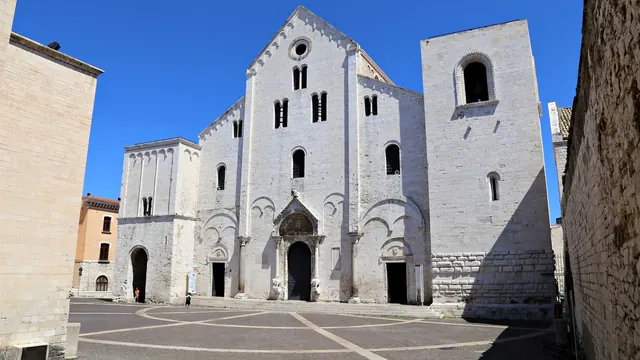
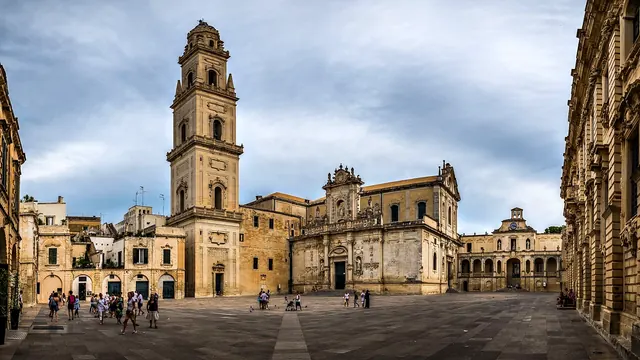
Puglia has far more to see, spread across many towns. There is the honey-coloured baroque of Lecce, the conical trulli of Alberobello, Frederick II's octagonal Castel del Monte and a line of Romanesque cathedrals from Trani to Otranto. You will spend time driving between them, but there is enough to fill a week of sightseeing.
Nightlife
Korčula's evenings are a cocktail on the town walls at sunset, a long dinner and an early night, with a few harbour bars open late in high summer. Visitors who want to dance take a boat to another island.
Puglia has a real summer party scene. Gallipoli's beach clubs run into the small hours, there are DJ nights in beach bars along the Salento, and Lecce's squares fill with people drinking outside. Bari keeps bars open all year in its old town and the Umbertino district.
Nature & outdoors
They are broadly level, but the landscapes differ. Korčula is a green island of pine, holm oak and vineyard terraces, best explored by kayak among the islets. Across the channel, Pelješac offers the climb up Sveti Ilija and the dependable windsurfing wind at Viganj, and Mljet's saltwater lakes are a boat ride away.
Puglia is mostly a gentle plateau of olive groves and dry-stone walls, best seen by bicycle. Its wilder country is in the Gargano, with the beech woods of the Foresta Umbra, sea caves and diving around the Tremiti islands. On both, spring and autumn are better than summer for walking.
Day trips
From Korčula, outings mean ferries: across to Pelješac for the Dingač wineries and Ston's walls, to Mljet for the lake monastery, or by catamaran to Hvar. Dubrovnik and Split are close to three hours each way.
Puglia gives you far more within a short drive. From the Valle d'Itria you can reach Ostuni, Locorotondo, Cisternino, Polignano and Monopoli, and Trani and Molfetta lie along the coast north of Bari. Matera's cave dwellings are about an hour from Bari, and Lecce is close to Otranto and the Greek-speaking villages.
Good for families
Korčula is safe and easy-going, and the sandy, shallow bays at Lumbarda suit small children. Beyond the beach there is little aimed at children, and the stepped lanes of Korčula Town are hard with a pushchair.
Puglia makes a family beach vacation easier. You get the shallow Ionian sands and gentle Gargano bays, villas and masserie with pools, and a piazza culture where children stay up late. There is a safari and amusement park at Fasano, and children usually love the trulli of Alberobello.
Getting around
Both are easiest with your own wheels, but the scale is very different. Korčula is one long, narrow island with a single main road and infrequent buses. Taxi boats link the town, Lumbarda and the islets, and arriving or leaving means a ferry.
Puglia is a long region where you spend real time on the road, and covering both the Gargano and the Salento needs two bases. In return, a main-line railway serves Bari, Polignano, Monopoli and Lecce, so a car-free stay is possible along that coast.
Shopping & style
Korčula has little shopping beyond souvenir lanes and a few craft studios. The best things to bring home are Grk, Pošip, olive oil and cukarini biscuits.
Puglia has proper craft traditions: the ceramic quarter of Grottaglie, papier-mâché figures from Lecce's studios, and linen and pottery across the Valle d'Itria. For ordinary fashion, Bari's streets around Via Sparano have the Italian chains.
Affordability
Korčula costs what a popular Dalmatian island costs in summer, especially in and around the old town. Boat trips, car hire and drinks on the walls add up. Private apartments in Lumbarda or Vela Luka and inland konobas keep costs down.
Puglia works out easier on the budget, mainly because eating and drinking are cheap by Italian standards, from trattorias and street snacks to local wine. Rooms near the best Salento beaches and lido loungers are where costs climb. Both are noticeably cheaper in June and September than in high summer.
Live music & performing arts
Korčula's draw is the Moreška, the old sword dance performed in Korčula Town through the summer, along with klapa singing in churches and squares. There is no theatre or opera.
Puglia has formal and folk traditions alike. There is opera and ballet at Bari's Teatro Petruzzelli and a summer opera festival in the ducal palace courtyard at Martina Franca. The Salento's pizzica fills village festivals and comes together each August at the Notte della Taranta in Melpignano.
Wellness & relaxation
On Korčula, relaxation mostly means doing very little: vineyard villages, long shaded lunches and quiet evenings, with spa treatments limited to the larger hotels near Korčula Town.
Puglia offers more comfort while you slow down. Restored masserie among the olive groves often have their own pools and spas. There are also small thermal spots: sulphur springs in the sea caves at Santa Cesarea Terme, the spa at Torre Canne and mud treatments by the salt pans of Margherita di Savoia.
When should you go?
Pick your month. The climate figures are measured averages, not a forecast.
Korčula in July
Puglia in July
Daytime high, °C
Rainfall in the month, mm
Where the figures come from
Korčula's temperatures are measured 69 km from the centre, at Mostar.
Korčula has no rain gauge within 25 km of the centre, so its rainfall comes from a gridded climate dataset read at the destination rather than from a gauge further away.
Puglia's temperatures are measured 64 km from the centre, at Brindisi.
Puglia has no rain gauge within 25 km of the centre, so its rainfall comes from a gridded climate dataset read at the destination rather than from a gauge further away.
Temperature and rainfall are climate normals, averaged over the years shown. Korčula: 1991-2020 normals, Mostar (69.2 km from centre). Puglia: 1991-2020 (sunshine 1981-2010) normals, Brindisi (64.4 km from centre).
The two share a summer swimming season. The sea is comfortable from June to late September on both, and in August it reaches about 25°C off Korčula and 26°C off Puglia where most visitors stay. Korčula's summer is the hotter one, with highs around 33°C in July and August, so on the island the middle of the day goes to the water and the shade. Puglia stays a few degrees milder, which makes walking its towns easier in high summer. Both are sunny and almost dry from June to August.
The difference shows more outside summer. Korčula turns wet from October, and November is its rainiest month at about 121mm, with cool winters. Puglia's autumn is drier and its winter days are milder, so it works better for walking towns out of season. On both, May, June and September are the best months for combining swimming with walking or cycling.
Which traveller are you?
On a food and nightlife trip, Korčula gives you good island wine, a drink on the walls at sunset and then an early night. Puglia is the clear choice: eating there is a reason to travel in itself, and in summer the evenings run late.
For a culture and arts trip, Korčula's walled town makes a pleasant day or two, not a week. Puglia rewards anyone who wants to keep looking, with towns built in quite different styles and living music and dance traditions to match.
On a family trip with children, Korčula suits a quiet week with little ones who are content to paddle all day. Puglia is the better all-round choice, with far more to fill the days once the swimming is done, and children part of everyday life late into the evening.
Before you go
| Measure | Korčula | Puglia |
|---|---|---|
| Official language | Croatian | Italian |
| Currency | Euro (EUR) | Euro (EUR) |
| Sockets | CF230 V, 50 Hz | CFL230 V, 50 Hz |
| Driving side | Right | Right |
| Time zone | UTC+1, UTC+2 in summer | UTC+1, UTC+2 in summer |
| Emergency number | 112 | 112 |
| Main airport | Dubrovnik Ruđer Bošković Airport (DBV)76 non-stop destinations | Bari Karol Wojtyła International Airport (BRI)104 non-stop destinations |
| Public holidays this year | 14 days | 13 days |
By the numbers
| Measure | Korčula | Puglia |
|---|---|---|
| Population | - | 3,866,174 |
| People per km² | - | 198 |
| Swim season, months above 21 °C | 5 months | 4 months |
Where else could you go?
Every comparison below shares a destination with this one, so you can follow Korčula or Puglia somewhere new.