Italy
Bari
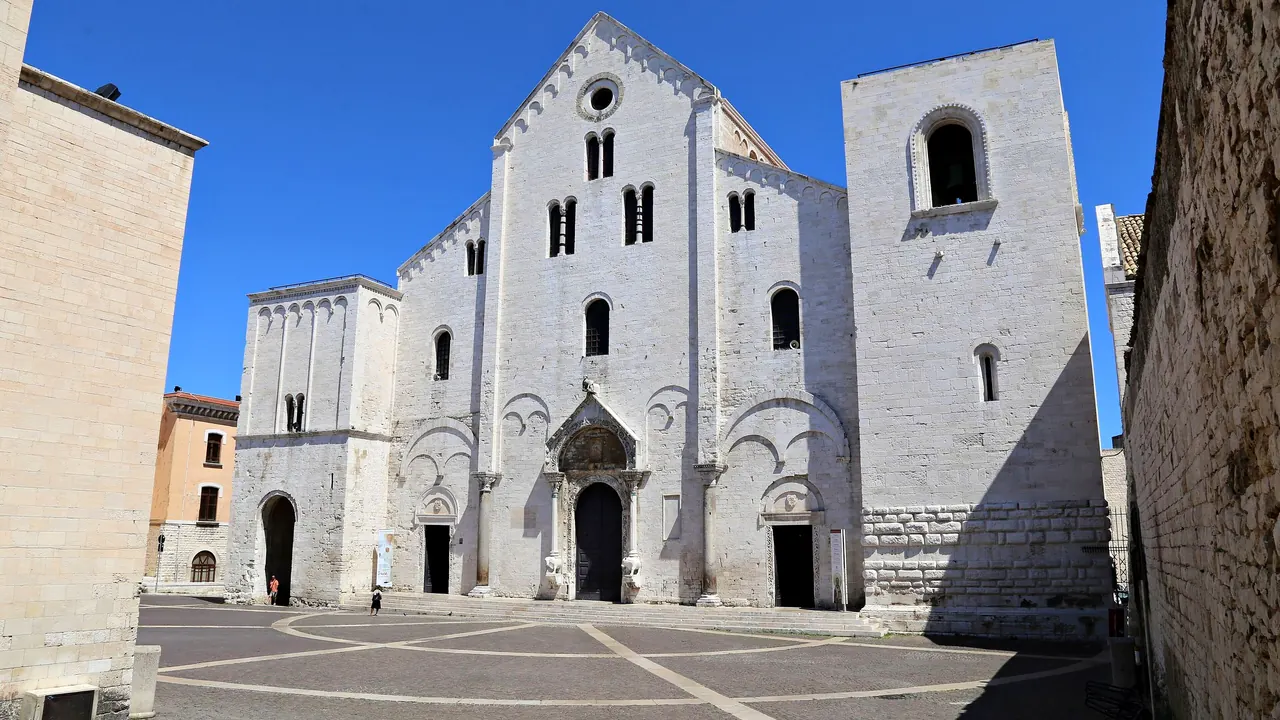
The Basilica of Saint Nicholas on its piazza
- Day trips88
- Food & drink70
- Beaches65
Photo: Sailko, CC BY-SA 4.0, cropped
Match
57
Every category weighted equally
- Beach & sun57
- Culture & arts59
- Food & nightlife58
- Family trip59
- Outdoors60
- Relax & unwind55
- Shopping & style56
- On a budget57
Bari in twelve categories
Our verdict on each, scored 0 to 100 against the same fixed benchmark cities, so a score means the same thing on every page.
Beaches & swimming. Scores 65 out of 100.
Food & drink. Scores 70 out of 100.
Culture & sights. Scores 58 out of 100.
Nightlife. Scores 55 out of 100.
Nature & outdoors. Scores 50 out of 100.
Day trips. Scores 88 out of 100.
Good for families. Scores 52 out of 100.
Getting around. Scores 62 out of 100.
Shopping & style. Scores 45 out of 100.
Affordability. Scores 60 out of 100.
Live music & performing arts. Scores 50 out of 100.
Wellness & relaxation. Scores 30 out of 100.
Bari category by category
Beaches & swimming
65Bari has a city beach of its own. Pane e Pomodoro is a sandy stretch just south-east of the centre, packed with local families on summer afternoons, and the lidos and rocky platforms around Torre Quetta continue along the shore. The water is warm and calm, reaching around 25°C in August, but the urban beaches are nothing special.
The better swimming is a short regional train ride south. Polignano a Mare has its famous pebble cove wedged between limestone cliffs, and around Monopoli the coast breaks into small rocky inlets and sandy coves with clear water. Beach life is a real part of a summer stay, but most visitors treat it as half-days out rather than the reason for coming.
Food & drink
70Eating in Bari means Apulian home cooking, and it is one of the best reasons to come. In the lanes of Bari Vecchia, women roll orecchiette by hand at tables outside their doorways. The street food is cheap and specific to the city: thick focaccia barese topped with tomatoes and olives, fried panzerotti, and sgagliozze, squares of fried polenta sold from kitchen windows. By the old fishermen's pier, locals eat raw sea urchins, mussels and octopus with a cold beer.
Sit-down meals are simple: tiella of rice, potatoes and mussels, orecchiette with turnip tops, grilled fish, and local burrata and olive oil. All of it goes with the region's Primitivo and Negroamaro wines. The fine-dining tier is small and the international range is narrow. What Bari does well is rooted, generous food at fair prices.
Culture & sights
58Bari's sights are concentrated in Bari Vecchia, a dense old town of whitewashed lanes, small courtyards and shrines on a peninsula between two harbours. Its centrepiece is the Basilica di San Nicola, a model of Apulian Romanesque that holds the relics of St Nicholas and draws Orthodox pilgrims from far away. The Cathedral of San Sabino and the Norman-Swabian castle are a short walk away.
South of the old town, the Murat quarter is a grid of nineteenth-century streets and palazzi, with a long seafront promenade lined with grand civic buildings. The Pinacoteca has a respectable collection of southern Italian painting. It is a pleasant, characterful set of sights rather than a deep one, and most visitors see it in a day or two.
Nightlife
55Going out in Bari starts late and happens mostly outdoors. On summer evenings Piazza Mercantile and Piazza Ferrarese, at the edge of the old town, fill with students and young locals drinking at tables and on the steps. The bars of the Umbertino streets and the seafront carry on past midnight. In July and August the action moves to beach clubs and open-air venues along the coast south of the city.
It is lively and friendly rather than deep: a handful of clubs, plenty of wine and cocktail bars, and a crowd that is mostly local. Winter weeknights are much quieter.
Nature & outdoors
50Bari sits on a flat coastal plain of olive groves and stone walls. The seafront promenade, running for kilometres, is its main outdoor space. Inland, the Alta Murgia National Park is about an hour away: a broad, open karst plateau of rocky grassland and old sheep tracks, good for quiet walks and cycling. The Grotte di Castellana, a large show cave system, are within an hour.
The coast to the south is pleasant for walking and sailing, and the Valle d'Itria makes gentle cycling country. There are no mountains nearby, though, and the wilder Gargano peninsula is beyond an easy day out.
Day trips
88Day trips are Bari's great strength, and many visitors pick it as a base for this reason alone. Matera, with its cave dwellings and rock churches carved into a ravine, is about an hour and a half away by train. The trulli of Alberobello, the white hill towns of Ostuni, Locorotondo and Martina Franca, and the wider Valle d'Itria are all within easy reach. Castel del Monte, Frederick II's octagonal castle, is about an hour by car.
Along the coast, Trani's pale Romanesque cathedral stands right on the sea, and Polignano a Mare and Monopoli are about half an hour south. The Baroque city of Lecce is about an hour and a half away by train. Some regional lines are slow, so a car helps for the inland towns.
Good for families
52Bari is a relaxed, child-welcoming southern Italian city, and families with children are part of every evening passeggiata on the seafront. The sandy city beach, the gelato and the traffic-free lanes of the old town work well for younger children, and the centre is small enough to manage on foot.
Very little is built specifically for children, though. The best options are short trips out: the Grotte di Castellana, the Fasano safari park and the trulli of Alberobello. Summer heat in the middle of the day means planning around a long afternoon break.
Getting around
62Central Bari is easy on foot. Bari Vecchia, the Murat shopping streets and the seafront promenade lie next to each other on flat ground, and the main station is at the edge of the grid. A rail link runs to the airport. City buses fill the gaps but are slow and not intuitive for visitors.
For day trips, Bari is the hub of several regional railways running along the coast to Polignano and Trani and inland towards Matera and Alberobello. Some of these lines are slow and run infrequently, so many visitors hire a car for the Valle d'Itria and Castel del Monte.
Shopping & style
45Shopping in Bari is mostly practical. Via Sparano, the long pedestrian street in the Murat quarter, and the streets around it carry Italian fashion chains and a few upmarket boutiques. The best things to take home are edible: dried orecchiette, taralli, olive oil and local wine, bought from delicatessens and the old town's doorways. Puglian ceramics are also worth looking for. There is no luxury district or notable craft scene, and serious shoppers will find the range limited.
Affordability
60Bari is one of the more affordable cities in Italy. Street food and a simple trattoria lunch cost little, local wine is cheap, and the old town and the basilica are free to explore. Rooms are moderately priced for most of the year but tighten in July and August, when much of Italy heads south. Beach clubs and day trips by car add up. On the whole a visitor gets good value without it ever feeling like a budget destination.
Live music & performing arts
50The Teatro Petruzzelli, one of Italy's largest opera houses, anchors Bari's cultural life. Its season of opera, ballet and symphonic concerts is a real reason to dress up for an evening. The smaller Teatro Piccinni and several prose and independent theatres add Italian-language drama. In summer, open-air concerts and a long-running jazz festival use the city's piazzas and the castle. Beyond these there is little regular live music, and the offer is modest for a visitor who does not speak Italian.
Wellness & relaxation
30Bari has no thermal baths or bathing tradition, and spa options are mostly hotel facilities. What it offers is a slow southern rhythm: long lunches, a quiet afternoon break, and the evening stroll along the seafront promenade as the heat fades. Visitors who want proper pampering usually book a stay at one of the restored country estates in the countryside beyond the city.
When should you go?
Pick a month to see what it is like. The climate figures are measured averages, not a forecast.
Bari in July
Daytime high, °C
Rainfall in the month, mm
The whole year
Shaded against this city’s own year: the deepest cell is its best month for that figure and the palest its weakest.
Where the figures come from
Bari has no rain gauge within 25 km of the centre, so its rainfall comes from a gridded climate dataset read at the city rather than from a gauge further away.
Bari's sunshine is measured 77 km from the centre, at Marina Di Ginosa.
Temperature and rainfall are climate normals, averaged over the years shown. Bari: 1991-2020 (sunshine 1961-1990) normals, Bari / Palese Macchie (7 km from centre).
Before you go
| Measure | Bari |
|---|---|
| Official language | Italian |
| Currency | Euro (EUR) |
| Sockets | CFL230 V, 50 Hz |
| Driving side | Right |
| Time zone | UTC+1, UTC+2 in summer |
| Emergency number | 112 |
| Elevation | 5 m |
| Main airport | Bari Karol Wojtyła International Airport (BRI)9 km from centre104 non-stop destinations |
| Public holidays this year | 13 days |
By the numbers
| Measure | Bari |
|---|---|
| City population | 315,473 |
| People per km² | 2,687 |
| Museums within 10 km | 12 |
| UNESCO World Heritage sites within 50 km | 1 |
| Swim season, months above 21 °C | 4 months |
Compare Bari with
Every comparison with a written verdict behind it.
- Amalfi
- Bologna
- Catania
- Como
- Cortina d'Ampezzo
- Dubrovnik
- Florence
- Genoa
- Kotor
- La Spezia
- Lecce
- Lucca
- Matera
- Milan
- Mostar
- Naples
- Palermo
- Pisa
- Portofino
- Positano
- Rome
- Salerno
- Sarajevo
- Siena
- Skopje
- Sorrento
- Split
- Tirana
- Trieste
- Turin
- Venice
- Verona
- Zadar