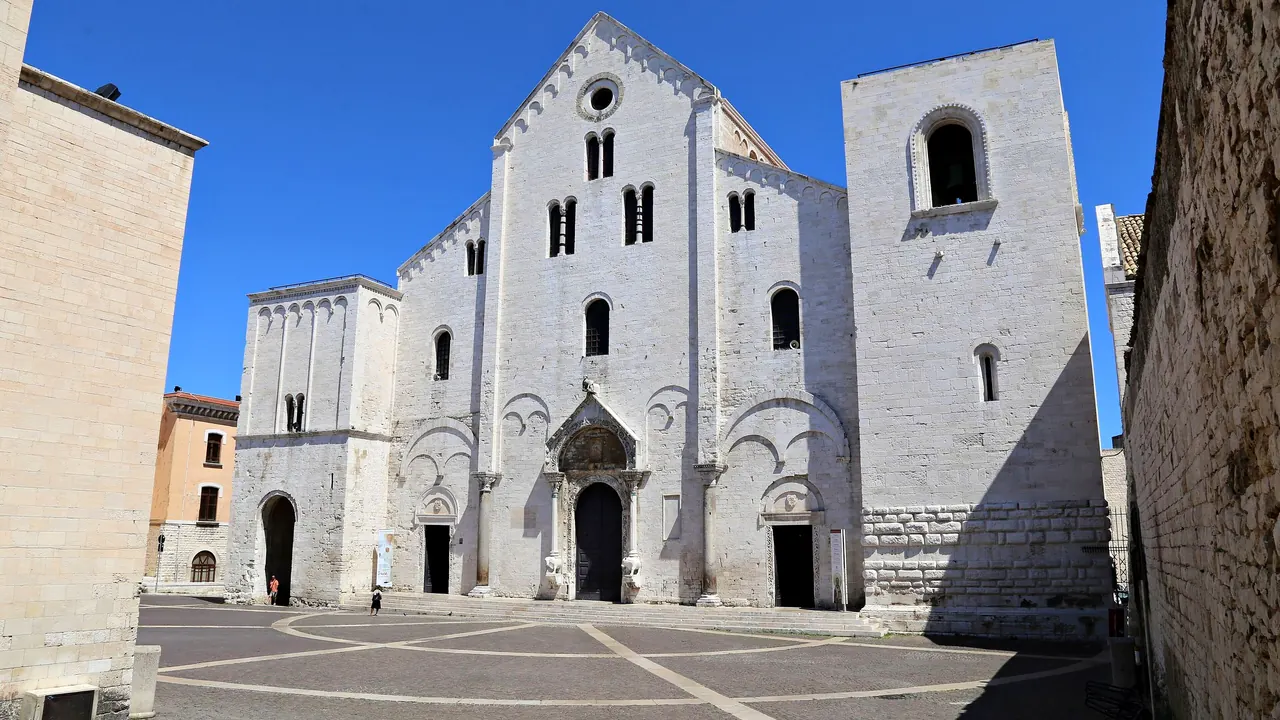
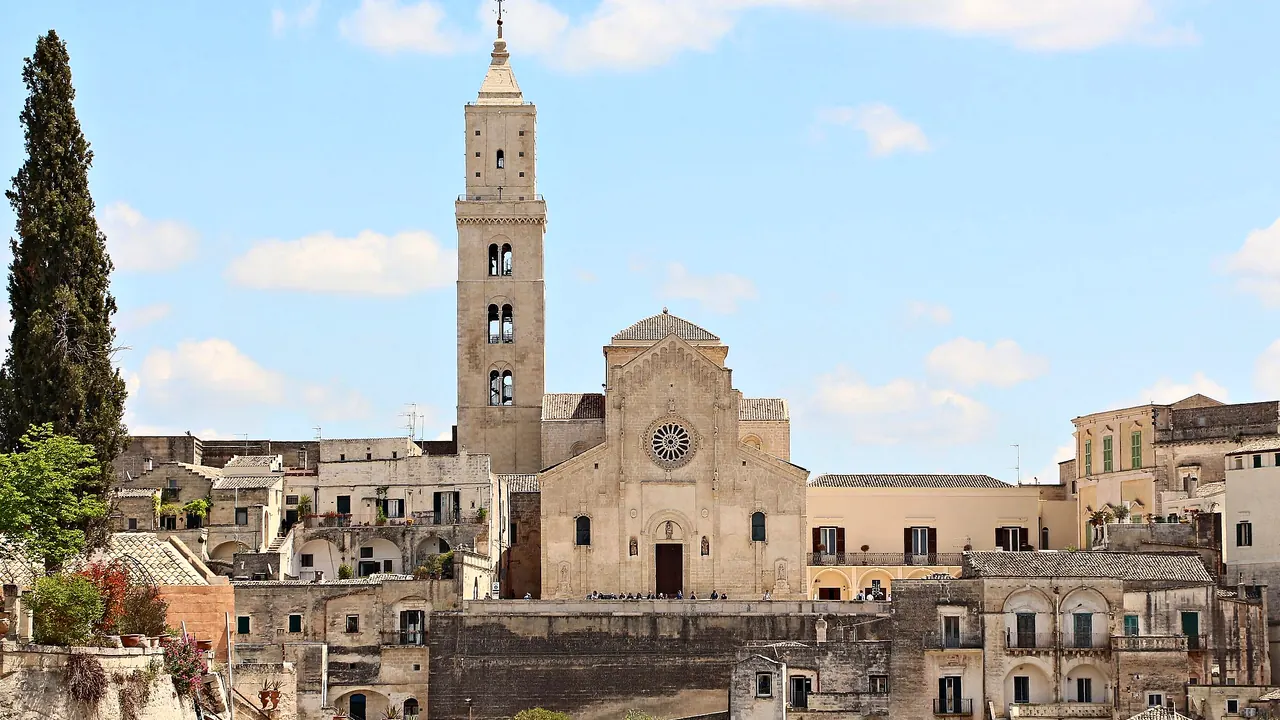
Photos: Bari by Sailko, CC BY-SA 4.0, cropped; Matera by Bernard Gagnon, CC BY 4.0, cropped.
Bari or Matera?
Our verdict in twelve categories, each scored against the same fixed benchmark cities, and the climate month by month, so you can choose for your trip.
Choose Bari for
- nightlife
- live music and the arts
- beaches
Bari is the better choice for a rounded summer stay in southern Italy. You get a real city with a working seafront, a sandy beach within walking distance and late evenings in the piazzas of the old town. It also has the best food of the two, from street focaccia to raw seafood by the old pier, and it is the more practical base for exploring Puglia, with trains running along the coast and inland. Pick it if you want variety, swimming and a night out alongside your sightseeing.
Choose Matera for
- culture and sights
- nature and the outdoors
- wellness
Matera suits travellers who come for one extraordinary place and are happy to slow down around it. Its cave districts, frescoed rock churches and the gorge below them make a more memorable set of sights than anything in Bari, and the Murgia park across the ravine offers proper walking straight from town. Expect quiet evenings, steep steps and a car for almost everything beyond the Sassi. It rewards couples and walkers far more than families or anyone wanting nightlife.
Scoreboard
Twelve categories on one fixed scale from 0 to 100. The shaded stretch is the gap between the two.
Your match
Pick a travel style or drag the sliders, and both match scores follow your weighting.
Wins on nightlife and live music and the arts with your weighting.
Wins on culture and sights and nature and the outdoors with your weighting.
What matters to you?
Category by category
What the scores mean for a trip.
Beaches & swimming
Bari has the sea on its doorstep. Pane e Pomodoro is a sandy city beach you can walk to, and the regional train reaches the cliff coves of Polignano and the clear inlets around Monopoli in about half an hour, so a swim fits easily into a half-day.
Matera is inland, and swimming means a drive of around 45 minutes to the Ionian coast at Metaponto or Policoro. The beaches there are long, sandy and shallow, backed by pine woods, but without a car they are hard to reach. Most visitors to Matera skip the sea altogether.
Food & drink
Bari is the stronger place to eat, largely because of its street life around food. You can watch orecchiette being rolled in the doorways of Bari Vecchia, buy focaccia and fried sgagliozze from kitchen windows, and eat raw urchins and octopus by the fishermen's pier. Puglia's Primitivo and Negroamaro go with all of it.
Matera's cooking is more austere: crusty pane di Matera, bean and chicory dishes, crapiata, roast lamb and crackling dried peppers, with Aglianico to drink. It is good, honest food, often served in cave dining rooms, but there is no street food or market culture to explore between meals.
Culture & sights
Matera has the more remarkable sights. The Sassi are cave dwellings and stacked houses inhabited since prehistory, climbing the side of a gorge. Add frescoed rock churches such as Santa Maria de Idris, the walk-through cistern of the Palombaro Lungo and sculpture shown in carved rooms at MUSMA, and you have a place unlike anywhere else in Italy.
Bari's heritage is more conventional and less absorbing. The Basilica di San Nicola is a fine Romanesque church and a pilgrimage site, and the cathedral, the castle and the Murat quarter's palazzi make a pleasant day or two of sightseeing. None of it carries the sense of strangeness you feel at dusk over the Sassi.
Nightlife
Of the two, Bari is the only one where a night out can carry on after dinner. It is the capital of Puglia and a university city, so the people out late are mostly young locals rather than visitors. It also has the two things Matera lacks: a few real clubs, and enough wine and cocktail bars that you can move from the squares at the edge of Bari Vecchia to the Umbertino grid and on to the seafront. The scene is friendly and mostly outdoors rather than big, and it thins out a good deal in the cooler months.
Matera's evenings are built around dinner. After the passeggiata on Via del Corso and a long meal, you can go on to one of a handful of cave wine bars, some with a terrace over the lit Sassi, and that is about all. It is a lovely place for a couple's last glass, but there is nowhere to dance, and outside summer the town goes quiet soon after dinner.
Nature & outdoors
Matera has wild country right at its edge. The Gravina gorge runs beneath the Sassi, and across it the Parco della Murgia Materana has trails past abandoned rock churches, with kestrels nesting in the cliffs. The sandstone peaks of the Lucanian Dolomites are a feasible day out.
Bari's landscape is flatter and gentler: olive groves, a long seafront promenade and easy cycling in the Valle d'Itria. Its best nature outing is the open karst plateau of the Alta Murgia, about an hour inland, which is good for quiet walks but much less dramatic than the gorge Matera has on its doorstep.
Day trips
Both towns make fine bases for exploring, and their lists overlap: Alberobello, the white Valle d'Itria towns, Castel del Monte and Polignano are within reach of either. Bari has the edge because it covers more ground with less effort. Trains run along the coast to Trani and Monopoli, Lecce is reachable by rail, and Matera itself is a classic day trip from Bari.
Matera adds outings Bari cannot easily match, such as Altamura and Gravina nearby, the ghost town of Craco, the temple of Hera at Metaponto and the mountain villages of Castelmezzano and Pietrapertosa. Almost all of these need a car.
Good for families
Bari is the easier city with children. The centre is flat and compact, the city beach is sandy, and the evening walk on the seafront with a gelato is a family ritual. The Grotte di Castellana and the Fasano safari park are short trips away.
Older children often love Matera's caves, the underground cistern and a scramble into the gorge. With toddlers, though, the steep stone steps rule out a pushchair, and the shadeless summer afternoons are draining. A short stay works best there.
Getting around
Bari is better connected. The old town, the shopping streets and the promenade sit side by side on level ground, a train runs to the airport, and several regional lines fan out to the coast and inland towns. A car still helps for the Valle d'Itria.
Matera is walkable but hilly. The upper town is flat, while the Sassi are reached by leg-tiring stairways where cars cannot go. The town is off the national rail network, served only by a slow narrow-gauge line to Bari and sparse buses, so a hire car is close to essential for anything beyond town.
Shopping & style
Neither is a shopping destination, but Bari has more range. Via Sparano in the Murat quarter has Italian chains and a few smarter boutiques, and the old town's delicatessens are good for taralli, olive oil and Puglian ceramics.
Matera's shops are small and aimed at visitors: painted cuccù whistles, tufa carvings of the Sassi and papier-mâché in workshops in the old districts. Beyond that, the most worthwhile purchases are dried peppers and Aglianico.
Affordability
Costs are broadly similar, and both feel good value by Italian standards. What differs is where the money goes. In Bari, cheap street food and free sights keep daily costs low, while beach clubs, car hire and the July and August rush for rooms push the total up.
In Matera, meals in the upper town are inexpensive, but the town's speciality, a cave hotel in the Sassi, comes at a premium. Staying in a guesthouse in the newer town a short walk away saves a good deal.
Live music & performing arts
The Teatro Petruzzelli, one of Italy's largest opera houses, gives Bari a full season of opera, ballet and symphonic concerts, and it is worth dressing up for. The Teatro Piccinni adds Italian-language drama, and in summer jazz and open-air concerts move into the piazzas and the castle.
Nothing in Matera compares. The conservatory puts on concerts, a summer jazz festival uses the Sassi as a backdrop, and the Festa della Bruna ends with the papier-mâché float torn apart after the procession. Most evenings, though, are about dinner and the view rather than a performance.
Wellness & relaxation
Neither has thermal baths, and both offer much the same: hotel spas and a slow southern pace. Matera's version is more distinctive, with spas in candlelit cave rooms and pools cut into rock, and its quiet off-season mornings in the Sassi are restful in a way a city cannot quite match.
Bari's calm comes from long lunches and the evening stroll on the seafront. Those wanting real pampering usually move out to a restored country estate beyond the city.
When should you go?
Pick your month. The climate figures are measured averages, not a forecast.
Bari in July
Matera in July
Daytime high, °C
Rainfall in the month, mm
Where the figures come from
Bari has no rain gauge within 25 km of the centre, so its rainfall comes from a gridded climate dataset read at the city rather than from a gauge further away.
Bari's sunshine is measured 77 km from the centre, at Marina Di Ginosa.
Matera has no rain gauge within 25 km of the centre, so its rainfall comes from a gridded climate dataset read at the city rather than from a gauge further away.
Temperature and rainfall are climate normals, averaged over the years shown. Bari: 1991-2020 (sunshine 1961-1990) normals, Bari / Palese Macchie (7 km from centre). Matera: 2005-2025, 10 years observed (rainfall 1991-2020) normals, Matera / Martella (4.8 km from centre).
Both towns follow the same southern Italian pattern, but Matera sits higher and inland, so its extremes are sharper. In Bari, June to September is beach weather, with the sea warmest in August at around 26°C, and the shoulder months of May and October are pleasant for walking the old town. Matera gets hotter in high summer, reaching about 32°C in July, which makes the stone steps of the Sassi and the bare Murgia plateau hard work in the middle of the day. Its sea, on the Ionian coast, stays warm a little longer into autumn.
Rain sets in for both from September and peaks in November, when Matera is the wetter of the two at around 89mm. Winters are mild in Bari but noticeably colder up in Matera, with January highs near 10°C. For walking and sightseeing, late April to early June and late September to October are the best months in either place, and Matera in particular is at its finest in spring and autumn.
Which traveller are you?
For a food and nightlife trip, Bari is the clear pick. Its street food, seafood by the pier and handmade orecchiette are livelier than Matera's plain Lucanian cooking, and the old-town piazzas and summer beach clubs keep going long after Matera has gone quiet.
On an outdoors trip, Matera wins. A path drops from the Sassi into the Gravina gorge and climbs into the Murgia park, with rock churches and Neolithic sites along the way. The Lucanian Dolomites and Pollino forests are also within reach, while Bari's surroundings are mostly flat.
On a family trip with children, Bari works better. It has a sandy beach in town, flat traffic-free lanes and a seafront promenade that suits pushchairs. Matera's steep, uneven steps and shadeless summer afternoons make it tiring for younger children, and its beaches need a car.
Before you go
| Measure | Bari | Matera |
|---|---|---|
| Official language | Italian | Italian |
| Currency | Euro (EUR) | Euro (EUR) |
| Sockets | CFL230 V, 50 Hz | CFL230 V, 50 Hz |
| Driving side | Right | Right |
| Time zone | UTC+1, UTC+2 in summer | UTC+1, UTC+2 in summer |
| Emergency number | 112 | 112 |
| Elevation | 5 m | 401 m |
| Main airport | Bari Karol Wojtyła International Airport (BRI)9 km from centre104 non-stop destinations | Bari Karol Wojtyła International Airport (BRI)54 km from centre104 non-stop destinations |
| Public holidays this year | 13 days | 13 days |
By the numbers
| Measure | Bari | Matera |
|---|---|---|
| City population | 315,473 | 59,685 |
| People per km² | 2,687 | 152 |
| Museums within 10 km | 12 | 8 |
| UNESCO World Heritage sites within 50 km | 1 | 1 |
| Swim season, months above 21 °C | 4 months | 5 months |
Where else could you go?
Every comparison below shares a destination with this one, so you can follow Bari or Matera somewhere new.