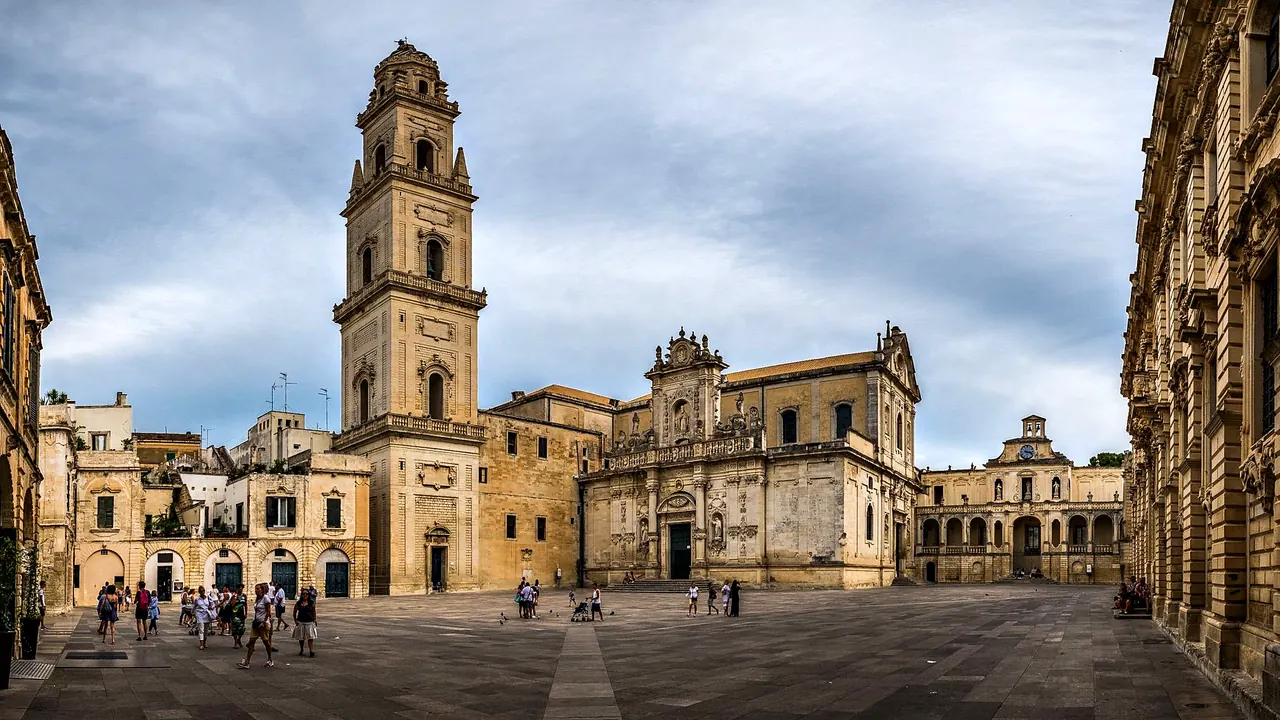
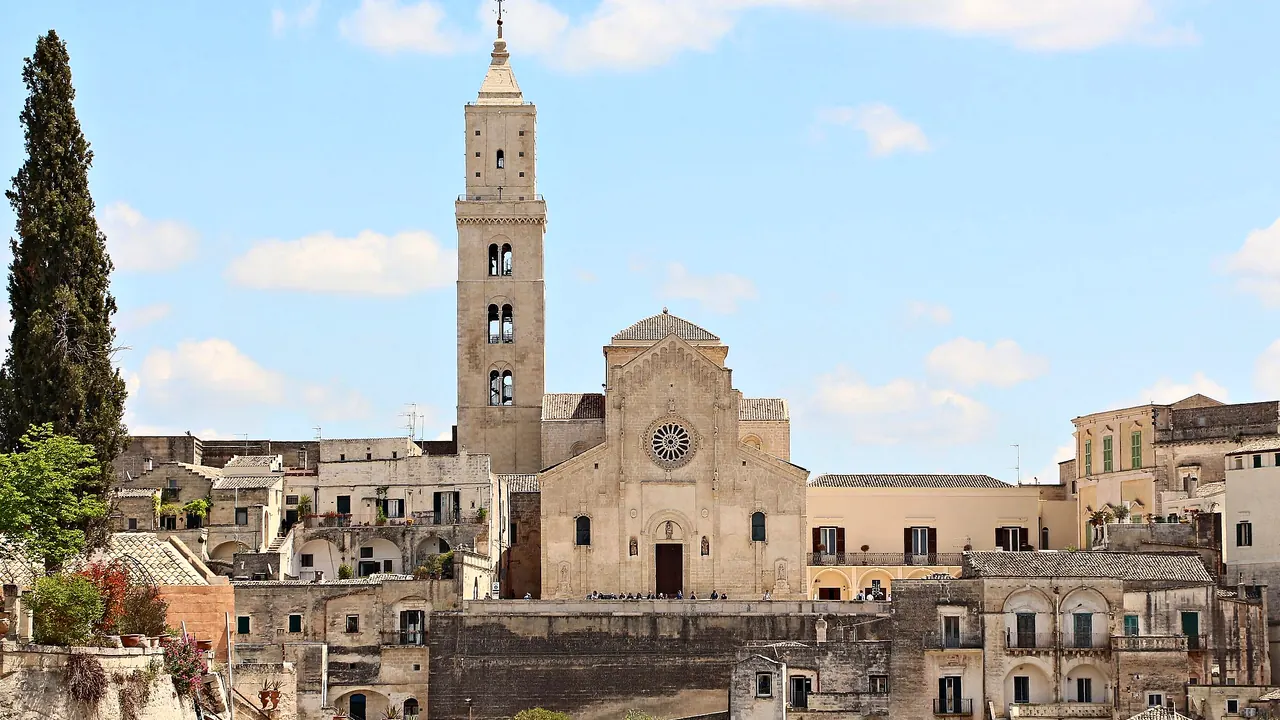
Photos: Lecce by Giuseppe Milo, CC BY 3.0, cropped; Matera by Bernard Gagnon, CC BY 4.0, cropped.
Lecce or Matera?
Our verdict in twelve categories, each scored against the same fixed benchmark cities, and the climate month by month, so you can choose for your trip.
Choose Lecce for
- beaches
- nightlife
- families
Lecce is the better choice for a longer summer stay that splits each day between town and sea. The Salento beaches are close enough to become a daily routine, the Baroque old town fills up in the evenings, and there is more going on after dark, from wine bars to pizzica festivals. Its flat, car-free streets and shallow sandy beaches also make it the easier of the two with children.
Choose Matera for
- day trips
- nature and the outdoors
Matera rewards a shorter, more singular trip built around the Sassi and the Gravina gorge. Walkers get trails straight from the edge of town, and drivers get the best spread of outings, reaching both Puglia and inland Basilicata. It asks more of your legs and has little to offer after dinner, so couples and keen walkers will get more out of it than beachgoers or families with pushchairs.
Scoreboard
Twelve categories on one fixed scale from 0 to 100. The shaded stretch is the gap between the two.
Your match
Pick a travel style or drag the sliders, and both match scores follow your weighting.
Wins on beaches and nightlife with your weighting.
Wins on day trips and nature and the outdoors with your weighting.
What matters to you?
Category by category
What the scores mean for a trip.
Beaches & swimming
Lecce is by far the better place for swimming. The town's own sandy beaches at San Cataldo are only about 12km away. Within half an hour or so you reach the coves and sea stacks of Torre dell'Orso on the Adriatic, or the fine, clear shallows of Porto Cesareo on the Ionian, so a summer stay quickly settles into a routine of mornings at the sea and evenings in town.
From Matera, the sea is a day out. The nearest beaches at Metaponto and Policoro are about 45 minutes away by car. They are wide, sandy and backed by pine woods, with calm water, but many visitors never get there at all.
Food & drink
Both cities serve proud peasant cooking, but Lecce's has more character and more ways to eat it. It has a real street and café habit that Matera lacks: a warm pasticciotto with an iced almond espresso for breakfast, a rustico mid-morning, then ciceri e tria and pittule in the old-town osterie, with Negroamaro to drink.
Matera's table is built around its horn-shaped durum-wheat bread, with crackling fried peperoni cruschi, pulse soups and hill cheeses, washed down with Aglianico. Eating in a cave room in the Sassi is part of the experience, though the better value is up in the upper town. Neither city offers much beyond its own regional food.
Culture & sights
The two cities are equally strong here, but in completely different ways. Lecce is a show of carved surfaces. Its soft, honey-coloured stone is covered in Baroque fruit, beasts and cherubs, on Santa Croce and around the enclosed cathedral square, and a half-buried Roman amphitheatre sits in the main piazza. You see it all by strolling from church to church.
Matera's heritage is cut into the rock rather than carved on top of it. The cave houses and stacked dwellings of the two Sassi climb the side of the gorge, rock churches keep faded Byzantine frescoes, and you can walk through the enormous Palombaro Lungo cistern under the main square. It feels older and stranger, and it is harder on the legs.
Nightlife
Lecce has the more sociable evenings, though neither city is a reason to travel for nightlife. After the aperitivo hour, the lanes of the old town keep their wine and cocktail bars busy, students stretch weekends late for most of the year, and in summer anyone with a car can head to the beach clubs around Gallipoli.
In Matera, an evening means dinner, the passeggiata on Via del Corso and a glass of wine on a terrace overlooking the lit-up Sassi. There is nowhere to dance, and outside summer the town goes quiet soon after dinner.
Nature & outdoors
Matera has the better landscape on foot, and it starts at the edge of town. A path drops from Sasso Caveoso into the Gravina gorge and climbs to the Murgia Timone belvedere, with kestrels in the cliffs and Neolithic sites along the trail. The sandstone peaks of the Lucanian Dolomites and the forests of the Pollino are within driving range.
Lecce sits on a flat plain of olive groves, good for gentle cycling and little else inland. Its outdoors is the coast: cliff paths and sea caves between Otranto and Leuca, the Alimini wetlands for birdwatching, and good snorkelling and kayaking.
Day trips
Matera has the edge, because it sits on the border of two regions. Altamura and Gravina in Puglia are close by. Within about an hour you can reach Alberobello, the white towns of the Itria valley, Castel del Monte and Bari, and Basilicata adds the ghost town of Craco and the mountain villages of Castelmezzano and Pietrapertosa.
Lecce's range is deeper than it is wide, covering the whole Salento peninsula: Otranto's cathedral mosaic, Gallipoli on its island and the frescoes of Galatina. The Itria valley is a longer drive from Lecce, and from either base most of these trips need a car.
Good for families
Lecce is the more comfortable city for families. Its old town is flat and largely free of traffic, children are part of the evening crowd on the piazzas, and the shallow beaches near Porto Cesareo are ideal for small swimmers.
Matera can thrill older children with its caves, the cistern and scrambles in the gorge. However, the Sassi are a maze of steep steps where a baby carrier works better than a pushchair. Neither town has attractions built for children, such as a zoo or a theme park.
Getting around
The two are evenly matched. Both are easy on foot in the centre, and both need a hire car for the countryside. The difference is the terrain and the trains. Lecce's centre is flat, and its station sits on the main line, with fast services north to Brindisi and Bari.
Matera's Sassi are reached by steep stairways that tire the legs. The town is also off the national rail network, linked to Bari only by a slow narrow-gauge line and sparse buses.
Shopping & style
Lecce has the slightly better shopping, though neither is a place to come for it. Its own craft is cartapesta, papier-mâché saints and nativity figures made in old-town workshops, and you can also find Grottaglie ceramics and olive oil and taralli to take home.
Matera's stalls sell the painted cuccù whistle and miniature Sassi carved in tufa, aimed squarely at visitors. Its edible souvenirs of dried peppers and Aglianico are the better buy.
Affordability
The two cost about the same overall, but the expensive parts are in different places. In Lecce, the price rise is seasonal: in August the whole Salento fills up, and rooms, beach-club loungers and the hire car all cost more.
In Matera, the premium is about location. Cave hotels in the Sassi are priced as the town's speciality, while guesthouses in the newer town, a short walk away, cost much less. Walking the gorge and the Murgia costs nothing.
Live music & performing arts
Lecce offers more live performance. The Politeama Greco and the historic Paisiello stage opera, concerts and theatre, and summer brings pizzica, the Salento's tambourine dance, to village festivals. It all builds to the vast Notte della Taranta night in nearby Melpignano.
Matera has occasional conservatory concerts and a summer jazz festival set against the Sassi. Its one big night is the Festa della Bruna, when the procession ends with the crowd tearing apart a papier-mâché float.
Wellness & relaxation
The real difference is between taking the waters and resting in a cave, and the Salento gives you more choice. From Lecce, the sulphur springs of Santa Cesarea Terme are under an hour away, in grottoes and pools on the sea cliffs. Several old fortified farmhouses on the plain also run as quiet spa retreats.
Matera has no thermal waters. Its draw is a hotel spa in a candlelit cave with a pool cut into the rock, and the early-morning calm of the Sassi before the tour groups arrive.
When should you go?
Pick your month. The climate figures are measured averages, not a forecast.
Lecce in July
Matera in July
Daytime high, °C
Rainfall in the month, mm
Where the figures come from
Lecce's temperatures are measured 38 km from the centre, at Brindisi.
Lecce has no rain gauge within 25 km of the centre, so its rainfall comes from a gridded climate dataset read at the city rather than from a gauge further away.
Matera has no rain gauge within 25 km of the centre, so its rainfall comes from a gridded climate dataset read at the city rather than from a gauge further away.
Temperature and rainfall are climate normals, averaged over the years shown. Lecce: 1991-2020 (sunshine 1981-2010) normals, Brindisi (38 km from centre). Matera: 2005-2025, 10 years observed (rainfall 1991-2020) normals, Matera / Martella (4.8 km from centre).
Both are at their best in May, June and September, when the days are warm without being punishing. Lecce is the beach town of high summer: it is dry and very sunny from June to August, and the Adriatic warms to about 26°C in August, so swimming lasts from June well into October. Matera's bare plateau gets hotter, peaking around 32°C in July, so walks in the gorge need early starts. Its Ionian beaches warm up on much the same timetable as Lecce's.
The rain comes in autumn in both places and is heaviest in November, when Lecce is the wetter of the two at about 102mm. Winter is noticeably colder up on Matera's plateau, with January highs near 10°C, against roughly 13°C in Lecce. That makes Lecce the gentler choice for walking the streets between November and March.
Which traveller are you?
On a beach and sun trip, Lecce wins without much argument. With two seas within reach, you can pick a shore to suit the wind, and the long, dry summer makes swimming a daily habit. Matera suits sightseers who can do without the sea.
For a food and nightlife trip, Lecce has more to fill the hours. Eating there runs from breakfast to a late dinner, and the night carries on in the bars of the old town, with summer music in the villages. Matera winds down after dinner.
For an outdoors trip, Matera is the better base. Wild, rocky ravine and upland country begins within walking distance of your room, and there are mountains within a day's drive. Around Lecce, time outdoors is gentler and is spent more on the sea than on the land.
Before you go
| Measure | Lecce | Matera |
|---|---|---|
| Official language | Italian | Italian |
| Currency | Euro (EUR) | Euro (EUR) |
| Sockets | CFL230 V, 50 Hz | CFL230 V, 50 Hz |
| Driving side | Right | Right |
| Time zone | UTC+1, UTC+2 in summer | UTC+1, UTC+2 in summer |
| Emergency number | 112 | 112 |
| Elevation | 49 m | 401 m |
| Main airport | Brindisi Airport (BDS)39 km from centre49 non-stop destinations | Bari Karol Wojtyła International Airport (BRI)54 km from centre104 non-stop destinations |
| Public holidays this year | 13 days | 13 days |
By the numbers
| Measure | Lecce | Matera |
|---|---|---|
| City population | 94,783 | 59,685 |
| People per km² | 393 | 152 |
| Museums within 10 km | 11 | 8 |
| UNESCO World Heritage sites within 50 km | 0 | 1 |
| Swim season, months above 21 °C | 4 months | 5 months |
Where else could you go?
Every comparison below shares a destination with this one, so you can follow Lecce or Matera somewhere new.