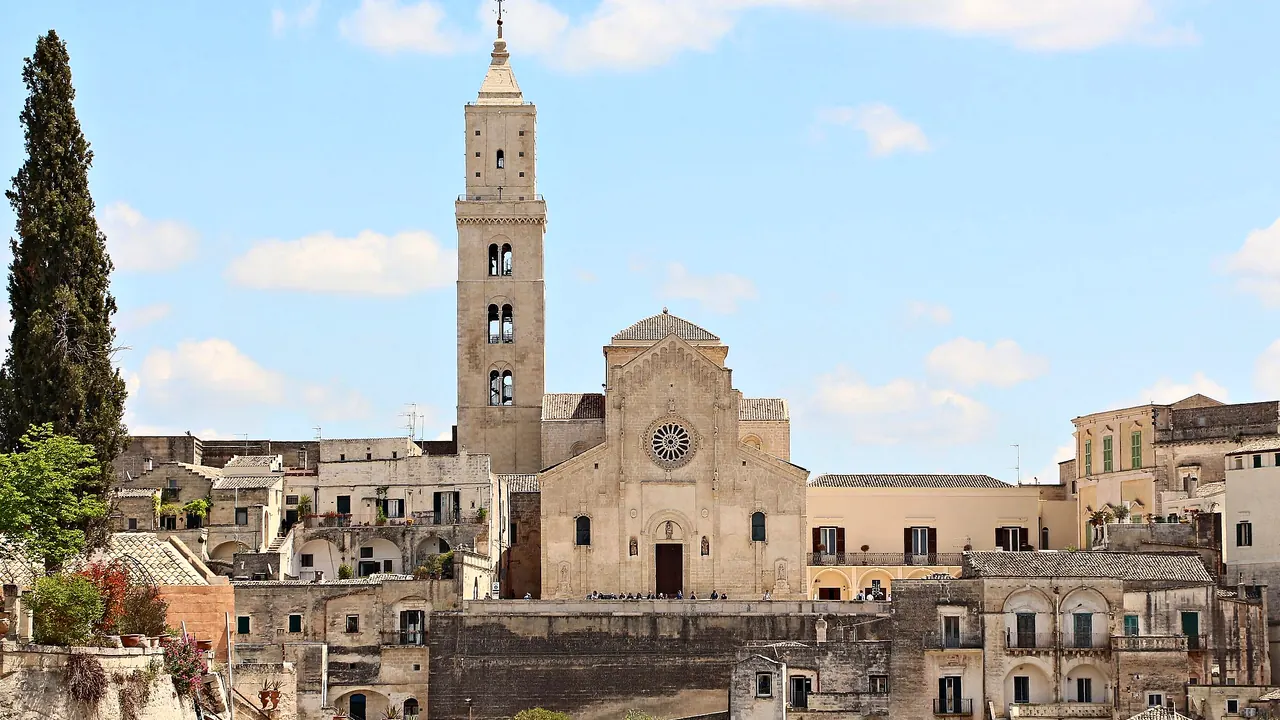
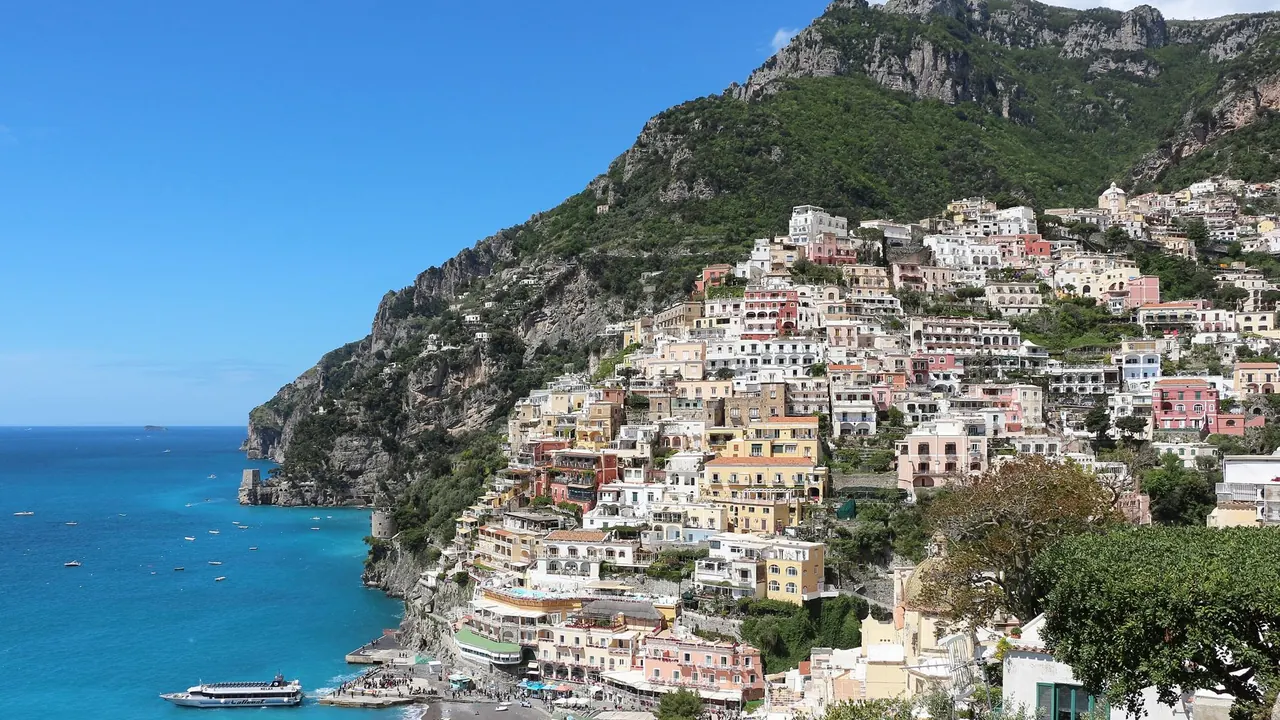
Photos: Matera by Bernard Gagnon, CC BY 4.0, cropped; Positano by Bernard Gagnon, CC BY 4.0, cropped.
Matera or Positano?
Our verdict in twelve categories, each scored against the same fixed benchmark cities, and the climate month by month, so you can choose for your trip.
Choose Matera for
- culture and sights
- prices
- food and drink
Matera suits travellers who want a place with a long human story they can walk through: cave districts on the side of a gorge, rock churches with fading frescoes, a cistern under the main square. Meals and rooms cost noticeably less, the cooking is more varied, and with a car the trulli and white towns of Puglia are within easy reach. The price is the sea, which is a drive away.
Choose Positano for
- beaches
- shopping
- nature and the outdoors
Positano is for a vacation built around the water and the view. Swimming off the town beach, boats to Capri and the coves, the Path of the Gods above the rooftops and linen boutiques in the lanes are what it does well. Go knowing that it is among the dearest places to stay in Italy, that its stairs are relentless and that there is little to visit indoors.
Scoreboard
Twelve categories on one fixed scale from 0 to 100. The shaded stretch is the gap between the two.
Your match
Pick a travel style or drag the sliders, and both match scores follow your weighting.
Too close to call, 2 points apart
Wins on culture and sights and prices with your weighting.
Wins on beaches and shopping with your weighting.
What matters to you?
Category by category
What the scores mean for a trip.
Beaches & swimming
From Matera the sea is a day out. The Ionian shore at Metaponto and Policoro is about 45 minutes by car, with wide sandy beaches backed by pine woods and shallow, calm water. Without a car you are unlikely to swim at all.
In Positano the beach is part of every day. Spiaggia Grande sits below the town, Fornillo is a cliff path away, and boats leave from the shore for coves and Capri. The water is clearer and deeper than on the Ionian coast. The shore is coarse grey sand and pebble, though, and it shelves quickly, so the flat sandy shallows near Matera are friendlier for small children.
Food & drink
Matera gives you more to explore at the table. The cooking is rooted in Basilicata: crusty pane di Matera, crapiata soup, fave e cicoria, hand-made cavatelli, roast lamb and peperoni cruschi fried until crisp, with Aglianico del Vulture to drink. The upper town around Via Ridola often cooks better than the cave restaurants in the Sassi.
Positano's menus are built on the sea and the lemon: clams, grilled fish, scialatielli and limoncello, served on terraces where the view is part of the bill. It is a lovely way to have lunch, but the dishes repeat from place to place and many kitchens close between November and Easter. Neither town has street food or a market to browse.
Culture & sights
This is where the two differ most. Matera's Sassi are among the oldest inhabited places in Europe and a UNESCO World Heritage Site. There are cave houses furnished as families lived in them until the 1950s, rock churches such as Santa Maria de Idris with Byzantine frescoes, the cathedral on the Civita and the walk-through cistern under the main piazza. Museo Ridola, Palazzo Lanfranchi and MUSMA add several more hours.
In Positano, the town itself is the sight. The majolica dome of Santa Maria Assunta and the painted Roman villa buried beneath it are the high points, and an afternoon covers them both.
Nightlife
Neither town is for a big night out, and they are quiet in different ways. Matera's evening is the passeggiata along Via del Corso, then a cave wine bar or a terrace above the lit-up Sassi, with a small student crowd keeping a few places open late in summer.
Positano is more about aperitivo with a view of the sea. It does have one thing Matera lacks: a club in a cave at the end of Spiaggia Grande where a dressed-up crowd dances late. Once the season ends, even that goes quiet.
Nature & outdoors
Matera's landscape is stony and quiet. A path drops from Sasso Caveoso into the Gravina gorge and climbs to Murgia Timone, past abandoned rock churches and Neolithic village sites, with kestrels on the cliffs. The Lucanian Dolomites and Pollino are longer drives.
Positano has the bigger scenery. The Path of the Gods runs high above the sea to Nocelle, trails climb through chestnut woods to ridges over 1,000m, and kayaks follow the cliffs to grottoes and the Li Galli islets. In both places summer heat drives walkers out early.
Day trips
Matera is a good base if you have a car. Altamura and Gravina in Puglia are close by. Within about an hour you reach the trulli of Alberobello, the white towns of the Valle d'Itria, Castel del Monte and Polignano a Mare on its cliffs, and on the Basilicata side there are the ghost town of Craco and the Greek temple at Metaponto. The range is wide, but for almost all of these trips you have to drive yourself.
Positano has the stronger list, and more of it is close at hand. Ferries from the beach run to Amalfi and Ravello, and Capri is about half an hour by boat. Pompeii and Herculaneum are about an hour and a half away via Sorrento and the local train, and Paestum's temples are a little further. Much of this needs no car. The drawback is timing: most boats stop running in winter, and the coast road is slow in summer traffic.
Good for families
Both are hard work with small children. Steep stone steps everywhere rule out pushchairs in each, and neither has anything built for children. In Matera, older children tend to love the cave houses, the underground cistern and scrambling into the gorge, and the shallow sandy Ionian beaches suit toddlers, if you have a car.
Positano offers less to explore on land. In return it has the sea right below the town and boat trips that older children enjoy, though the pebbly beaches drop off quickly.
Getting around
Matera is the easier town to move around, though only on foot. The upper town is flat, and only the descent into the Sassi tests the legs. Reaching anywhere else is slow, with a narrow-gauge train to Bari and sparse buses, so a hire car does the real work.
In Positano almost every walk means hundreds of steps. A car is more burden than help on the single narrow road, and the crowded coastal buses crawl in summer. Ferries are the best link to nearby towns, but mainly in season.
Shopping & style
Positano gives you a reason to shop: the lanes down to the beach are full of moda Positano, loose white linen and bright resort prints, and sandal makers will cut a pair to fit while you wait. It is one look, though, with nothing beyond it.
Matera's shopping is souvenirs: painted cuccù whistles, tufa carvings of the Sassi and ceramics, with ordinary high-street shops on Via del Corso. The things most worth carrying home are dried peppers, local pasta and Aglianico.
Affordability
Matera is far kinder to the wallet. Trattorias in the upper town cost less than in Italy's big cities, guesthouses in the newer town are cheap and a short walk from the Sassi, and the gorge and old districts are free to wander. Only the cave hotels charge a premium.
Positano is among the dearest places to stay in Italy. Sea-view rooms, beach loungers, terrace lunches and boat transfers all cost a lot. Sleeping in Praiano or Sorrento and coming in by ferry, or going in May or October, makes a real difference.
Live music & performing arts
Neither town has much of a stage, and both depend on summer. Matera has its own events: conservatory concerts, a summer jazz festival set against the Sassi, and the Festa della Bruna, when the papier-mâché float is torn apart.
Positano offers little beyond occasional concerts in churches and squares, but Ravello's classical festival on its terrace above the sea is an evening's trip away, and Naples is there for opera.
Wellness & relaxation
For a restful stay Positano has the edge, though Matera offers a quieter kind of calm. Neither town has a bathing tradition, so in both a spa means a hotel spa. Matera's are the stranger of the two: candlelit cave rooms with pools carved into the tufa, enclosed and hushed, with no view at all. Beyond them, rest in Matera is about pace. It is a small inland town, and an early walk through the empty Sassi relaxes you more than any treatment.
Positano has more upscale hotels with spas to choose from, and here the view does the relaxing: a lounger above the sea, the light on the water and a lunch that runs into the afternoon. The cost is company. In high summer the beaches and lanes are full and loud, and with stairs everywhere even a short walk takes effort, so the calm tends to stay inside the hotel.
When should you go?
Pick your month. The climate figures are measured averages, not a forecast.
Matera in July
Positano in July
Daytime high, °C
Rainfall in the month, mm
Where the figures come from
Matera has no rain gauge within 25 km of the centre, so its rainfall comes from a gridded climate dataset read at the city rather than from a gauge further away.
Positano's temperatures are measured 25 km from the centre, at Capri.
Positano has no rain gauge within 25 km of the centre, so its rainfall comes from a gridded climate dataset read at the city rather than from a gauge further away.
Positano's sunshine is measured 59 km from the centre, at Grazzanise.
Temperature and rainfall are climate normals, averaged over the years shown. Matera: 2005-2025, 10 years observed (rainfall 1991-2020) normals, Matera / Martella (4.8 km from centre). Positano: 2005-2025 (sunshine 1991-2020, rainfall 1991-2020) normals, Capri (25.3 km from centre).
Matera sits inland on a high plateau, so it swings further between seasons. July reaches about 32°C, which makes the steep Sassi stairways and the bare Murgia hard going after mid-morning. April, May, late September and October are the comfortable months for walking. Winters are cool, and the rain builds from October. If you plan beach days on the Ionian coast, the water there is warm from late June to September.
Positano has milder winters but much wetter ones, with about 127mm of rain in November and many places closed. Summer is the sunniest stretch, with around 324 hours of sun in July. The sea is pleasant for swimming from June to early October and reaches about 26°C in August. The heat stays more bearable by the water than on Matera's plateau, though the climbs are still tiring at midday. For both towns, May and late September give the best balance.
Which traveller are you?
For a culture and arts trip, Matera is the clear choice. The Sassi, the frescoed rock churches, the Palombaro Lungo and Carlo Levi's panorama at Palazzo Lanfranchi can fill several days, while Positano's sights take a couple of hours.
On a beach and sun trip, Positano wins easily. You can walk down to Spiaggia Grande or Fornillo, swim in clear deep water and take a boat to coves or Capri. From Matera, every swim means a drive to the coast.
On a trip on a tight budget, Matera stretches your money much further. Simple trattorias and guesthouses in the upper town cost far less, and walking the Sassi and the Murgia is free. In Positano, even a lounger and lunch with a view add up fast.
Before you go
| Measure | Matera | Positano |
|---|---|---|
| Official language | Italian | Italian |
| Currency | Euro (EUR) | Euro (EUR) |
| Sockets | CFL230 V, 50 Hz | CFL230 V, 50 Hz |
| Driving side | Right | Right |
| Time zone | UTC+1, UTC+2 in summer | UTC+1, UTC+2 in summer |
| Emergency number | 112 | 112 |
| Elevation | 401 m | 142 m |
| Main airport | Bari Karol Wojtyła International Airport (BRI)54 km from centre104 non-stop destinations | Naples International Airport (NAP)33 km from centre131 non-stop destinations |
| Public holidays this year | 13 days | 13 days |
By the numbers
| Measure | Matera | Positano |
|---|---|---|
| City population | 59,685 | 3,729 |
| People per km² | 152 | 429 |
| Museums within 10 km | 8 | 10 |
| UNESCO World Heritage sites within 50 km | 1 | 5 |
| Swim season, months above 21 °C | 5 months | 5 months |
Where else could you go?
Every comparison below shares a destination with this one, so you can follow Matera or Positano somewhere new.