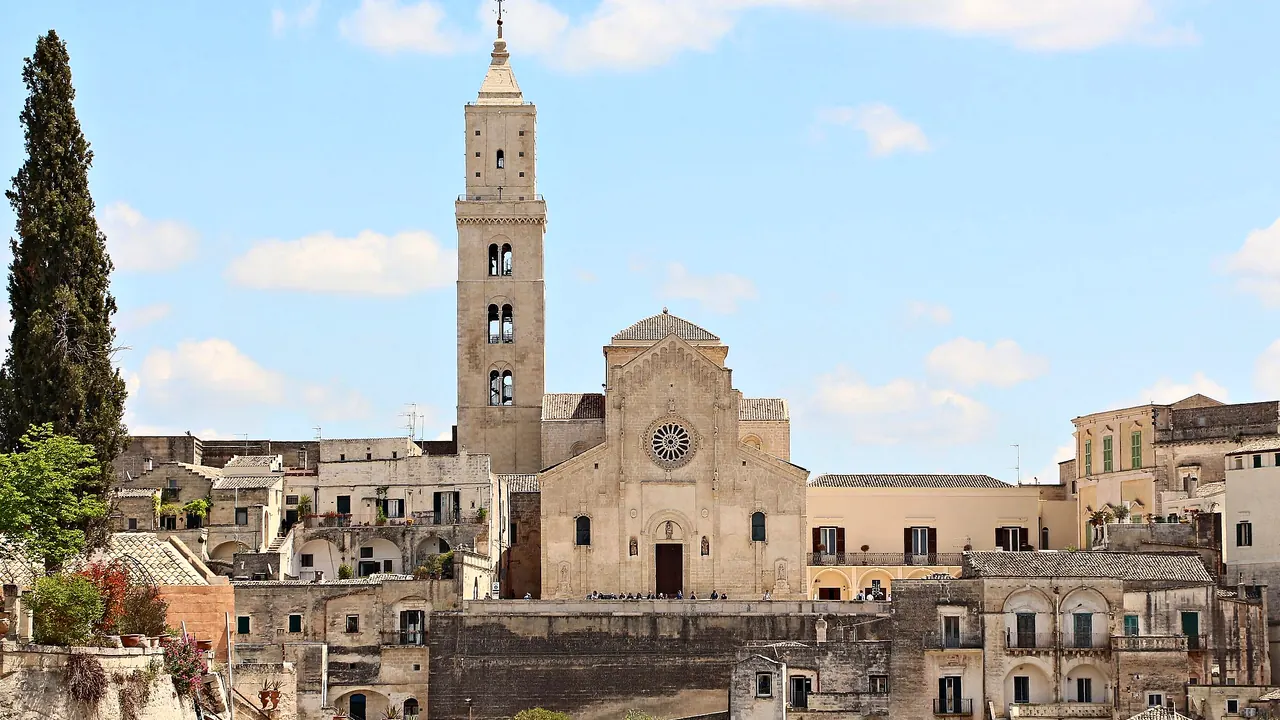
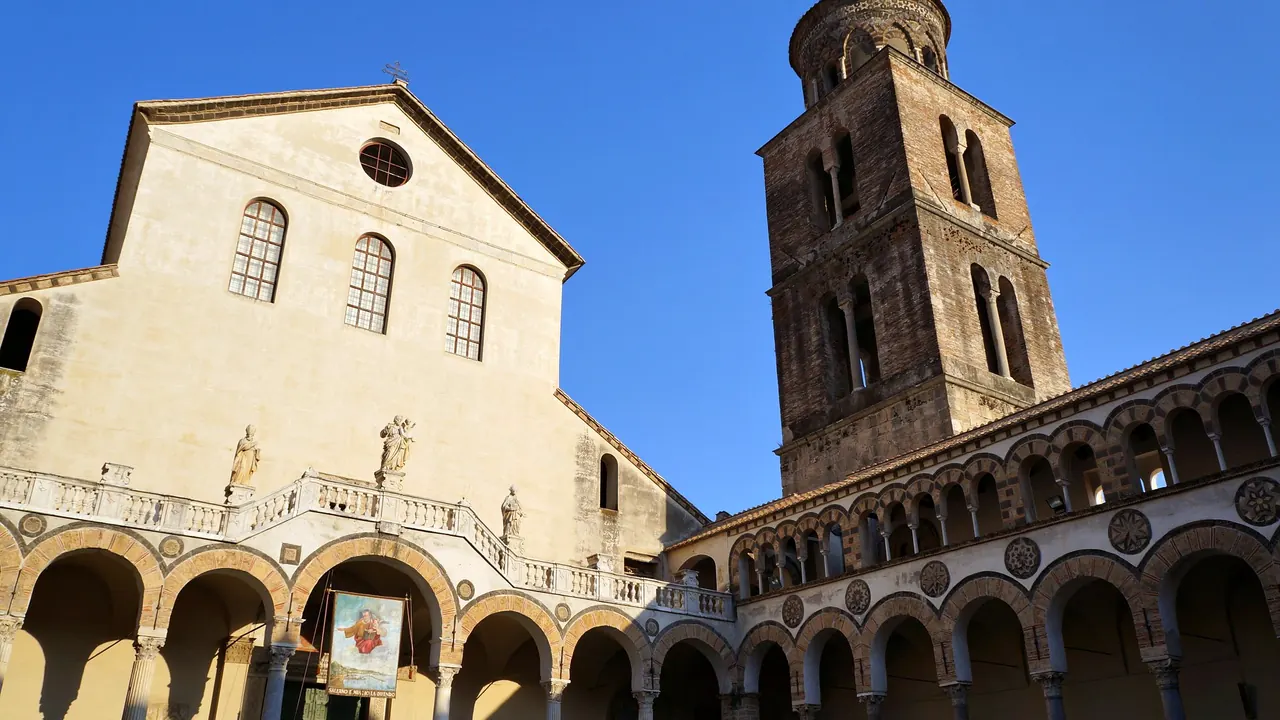
Photos: Matera by Bernard Gagnon, CC BY 4.0, cropped; Salerno by Leandro Neumann Ciuffo, CC BY 2.0, cropped.
Matera or Salerno?
Our verdict in twelve categories, each scored against the same fixed benchmark cities, and the climate month by month, so you can choose for your trip.
Choose Matera for
- culture and sights
Matera is the one to pick if you want a single extraordinary place. The cave districts of the Sassi, the carved rock churches and the gorge below make a town unlike anywhere else in Italy, and it rewards a slow two or three days of walking, looking and long dinners above the lit-up ravine. It suits couples and curious travellers who are happy with quiet evenings and have a car for the Puglian towns and the Ionian shore.
Choose Salerno for
- families
- beaches
- live music and the arts
Salerno makes more sense as a base than as a sight. The sea is on its doorstep, and the city puts Paestum, Pompeii, Naples and the Amalfi Coast within easy reach by train or ferry. You also get livelier evenings, stronger everyday food, an opera house and a flat seafront that works for families. Choose it for a week that mixes swimming, coastal walks and ancient sites, with no need to drive.
Scoreboard
Twelve categories on one fixed scale from 0 to 100. The shaded stretch is the gap between the two.
Your match
Pick a travel style or drag the sliders, and both match scores follow your weighting.
Wins on culture and sights with your weighting.
Wins on families and beaches with your weighting.
What matters to you?
Category by category
What the scores mean for a trip.
Beaches & swimming
Salerno has the sea at its door. Its grey-sand city beaches are fine for a quick dip, and the wide sands towards Paestum and the clear coves near Amalfi are a short ride away, so swimming can be part of every summer day.
Matera has no beach of its own. The sandy, shallow Ionian beaches at Metaponto and Policoro are good for children, but they are a drive away, and without a car you will not swim at all.
Food & drink
Matera cooks the plain dishes of inland Basilicata: crusty durum-wheat bread, crapiata, cavatelli, roast lamb and crackling peperoni cruschi with Aglianico. It is satisfying, but there is little else to choose from.
Salerno eats better and more widely. It has the sea and the Campanian plain to draw on, so you get clams, fried fish, wood-fired pizza, mozzarella made the same morning and lemon pastries, from friggitorie in the old town to dinners on the seafront.
Culture & sights
Here Matera is clearly ahead. Sasso Caveoso and Sasso Barisano are whole districts of cave homes and rock churches carved into the Gravina gorge, lived in from prehistory until the 1950s. Add MUSMA's sculpture in rock rooms and the walk-through cistern under the piazza, and you have a set of sights you will find nowhere else.
Salerno's heritage is medieval: the Norman cathedral with Saint Matthew's crypt, the medicinal garden of Europe's first medical school and the Arechi Castle. It is worth seeing, but most of the region's great sights lie outside the city.
Nightlife
Neither city is for clubbing, but Salerno has the livelier evenings. On weekends and through the summer, young locals fill the lanes around Largo Campo and Via dei Mercanti until late, and Naples is close for a bigger night. Matera offers the passeggiata, dinner and a glass of wine on a terrace above the lit Sassi, then quiet.
Nature & outdoors
Salerno looks out on the cliffs and lemon terraces of the Amalfi Coast, with the Path of the Gods and the Valle delle Ferriere in the Lattari mountains behind. The Cilento's gorges and headlands lie to the south, and you can kayak or sail along the coast.
Matera's outdoors is drier and starker. You cross the gorge to the thyme-covered Murgia, where rock churches and Neolithic sites stand on the plateau, and the Lucanian Dolomites and Pollino are longer drives. It is good walking, but it has less variety and no sea.
Day trips
Both are good bases, but Salerno's choice is exceptional and easier to reach. Trains run to Paestum, Pompeii and Naples, and ferries cross to Amalfi and Positano, so you can do a world-class outing every day without a car.
Matera's range is strong too: Alberobello's trulli, Ostuni, Castel del Monte, Craco and the peak villages of Castelmezzano. Nearly all of them need a hire car, though.
Good for families
Salerno is the easier choice with children. It has a flat, car-free seafront with playgrounds and gelato, shallow sandy beaches to the south and the Luci d'Artista lights in winter.
In Matera, older children enjoy the caves and the cistern, but the Sassi are all steep stone steps that defeat a pushchair, and there is little shade. Families do better there with a short stay and a car.
Getting around
Salerno is walkable along its seafront strip, and it has a short metro, city buses and direct regional trains to Naples, Pompeii and Paestum, with ferries along the coast in summer. Most visitors never need a car.
Matera is all on foot inside town, with leg-testing stairways down into the Sassi. It sits off the national rail network, so beyond the town a hire car is close to essential.
Shopping & style
Salerno offers more: Corso Vittorio Emanuele has a long pedestrian run of Italian chains, Vietri's painted majolica is just outside town, and the coast supplies limoncello and colatura. In Matera, shopping comes down to cuccù whistles, tufa carvings and the high street on Via del Corso. The best things to take home from Matera are dried peppers and Aglianico.
Affordability
The two cost about the same overall, but you save in different places. In Matera, meals in the upper town's trattorias are cheap and walking the Sassi and the Murgia costs nothing, while cave hotels in the old districts are expensive.
Salerno is cheap because it is a working city and a cheaper base than the cliff villages along the coast. The costs build up elsewhere: ferries, lido sunbeds and entry to the big archaeological sites.
Live music & performing arts
Salerno has a real stage in the gilded Teatro Verdi, with a season of opera, ballet and concerts, and the Ravello Festival's cliff-top concerts are within reach in summer. Matera has conservatory concerts, a summer jazz festival and the Festa della Bruna, but on most nights there is nothing to see.
Wellness & relaxation
Both cities offer hotel spas rather than a bathing tradition, but the calm they give is different. Matera's spas include candlelit cave pools, and the town itself is deeply quiet in the early morning and out of season. Salerno has sunset walks on its palm-lined promenade and the open-air sulphur pools of Contursi Terme an hour inland, though port traffic makes the city noisier.
When should you go?
Pick your month. The climate figures are measured averages, not a forecast.
Matera in July
Salerno in July
Daytime high, °C
Rainfall in the month, mm
Where the figures come from
Matera has no rain gauge within 25 km of the centre, so its rainfall comes from a gridded climate dataset read at the city rather than from a gauge further away.
Salerno's temperatures are measured 71 km from the centre, at Grazzanise.
Salerno has no rain gauge within 25 km of the centre, so its rainfall comes from a gridded climate dataset read at the city rather than from a gauge further away.
Temperature and rainfall are climate normals, averaged over the years shown. Matera: 2005-2025, 10 years observed (rainfall 1991-2020) normals, Matera / Martella (4.8 km from centre). Salerno: 1991-2020 normals, Grazzanise (71.3 km from centre).
Matera is at its best in May and from late September into October, when the days are warm enough to linger in the Sassi and to cross the Murgia on foot without the walk becoming a slog. High summer reaches about 31°C there, and with bare stone and little shade, sightseeing is best done early in the morning or in the evening. Winter is cold for southern Italy, around 10°C by day in January, though rain stays moderate all year and peaks in late autumn. The Ionian sea within driving distance is at its warmest from July to September.
Salerno has the same summer heat, but with the sea on its doorstep. From June to August it is dry and very sunny, and with the water near 25°C this is its beach season. For sightseeing and walks on the coast, choose April to early June or late September into early October. After that the rain sets in, peaking at around 154mm in November, so Salerno's winters are milder than Matera's, at about 13°C, but much wetter and greyer.
Which traveller are you?
For a culture and arts trip, Matera is the stronger choice. The Sassi, the frescoed rock churches, the Palombaro Lungo cistern and Carlo Levi's panorama at Palazzo Lanfranchi add up to a place without parallel, while Salerno's cathedral and old town take a day or two.
On a beach and sun trip, Salerno wins easily. You can swim on its own seafront, spend a day on the long sands towards Paestum, or take a ferry to the clear coves of the Amalfi Coast. From Matera every swim means driving to the Ionian shore.
For a food and nightlife trip, go to Salerno. Fresh buffalo mozzarella, fried seafood and Cetara's colatura beat Matera's narrower peasant cooking, and the squares around Largo Campo stay full late, while Matera winds down soon after dinner.
Before you go
| Measure | Matera | Salerno |
|---|---|---|
| Official language | Italian | Italian |
| Currency | Euro (EUR) | Euro (EUR) |
| Sockets | CFL230 V, 50 Hz | CFL230 V, 50 Hz |
| Driving side | Right | Right |
| Time zone | UTC+1, UTC+2 in summer | UTC+1, UTC+2 in summer |
| Emergency number | 112 | 112 |
| Elevation | 401 m | 4 m |
| Main airport | Bari Karol Wojtyła International Airport (BRI)54 km from centre104 non-stop destinations | Naples International Airport (NAP)46 km from centre131 non-stop destinations |
| Public holidays this year | 13 days | 13 days |
By the numbers
| Measure | Matera | Salerno |
|---|---|---|
| City population | 59,685 | 127,186 |
| People per km² | 152 | 2,123 |
| Museums within 10 km | 8 | 9 |
| UNESCO World Heritage sites within 50 km | 1 | 5 |
| Swim season, months above 21 °C | 5 months | 5 months |
Where else could you go?
Every comparison below shares a destination with this one, so you can follow Matera or Salerno somewhere new.