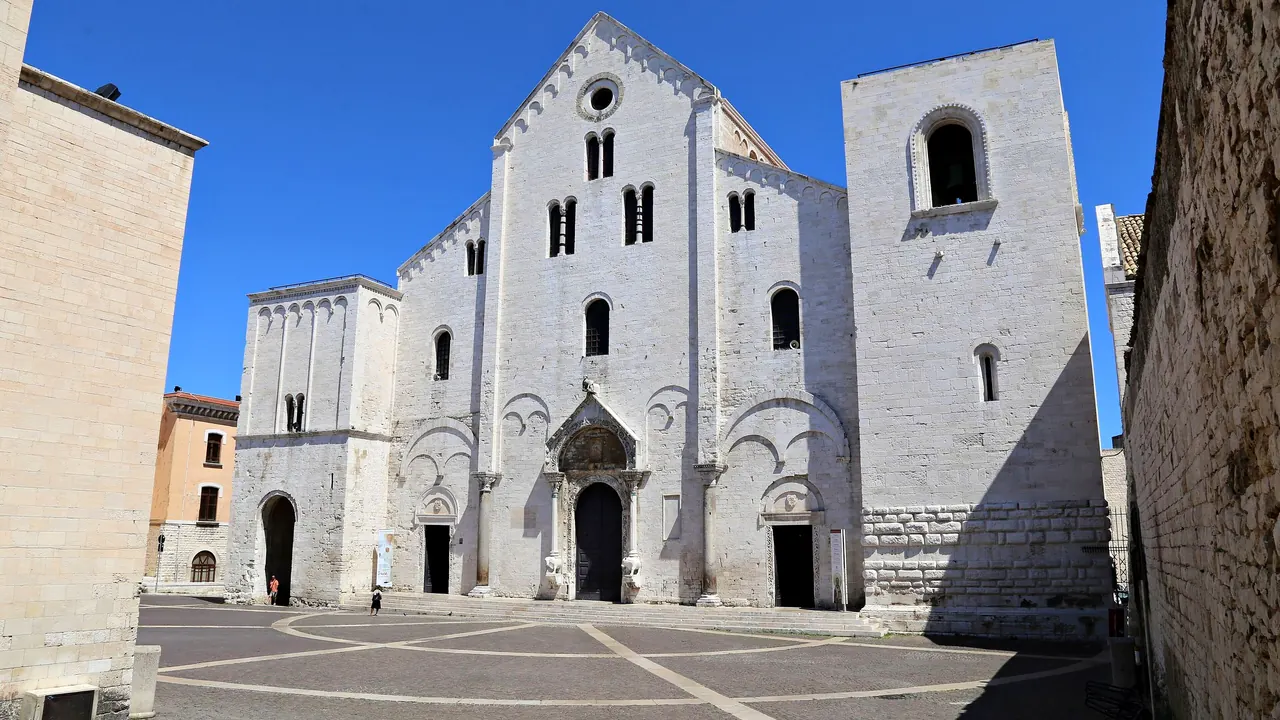
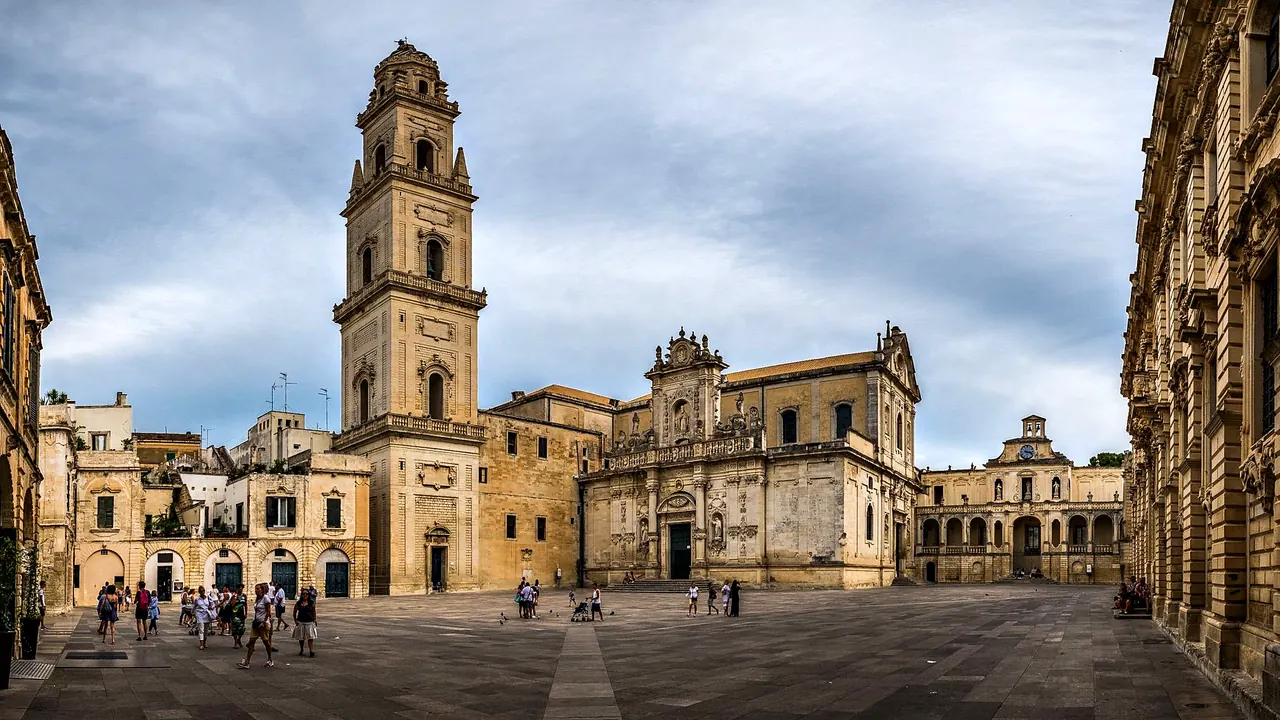
Photos: Bari by Sailko, CC BY-SA 4.0, cropped; Lecce by Giuseppe Milo, CC BY 3.0, cropped.
Bari or Lecce?
Our verdict in twelve categories, each scored against the same fixed benchmark cities, and the climate month by month, so you can choose for your trip.
Choose Bari for
- day trips
- getting around
- nightlife
Bari suits travellers who want a base more than a destination. Its railways reach Matera, the trulli country, Trani and Polignano, and its street food and harbour seafood are the better eating of the pair. Nights out in the old town piazzas also run later. Add an opera season at the Petruzzelli and it is the easier choice for a week of moving around Puglia.
Choose Lecce for
- wellness
- culture and sights
- beaches
Choose Lecce for a slower stay built around the place itself. Its Baroque old town is the finer of the two to wander, and the two seas of the Salento give it the better beaches. Thermal springs and masseria retreats make it the more restful pick. Plan on hiring a car, because most of what lies beyond the walls needs one.
Scoreboard
Twelve categories on one fixed scale from 0 to 100. The shaded stretch is the gap between the two.
Your match
Pick a travel style or drag the sliders, and both match scores follow your weighting.
Wins on day trips and getting around with your weighting.
Wins on wellness and culture and sights with your weighting.
What matters to you?
Category by category
What the scores mean for a trip.
Beaches & swimming
Neither city has great swimming on its doorstep, but Lecce has the better coast within reach. Bari does have a sandy city beach, Pane e Pomodoro, a walk from the centre. Polignano a Mare's pebble cove between cliffs and the rocky inlets around Monopoli are a short train ride south, and most visitors treat them as half-days out.
Lecce sits 12km inland, yet the Salento gives it two seas. On the Adriatic there are the pale coves and sea stacks of Torre dell'Orso. On the Ionian there are the long, shallow fine-sand beaches of Porto Cesareo. In summer the whole stay revolves around them, though you need a car or the seasonal buses to get there.
Food & drink
Both cook Apulian food with the same Primitivo and Negroamaro wines and orecchiette with turnip tops, but Bari has the edge. Focaccia barese, panzerotti and sgagliozze from kitchen windows, pasta rolled by hand in Bari Vecchia's doorways and raw sea urchins at the old pier make for a day of eating on foot, much of it from the sea.
Lecce's specialities lean towards pastry and the land. Breakfast is a pasticciotto with almond-milk iced coffee, mid-morning brings a rustico, and dinner is ciceri e tria and fava purée in an old town osteria. It is distinctive and cheap, but the range is narrower.
Culture & sights
Lecce is the more rewarding city to walk through. Its old town is a near-complete Baroque townscape in honey-coloured limestone, from the carved facade of Santa Croce to Piazza del Duomo at dusk. Half of a Roman amphitheatre lies open below Piazza Sant'Oronzo, and there are Messapian layers beneath the streets.
Bari's sights are fewer and of an older style. The Romanesque Basilica di San Nicola draws Orthodox pilgrims, and the cathedral and the Norman-Swabian castle stand close by in Bari Vecchia, with the nineteenth-century Murat grid beyond. A day or two covers it, while Lecce rewards slower wandering.
Nightlife
Bari has the bigger night out. Students and young locals fill Piazza Mercantile and Piazza Ferrarese, the bars of the Umbertino streets run past midnight, and the city has a handful of clubs. In high summer there are also beach venues along the coast to the south.
Lecce's evenings are gentler: an aperitivo on the piazzas, then the small wine and cocktail bars in the old town lanes. There is little dancing in town, and the summer discos are around Gallipoli, a drive away.
Nature & outdoors
Neither city has mountains, and both sit on flat plains of olive groves and stone walls, so the difference lies in what surrounds them. Bari looks inland, to the open karst grassland of the Alta Murgia for walks and cycling and to the show caves of the Grotte di Castellana.
Lecce's outdoors is the edge of the sea. There are clifftop paths and sea caves between Roca Vecchia and Otranto, birdwatching at Le Cesine and the Alimini lakes, pine woods above the bay at Porto Selvaggio, and good snorkelling and diving.
Day trips
This is where Bari pulls clearly ahead, because it sits in the middle of Puglia's best-known sights. Matera by train, the trulli of Alberobello, Ostuni and the Valle d'Itria, Castel del Monte and Trani's cathedral by the sea all make easy days out, and Lecce itself is reachable by train.
Lecce's range is smaller and reaches further into the south. It has Otranto's vast mosaic floor, Gallipoli's island old town and the frescoes of Galatina close at hand. The Itria valley is nearly two hours' drive away, and most of these outings are far easier with a car.
Good for families
Families will find the two much alike. Both have traffic-free old towns, gelato, evenings on the piazzas and very little built for children, and both need a long afternoon rest in the summer heat.
The difference is in the beach and the outings. Bari has a sandy city beach close to the centre and short trips to the Grotte di Castellana and the Fasano safari park. Lecce's draw is the shallow, sandy water around Porto Cesareo, ideal for small children but a drive away.
Getting around
Both centres are flat and easy on foot, but Bari is much better connected. A rail link runs to the airport, and regional lines run along the coast and inland, so Polignano, Trani and Matera can be reached without a car, even if some trains are slow.
In Lecce, the walking is just as easy and fast trains run north to Brindisi and Bari. Beyond the city, though, the Salento's local railways are slow and infrequent and the beach buses run only in summer. Most visitors hire a car and park outside the walls.
Shopping & style
For clothes and everyday shopping, Bari is the better bet. The pedestrianised Via Sparano and the Murat grid around it work as a proper Italian high street of fashion chains and a few smarter boutiques, which Lecce cannot match. Even so, Bari's most memorable things to take home are edible: dried orecchiette, taralli and olive oil from the delicatessens. Puglian ceramics are also worth hunting for.
Lecce has less to buy, but more of it is made in the town itself. Cartapesta saints and nativity figures come out of workshops in the old town, and small objects carved from its pale limestone are a souvenir Bari has no answer to. Neither city justifies a shopping trip, but Lecce is the place to find something handmade.
Affordability
Both are good value for Italy, with cheap street food, simple trattorias and local wine. The difference is when costs rise and what adds to the bill.
In Bari, rooms get scarcer in July and August, and day trips by car add up. In Lecce, the August crowds across the Salento make rooms and beach loungers expensive, and a hire car is close to essential, so May, June and September give the best balance there.
Live music & performing arts
Bari has more on stage. The Teatro Petruzzelli, one of Italy's largest opera houses, runs a full season of opera, ballet and symphonic concerts. In summer there are open-air concerts and a long-running jazz festival in the piazzas and the castle.
Lecce's two theatres, the Politeama Greco and the Paisiello, carry a smaller season. Its own tradition is pizzica, the Salento's tambourine dance, heard at village festivals all summer and at the Notte della Taranta in Melpignano in August.
Wellness & relaxation
Lecce is the better choice for real rest. The sulphur springs of Santa Cesarea Terme, in grottoes and pools on the cliffs above the sea, are under an hour away, and old fortified masserie on the plain have become quiet retreats with spas.
Bari shares the slow southern rhythm of long lunches and an evening stroll along the seafront. Its spas, though, are mostly hotel facilities, and proper pampering means leaving the city for a country estate.
When should you go?
Pick your month. The climate figures are measured averages, not a forecast.
Bari in July
Lecce in July
Daytime high, °C
Rainfall in the month, mm
Where the figures come from
Bari has no rain gauge within 25 km of the centre, so its rainfall comes from a gridded climate dataset read at the city rather than from a gauge further away.
Bari's sunshine is measured 77 km from the centre, at Marina Di Ginosa.
Lecce's temperatures are measured 38 km from the centre, at Brindisi.
Lecce has no rain gauge within 25 km of the centre, so its rainfall comes from a gridded climate dataset read at the city rather than from a gauge further away.
Temperature and rainfall are climate normals, averaged over the years shown. Bari: 1991-2020 (sunshine 1961-1990) normals, Bari / Palese Macchie (7 km from centre). Lecce: 1991-2020 (sunshine 1981-2010) normals, Brindisi (38 km from centre).
The two share almost the same climate, so when you go matters more than which city you pick. Both are warm enough for the beach from June to September, with the sea around 22°C in June and still 24°C in September. In July and August the days reach 30°C, which is too hot for walking the streets at midday. That slows down sightseeing in Lecce's old town and day trips from Bari alike. May, late September and early October are the most comfortable months for being on your feet.
The rain comes in autumn and is heaviest in November. Lecce is the wetter of the two then, at 102mm against 83mm in Bari. Winters are mild and damp in both. Lecce's summers are very sunny, with long, bright days from May through August.
Which traveller are you?
For a food and nightlife trip, Bari is the stronger choice. Its street food, from focaccia barese to raw sea urchins at the fishermen's pier, beats Lecce's narrower menu. Its piazza bars, clubs and summer beach venues also keep going later than Lecce's quieter lanes.
On a relaxing and wellness trip, Lecce comes out ahead. The sulphur pools of Santa Cesarea Terme above the sea are within an hour, masserie with spas dot the surrounding plain, and beach mornings set the pace. Bari offers little beyond hotel spas.
For travellers who want one base for touring Puglia, Bari is the obvious pick. Matera, Alberobello, Castel del Monte and the coastal towns are all within a day, and regional railways reach many of them. From Lecce, the north of the region is a long drive.
Before you go
| Measure | Bari | Lecce |
|---|---|---|
| Official language | Italian | Italian |
| Currency | Euro (EUR) | Euro (EUR) |
| Sockets | CFL230 V, 50 Hz | CFL230 V, 50 Hz |
| Driving side | Right | Right |
| Time zone | UTC+1, UTC+2 in summer | UTC+1, UTC+2 in summer |
| Emergency number | 112 | 112 |
| Elevation | 5 m | 49 m |
| Main airport | Bari Karol Wojtyła International Airport (BRI)9 km from centre104 non-stop destinations | Brindisi Airport (BDS)39 km from centre49 non-stop destinations |
| Public holidays this year | 13 days | 13 days |
By the numbers
| Measure | Bari | Lecce |
|---|---|---|
| City population | 315,473 | 94,783 |
| People per km² | 2,687 | 393 |
| Museums within 10 km | 12 | 11 |
| UNESCO World Heritage sites within 50 km | 1 | 0 |
| Swim season, months above 21 °C | 4 months | 4 months |
Where else could you go?
Every comparison below shares a destination with this one, so you can follow Bari or Lecce somewhere new.