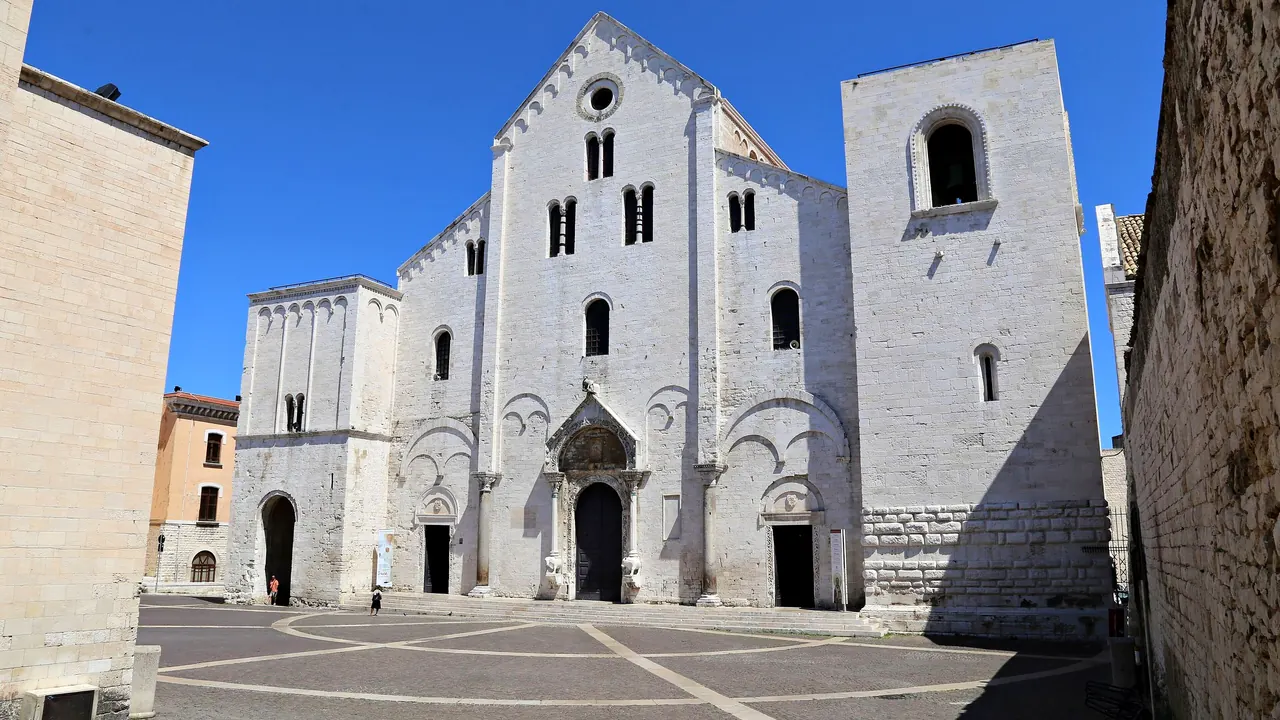
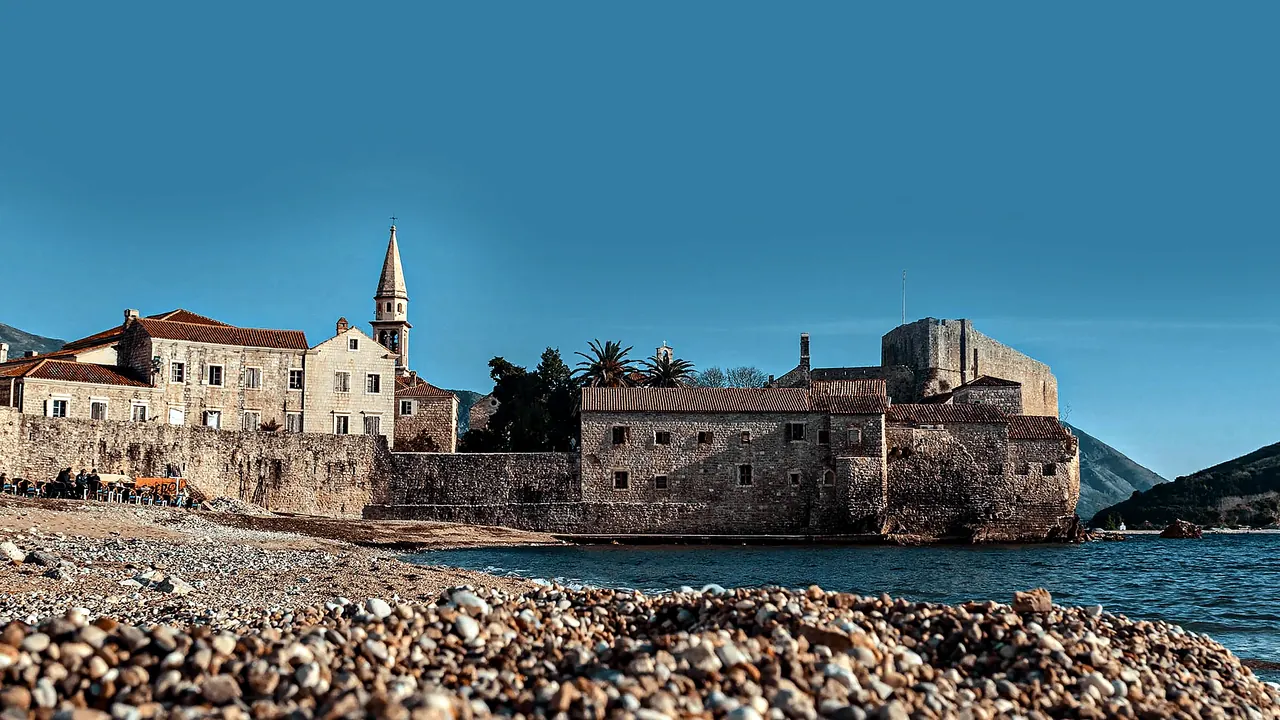
Photos: Bari by Sailko, CC BY-SA 4.0, cropped; Budva by Ender Vatan, Pexels License.
Bari or Budva?
Our verdict in twelve categories, each scored against the same fixed benchmark cities, and the climate month by month, so you can choose for your trip.
Choose Bari for
- food and drink
- live music and the arts
- culture and sights
Bari suits the traveller who plans a trip around eating and seeing. Its food, from orecchiette rolled in the doorways of Bari Vecchia to raw sea urchins at the fishermen's pier, is far better than Budva's resort menus. The city also works as a base for Matera, Alberobello, Lecce and the white towns of the Valle d'Itria, and in the evening there is opera back in town.
Choose Budva for
- nature and the outdoors
- beaches
Pick Budva if the sea and the mountains are the point. Its beaches start at the old town walls and run down a coast of bays to Sveti Stefan and Petrovac. Behind them, bare limestone climbs towards Lovcen, and Lake Skadar is within reach. It is a summer resort first, with loud seafront nights. For sightseeing beyond the small Stari Grad, you head down the road to Kotor and Perast.
Scoreboard
Twelve categories on one fixed scale from 0 to 100. The shaded stretch is the gap between the two.
Your match
Pick a travel style or drag the sliders, and both match scores follow your weighting.
Wins on food and drink and live music and the arts with your weighting.
Wins on nature and the outdoors and beaches with your weighting.
What matters to you?
Category by category
What the scores mean for a trip.
Beaches & swimming
Budva is the stronger beach destination. Slovenska Plaza and the Mogren coves are right beside the old town, and Becici, Jaz and the bays facing Sveti Stefan are a short ride away. The beaches are fine pebble and coarse sand, and the swimming season runs from June into October.
Bari's own beach at Pane e Pomodoro is a sandy urban strip where you cool off among local families. For good swimming you take the train to the cliff-backed cove at Polignano or the rocky inlets around Monopoli. In Bari the beach fills half-days. In Budva it fills the trip, though the town beaches are crowded and loud in August.
Food & drink
Food is one of Bari's best arguments and one of Budva's weak points. Bari has its own street cooking: focaccia barese, panzerotti, sgagliozze passed out of kitchen windows and raw seafood at the pier. At the table there are tiella, orecchiette and burrata, with Primitivo or Negroamaro to drink.
Budva's promenade restaurants cook for summer crowds, and quality varies. The rewarding meals are regional: Njegusi ham and mountain cheese, grilled squid at a family konoba and a glass of Vranac. You have to go looking for them.
Culture & sights
Bari has more to see, though neither city is a heavyweight. Bari Vecchia holds the Basilica di San Nicola, a pilgrimage church for Orthodox Christians, along with the cathedral and the Norman-Swabian castle. The Murat quarter and the Pinacoteca fill a second day.
Budva's Stari Grad is attractive but small, and much of it was rebuilt after the 1979 earthquake. You can see it, the Citadel and the archaeological museum in a morning. The real heritage of this coast is in Kotor and Cetinje.
Nightlife
The two are evenly matched for going out, but the nights feel different. Bari's scene is late and sociable, with students and locals drinking on the steps of Piazza Mercantile and Piazza Ferrarese. Bars in the Umbertino streets stay open late, and in high summer the beach clubs south of the city take over.
Budva is a Balkan party resort, with beach bars and terrace clubs along Slovenska Plaza and a big open-air club above town that runs until dawn. It suits groups. Both cities quieten in winter, but most of Budva's nightlife shuts from October to May.
Nature & outdoors
Budva has the more dramatic setting. Bare limestone mountains rise straight behind the town. Lovcen National Park has beech forest and high trails above the Bay of Kotor, and Lake Skadar is good for birdwatching and kayaking. Closer in, there are coastal paths, sea kayaking and paragliding above Becici.
Bari's surroundings are flat olive country. The Alta Murgia plateau suits quiet walks and cycling, the Grotte di Castellana make a good outing and the Valle d'Itria is gentle cycling country, but there are no mountains within reach.
Day trips
Both cities make good bases, but Bari's range is wider and richer. Matera's cave dwellings, the trulli of Alberobello, Ostuni, Castel del Monte, Trani's seafront cathedral and Baroque Lecce are all within a day's reach. Many are on the train, and a car makes the inland towns easier.
From Budva the outings are shorter and mostly along one stretch of coast: Kotor and Perast on the bay, Cetinje, the wine villages on Lake Skadar, Stari Bar and Ulcinj. Dubrovnik is possible but makes a long day, with a border crossing.
Good for families
Families will find the two much alike: both are relaxed about children staying out in the evening, and neither has much built for them. Bari's draws are its small, walkable centre, the traffic-free old town and outings to the Grotte di Castellana and the Fasano safari park.
Budva is more simply a beach stay, with gently shelving beaches and a water park. In July and August, though, the town is noisy at night, so families often stay in Becici or come in June or September.
Getting around
Both centres are easy on foot, but Bari makes it easier to get out of town. It has a rail link to the airport and regional lines to Polignano, Trani, Matera and Alberobello, though some are slow.
Budva has no railway, and its one coast road jams in summer. Buses and minibuses reach Kotor, and boat taxis from the marina serve the coves. Lovcen and Cetinje are far simpler with a car or an organised trip.
Shopping & style
Neither city is a shopping destination, but Bari offers more. Via Sparano and the Murat streets have Italian fashion chains and a few upmarket boutiques. Its delicatessens sell orecchiette, taralli, olive oil and wine worth packing, and Puglian ceramics are worth looking for.
Budva sells mostly souvenirs, beachwear, silver filigree, honey and rakija, with a modest shopping centre by the marina for the basics.
Affordability
Costs are close, but they work differently. Bari is an inexpensive city by Italian standards. Street food, trattoria lunches and a free old town keep daily spending low, though rooms are harder to find in July and August.
Budva is Montenegro's most expensive resort, and seafront rooms, sunbeds and promenade meals cost resort prices in summer. Bakeries, buses and apartments a few streets back stay cheap, and June or September brings prices down.
Live music & performing arts
Bari is far ahead here. The Teatro Petruzzelli, one of Italy's largest opera houses, has a season of opera, ballet and concerts. In summer there is a jazz festival and open-air concerts at the castle, though the spoken theatre is in Italian.
Budva has the long-running Grad Teatar festival on open-air stages in the old town each summer. Otherwise there is little more than cover bands in the seafront bars.
Wellness & relaxation
Neither is a spa destination, and in both the real pampering is found outside town. Bari offers a slow rhythm of long lunches and the evening walk along the seafront, with restored country estates nearby for a proper retreat.
Budva's spas are in the large resort hotels at Becici and Sveti Stefan. The town itself is noisy at night in high summer, so May, June or late September suit a quiet stay better.
When should you go?
Pick your month. The climate figures are measured averages, not a forecast.
Bari in July
Budva in July
Daytime high, °C
Rainfall in the month, mm
Where the figures come from
Bari has no rain gauge within 25 km of the centre, so its rainfall comes from a gridded climate dataset read at the city rather than from a gauge further away.
Bari's sunshine is measured 77 km from the centre, at Marina Di Ginosa.
Budva has no rain gauge within 25 km of the centre, so its rainfall comes from a gridded climate dataset read at the city rather than from a gauge further away.
Budva's sunshine is measured 40 km from the centre, at Podgorica-Grad.
Temperature and rainfall are climate normals, averaged over the years shown. Bari: 1991-2020 (sunshine 1961-1990) normals, Bari / Palese Macchie (7 km from centre). Budva: 1991-2020 normals, Tivat (15.8 km from centre).
Through high summer the two are close. In July and August the days reach 30°C or a little more in both, the sea warms to about 26°C and the sun shines for long hours, slightly longer in Bari. The water is warm enough for swimming from June to September in either city. At midday in July and August it is too hot to walk either old town, so sightseeing is more comfortable in the early morning and evening, or in May, June and September.
The rest of the year is where they differ. Bari stays fairly dry. Rain returns in September and builds gently to about 83mm in November, so its old town and day trips still work in spring, autumn and winter. In Budva, September is a wetter shoulder month at around 125mm. It is still warm and good for swimming, but showers are likely. From October the real wet season sets in under the mountains, rising above 200mm in November and lasting well into spring. Budva is at its best from June to August, with September a warm but less settled extra month. Outside summer, Bari is the better choice.
Which traveller are you?
On a culture and arts trip, Bari is the better choice. The Basilica di San Nicola and Bari Vecchia, opera at the Petruzzelli and day trips to Matera, Lecce and Castel del Monte give far more depth than Budva's compact old town and its summer festival.
For a beach and sun trip, Budva wins. Its beaches begin beneath the old town walls and continue to Becici, Jaz and Sveti Stefan. Bari's city beach is a modest urban strip, and its better coves are a train ride away.
On an outdoors trip, Budva has the setting that Bari lacks. Mountains rise straight behind the coast, and there are Lovcen's high trails, kayaking on Lake Skadar, sea kayaking and paragliding nearby. Around Bari it is mainly flat olive country and the gentle Alta Murgia plateau.
Before you go
| Measure | Bari | Budva |
|---|---|---|
| Official language | Italian | Montenegrin |
| Currency | Euro (EUR) | Euro (EUR) |
| Sockets | CFL230 V, 50 Hz | CF230 V, 50 Hz |
| Driving side | Right | Right |
| Time zone | UTC+1, UTC+2 in summer | UTC+1, UTC+2 in summer |
| Emergency number | 112 | 112 |
| Elevation | 5 m | 3 m |
| Main airport | Bari Karol Wojtyła International Airport (BRI)9 km from centre104 non-stop destinations | Tivat Airport (TIV)17 km from centre42 non-stop destinations |
| Public holidays this year | 13 days | - |
By the numbers
| Measure | Bari | Budva |
|---|---|---|
| City population | 315,473 | 13,338 |
| People per km² | 2,687 | 109 |
| Museums within 10 km | 12 | 0 |
| UNESCO World Heritage sites within 50 km | 1 | 3 |
| Swim season, months above 21 °C | 4 months | 5 months |
Where else could you go?
Every comparison below shares a destination with this one, so you can follow Bari or Budva somewhere new.