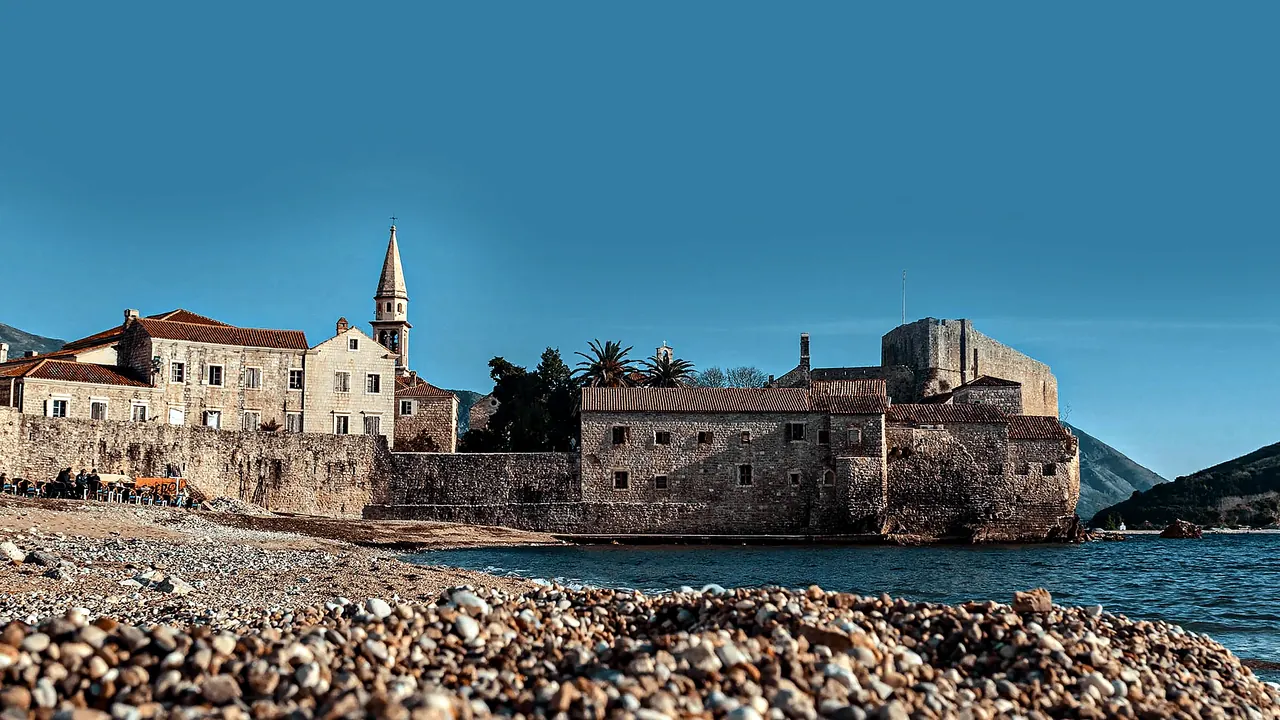
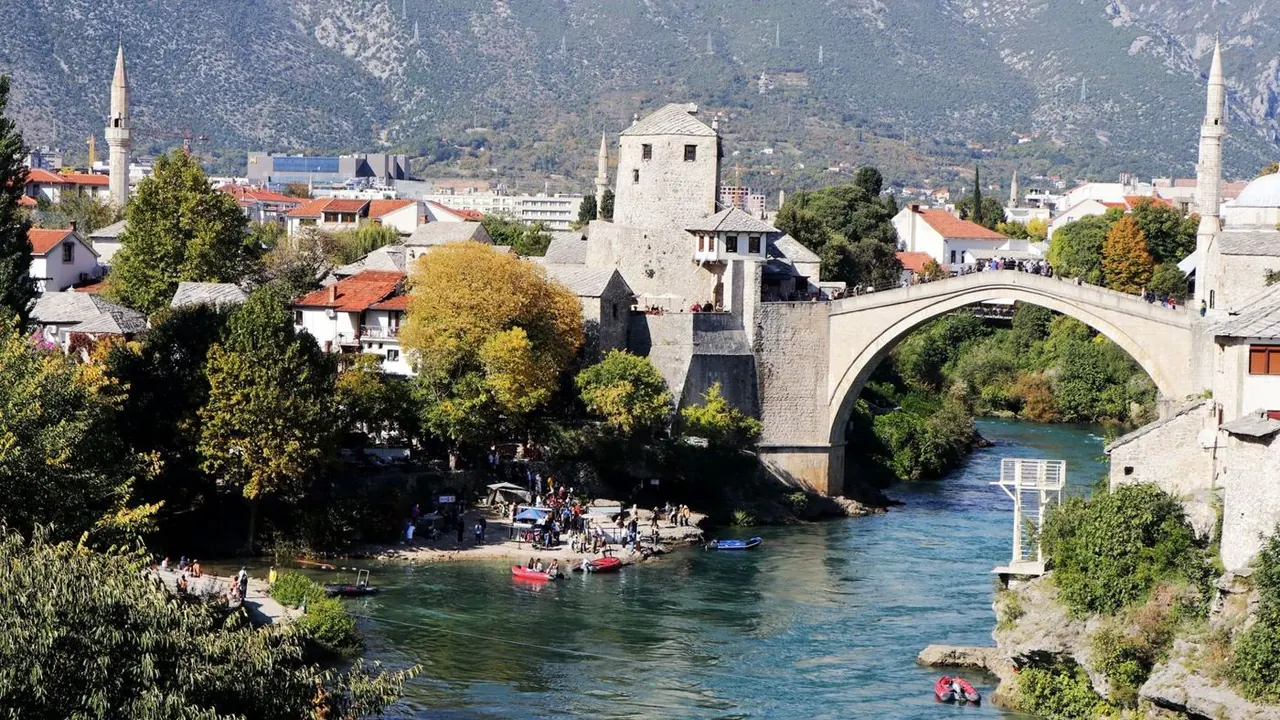
Photos: Budva by Ender Vatan, Pexels License; Mostar by Alan Wang, Pexels License.
Budva or Mostar?
Our verdict in twelve categories, each scored against the same fixed benchmark cities, and the climate month by month, so you can choose for your trip.
Choose Budva for
- beaches
- nightlife
- families
Budva is for a summer trip built around the sea: town beaches and coves, water warm enough to swim from June into October, loud nights along the seafront and an easy run to Kotor, Perast and Lovcen. It suits groups of friends and families who want to swim every day and don't need much more than that.
Choose Mostar for
- culture and sights
- prices
- shopping
Travellers who would rather walk through history than lie on a sunbed will get more from Mostar. The Old Bridge, the Ottoman houses and the war-marked streets make a richer cultural stop, the Bosnian cooking is honest, and the whole stay costs noticeably less. It works best as two unhurried days in spring or autumn, not as a base for a week.
Scoreboard
Twelve categories on one fixed scale from 0 to 100. The shaded stretch is the gap between the two.
Your match
Pick a travel style or drag the sliders, and both match scores follow your weighting.
Wins on beaches and nightlife with your weighting.
Wins on culture and sights and prices with your weighting.
What matters to you?
Category by category
What the scores mean for a trip.
Beaches & swimming
This is the biggest gap between the two. Budva has fine pebble and coarse sand on its doorstep, with Slovenska Plaza and the Mogren coves in town and Becici, Jaz and the beach facing Sveti Stefan a short ride away. The drawback is packed sunbeds and loud music in high summer.
Mostar has no beach. The Neretva is too cold for more than a quick plunge, so most visitors swim in the pool beneath the Kravica waterfalls. The nearest sea, at Neum, is over an hour's drive away, which makes it a day out rather than a place to stay.
Food & drink
Neither city is a place to travel for food, and the gap is small, though Mostar's cooking has the stronger identity. In Budva the promenade menus of grilled fish, black risotto and pizza are uneven. The good meals come from Njegusi ham, mountain cheese and the day's catch at family konobas, with a glass of Vranac.
Mostar sticks to Bosnian cooking: ćevapi in somun bread, pies made with thin pastry, stuffed peppers, and white Žilavka or red Blatina from the nearby valleys. Bosnian coffee in a copper džezva is a ritual in itself. Fine dining is thin in both.
Culture & sights
Mostar has far more to see. The Old Bridge, rebuilt after it was destroyed in 1993, stands at the centre of a UNESCO-listed old town with the Kujundžiluk bazaar, a mosque minaret you can climb and Ottoman houses with carpeted rooms. The war-damaged façades along the old front line add a harder side to the visit.
Budva's walled Stari Grad, largely rebuilt after the 1979 earthquake, takes an hour or two. It has its churches, the Citadel and a small archaeological museum. For more heritage you have to travel to Kotor and Cetinje.
Nightlife
Budva is the place to go out, at least in summer. Beach bars and terrace clubs line Slovenska Plaza, and a large open-air club on the hill keeps going until dawn. Groups of friends come for exactly this, though nearly all of it shuts from October to May.
Evenings in Mostar are slower. You have dinner and a drink on a terrace facing the lit bridge, and there are a few cocktail bars and student clubs at weekends. It suits a quiet evening, not a late night.
Nature & outdoors
Both towns sit beneath bare limestone mountains, but Budva has a slight edge because it also has the sea. There are paths between the bays, kayaking along the cliffs and paragliding above Becici, and Lovcen's beech forests and Lake Skadar are about an hour inland.
Mostar's outdoors is about rivers and high ground: rafting in the Neretva canyons, the Buna spring at Blagaj, the rugged Prenj range and the birdlife of Hutovo Blato. Spring and autumn are the times to walk in both, because summer heat is punishing in each.
Day trips
Budva has the better choice of day trips. Kotor and its bay are about half an hour away, Perast and Cetinje are not much further, and the coast to the south leads to Stari Bar and Ulcinj. Dubrovnik is possible as a long day.
Mostar's outings are smaller and more personal: the dervish house at Blagaj, the hillside village of Počitelj, the medieval tombstones at Stolac and Tito's bunker at Konjic. Sarajevo makes a long day by train through the Neretva gorge, but most of the other trips need a car or a tour.
Good for families
Budva works better with children, mostly because of its beaches. The town beaches slope gently, there are calmer bays at Becici and there is a water park on the hill. July and August are loud at night, so families often stay in Becici or come in June or September.
Mostar is manageable for a day or two. Children enjoy the bridge divers and swimming at Kravica, but the slippery cobbles are hard work with a pushchair and the summer heat is tough on small children.
Getting around
Both have compact centres you can walk, and both need a car, taxi or tour for what lies beyond. Budva's old town, marina and promenade are close together, with buses along the coast and boat taxis to the coves. It has no railway, though, and its one coast road jams in summer.
Mostar's bridge and old town fit into a short walk along the river on worn cobbles. Its advantage is a train line to Sarajevo.
Shopping & style
Neither is a shopping destination, but Mostar has more worth taking home. In the Kujundžiluk a few coppersmiths still hammer coffee sets by hand, alongside kilims and embroidered textiles, though much of the stock is imported. Budva's old town lanes and promenade stalls sell beachwear, silver filigree, olive oil, honey and rakija, and little else.
Affordability
Mostar is clearly the cheaper of the two. Guesthouses cost little, so does a plate of ćevapi or a bottle of Herzegovinian wine, and only rooms near the bridge in midsummer push prices up.
Budva is Montenegro's most expensive resort, especially for seafront rooms and sunbeds in July and August. Apartments a few streets back, bakeries and local buses still compare well with Western European coasts, and coming in June or September brings costs down.
Live music & performing arts
Live performance plays a small part in a visit to either. Budva's one fixture is Grad Teatar, a summer festival of theatre and concerts on open-air stages in the old town squares. Mostar has a national theatre and a long-established youth theatre, mostly performing in local languages, plus open-air concerts in summer.
Wellness & relaxation
Budva is the better choice for this. The large resort hotels at Becici and around Sveti Stefan have spas, and May or late September brings calm with the sea still warm. In high summer, though, the town itself is not restful.
Mostar has no working bathing tradition, since its old hammam is now a historic building, and only a few hotels offer spa treatments. What it offers instead is a slow pace: long coffees in the shade and quiet early mornings by the river.
When should you go?
Pick your month. The climate figures are measured averages, not a forecast.
Budva in July
Mostar in July
Daytime high, °C
Rainfall in the month, mm
Where the figures come from
Budva has no rain gauge within 25 km of the centre, so its rainfall comes from a gridded climate dataset read at the city rather than from a gauge further away.
Budva's sunshine is measured 40 km from the centre, at Podgorica-Grad.
Temperature and rainfall are climate normals, averaged over the years shown. Budva: 1991-2020 normals, Tivat (15.8 km from centre). Mostar: 1991-2020 normals, Mostar (0.9 km from centre).
Budva is at its best for the beach from June to August, when daytime highs climb to 32°C, the days are long and sunny and the sea reaches 26°C by August. The rain comes back in September, when the month's total jumps to 125mm, although the days stay warm and the water is still fine for swimming into October. May and early June are the best months for the coastal paths, before the summer heat arrives. After that, the rain keeps building through October to a peak in November. Winters are mild but wet and grey, with short days and little sun.
Mostar is hotter in summer. Highs reach 33°C in July and August in a valley that traps the heat, so the middle of the day is hard going on the stone lanes. April and May are the months to explore the old town and the hills around it, and October works again once the heat has gone, though autumn brings heavy rain here as well. Winters are colder than on the coast, and in both places November and December are the wettest months.
Which traveller are you?
On a beach and sun trip, Budva is the clear choice. It has beaches in town, the coves at Mogren and longer bays down the coast, with warm sea from June to October. Mostar's nearest swim is a waterfall pool or a drive to Neum.
For a culture and arts trip, Mostar gives you more. The Old Bridge, the Ottoman bazaar and houses, and the scars of the 1990s war fill a couple of thoughtful days. Budva's old town takes an hour to walk, and its best heritage lies in Kotor and Cetinje.
On a trip on a tight budget, your money goes further in Mostar. Family guesthouses, cheap ćevapi, local wine and slow coffees keep daily costs low. Budva charges resort prices for rooms, sunbeds and promenade meals in July and August.
Before you go
| Measure | Budva | Mostar |
|---|---|---|
| Official language | Montenegrin | Croatian, Serbian, Bosnian |
| Currency | Euro (EUR) | Convertible Mark (BAM) |
| Sockets | CF230 V, 50 Hz | CF230 V, 50 Hz |
| Driving side | Right | Right |
| Time zone | UTC+1, UTC+2 in summer | UTC+1, UTC+2 in summer |
| Emergency number | 112 | 112 |
| Elevation | 3 m | 60 m |
| Main airport | Tivat Airport (TIV)17 km from centre42 non-stop destinations | Sarajevo International Airport (SJJ)68 km from centre38 non-stop destinations |
| Public holidays this year | - | 8 days |
By the numbers
| Measure | Budva | Mostar |
|---|---|---|
| City population | 13,338 | 105,448 |
| People per km² | 109 | 90 |
| Museums within 10 km | 0 | 3 |
| UNESCO World Heritage sites within 50 km | 3 | 1 |
| Swim season, months above 21 °C | 5 months | - |
Where else could you go?
Every comparison below shares a destination with this one, so you can follow Budva or Mostar somewhere new.