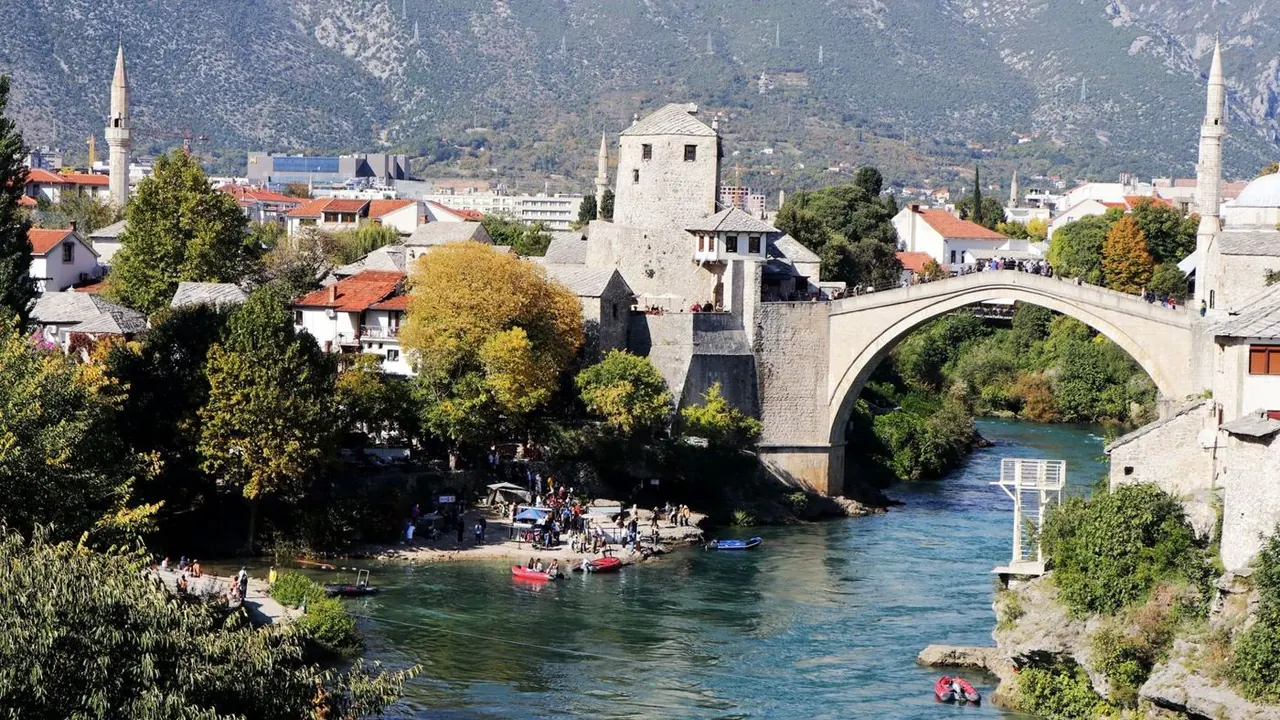
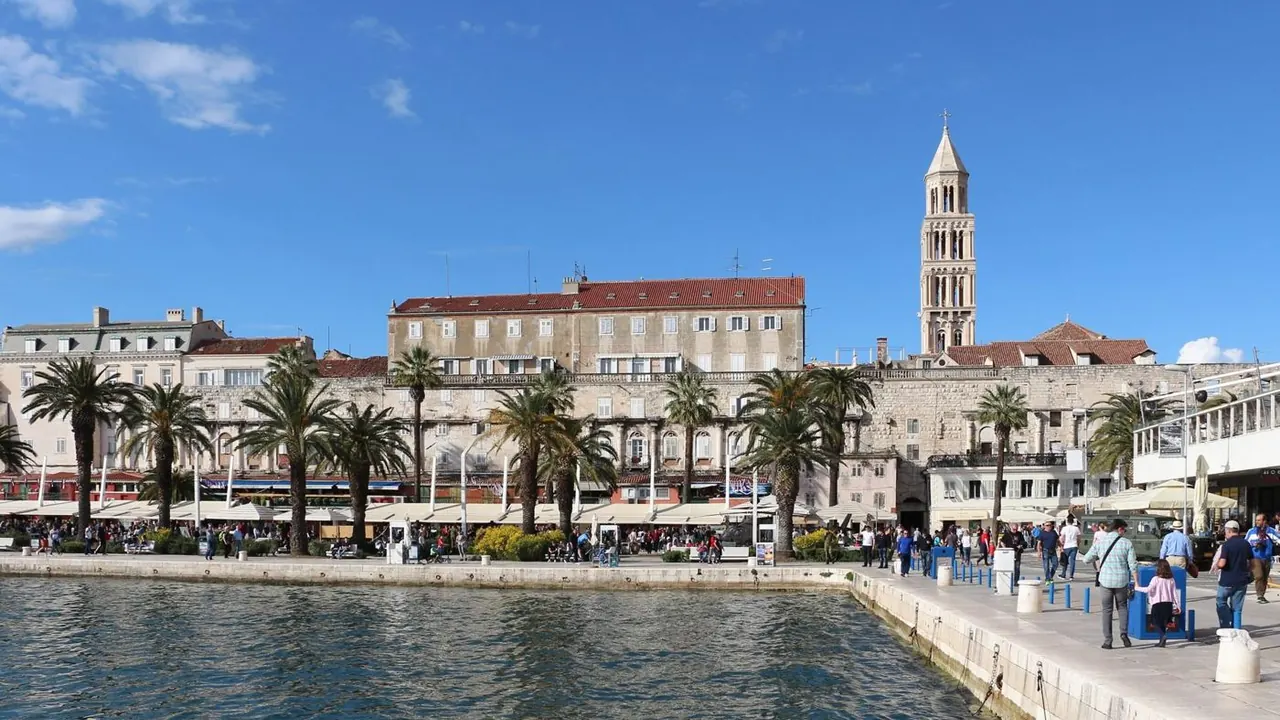
Photos: Mostar by Alan Wang, Pexels License; Split by Bernard Gagnon, CC BY-SA 4.0, cropped.
Mostar or Split?
Our verdict in twelve categories, each scored against the same fixed benchmark cities, and the climate month by month, so you can choose for your trip.
Choose Mostar for
- prices
Mostar suits a traveller passing through the Balkans who wants a short stop full of history at little cost. The rebuilt Old Bridge, the Ottoman houses and the war-marked streets along the old front line fill a day or two. Guesthouses and meals are cheap, and a car opens up Blagaj, Počitelj and the Kravica falls. It works best as one stage of a longer route, not as a base for a week.
Choose Split for
- beaches
- nightlife
- getting around
For a longer vacation, especially one built around the sea, Split is the better choice. You can swim within walking distance of a Roman palace, eat Dalmatian fish with local wine, and go out in the stone alleys on summer nights. Ferries and buses from the harbour reach Hvar, Brač, Trogir and Krka. It costs noticeably more in high summer, but there is far more to do once the main sights are done.
Scoreboard
Twelve categories on one fixed scale from 0 to 100. The shaded stretch is the gap between the two.
Your match
Pick a travel style or drag the sliders, and both match scores follow your weighting.
Wins on prices with your weighting.
Wins on beaches and nightlife with your weighting.
What matters to you?
Category by category
What the scores mean for a trip.
Beaches & swimming
For beaches the difference is total. Mostar is inland, and the emerald Neretva is too cold for more than a quick plunge off the rocks. The real swim is a trip to the pool beneath the Kravica waterfalls, or more than an hour's drive to the sea at Neum.
In Split the Adriatic is part of daily life. Bačvice has shallow sand and locals playing picigin, and the pine-shaded coves around Marjan are quieter. Most of the shore is pebble or concrete, and the city beaches fill up in high summer, but the islands are a ferry ride away.
Food & drink
Both cities serve burek for breakfast and like a coffee that lasts an hour, but Split has more range. Mostar's cooking is Bosnian with an Ottoman accent: charcoal-grilled ćevapi in somun bread, stuffed peppers and slow stews, with Herzegovina's Žilavka and Blatina wines to drink. It is satisfying, but the choice soon runs out.
Split adds the sea: grilled fish, black risotto, pašticada, octopus under the peka bell, and the fish market and Pazar to show what is in season. The best tables are in the konobas of Varoš rather than inside the palace walls.
Culture & sights
Each city has one great monument and a small set of sights around it, and in both you can see the main sights in a day or two. Mostar's is the Old Bridge, a sixteenth-century Ottoman arch destroyed in the war and rebuilt, with divers jumping from it. Around it are the bazaar, the minaret of Koski Mehmed Pasha and the war-scarred front line, so the city tells a story of conflict and repair.
Split's Diocletian's Palace has a greater depth of history. It is a Roman complex people still live in, with the cathedral set inside the emperor's mausoleum and the substructures underneath. The Meštrović Gallery and the Archaeological Museum give Split a real museum side that Mostar lacks.
Nightlife
Split has a real summer night scene. Bars fill the palace stairways until late, and the Bačvice clubs run into the early hours. In Mostar the evening is a long dinner facing the lit bridge, and the old town goes quiet once the day visitors leave, with only a few student clubs on weekends. Out of season the gap narrows, because Split also shrinks to a glass of wine with locals.
Nature & outdoors
Both cities sit among bare limestone mountains, but Split puts the outdoors within easier reach and adds the sea. Marjan's forest trails start on foot from the old town, Mosor and Kozjak give ridge hikes above the coast, and sea kayaking, sailing, the Cetina canyon and Krka's waterfalls are all close.
Mostar's landscape is wilder and harder to get into. The Prenj massif, rafting on the upper Neretva, the Blidinje plateau and the birdlife of Hutovo Blato mostly need a car and some planning, and the valley's summer heat limits walking to spring and autumn.
Day trips
Split is the easier and broader base. Trogir and Šibenik, both with UNESCO-listed old cores, are an easy run up the coast, Salona and Klis are on the city's edge, and ferries reach Hvar, Brač and Vis without a car.
Mostar's outings are smaller and more intimate: the dervish tekke at Blagaj, walled Počitelj, Stolac's stećci tombstones and the bridges of Konjic and Jablanica. Most need a car or a tour, and Sarajevo makes a long day by train through the gorge.
Good for families
Neither city has much built for children, but Split is easier with them. The shallow water at Bačvice, room to run on Marjan and a ferry to an island make simple, reliable days. Mostar holds young children for an afternoon of bridge divers and a minaret climb, and Kravica makes a good swimming day. Its slippery, steep lanes and fierce valley heat are harder going, though families get a warm welcome at the table.
Getting around
You walk everywhere in both centres, on stone worn smooth enough to need good shoes. The difference is what happens when you leave the centre. Split's ferry port, bus station and railway station sit together on the harbour, and local buses reach Solin and Trogir, so you can manage without a car.
In Mostar the buses serve residents, and Blagaj, Počitelj and Kravica really need a car, taxi or tour. Only the train and the long-distance buses link it easily to the wider region.
Shopping & style
Neither city is a shopping destination, but what you can buy differs. Mostar's Kujundžiluk is a single bazaar street where a few coppersmiths still hammer coffee sets by hand among imported souvenir stock. Split has the mainstream chains on Marmontova, and the Pazar market, where dried figs, honey, olive oil and Dalmatian wine make better things to take home than anything sold inside the palace.
Affordability
Mostar is much cheaper. Guesthouses, grilled meat, local wine and coffee all cost little, and only the bridge-view terraces and old-town rooms in midsummer charge more. Split in July and August costs about as much as a large Western European city, especially for rooms near the palace, fish sold by weight and island ferries for a family. Bakeries, the market and May, June or late September bring it closer to reasonable.
Live music & performing arts
Split gives more to an evening out at a performance. Its 19th-century Croatian National Theatre stages opera and ballet that need no translation, the Summer Festival uses the Peristyle as an open-air stage, and klapa singers fill the palace vestibule with unaccompanied harmony. Mostar's national and youth theatres mostly play in local languages, and outside summer concerts its live music is mostly the odd café band.
Wellness & relaxation
Neither city has a living bath culture, so rest in both comes mostly from the pace of the day. Mostar's version is narrower but real. The old hammam by the bridge is a monument rather than somewhere to bathe, and there is little to book beyond a treatment in one of a few hotels. Its reward is the quiet at either end of the day, when the day-trippers have moved on and you can sit above the Neretva with nothing louder than the water.
Split gives you more ways to switch off when the old town gets noisy. The larger resort hotels along the coast east of the centre have spas and massage rooms, Marjan's pine woods are a short walk from the palace but feel far from its crowds, and a morning ferry takes you to an island where everything slows further. The Dalmatian idea of fjaka, a deliberate unhurried idleness, comes most easily outside July and August, when the city has room to breathe.
When should you go?
Pick your month. The climate figures are measured averages, not a forecast.
Mostar in July
Split in July
Daytime high, °C
Rainfall in the month, mm
Temperature and rainfall are climate normals, averaged over the years shown. Mostar: 1991-2020 normals, Mostar (0.9 km from centre). Split: 1991-2020 normals, Split / Marjan (0.9 km from centre).
Mostar sits in an inland basin, so its summers are harsher and its winters wetter than on the coast. July and August reach about 33°C, too hot for walking the old town in the middle of the day, which makes May and the first part of autumn the comfortable months. Rain picks up sharply from September, and November and December are very wet, at close to 200mm a month.
Split is a little milder in summer and much drier all year, with more sunshine in every month. The sea is warm enough for swimming from June to September and reaches about 25°C in August, so the beach season is long. Spring and autumn are the best months for sightseeing and hiking, when highs sit around the low twenties. In winter it gets about half Mostar's rain.
Which traveller are you?
On a beach and sun trip, Split is the clear pick. You can walk from the palace to swim at Bačvice or the Marjan coves, and ferries reach the longer beaches on Brač and Hvar. In Mostar, swimming means a day out to Kravica or Neum.
For a trip on a tight budget, Mostar goes much further. Family guesthouses, plates of ćevapi, local wine and slow Bosnian coffee all cost little. Split in July and August charges close to Western European city prices for rooms and fish.
On a food and nightlife trip, Split has more on both counts: seafood, peka and konobas in Varoš, then summer evenings that move from the Riva into the palace bars and the Bačvice clubs. Mostar's evenings mostly end over dinner by the bridge.
Before you go
| Measure | Mostar | Split |
|---|---|---|
| Official language | Croatian, Serbian, Bosnian | Croatian |
| Currency | Convertible Mark (BAM) | Euro (EUR) |
| Sockets | CF230 V, 50 Hz | CF230 V, 50 Hz |
| Driving side | Right | Right |
| Time zone | UTC+1, UTC+2 in summer | UTC+1, UTC+2 in summer |
| Emergency number | 112 | 112 |
| Elevation | 60 m | 0 m |
| Main airport | Sarajevo International Airport (SJJ)68 km from centre38 non-stop destinations | Split Saint Jerome Airport (SPU)12 km from centre69 non-stop destinations |
| Public holidays this year | 8 days | 14 days |
By the numbers
| Measure | Mostar | Split |
|---|---|---|
| City population | 105,448 | 160,577 |
| People per km² | 90 | - |
| Museums within 10 km | 3 | 11 |
| UNESCO World Heritage sites within 50 km | 1 | 4 |
| Swim season, months above 21 °C | - | 4 months |
Where else could you go?
Every comparison below shares a destination with this one, so you can follow Mostar or Split somewhere new.