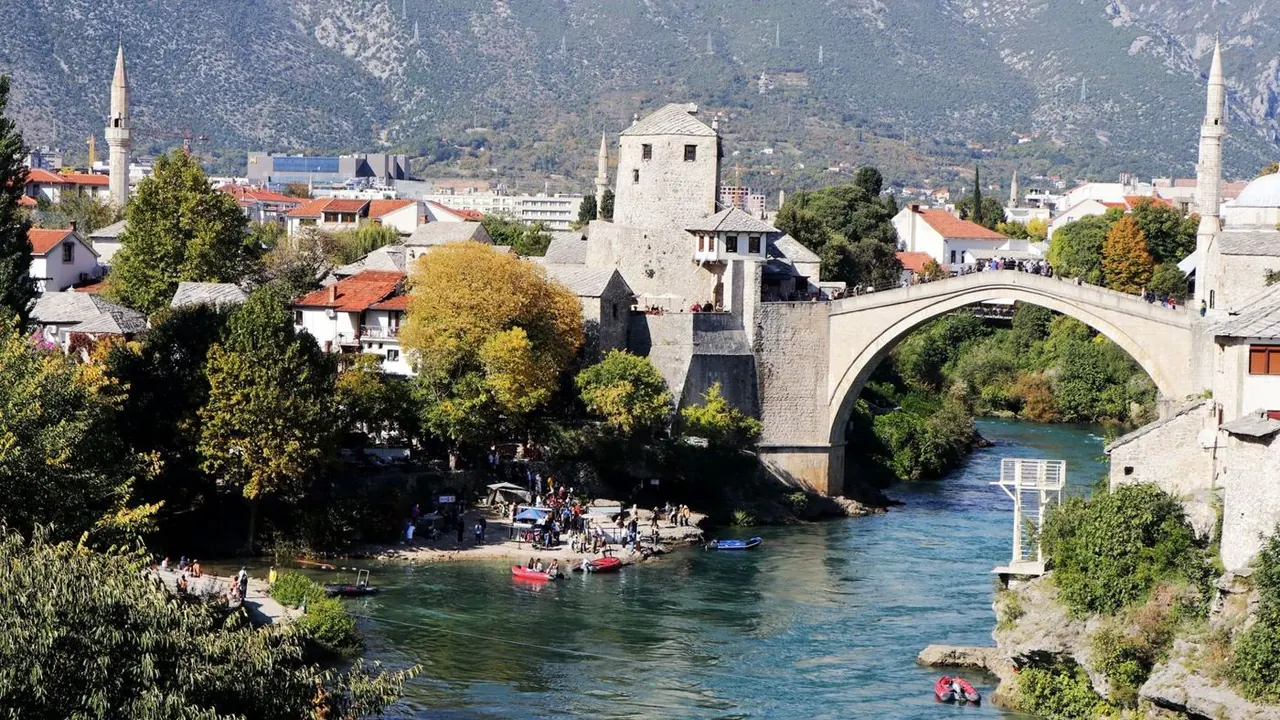
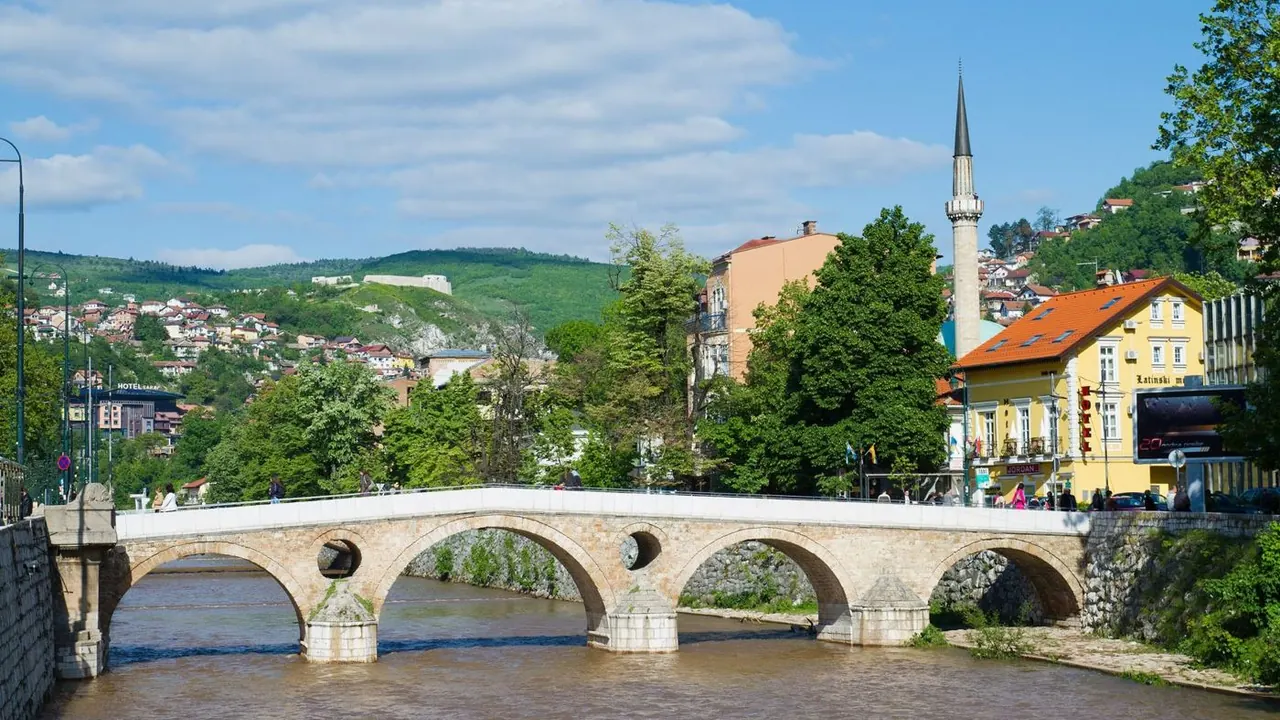
Photos: Mostar by Alan Wang, Pexels License; Sarajevo by Tumi-1983, CC0.
Mostar or Sarajevo?
Our verdict in twelve categories, each scored against the same fixed benchmark cities, and the climate month by month, so you can choose for your trip.
Choose Mostar for
- beaches
Mostar suits a short, warm stay built around one remarkable sight and the valley that surrounds it: the Old Bridge and its divers, the Ottoman villages of Počitelj and Blagaj, Herzegovina's wines and a swim under the Kravica falls. Two nights are usually enough, and travellers with a car get the most from it, since the best of the region is a short drive out of town.
Choose Sarajevo for
- live music and the arts
- wellness
- food and drink
Sarajevo is the better choice for anyone who wants a proper city trip. Its sights go deeper, with mosques, cathedrals and a synagogue a few streets apart and the siege told at the Tunnel of Hope. The cooking is better and the café-bars stay busier. It also has a stage season, thermal pools at Ilidža and mountains you can reach by cable car from the Old Town. It works well as a base too, with trams around the city and the train south to Mostar.
Scoreboard
Twelve categories on one fixed scale from 0 to 100. The shaded stretch is the gap between the two.
Your match
Pick a travel style or drag the sliders, and both match scores follow your weighting.
Wins on beaches with your weighting.
Wins on live music and the arts and wellness with your weighting.
What matters to you?
Category by category
What the scores mean for a trip.
Beaches & swimming
Neither city is built for a beach vacation, but Mostar is much closer to the water. The wide pool below the Kravica waterfalls is about 40km away, and the Adriatic at Neum is a little over an hour's drive, so a swim in the sea fits into a day.
In Sarajevo the coast is around three hours away by road, so in summer you swim in cold mountain rivers, Jablanica lake or a pool. If the sea matters, add a few nights on the coast after you leave.
Food & drink
Both cities cook the same Ottoman-Balkan food: ćevapi in somun bread, burek, stuffed vegetables and coffee from a copper džezva. Mostar's terraces by the bridge are aimed at visitors, and the better cooking is a few streets back. Its real strength is the local wine, Žilavka and Blatina from the hot valleys around the town.
Sarajevo does this cooking with more care and more variety. Baščaršija has grills that make little but ćevapi, served with kajmak, and pita bakeries sell their pies by weight. There is begova čorba soup, lamb cooked under a metal lid, and tufahija and baklava for dessert. Neither city has much in the way of international or fine dining.
Culture & sights
Mostar is about one great monument and the area around it. Stari Most, rebuilt stone by stone after 1993, stands over the Kujundžiluk bazaar, the Koski Mehmed Pasha minaret and a few carpeted Ottoman houses, and the scarred former front line tells the harder story. You can see it well in a day or two.
Sarajevo has more layers and more to see. The mosques and madrasa of Baščaršija give way within minutes to Austro-Hungarian avenues, the Orthodox and Catholic cathedrals and the Old Synagogue. The Latin Bridge marks where the First World War began. The siege is remembered at the Tunnel of Hope and the War Childhood Museum, and the National Museum holds the Sarajevo Haggadah.
Nightlife
A night out in Mostar mostly means a long dinner on a terrace facing the lit bridge. Once the day visitors leave, the old town is quiet, and only a few bars and student clubs stay open later at weekends.
Sarajevo has more going on in the evening. Café-bars fill from the afternoon and get louder towards night, the streets around Ferhadija are lively on warm evenings, and cellar bars and small clubs stay open past midnight at weekends. Neither city has much of a club scene, but in Sarajevo an evening can carry on.
Nature & outdoors
Mostar's countryside is dry karst: bare limestone, the jagged Prenj range, rafting in the Neretva canyons and the Buna gushing from the cliff at Blagaj. Birdwatchers have Hutovo Blato. The catch is the summer heat, which often goes above 35°C in the valley and makes walking in high summer hard work.
Sarajevo's mountains are closer and greener. A cable car from the Old Town climbs Trebević, past the overgrown Olympic bobsleigh track. Jahorina and Bjelašnica offer winter skiing and grassy summer ridges for hiking and biking, and they lead out to the shepherds' village of Lukomir above the Rakitnica canyon. Here you can be in the mountains in any season.
Day trips
Both cities have a good range of day trips, and the best one from each is the other city, two hours apart by the train through the Neretva gorge. Konjic's bunker and Jablanica's wrecked bridge lie on the line between them. From Mostar, the other trips are short and close: Blagaj's tekke, Počitelj on its hillside, Stolac's stećci tombstones and pilgrim Međugorje, all short drives.
From Sarajevo the trips go further. Travnik has a fortress and Ivo Andrić's birthplace, and the UNESCO bridge at Višegrad is about two hours east on slow, winding roads. From either city most trips need a car or a tour.
Good for families
Neither city has much made for children, and both are fine for a few days. The difference is in what you can do. In Mostar, children enjoy the bridge divers, the climb up the minaret and, above all, swimming at Kravica, but the steep, polished cobbles are hard with a pushchair and summer is very hot.
Sarajevo's Old Town is flat and easy to walk with children. The cable car, the carriage ride to Vrelo Bosne, the small zoo and gentle winter skiing give you more outings. On the other hand, the main sights are about war, and grill smoke and winter smog are hard on small lungs.
Getting around
You can walk everything in Mostar's centre, from the bridge along the river to the Austro-Hungarian streets. Beyond that you need a car, a taxi or a tour, because the city buses are not much use to visitors.
Sarajevo has real public transport. The tram runs along the valley floor from Baščaršija to Ilidža, trolleybuses and minibuses climb the slopes, and taxis are cheap and easy to find. Off the tram line the network is harder to work out, and the Tunnel of Hope and the ski mountains are still easiest by taxi or car.
Shopping & style
Both cities have an old coppersmiths' street where craftsmen still hammer coffee sets by hand. Mostar's Kujundžiluk is a single lane up to the bridge, and much of what it sells is imported souvenir stock, so look for someone actually working in a doorway.
Sarajevo's Kazandžiluk is part of a larger bazaar, with the old Bezistan covered market and lanes selling kilims, leather slippers and filigree jewellery. That gives you more to look through, though you still need to check what is handmade. Away from the bazaars, neither city offers much beyond ordinary malls.
Affordability
Both are among the cheapest places to visit in Europe, and the costs are much the same: ćevapi, pastries and coffee cost little in either, and so do family guesthouses. Where prices rise is different. In Mostar it is the terraces with bridge views and old-town rooms in midsummer. In Sarajevo it is the Old Town and the summer film festival, while trams and museum tickets stay cheap all year.
Live music & performing arts
Mostar has little in the way of stage life for visitors. Its national and youth theatres perform mostly in local languages, and apart from open-air concerts in summer, live music usually means a band in a café bar.
Sarajevo has a proper season. The National Theatre stages opera and ballet as well as drama, the Philharmonic plays regularly, and the MESS theatre festival in autumn and the jazz festival in November are worth planning around. You may also hear sevdah, the slow Bosnian love songs, in traditional restaurants.
Wellness & relaxation
Sarajevo has the one real spa of the two. At Ilidža, at the end of the tram line, thermal springs used since Roman times feed warm pools and treatments, and the shaded avenue at Vrelo Bosne makes a calm walk afterwards.
Mostar's old hammam is a historic building rather than a working bath, and spa treatments are limited to a few hotels. What relaxes you here is the pace of the place: long coffees in the shade and the quiet early mornings by the river before the day visitors arrive.
When should you go?
Pick your month. The climate figures are measured averages, not a forecast.
Mostar in July
Sarajevo in July
Daytime high, °C
Rainfall in the month, mm
Temperature and rainfall are climate normals, averaged over the years shown. Mostar: 1991-2020 normals, Mostar (0.9 km from centre). Sarajevo: 1991-2020 normals, Sarajevo-Bejelave (2 km from centre).
Mostar sits low in a hot karst basin. July and August are its driest and sunniest months, but they reach about 33°C. That is fine for a swim at Kravica and punishing in the lanes and on the trails. May and early June are the pleasant time, warm, bright and fairly dry before the full heat arrives. September is still warm, but the rain comes back then and gets heavy through autumn into winter, close to 198mm in December, so the town is grey and wet.
Sarajevo is higher and noticeably cooler. Summer peaks at around 28°C, so from June to September you can walk the city all day in comfort. Its rain is spread more evenly through the year and never gets as heavy as Mostar's in autumn and winter. Winter is cold, with highs near 4°C and short, dull days in the valley, but that is when the nearby ski mountains are at their best. To combine the two cities, late May and June work best, when Mostar is fairly dry and not yet at its hottest and Sarajevo is mild.
Which traveller are you?
On a beach and sun trip, Mostar is the only realistic choice of the two. The pool under the Kravica falls is close by, and the Adriatic at Neum makes a day out. From Sarajevo the coast is too far for a day.
For a food and nightlife trip, Sarajevo is clearly ahead. Baščaršija's grills, pita bakeries and slow-cooked dishes give it more depth, and its café-bars and student cellar bars keep going past midnight, while Mostar goes quiet after dinner on a terrace.
On a culture and arts trip, Sarajevo gives you more to fill the days. Ottoman, Austro-Hungarian and siege history all sit close together, and it has opera, ballet, the Philharmonic and its autumn theatre and November jazz festivals. Mostar's bridge and old town take a day or two.
Before you go
| Measure | Mostar | Sarajevo |
|---|---|---|
| Official language | Croatian, Serbian, Bosnian | Croatian, Serbian, Bosnian |
| Currency | Convertible Mark (BAM) | Convertible Mark (BAM) |
| Sockets | CF230 V, 50 Hz | CF230 V, 50 Hz |
| Driving side | Right | Right |
| Time zone | UTC+1, UTC+2 in summer | UTC+1, UTC+2 in summer |
| Emergency number | 112 | 112 |
| Elevation | 60 m | 518 m |
| Main airport | Sarajevo International Airport (SJJ)68 km from centre38 non-stop destinations | Sarajevo International Airport (SJJ)7 km from centre38 non-stop destinations |
| Public holidays this year | 8 days | 8 days |
By the numbers
| Measure | Mostar | Sarajevo |
|---|---|---|
| City population | 105,448 | 275,524 |
| People per km² | 90 | 1,947 |
| Museums within 10 km | 3 | 25 |
| UNESCO World Heritage sites within 50 km | 1 | 1 |
Where else could you go?
Every comparison below shares a destination with this one, so you can follow Mostar or Sarajevo somewhere new.