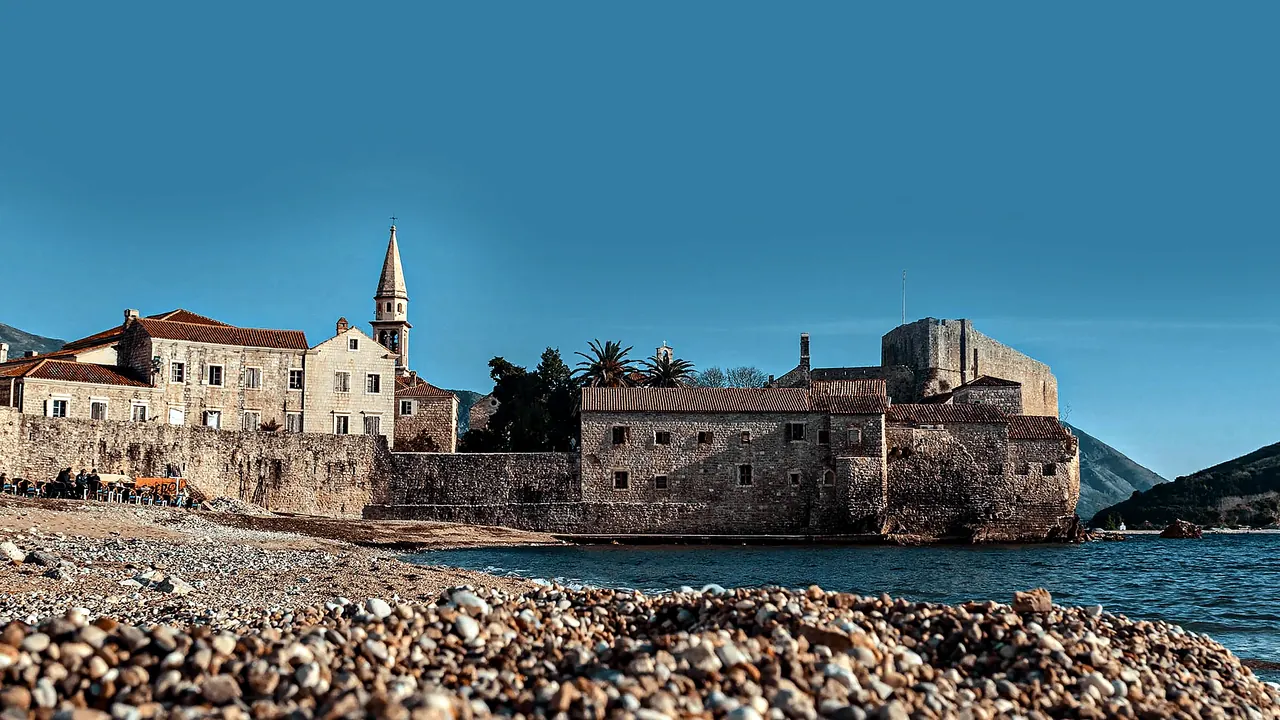
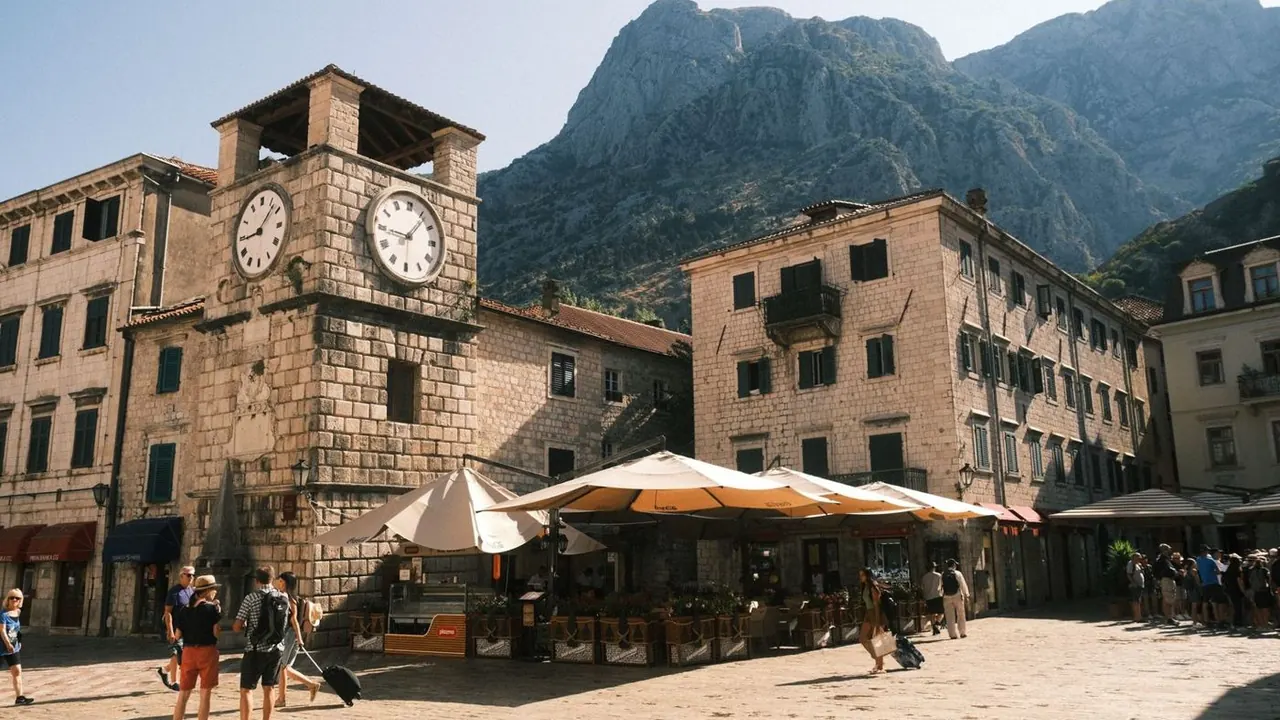
Photos: Budva by Ender Vatan, Pexels License; Kotor by Muhammed Fatih Beki, Pexels License.
Budva or Kotor?
Our verdict in twelve categories, each scored against the same fixed benchmark cities, and the climate month by month, so you can choose for your trip.
Choose Budva for
- nightlife
- beaches
- families
Budva is the better choice for a beach trip. Slovenska Plaza and the Mogren coves are right in town, and Becici, Jaz and Sveti Stefan are a short ride along the open coast. Long summer nights in the seafront clubs suit groups of friends, and families who mainly want sand, shallow water and a water park will find more for children here. The old town is pretty, but you will see it in a morning.
Choose Kotor for
- culture and sights
- nature and the outdoors
- getting around
Kotor suits travellers who care more about the setting than the sunbed. Its UNESCO-listed walled town, the cathedral and the stone stairway up to the fortress of St John give it far more history to explore. The fjord-like bay and the mountain trails that start at the town gates make it the stronger base for walking and kayaking. Evenings are calmer, and Budva's beaches and bars are only half an hour away when you want them.
Scoreboard
Twelve categories on one fixed scale from 0 to 100. The shaded stretch is the gap between the two.
Your match
Pick a travel style or drag the sliders, and both match scores follow your weighting.
Too close to call, 2 points apart
Wins on nightlife and beaches with your weighting.
Wins on culture and sights and nature and the outdoors with your weighting.
What matters to you?
Category by category
What the scores mean for a trip.
Beaches & swimming
Budva was built around its shore. Slovenska Plaza runs along the town front, the two Mogren coves sit just past the walls, and Becici, Jaz, Sveti Stefan and the bays towards Petrovac are all close by. The shore is mostly fine pebble and coarse sand facing the open Adriatic. In high summer it fills with rows of sunbeds and music.
Kotor has no real beach of its own. People swim from concrete platforms, jetties and thin pebble strips towards Dobrota and Muo. The water is calm and warm, but the inner bay is enclosed and less clear than the open sea. For a proper beach day, most people head over the hill to Budva.
Food & drink
The two towns eat in much the same way, with Njegusi ham, mountain cheese, black risotto, grilled fish and Vranac wine. Both also have tourist-facing terraces where quality is uneven. In Budva the weak spot is the promenade, and the better meals are found at family-run konobas, with burek from the bakeries.
Kotor adds mussels farmed near the mouth of the bay and a stronger Venetian accent. Its best meals are out of town, in the shoreline konobas of Dobrota, Prcanj and Perast. The green market outside the walls is also worth a morning visit.
Culture & sights
Kotor is the real draw for history. Its UNESCO-listed walled town is a tight web of marble lanes and squares around the Cathedral of St Tryphon, consecrated in 1166. Among the old seafaring palazzi is the Maritime Museum, and the Venetian walls climb the cliff behind the town to the fortress of St John.
Budva's Stari Grad is attractive, but most of its stone was rebuilt after the 1979 earthquake. A walk past its churches and up to the Citadel takes an hour or two, and the small archaeological museum completes it. Most culture-minded visitors staying in Budva end up making the trip to Kotor.
Nightlife
In summer Budva is the party town of this coast. The bars and terrace clubs along Slovenska Plaza play loud pop and house, and the open-air club on the hill keeps going until dawn. It suits groups who want long, loud nights.
A night in Kotor usually means a drink on a lit-up square after the day visitors leave, with a few bars and a small club scene inside the walls. Kotor's own guests often go down the coast to Budva for a big night. In both towns it goes quiet early outside the warm months.
Nature & outdoors
Both towns have limestone mountains behind them, but Kotor sits right inside the scenery. The bay winds inland between walls that rise over 1,000m. From the town gates you can walk straight up the Ladder of Kotor mule track or the fortress path, and the 25 hairpins lead up into Lovcen. Kayaking along the bay shows how close the mountains come to the water.
From Budva, Lovcen is about an hour's drive. Close to town the outdoor options are coastal paths between bays, boat trips under the cliffs, sea kayaking and paragliding above Becici. Lake Skadar is nearer to Budva than to Kotor.
Day trips
Both make equally good bases, and many outings overlap, with Cetinje, Perast and Sveti Stefan within easy reach of either. Budva is better placed for the southern coast: Petrovac, the hilltop ruins of Stari Bar and the Ottoman-flavoured old town of Ulcinj. Lake Skadar is also closer from Budva, so an unhurried afternoon among the vineyards around Virpazar fits more easily into a day from here than from Kotor.
Kotor looks along its bay instead. Perast and its island church are twenty minutes away, with Dobrota, Prcanj and Herceg Novi further round the water. Dubrovnik is nearer too, a couple of hours by road, though the summer border queue can add to that. The drive to Cetinje passes the mausoleum of Njegos on the summit of Lovcen, and the cliff monastery of Ostrog makes a longer day out from either town.
Good for families
Budva works better with children, mainly because of its beaches. The town beaches shelve gently, the bays at Becici are calmer and there is a water park on the hill. In July and August the noise at night leads many families to stay in Becici instead.
Kotor's car-free old town and its street cats are a hit with young children. Beyond that there is little made for them, and the fortress climb is steep and hot in summer. Families usually swim from the bay jetties and drive to the sand near Budva, with a boat trip to Perast's island church as the favourite outing.
Getting around
Both towns are easy on foot and hard to leave without a car. Neither has a railway, and the single coast road jams in summer. In Budva the walking runs in a line along the shore, from the old town and marina along the promenade to Becici. Coastal buses and boat taxis take you on to the coves.
Kotor is a small, flat, car-free triangle inside its walls, though the marble paving is slippery after rain. Its bus station sits just outside the gates, water taxis link some of the bay villages, and Tivat airport is a short drive away.
Shopping & style
Neither town is a shopping destination, and both sell much the same silver filigree, olive oil and honey. Budva leans towards beach supplies, with sunglasses and beachwear on the promenade and a modest shopping centre by the marina. Kotor adds lace, coral jewellery, cat-themed souvenirs and a few galleries of local painters. For brands, people go to the marina at Tivat.
Affordability
Costs are much the same in both towns, and both get expensive in July and August. Budva is the most expensive place in Montenegro on its seafront, though the bakeries, grill houses and apartments a few streets back are good value. In Kotor the high prices are inside the walls, and an apartment in Dobrota or Muo brings the cost down. In both towns, coming in June or September is the easiest way to save.
Live music & performing arts
Neither town has a year-round stage, so live performance in both depends on summer. Budva's Grad Teatar brings theatre, concerts and readings to the old town squares, and seafront bars have cover bands.
Kotor's summer programme is quieter, with classical recitals, choirs and concerts in the cathedral and churches. Its carnival and Boka Night fill the bay with masked parades and decorated boats.
Wellness & relaxation
For a restful stay, neither town offers much beyond hotel spas. Budva has more of them, in the resort hotels at Becici and around Sveti Stefan, but music from the seafront carries late into summer nights. Kotor is noisy at midday instead, when the day visitors pack the walls. Its early mornings on the water and its evenings are quiet, and long lunches in the shore villages suit a slow pace.
When should you go?
Pick your month. The climate figures are measured averages, not a forecast.
Budva in July
Kotor in July
Daytime high, °C
Rainfall in the month, mm
Where the figures come from
Budva has no rain gauge within 25 km of the centre, so its rainfall comes from a gridded climate dataset read at the city rather than from a gauge further away.
Budva's sunshine is measured 40 km from the centre, at Podgorica-Grad.
Kotor has no rain gauge within 25 km of the centre, so its rainfall comes from a gridded climate dataset read at the city rather than from a gauge further away.
Kotor's sunshine is measured 42 km from the centre, at Podgorica-Grad.
Temperature and rainfall are climate normals, averaged over the years shown. Budva: 1991-2020 normals, Tivat (15.8 km from centre). Kotor: 1991-2020 normals, Tivat (4.2 km from centre).
Both towns sit on the same stretch of coast and share the same climate. June to September is the beach season, with the sea at its warmest in August at around 26°C. July and August are also the driest months, but daytime highs reach 31°C to 32°C. In Budva that heat is fine for lying on the beach. In Kotor it makes the fortress steps and the bare limestone trails hard work around midday.
Late May and June, along with the first half of September, are the best balance for both, with warm water and comfortable streets. The rain returns from mid-September and peaks in November at over 200mm. From then until spring Budva loses most of its reason to visit. Kotor still rewards a winter walk around the walled town on a dry day.
Which traveller are you?
For a beach and sun trip, Budva is the clear pick. Its town beaches, the Mogren coves and the long bays at Becici and Jaz are all close at hand. In Kotor you swim off jetties in the enclosed bay, and most visitors catch a bus over the hill to Budva for a proper beach.
On a culture and arts trip, Kotor gives far more. It has a UNESCO-listed walled town, the twelfth-century Cathedral of St Tryphon, the Maritime Museum in a seafaring family's palazzo and the fortress walls above. Budva's rebuilt old town fills a morning, and most of the region's major heritage lies elsewhere.
For a food and nightlife trip, Budva is the livelier base. Its seafront clubs and the big open-air club on the hill run until dawn in summer. The food in the two towns is much alike, with konobas, Njegusi ham and Vranac wine, so the nights decide it.
Before you go
| Measure | Budva | Kotor |
|---|---|---|
| Official language | Montenegrin | Montenegrin |
| Currency | Euro (EUR) | Euro (EUR) |
| Sockets | CF230 V, 50 Hz | CF230 V, 50 Hz |
| Driving side | Right | Right |
| Time zone | UTC+1, UTC+2 in summer | UTC+1, UTC+2 in summer |
| Emergency number | 112 | 112 |
| Elevation | 3 m | 10 m |
| Main airport | Tivat Airport (TIV)17 km from centre42 non-stop destinations | Tivat Airport (TIV)5 km from centre42 non-stop destinations |
By the numbers
| Measure | Budva | Kotor |
|---|---|---|
| City population | 13,338 | 562 |
| People per km² | 109 | - |
| Museums within 10 km | 0 | 3 |
| UNESCO World Heritage sites within 50 km | 3 | 3 |
| Swim season, months above 21 °C | 5 months | 5 months |
Where else could you go?
Every comparison below shares a destination with this one, so you can follow Budva or Kotor somewhere new.