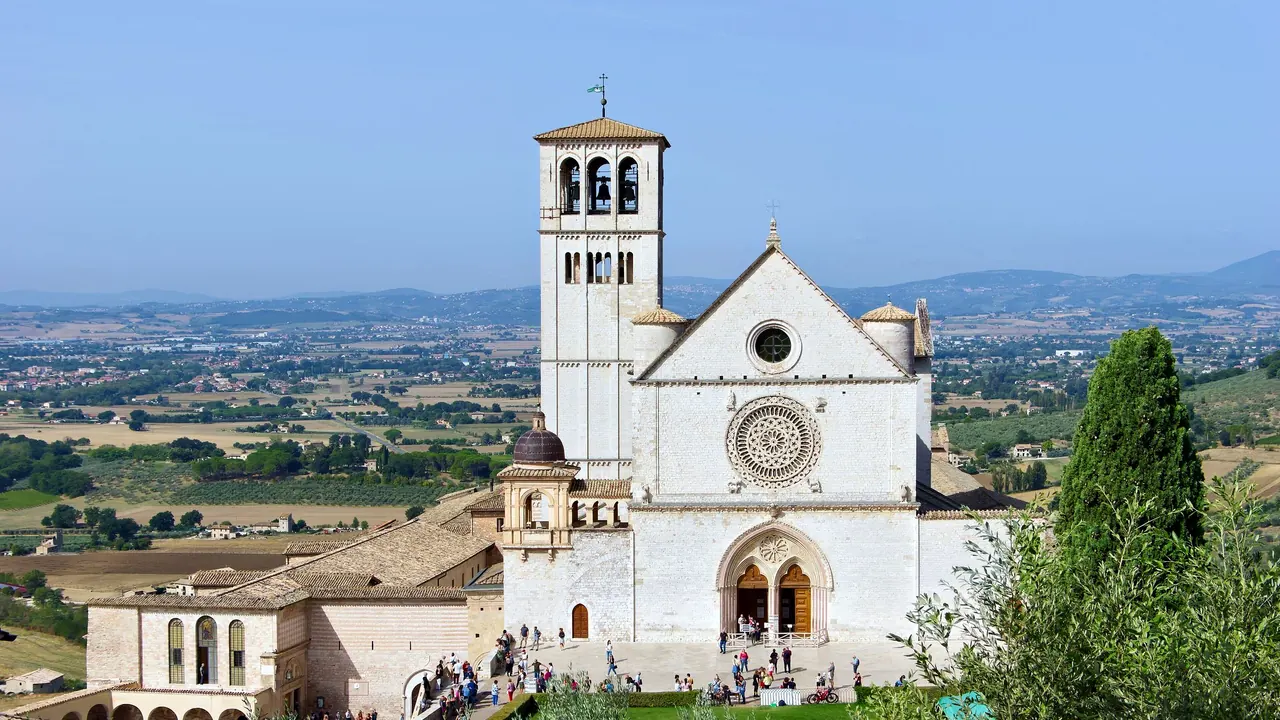
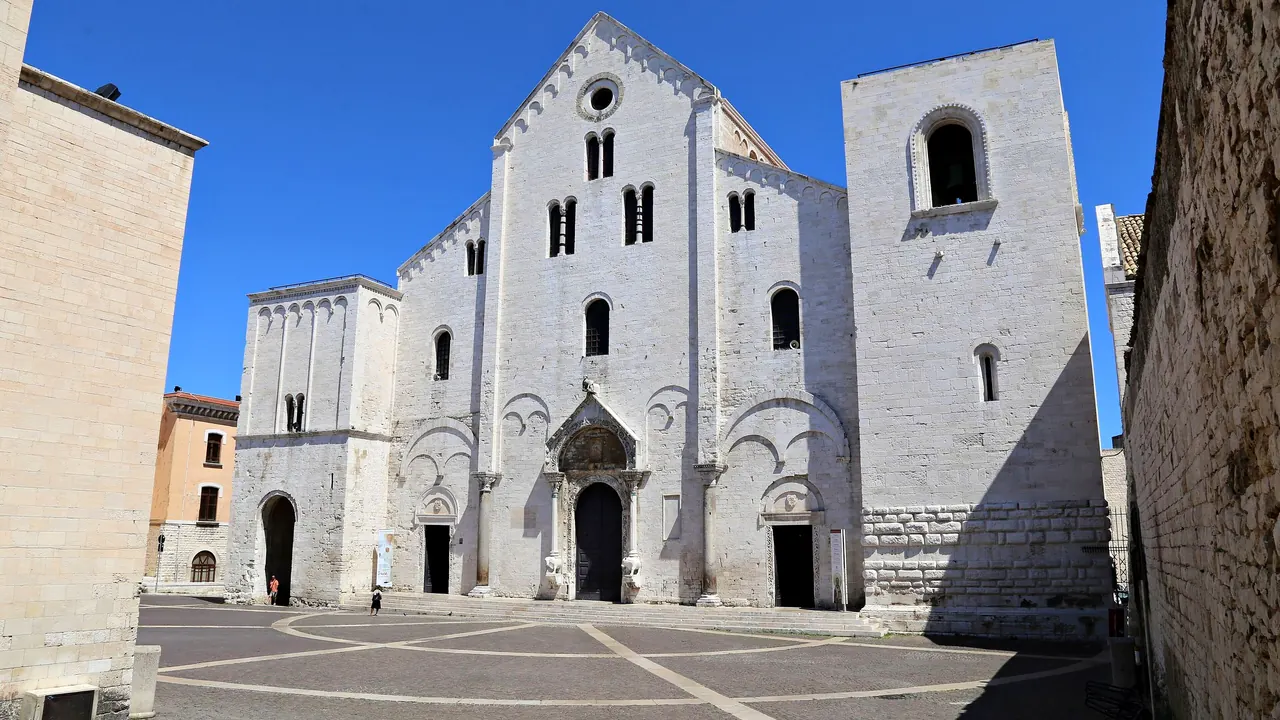
Photos: Assisi by Berthold Werner, CC BY-SA 4.0, cropped; Bari by Sailko, CC BY-SA 4.0, cropped.
Assisi or Bari?
Our verdict in twelve categories, each scored against the same fixed benchmark cities, and the climate month by month, so you can choose for your trip.
Choose Assisi for
- culture and sights
- nature and the outdoors
- wellness
Assisi suits a slower, quieter trip built around art, faith and landscape. The frescoes of the Basilica of San Francesco are in a different league from anything Bari has, Monte Subasio gives you real walking straight from the town walls, and the evenings are still. It is the place for couples, pilgrims and walkers who are happy to give up the sea and late nights in exchange for calm.
Choose Bari for
- beaches
- nightlife
- food and drink
For a summer vacation with swimming, street food and evenings out, Bari is the stronger pick. It has a sandy beach in town and the clear coves of Polignano a Mare a short train ride away. Its food is earthier and easier to graze on the move, and its old-town piazzas stay full late. Families and groups of friends will find more to fill the days.
Scoreboard
Twelve categories on one fixed scale from 0 to 100. The shaded stretch is the gap between the two.
Your match
Pick a travel style or drag the sliders, and both match scores follow your weighting.
Wins on culture and sights and nature and the outdoors with your weighting.
Wins on beaches and nightlife with your weighting.
What matters to you?
Category by category
What the scores mean for a trip.
Beaches & swimming
Assisi sits in the middle of Italy, far from either coast. The closest swimming is at the small, shallow lido beaches on Lake Trasimeno, so in practice a pool at your agriturismo is the way to cool off.
Bari is in another category for this. Pane e Pomodoro gives you sand and warm, calm water within walking distance of the centre, and a short regional train takes you to the much better pebble cove at Polignano a Mare and the rocky inlets around Monopoli. Beach time fits easily into a summer stay here.
Food & drink
The two kitchens share an Italian love of produce, but Bari makes more of it. Assisi cooks in the Umbrian way: strangozzi with black truffle, Castelluccio lentils, wild boar and Monte Subasio olive oil, with Sagrantino to drink. The catch is the set menus near the basilica, so the good meals are found on side lanes or in the countryside below the town.
Bari has much more going on in the streets. Orecchiette are rolled by hand in the doorways of Bari Vecchia, sgagliozze and focaccia barese are sold from kitchen windows, and raw seafood is eaten at the fishermen's pier. Eating well here costs little and takes no planning.
Culture & sights
Assisi is the richer place for art. The Basilica of San Francesco is two churches stacked on the hillside, filled with frescoes by Cimabue, Simone Martini, Lorenzetti and the Giotto circle. Add Santa Chiara, the Temple of Minerva and the Porziuncola below the walls, and the whole town feels like one monument.
Bari's sights are pleasant, but there are fewer of them. The Basilica di San Nicola is a fine piece of Apulian Romanesque and a real pilgrimage site, and the old town, castle and Murat grid make good walking. A day or two covers it, without the depth Assisi offers.
Nightlife
Assisi has almost no nightlife. Evenings mean a long dinner, a glass of wine and a walk through floodlit lanes. Anyone who wants bars has to drive to Perugia.
Bari goes out late and outdoors. In summer, students and young locals fill Piazza Mercantile and Piazza Ferrarese, and the bars in the Umbertino streets and along the seafront stay open past midnight. In July and August the crowd moves to beach clubs on the coast. It is sociable more than sophisticated, and quieter in winter, but it is a real night out.
Nature & outdoors
Assisi has better walking country. Monte Subasio rises right behind the town, and a path climbs through holm-oak woods past the Eremo delle Carceri to open summit meadows at about 1,290m. The Valnerina and the Sibillini mountains are within reach for bigger days out.
Bari's outdoors is flatter and gentler: kilometres of seafront promenade, olive groves on the plain, and the open karst plateau of the Alta Murgia about an hour inland. The sea makes up for some of this with sailing and coastal walks, but there are no mountains within easy reach.
Day trips
Both are excellent bases, and the difference is in the kind of trip. From Assisi, the Umbrian hill towns are packed close together. Spello is ten minutes away, Perugia and Spoleto are short train rides, and Gubbio, Todi and Orvieto make fuller days, with the Tuscan border towns beyond them.
Bari's trips cover more varied ground over longer distances: the cave dwellings of Matera, the trulli of Alberobello, the white towns of the Valle d'Itria, Castel del Monte, and the sea-front cathedral at Trani. From either city, a car makes the smaller places much easier.
Good for families
Bari is easier with children. It has a sandy beach in town, gelato on the evening passeggiata and flat, traffic-free lanes, with the Grotte di Castellana and the Fasano safari park within reach for outings.
Assisi is safe and welcoming, but its sights are silent churches and its streets are steep, stepped and hard with a pushchair. Older children enjoy the Rocca Maggiore and the climb up Subasio. Most families are happier staying at a valley agriturismo with a pool and visiting the town in short trips.
Getting around
Bari is the easier city to move around. The old town, the Murat streets and the seafront lie side by side on flat ground, a rail link reaches the airport, and regional lines fan out along the coast and inland.
Assisi's centre is small but climbs hard from the basilica up to Piazza del Comune, so expect plenty of stairs. The station is about 4km below in Santa Maria degli Angeli, which means a bus or taxi up to the old town. Away from the valley rail line, buses are sparse, and a hire car becomes almost essential.
Shopping & style
Neither is a shopping destination, but Bari offers more. Via Sparano and the Murat streets around it have Italian fashion chains and a few boutiques, and the delis sell orecchiette, taralli and wine to take home.
Assisi's streets are mostly lined with rosaries, Tau crosses and other pilgrim souvenirs. Look past them for hand-woven linens with Assisi embroidery, Deruta ceramics and Sagrantino. Beyond that, there are no clothes or design shops to browse.
Affordability
The two cost much the same, and both are fair value for Italy. Assisi's savings come from free basilicas, cheap convent guesthouses and good-value agriturismi, though rooms inside the walls cost more around Easter. Bari's come from cheap street food, cheap local wine and simple trattoria lunches, while rooms get scarcer in July and August, and beach clubs and car trips add up.
Live music & performing arts
Bari has a proper stage. The Teatro Petruzzelli, one of Italy's largest opera houses, runs a season of opera, ballet and symphonic concerts, and in summer there are open-air concerts and a jazz festival in the piazzas and at the castle.
Assisi's offer is sacred and seasonal: organ recitals and choirs in the basilicas around the feast days, and the medieval costume and song of Calendimaggio in spring. For opera or the big summer jazz festival, visitors have to go to Perugia.
Wellness & relaxation
Neither has thermal baths, and spas in both are mostly in hotels or country estates. Assisi offers a deeper kind of rest. After the tour groups leave, its lanes are completely still, and many visitors come for retreats in convent guesthouses or silent walks up to the Eremo delle Carceri.
Bari's calm comes from its rhythm: long lunches, the afternoon break and the evening stroll by the sea. It is still a working city, though, so for real quiet most people head out to the country estates.
When should you go?
Pick your month. The climate figures are measured averages, not a forecast.
Assisi in July
Bari in July
Daytime high, °C
Rainfall in the month, mm
Where the figures come from
Assisi's temperatures are measured 51 km from the centre, at Frontone.
Assisi has no rain gauge within 25 km of the centre, so its rainfall comes from a gridded climate dataset read at the city rather than from a gauge further away.
Bari has no rain gauge within 25 km of the centre, so its rainfall comes from a gridded climate dataset read at the city rather than from a gauge further away.
Bari's sunshine is measured 77 km from the centre, at Marina Di Ginosa.
Temperature and rainfall are climate normals, averaged over the years shown. Assisi: 1991-2020 normals, Frontone (50.5 km from centre). Bari: 1991-2020 (sunshine 1961-1990) normals, Bari / Palese Macchie (7 km from centre).
Assisi is a hill town with real seasons. July and August reach about 30°C, which makes the steep lanes tiring by midday, and January highs of around 7°C make winter raw. The best months for walking are May, June and September. October still works, but rain builds through autumn and peaks at about 94mm in November.
Bari is milder in winter, with January highs around 12°C, and drier in summer, when June to August see little rain and long hours of sunshine. The sea is warm enough for swimming from June to September and reaches about 26°C in August. Midsummer heat matches Assisi's, so in practice Bari is the summer choice and Assisi is better in spring and early autumn.
Which traveller are you?
On a culture and arts trip, Assisi is the better choice. The two-level Basilica of San Francesco, with Cimabue, Simone Martini and the Saint Francis cycle, is among Europe's great monuments, and the whole stone town around it is part of the experience.
For a beach and sun trip, Bari wins easily. It has a sandy city beach, warm calm water through the summer and dry, sunny weather, with the cliff coves of Polignano a Mare and Monopoli half an hour south. Assisi is hours from the sea.
On a food and nightlife trip, Bari is far livelier. You can eat focaccia, panzerotti and raw sea urchins from the street and then join the late crowds in Piazza Mercantile. Assisi has good rustic cooking, but its lanes are empty by eleven.
Before you go
| Measure | Assisi | Bari |
|---|---|---|
| Official language | Italian | Italian |
| Currency | Euro (EUR) | Euro (EUR) |
| Sockets | CFL230 V, 50 Hz | CFL230 V, 50 Hz |
| Driving side | Right | Right |
| Time zone | UTC+1, UTC+2 in summer | UTC+1, UTC+2 in summer |
| Emergency number | 112 | 112 |
| Elevation | 424 m | 5 m |
| Main airport | Perugia San Francesco d'Assisi – Umbria International Airport (PEG)9 km from centre17 non-stop destinations | Bari Karol Wojtyła International Airport (BRI)9 km from centre104 non-stop destinations |
| Public holidays this year | 13 days | 13 days |
By the numbers
| Measure | Assisi | Bari |
|---|---|---|
| City population | 27,605 | 315,473 |
| People per km² | 147 | 2,687 |
| Museums within 10 km | 14 | 12 |
| UNESCO World Heritage sites within 50 km | 2 | 1 |
| Swim season, months above 21 °C | - | 4 months |
Where else could you go?
Every comparison below shares a destination with this one, so you can follow Assisi or Bari somewhere new.