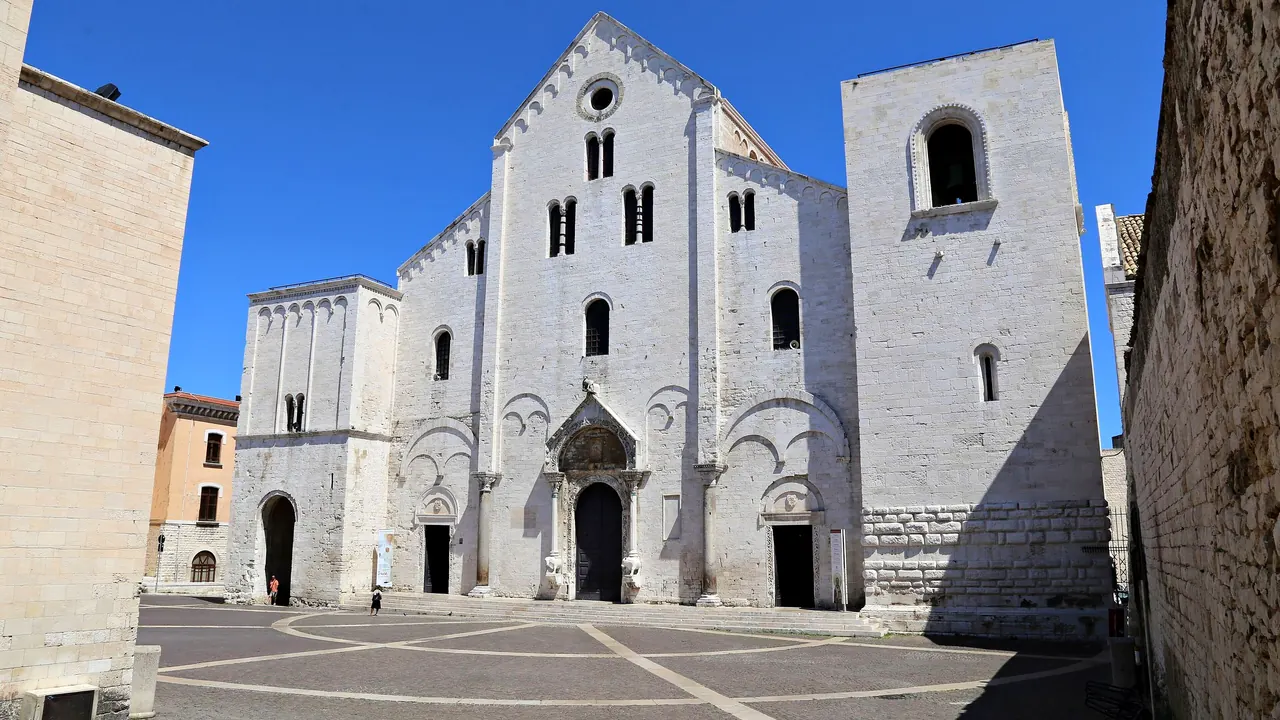
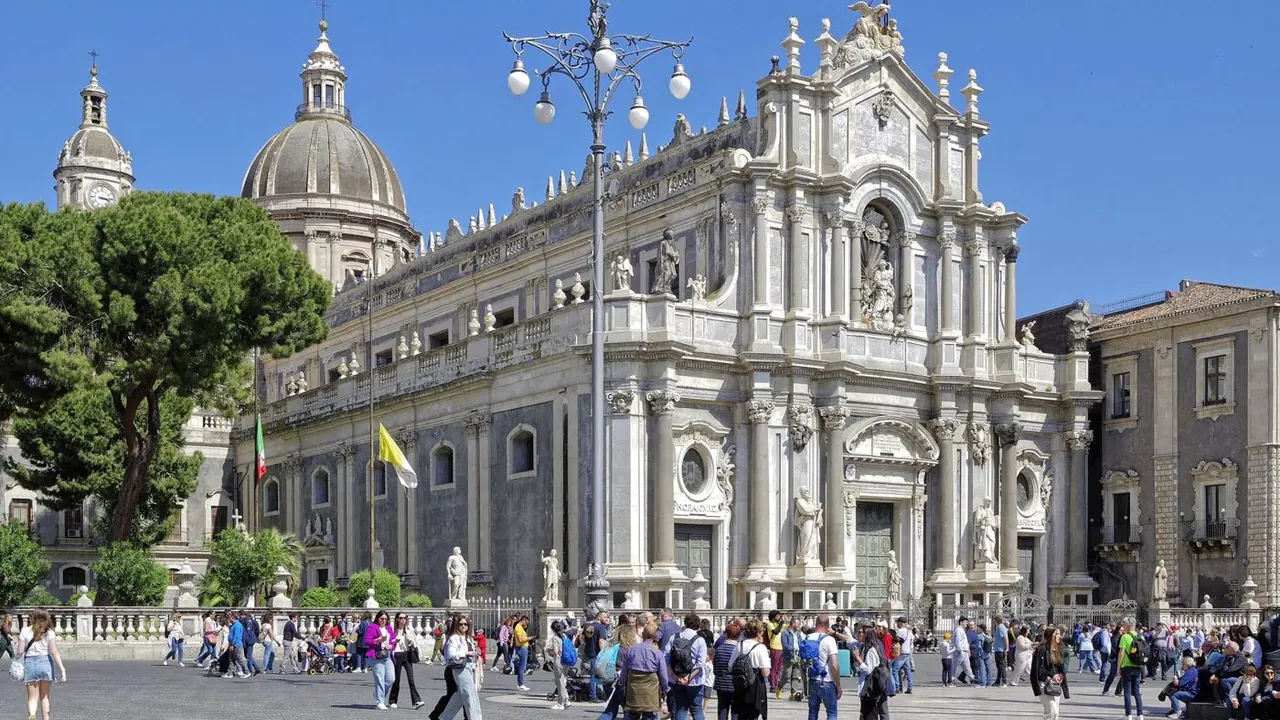
Photos: Bari by Sailko, CC BY-SA 4.0, cropped; Catania by Berthold Werner, CC BY-SA 4.0, cropped.
Bari or Catania?
Our verdict in twelve categories, each scored against the same fixed benchmark cities, and the climate month by month, so you can choose for your trip.
Choose Bari for
- getting around
- day trips
- shopping
Bari suits a traveller who wants an easy, compact base for exploring a region. Its old town, shopping grid and seafront sit side by side on flat ground, a train runs to the airport, and regional lines lead out to Matera, the trulli of Alberobello and the white towns of the Valle d'Itria. It is the better choice if your days are for small towns and countryside and your evenings are for orecchiette and a walk along the seafront.
Choose Catania for
- nature and the outdoors
- beaches
- food and drink
Pick Catania when you want more out of the landscape and the table. Etna stands over the city with craters, lava trails and winter ski slopes, and the lava coast lets you swim off the rocks without leaving town. The street food is among the best in the south. Siracusa and Taormina are each about an hour away. Getting around is harder work, with heavy traffic and patchy transport, but anyone after volcano walks and eastern Sicily's Greek and baroque towns gets more from staying here.
Scoreboard
Twelve categories on one fixed scale from 0 to 100. The shaded stretch is the gap between the two.
Your match
Pick a travel style or drag the sliders, and both match scores follow your weighting.
Wins on getting around and day trips with your weighting.
Wins on nature and the outdoors and beaches with your weighting.
What matters to you?
Category by category
What the scores mean for a trip.
Beaches & swimming
Catania gives you better swimming without leaving town. To the south, La Playa is a long sandy stretch for an easy beach-club day. To the north, the black basalt of the Riviera dei Ciclopi lets you climb down ladders into very clear water beside the sea stacks of Aci Trezza.
Bari's own Pane e Pomodoro is a sandy local beach that is handy but plain. Most of the time, a beach day there means a train south to the pebble cove at Polignano a Mare or the rocky inlets around Monopoli, which are lovely but are half-day outings rather than a swim on your doorstep.
Food & drink
Both are cities for rooted, inexpensive southern cooking, and Catania has the edge in range and depth. In Bari you eat focaccia barese, sgagliozze and orecchiette rolled in the old town's doorways, raw sea urchins by the fishermen's pier, and Primitivo or Negroamaro wine with simple sit-down meals.
Catania's street food goes further: ragù arancini, crispelle, horse meat grilled on Via Plebiscito, and granita with brioche for breakfast. The Pescheria fish market feeds the trattorias around it. Etna's volcanic vineyards also give it a more interesting wine list than Bari's sturdy reds.
Culture & sights
The sights are similar in scale, and either city takes a couple of days, but they come from different periods. Bari is medieval and Romanesque: the dense lanes of Bari Vecchia, the pilgrim Basilica di San Nicola with its relics of St Nicholas, and the Norman-Swabian castle, plus the nineteenth-century Murat grid.
Catania is a baroque city rebuilt after the earthquake of 1693 in dark lava and pale limestone. It has Via dei Crociferi, the vast Benedictine monastery, and Roman remains surfacing below its streets. In early February the Feast of Sant'Agata adds one of Italy's largest processions.
Nightlife
The two are much alike: student crowds, drinks outdoors, and a move to beach clubs in summer. Bari's evenings gather on the steps of Piazza Mercantile and Piazza Ferrarese and then spread into the Umbertino bars.
Catania runs a bit later and louder around Piazza Bellini and Via Gemmellaro, and in summer La Playa's clubs become open-air dance floors. Neither has much serious club culture, and both are quiet on winter weeknights.
Nature & outdoors
This is where the two differ most. Catania lives under Etna, a smoking volcano of about 3,300m that you can reach in under an hour. A cable car and off-road vehicles climb towards the summit craters, and trails cross lava flows and birch woods. Add the Alcantara Gorge, forest walks in the Nebrodi and diving around the sea stacks.
Bari sits on a flat plain of olive groves. Its outdoor options are the seafront promenade, quiet walks and cycling on the Alta Murgia plateau, and the Grotte di Castellana. They are pleasant, but there are no mountains anywhere nearby.
Day trips
Both cities make excellent bases, but the trips they offer are different in kind. Bari's lead into small towns and rural Puglia. Matera's cave dwellings and rock churches are about an hour and a half away by train, the trulli of Alberobello and the white towns of Ostuni and Locorotondo fill the Valle d'Itria, and Trani's pale cathedral stands right on the sea. Frederick II's octagonal Castel del Monte and baroque Lecce complete the list.
Catania's trips lead to Greek theatres, Roman mosaics and baroque showpieces. Ortigia and the Neapolis theatre in Siracusa lie about an hour south, and Taormina's ancient theatre looks over the sea about an hour north. Further out are the mosaics of the Villa Romana del Casale and the baroque circuit of Noto, Modica and Ragusa Ibla. In both regions a hire car makes the inland towns far easier than the slow trains and buses.
Good for families
Bari is the easier city for everyday life with children. It has a sandy city beach, traffic-free lanes in the old town and a small, flat centre you can cover on foot. For outings, the Fasano safari park and the Grotte di Castellana are close by.
Catania asks more of parents in town, with narrow, uneven pavements, heavy traffic and little shade, but its excursions are bigger. Older children tend to love walking on Etna's old craters, the sand at La Playa shelves gently, and Etnaland's water park fills a hot afternoon. In both cities the midday summer heat means planning around a long break.
Getting around
Bari is noticeably simpler. Its old town, shopping streets and promenade join up on flat ground, a train runs to the airport, and the city is the hub of regional railways to Polignano, Trani, Matera and Alberobello, even if some of those lines are slow.
In Catania the walkable part ends at the edge of the historic centre. The single metro line covers little, buses crawl in traffic, and drivers do not always stop for pedestrians. Regional buses do reach Siracusa, Taormina and the Etna refuge, but many visitors end up driving and then struggle to park.
Shopping & style
Neither is a shopping destination, and in both the best souvenirs are edible. Bari's version is tidy: Via Sparano's pedestrian chains and a few boutiques, plus taralli, dried orecchiette and Puglian ceramics.
Catania's is more theatrical. You can browse Via Etnea's long run of stores, but the noisy La Fiera market is more fun, and you can take home Bronte pistachio cream, Etna wine and Caltagirone pottery.
Affordability
Costs are much the same: cheap street food, fair trattorias, free old towns to wander, and rooms that cost noticeably more in July and August. What differs is where the extras come from. In Bari it is beach clubs and a car for the Valle d'Itria. In Catania, guided trips to Etna's summit craters are the big expense, though the city's buses and metro cost little.
Live music & performing arts
Each city has a grand opera house as its anchor. Bari's Teatro Petruzzelli is one of Italy's largest, with a season of opera, ballet and concerts, and a long-running summer jazz festival uses the piazzas and the castle.
Catania has more local character. It is Bellini's birthplace, with the Teatro Massimo Bellini and a museum to the composer. Small companies keep up the opera dei pupi marionette tradition, and summer concerts move into ancient theatres in the region. Outside opera, both cities are thin for visitors who don't speak Italian.
Wellness & relaxation
Neither city is built for pampering. There are no thermal baths, spas are mostly in hotels, and rest comes from long lunches and the evening passeggiata. Bari is the calmer of the two, and its escape is a restored country estate outside the city. Catania's centre is noisier, so people who want quiet head for resorts on the coast or villages on Etna's slopes.
When should you go?
Pick your month. The climate figures are measured averages, not a forecast.
Bari in July
Catania in July
Daytime high, °C
Rainfall in the month, mm
Where the figures come from
Bari has no rain gauge within 25 km of the centre, so its rainfall comes from a gridded climate dataset read at the city rather than from a gauge further away.
Bari's sunshine is measured 77 km from the centre, at Marina Di Ginosa.
Temperature and rainfall are climate normals, averaged over the years shown. Bari: 1991-2020 (sunshine 1961-1990) normals, Bari / Palese Macchie (7 km from centre). Catania: 1991-2020 (sunshine 1961-1990, rainfall 1971-2000) normals, Catania / Fontanarossa (5.2 km from centre).
The two run on a similar calendar, but Catania is a little hotter, drier and milder at both ends of the year. In both cities the sea is warm enough for swimming from June to September, and midsummer gets hot for walking the streets, with Bari reaching 30°C in July and August and Catania 32°C, so sightseeing works best early and late in the day. Catania keeps its warmth longer. Its sea is still about 23°C in October, and its summers are almost rainless, with more than 290 hours of sunshine a month from June to August.
Rain arrives in both cities in September. In Bari it builds to around 83mm in November, while in Catania the wettest months are November and December. Winter in Bari is cool, with daytime highs in the low teens. Catania stays a few degrees milder at around 15°C in January, which makes it the better winter city break of the two. For walking either city in comfort, May and October are the best months.
Which traveller are you?
On an outdoors trip, Catania wins clearly. Etna is less than an hour away, with crater walks, lava fields, beech woods and small winter ski areas. Then there are the Alcantara Gorge and snorkelling along the lava coast. Bari has flat plains and the gentle Alta Murgia plateau.
For a short city break, Bari is easier. The airport train drops you close to a flat centre where Bari Vecchia, the Murat streets and the seafront all join up, so a long weekend goes on sights and food. Catania's traffic and patchy transport take more effort.
On a beach and sun trip, Catania gives more choice right at the city's edge: the broad sand of La Playa and clear water off the lava rocks at Aci Trezza. Its sea stays warm into October. In Bari the swimming that is really worth it means a train to Polignano or Monopoli.
Before you go
| Measure | Bari | Catania |
|---|---|---|
| Official language | Italian | Italian |
| Currency | Euro (EUR) | Euro (EUR) |
| Sockets | CFL230 V, 50 Hz | CFL230 V, 50 Hz |
| Driving side | Right | Right |
| Time zone | UTC+1, UTC+2 in summer | UTC+1, UTC+2 in summer |
| Emergency number | 112 | 112 |
| Elevation | 5 m | 7 m |
| Main airport | Bari Karol Wojtyła International Airport (BRI)9 km from centre104 non-stop destinations | Catania-Fontanarossa Airport (CTA)4 km from centre96 non-stop destinations |
| Public holidays this year | 13 days | 13 days |
By the numbers
| Measure | Bari | Catania |
|---|---|---|
| City population | 315,473 | 311,584 |
| People per km² | 2,687 | 1,704 |
| Museums within 10 km | 12 | 25 |
| UNESCO World Heritage sites within 50 km | 1 | 3 |
| Swim season, months above 21 °C | 4 months | 5 months |
Where else could you go?
Every comparison below shares a destination with this one, so you can follow Bari or Catania somewhere new.