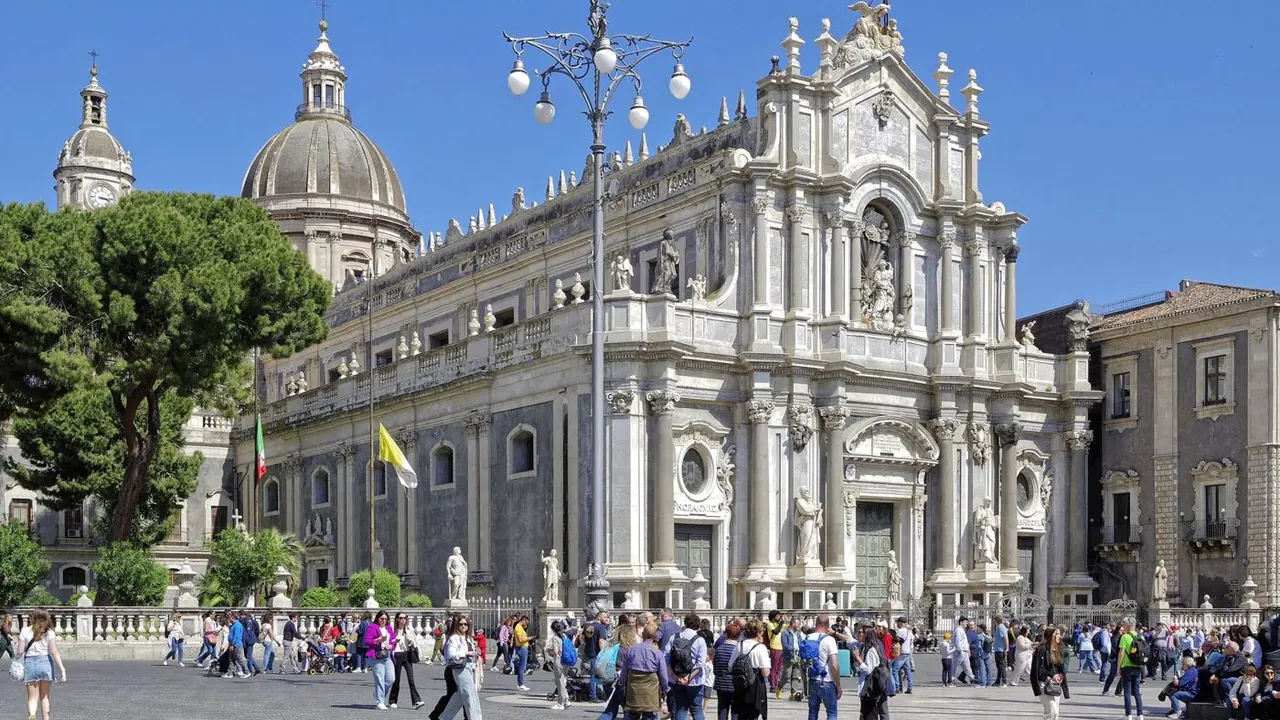
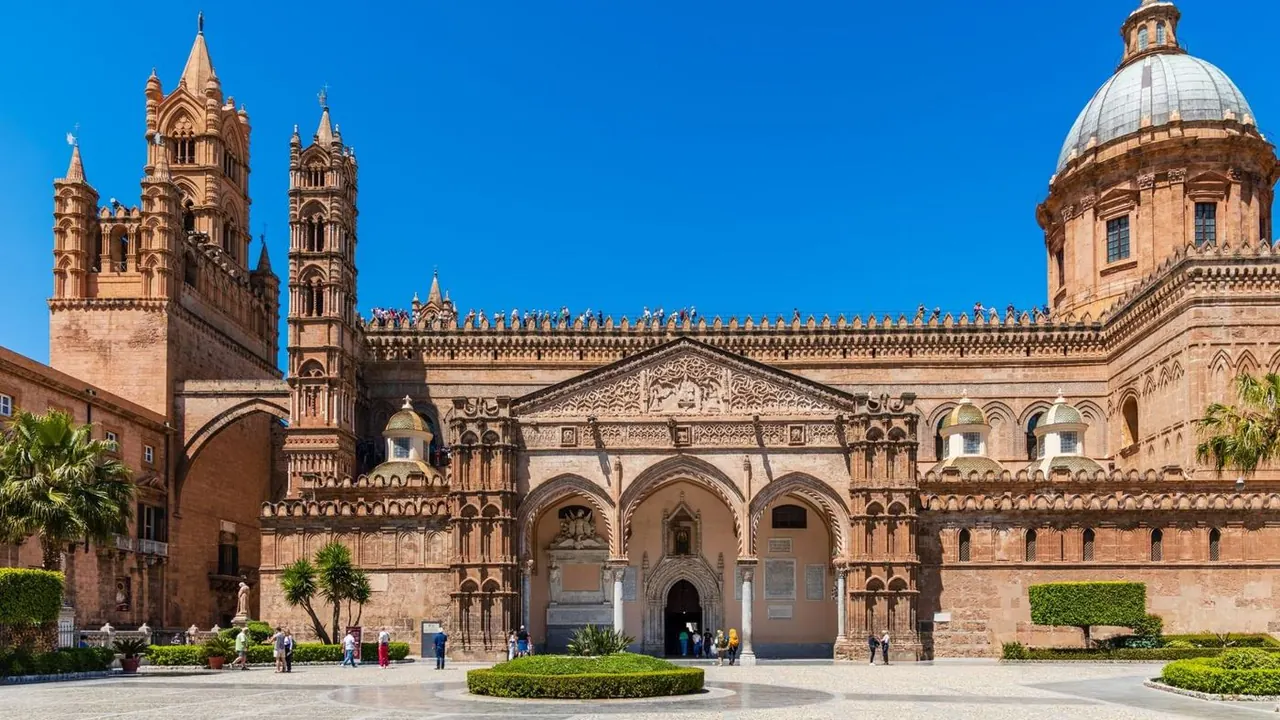
Photos: Catania by Berthold Werner, CC BY-SA 4.0, cropped; Palermo by Antonino Giangrasso, Pexels License.
Catania or Palermo?
Our verdict in twelve categories, each scored against the same fixed benchmark cities, and the climate month by month, so you can choose for your trip.
Choose Catania for
- nature and the outdoors
- families
- nightlife
If the landscape matters as much as the towns, Catania is the better base. Etna is close enough for a morning on the craters and an evening back in the city, the lava coast north of the centre is made for snorkelling, and Siracusa, Taormina and the baroque towns of the southeast are all within reach. It suits an active, outdoor trip fuelled by street food, provided you can handle a very hot summer.
Choose Palermo for
- culture and sights
- live music and the arts
- beaches
Palermo rewards the traveller who comes for history and art. The gold mosaics of its Arab-Norman churches and the collections at the Salinas and Palazzo Abatellis give it far more to see than Catania's compact baroque centre, and its music programme runs fuller through the week. Mondello's turquoise bay is a bus ride away for the afternoons, and Monreale, Cefalù and Segesta carry the story beyond the city. Choose it for a trip built around sightseeing rather than hiking.
Scoreboard
Twelve categories on one fixed scale from 0 to 100. The shaded stretch is the gap between the two.
Your match
Pick a travel style or drag the sliders, and both match scores follow your weighting.
Too close to call, 2 points apart
Wins on nature and the outdoors and families with your weighting.
Wins on culture and sights and live music and the arts with your weighting.
What matters to you?
Category by category
What the scores mean for a trip.
Beaches & swimming
The two are fairly evenly matched, but the swimming differs in character. Catania's long sandy beach, La Playa, starts just south of the centre and is easy to reach, but it is plain and lined with beach clubs. The more memorable swimming is off the black lava platforms of the Riviera dei Ciclopi, where you climb down ladders into clear water beside the sea stacks.
Palermo has no beach in town. Its prize is Mondello, a pale crescent of shallow turquoise water under Monte Pellegrino, about half an hour away by bus. It is a prettier beach than La Playa, though just as crowded on summer weekends, and Capo Gallo offers rocky, deeper swimming nearby.
Food & drink
Both are great street-food cities, and the difference lies in what you eat. Catania's specialities are cone-shaped arancini, fried crispelle, horse meat grilled over smoke on Via Plebiscito and pasta alla Norma. They come with pistachios from Bronte and some of Italy's most interesting wines from Etna's volcanic vineyards.
Palermo's cooking carries more of its Arab past, with raisins, pine nuts and saffron in pasta con le sarde and sweet-and-sour caponata. Its three old markets are full of fryers making panelle and crocchè, and its pastry is outstanding, from cannoli filled to order to cassata. Catania's food life centres on one dramatic fish market, La Pescheria, while Palermo's is spread across Ballarò, the Capo and the Vucciria.
Culture & sights
Catania offers one coherent picture rather than many layers. It is a late-baroque city of dark lava stone and pale limestone, rebuilt after 1693, with the cathedral and elephant fountain, the church-lined Via dei Crociferi and the vast San Nicolò l'Arena monastery, plus Roman remains and Castello Ursino. Its museums are modest and a few days cover it, unless you arrive for the Feast of Sant'Agata in February.
Palermo is far richer. Its twelfth-century Arab-Norman monuments are unlike anything else in Europe: the gold mosaics of the Palatine Chapel under an Islamic wooden ceiling, the red domes of San Giovanni degli Eremiti and the mosaic interior of La Martorana. On top of these come Serpotta's stucco oratories and two strong museums, the Salinas, with the Selinunte metopes, and Palazzo Abatellis.
Nightlife
Evenings out are much alike, mostly drinks outdoors until well past midnight with little serious club life, but the crowd and setting differ. Catania's large university makes it younger and louder, with the lanes around Piazza Bellini and the Teatro Massimo packed with students.
Palermo's signature is the Vucciria market after dark, with cheap beer, smoking grills and music spilling from small bars, and wine bars in the Kalsa. In summer both cities head for the coast to dance, Catania to the beach clubs at La Playa and Palermo to Mondello.
Nature & outdoors
Catania has the bigger landscape by some distance. Etna rises to about 3,300m, often smoking, and you can be on its slopes within an hour. Cable cars and off-road vehicles climb towards the summit craters, trails cross fresh lava, and there is even winter skiing with a sea view. The Alcantara Gorge and the lava coast for diving and kayaking add variety.
Palermo's outdoors is gentler and closer to the door. You can walk straight up Monte Pellegrino from the city or snorkel at Capo Gallo. The coastal trail at Zingaro and the beech woods of the Madonie are fine, but they are further away and need a car.
Day trips
Both are excellent bases, and the choice depends on which half of Sicily you want to see. From Catania you reach the Greek and baroque east: Ortigia and the theatre at Siracusa, Taormina above the sea, the baroque showpieces of Noto, Modica and Ragusa Ibla, and the Roman mosaics at Piazza Armerina.
Palermo opens up the west. Monreale's mosaics are only half an hour away, Cefalù is an easy train ride, and the lonely temple at Segesta, hilltop Erice and the Valley of the Temples at Agrigento are all within reach. Palermo's nearest highlights work well by train, while Catania's baroque circuit is much easier with a car.
Good for families
Catania comes out a little ahead, mostly thanks to the volcano. Walking on old Etna craters is a real adventure for older children, Etnaland's water park on the lower slopes rescues a hot day, and La Playa's gently shelving sand is right by the city.
Palermo's best offer for young children is Mondello's shallow bay, plus short puppet shows of knights and Saracens. Otherwise there is little aimed at children, and narrow lanes without pavements are hard going with a pushchair. Both cities are fierce in summer, so a base by the sea often works better.
Getting around
In both cities the old centre is the part you can walk, and beyond it slow buses and heavy traffic take over. Catania's sights cluster along Via Etnea and Piazza del Duomo. It has a single metro line, regional buses to Siracusa, Taormina and the Etna refuge, and the slow Circumetnea railway around the volcano.
Palermo's centre is mostly flat, laid out along Via Maqueda and Corso Vittorio Emanuele, though scooters and missing pavements make the side lanes tiring. Its practical advantage is regional trains to Cefalù and Bagheria. Its trams mostly serve the suburbs. In both, a hire car is the easiest way to reach the inland sites.
Shopping & style
Neither city is a shopping destination, but the browsing differs. Catania's Via Etnea is a long run of Italian chains, and the daily La Fiera market around Piazza Carlo Alberto is the livelier experience. The souvenirs to look for are Bronte pistachio creams, Etna wines, Caltagirone ceramics and lava-stone pieces.
Palermo has a little more polish, with fashion and a few luxury labels along Via Libertà. Its crafts are more distinctive, including handmade marionettes, moor's-head vases and coral and filigree jewellery, and there is a flea market near the cathedral for antiques.
Affordability
The two cost much the same, and both are cheap for Western Europe. Street food makes a full meal for little money, trattorias are fairly priced, and rooms in the old centres are reasonable outside July and August.
The extra costs differ. In Catania it is the guided trip to Etna's summit craters and a hire car for the baroque towns. In Palermo it is seaside rooms around Mondello in high summer and the fish restaurants, which charge mainland prices.
Live music & performing arts
Palermo has the fuller programme. The huge Teatro Massimo runs a season of opera, ballet and concerts, the nearby Politeama is home to the Sicilian symphony orchestra, and jazz has a long local following.
Catania's draw is Bellini himself. It is his birthplace, with a museum of his manuscripts and the grand Teatro Massimo Bellini, but there is less going on across a week of evenings. Both keep the Opera dei Pupi alive in small marionette theatres, and both move concerts outdoors in summer, Catania's sometimes into the region's ancient theatres.
Wellness & relaxation
Neither city is restful, since both are noisy and full of traffic with no bathing tradition of their own, so rest has to be found at the edges. From Catania that means hotel spas along the coast or a quieter base in the cooler villages on Etna's slopes.
Palermo has a real thermal town at Termini Imerese, about forty minutes away by train. In the city you can find quiet in its cloisters, the palm-filled Orto Botanico and the evening walk along the Foro Italico.
When should you go?
Pick your month. The climate figures are measured averages, not a forecast.
Catania in July
Palermo in July
Daytime high, °C
Rainfall in the month, mm
Where the figures come from
Catania's sunshine is measured 88 km from the centre, at Messina.
Palermo has no rain gauge within 25 km of the centre, so its rainfall comes from a gridded climate dataset read at the city rather than from a gauge further away.
Palermo's sunshine is measured 67 km from the centre, at Ustica.
Temperature and rainfall are climate normals, averaged over the years shown. Catania: 1991-2020 normals, Catania / Fontanarossa (5.2 km from centre). Palermo: 1991-2020 (sunshine 1961-1990) normals, Palermo / Punta Raisi (24.1 km from centre).
Both cities are at their best in late spring and early autumn, but Catania runs much hotter. Its summer highs reach about 32°C in August, which makes walking the streets in the middle of the day punishing. Palermo's peak stays nearer 30°C, so it is the easier summer city for sightseeing. In winter the order reverses and Catania is a few degrees milder. For walking, Catania is most comfortable in April, May and October, and Palermo from May to June and again in September and October.
Both are almost dry from May to August and very sunny through the summer. The rain comes back in autumn. Palermo is at its wettest from October to December, and Catania peaks later, at about 83mm in December. The sea behaves almost identically on both coasts: it is warm enough for swimming from June into October and reaches about 26°C in August.
Which traveller are you?
On a culture and arts trip, Palermo is the clear choice. The Palatine Chapel, La Martorana, the Salinas and Abatellis museums and a full opera season at the Teatro Massimo outweigh Catania's handsome but compact baroque centre, which you can see in two or three days.
For an outdoors trip, Catania wins easily. Etna's summit craters, lava flows and beech woods are under an hour away, the Alcantara Gorge can be waded, and the basalt coast at Aci Trezza is good for kayaking and snorkelling. Palermo's best hiking needs a car.
On a family trip with children, Catania has the slight edge. Walking on old craters thrills older children, Etnaland fills a scorching day and La Playa's sand shelves gently. Palermo has Mondello's shallow bay and puppet shows, but fewer outings built for children.
Before you go
| Measure | Catania | Palermo |
|---|---|---|
| Official language | Italian | Italian |
| Currency | Euro (EUR) | Euro (EUR) |
| Sockets | CFL230 V, 50 Hz | CFL230 V, 50 Hz |
| Driving side | Right | Right |
| Time zone | UTC+1, UTC+2 in summer | UTC+1, UTC+2 in summer |
| Emergency number | 112 | 112 |
| Elevation | 7 m | 14 m |
| Main airport | Catania-Fontanarossa Airport (CTA)4 km from centre96 non-stop destinations | Falcone–Borsellino Airport (PMO)25 km from centre106 non-stop destinations |
| Public holidays this year | 13 days | 13 days |
By the numbers
| Measure | Catania | Palermo |
|---|---|---|
| City population | 311,584 | 630,167 |
| People per km² | 1,704 | 3,924 |
| Museums within 10 km | 25 | 42 |
| UNESCO World Heritage sites within 50 km | 3 | 1 |
| Swim season, months above 21 °C | 5 months | 5 months |
Where else could you go?
Every comparison below shares a destination with this one, so you can follow Catania or Palermo somewhere new.