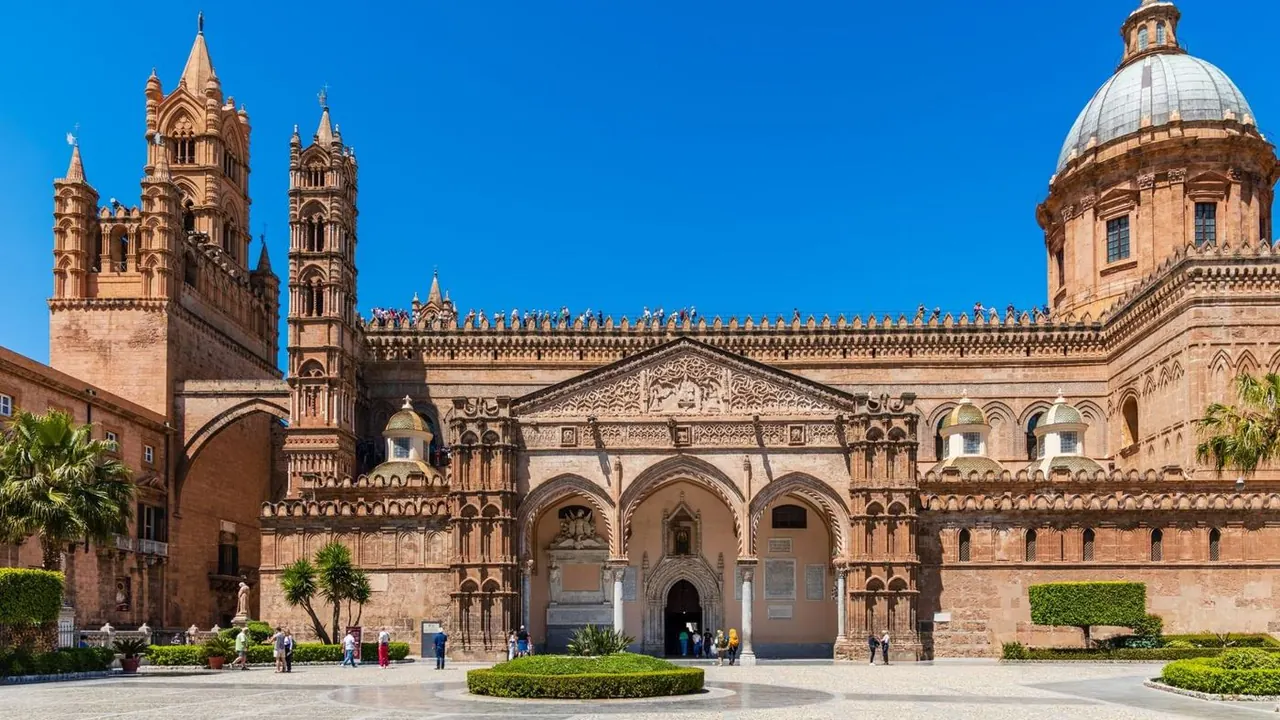
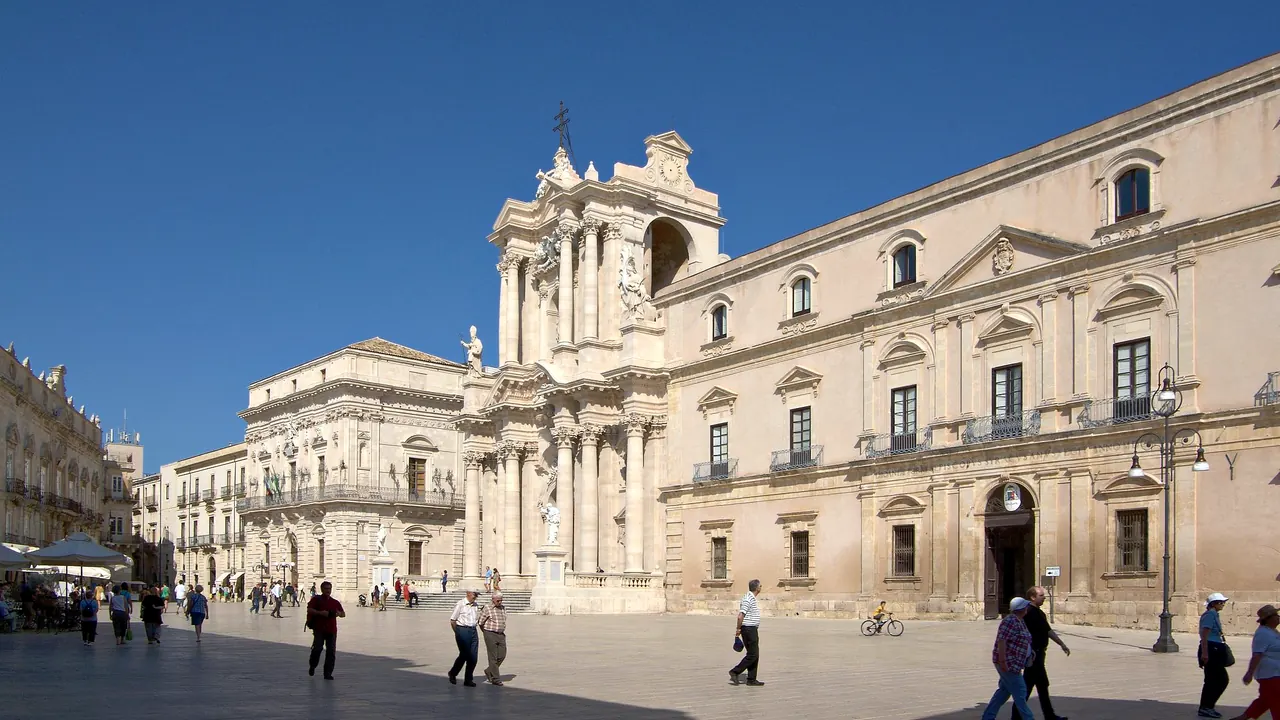
Photos: Palermo by Antonino Giangrasso, Pexels License; Syracuse, Sicily by Berthold Werner, CC BY-SA 3.0, cropped.
Palermo or Syracuse, Sicily?
Our verdict in twelve categories, each scored against the same fixed benchmark cities, and the climate month by month, so you can choose for your trip.
Choose Palermo for
- live music and the arts
- nightlife
- food and drink
Palermo is the pick for travellers who want a proper city with an appetite. You get market street food at Ballarò and the Capo, the Arab-Norman mosaics, an evening at the Teatro Massimo and drinks spilling out of the Vucciria after dark. It is rougher, louder and harder going with young children, but it gives you more to do each evening and costs a little less.
Choose Syracuse, Sicily for
- families
- wellness
- day trips
Syracuse suits a slower trip built around the sea and the Greek past. Ortigia is small enough to explore on foot, you can swim from the rocks under its walls, and the baroque towns of the Val di Noto are close by. Families and anyone who wants calm will find it easier, although the evenings are quieter and the food is narrower in range.
Scoreboard
Twelve categories on one fixed scale from 0 to 100. The shaded stretch is the gap between the two.
Your match
Pick a travel style or drag the sliders, and both match scores follow your weighting.
Wins on live music and the arts and nightlife with your weighting.
Wins on families and wellness with your weighting.
What matters to you?
Category by category
What the scores mean for a trip.
Beaches & swimming
Both have good summer swimming, but it works differently. From Palermo you take a bus to Mondello, a shallow, sandy bay that fills with cabins and families at weekends. For quieter swims you can head north to the flat rocks near Sferracavallo and Capo Gallo.
Syracuse brings the sea closer. On Ortigia you swim off the rocks and wooden platforms below the sea walls without leaving the old town. Its sandy bays lie south of the city, and the best of them, the undeveloped beaches of the Vendicari reserve, are a drive away.
Food & drink
Palermo is the better place to eat, above all on the street. The stalls of Ballarò, the Capo and the Vucciria turn out panelle, crocchè, arancine and spleen sandwiches, and sfincione is sold from vans. Sweet-and-sour Arab-influenced dishes and convent pastries give the city a cuisine of its own.
Syracuse eats well too, but in a narrower range, built around the Ortigia market and its fish: sea urchin pasta, raw prawns and rolled swordfish. It is more a place for a good seafood lunch than for grazing from stall to stall, and the piazza tables with the best views are not always the best food.
Culture & sights
Here the two cities match, but with very different pasts. Palermo's treasure is its Arab-Norman twelfth century: gold mosaic in the Palatine Chapel, the red domes of San Giovanni degli Eremiti, and Serpotta's white stucco in the oratories, with Palazzo Abatellis and the Salinas museum alongside.
Syracuse goes back further, to the Greek city. It has temple columns built into the cathedral, the rock-cut theatre in the Neapolis park and the Paolo Orsi museum, plus a Caravaggio. Palermo's sights are spread through a larger, partly crumbling centre, while Syracuse's are concentrated on Ortigia and one archaeological park.
Nightlife
Palermo has much livelier evenings. After dark the Vucciria becomes an open-air bar with smoking grills and music, and the wine and cocktail bars in the Kalsa and off Via Maqueda fill up after a late dinner. Neither city has much in the way of clubs.
Syracuse is gentler. Evenings mean an aperitivo on the sea walls and a few small bars in Ortigia's lanes, and from November most nights end early. Anyone after a real night out goes to Catania.
Nature & outdoors
Both are equally rewarding, with very different landscapes. Palermo's mountains rise right over the city, with an old path up Monte Pellegrino. Inland are the beech woods and peaks of the Madonie, close to 2,000m, and to the west is the coastal trail through the Zingaro reserve.
Around Syracuse the scenery is gorges, wetlands and rivers. You can walk down to the pools of Cavagrande del Cassibile, see flamingos at Vendicari or take a boat past the papyrus on the Ciane, and Etna is within a day's reach. Each city also has a marine reserve for snorkelling: Capo Gallo for Palermo, Plemmirio for Syracuse.
Day trips
Palermo's day trips lead west into the island's Greek and Norman past. Monreale's golden mosaics and cloister are half an hour up the hill, Segesta's Doric temple stands alone in open country, and Erice looks down on the salt pans from its rock. Cefalù pairs a Norman cathedral with a town beach, and Agrigento's Valley of the Temples and Selinunte make longer days.
Syracuse points instead to the baroque south-east, the towns rebuilt after the earthquake of 1693. Noto is about forty minutes away, with Modica, Ragusa Ibla and Scicli beyond, and the fishing village of Marzamemi makes a lighter outing. To the north lie Catania's lava-stone baroque and Taormina's theatre above the sea. From either city, a hire car makes the outlying sites far easier to reach.
Good for families
Syracuse is the easier choice with children. Its sandy southern beaches shelve gently, Ortigia's largely car-free lanes are pleasant to wander, and the echoing Ear of Dionysius and the papyrus boat trips give children something of their own.
Palermo has Mondello's shallow bay and its puppet theatres. Beyond those, the narrow lanes without pavements, the scooters and the uneven stone make the old town hard work, especially with a pushchair.
Getting around
Both cities are easy on foot in the centre and hard work beyond it. Palermo's main sights lie along two long, mostly flat streets. A bus to Mondello and regional trains to Cefalù and Bagheria cover some trips without a car.
Syracuse's walkable core is smaller, since you can cross Ortigia in a quarter of an hour. Its beaches, gorges and baroque towns depend much more on a hire car, because buses and trains are sparse.
Shopping & style
Palermo has more to browse. Via Libertà has Italian fashion and a few luxury labels, there is a flea market near the cathedral, and the puppet workshops sell handmade marionettes. Syracuse's shopping is smaller in scale: craft shops on Ortigia selling ceramics, linen and papyrus paintings, and ordinary chains around Corso Gelone. In both cities, the food markets are the place for capers, almonds and pistachio to take home.
Affordability
Palermo is the cheaper of the two. You can make a meal from several market stalls, and guesthouses in the old centre stay fairly priced for most of the year. Eating in Syracuse is good value too, but rooms on Ortigia are in heavy demand from June to September, so staying on the island costs more. In both, a hire car adds noticeably to the bill.
Live music & performing arts
Palermo has a proper evening programme. The Teatro Massimo runs a full season of opera, ballet and concerts, the Sicilian symphony orchestra plays at the Politeama, and family puppet theatres stage the Opera dei Pupi's battles of knights and Saracens.
Syracuse has one great event: Greek tragedy and comedy performed in the ancient theatre each late spring and early summer, a tradition since 1914 that is worth planning a trip around. Outside that season there are puppet shows on Ortigia and not much else, with no opera company or orchestra.
Wellness & relaxation
Neither city has a spa culture worth travelling for, so the difference lies in the surroundings. Ortigia is a small island with the sea on every side and lanes that are mostly free of cars. Once the August heat and crowds have passed, it is quiet enough to slow right down without leaving town.
Palermo gives you scooters, market shouts and traffic, and calm comes only in pockets: the palms of the Orto Botanico, a cloister, the Foro Italico at dusk. What it has that Syracuse lacks is thermal water within easy reach, at Termini Imerese about forty minutes east by train.
When should you go?
Pick your month. The climate figures are measured averages, not a forecast.
Palermo in July
Syracuse, Sicily in July
Daytime high, °C
Rainfall in the month, mm
Where the figures come from
Palermo's sunshine is measured 67 km from the centre, at Ustica.
Syracuse, Sicily's temperatures are measured 45 km from the centre, at Cozzo Spadaro.
Syracuse, Sicily has no rain gauge within 25 km of the centre, so its rainfall comes from a gridded climate dataset read at the city rather than from a gauge further away.
Temperature and rainfall are climate normals, averaged over the years shown. Palermo: 1991-2020 normals, Palermo / Punta Raisi (24.1 km from centre). Syracuse, Sicily: 1991-2020 normals, Cozzo Spadaro (45 km from centre).
Both cities are hottest from June to September, with highs around 30°C in July and August. That suits the sea far better than midday sightseeing. In both, the water is warm enough for swimming from June into October. For walking the streets and the ruins, April, May and late September are the most comfortable months, warm without the summer glare. October stays mild, but it is when the rain arrives in both cities, close to 95mm in each.
From November to March the two part ways. Palermo is much the wetter, and December is its rainiest month at 138mm. Over those months Syracuse gets a little over half as much rain and noticeably more winter sunshine. It also dries out sooner in spring, so a March or April trip is more likely to stay dry on the east coast.
Which traveller are you?
For a food and nightlife trip, Palermo is the stronger choice. Its markets fry panelle and arancine all day, the cooking is broader and more distinctive, and the Vucciria and the Kalsa bars stay lively long after Syracuse's lanes have gone quiet.
On a family trip with young children, Syracuse is easier. It has gently shelving sandy beaches at Arenella and Fontane Bianche, the largely car-free lanes of Ortigia and boat trips on the Ciane, which make for calmer days than Palermo's scooter-filled streets.
For a relaxing and wellness trip, Syracuse wins on pace rather than spas. Outside August, long lunches on Ortigia, walks on the sea walls and sunsets over the harbour are restful. In noisy Palermo, real rest usually means leaving the city altogether.
Before you go
| Measure | Palermo | Syracuse, Sicily |
|---|---|---|
| Official language | Italian | Italian |
| Currency | Euro (EUR) | Euro (EUR) |
| Sockets | CFL230 V, 50 Hz | CFL230 V, 50 Hz |
| Driving side | Right | Right |
| Time zone | UTC+1, UTC+2 in summer | UTC+1, UTC+2 in summer |
| Emergency number | 112 | 112 |
| Elevation | 14 m | 17 m |
| Main airport | Falcone–Borsellino Airport (PMO)25 km from centre106 non-stop destinations | Catania-Fontanarossa Airport (CTA)48 km from centre96 non-stop destinations |
| Public holidays this year | 13 days | 13 days |
By the numbers
| Measure | Palermo | Syracuse, Sicily |
|---|---|---|
| City population | 630,167 | 115,515 |
| People per km² | 3,924 | 556 |
| Museums within 10 km | 42 | 11 |
| UNESCO World Heritage sites within 50 km | 1 | 2 |
| Swim season, months above 21 °C | 5 months | 5 months |
Where else could you go?
Every comparison below shares a destination with this one, so you can follow Palermo or Syracuse, Sicily somewhere new.
- Cataniavs Syracuse, Sicily
- Taorminavs Syracuse, Sicily
- Vallettavs Syracuse, Sicily
- Cataniavs Palermo
- Taorminavs Palermo
- Vallettavs Palermo