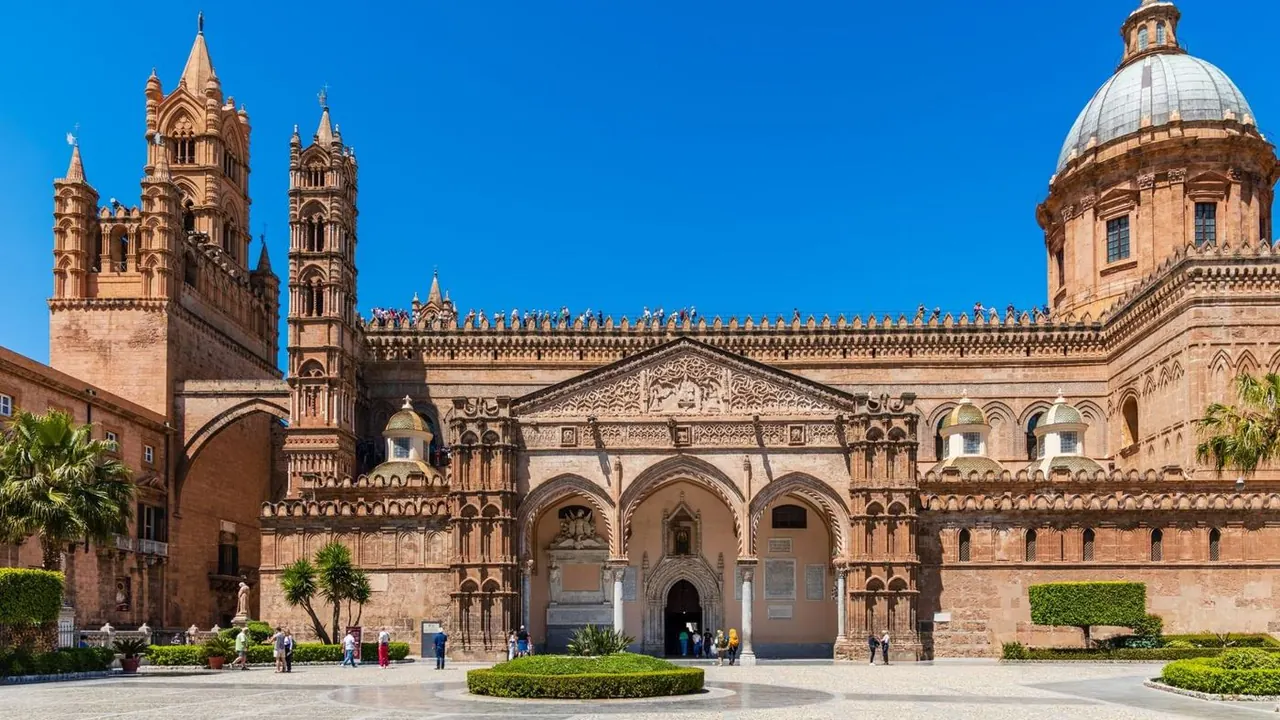
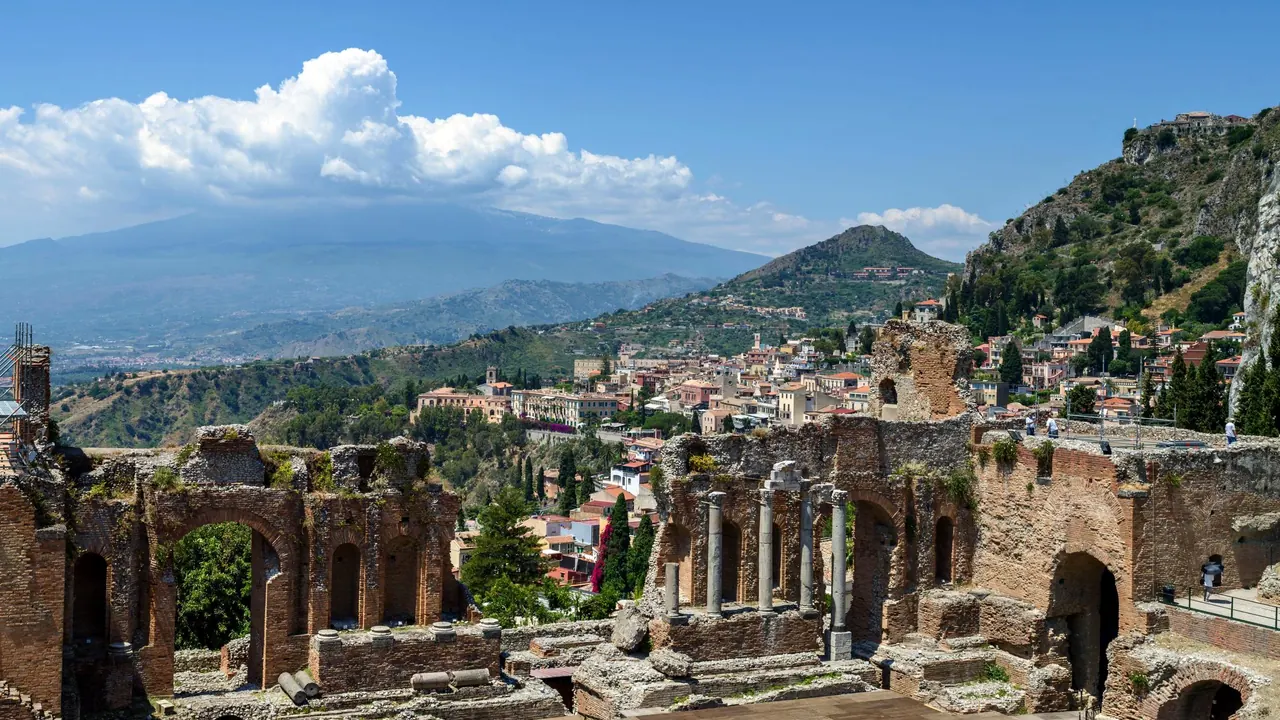
Photos: Palermo by Antonino Giangrasso, Pexels License; Taormina by Reinhard Bruckner, Pexels License.
Palermo or Taormina?
Our verdict in twelve categories, each scored against the same fixed benchmark cities, and the climate month by month, so you can choose for your trip.
Choose Palermo for
- culture and sights
- prices
- nightlife
Palermo suits travellers who want a real Sicilian city rather than a resort. The Arab-Norman mosaics, the baroque oratories and two serious museums give it far more to see. The street food of Ballarò and the Vucciria and a year-round opera house give it more to do after dark. Stays cost noticeably less, and Mondello's sand is close enough for afternoon swims, as long as you can live with noise, crumbling lanes and some chaos.
Choose Taormina for
- wellness
- nature and the outdoors
- getting around
Taormina is the better pick for a slower, prettier stay, especially for couples. It is a small terrace town with Etna on the horizon, the Greek theatre and pebble coves below. The volcano and the Alcantara gorges are close, the hotel spas look out over the sea and evenings are quiet. The town is much more expensive, and a curious visitor will run out of sights in a day or two.
Scoreboard
Twelve categories on one fixed scale from 0 to 100. The shaded stretch is the gap between the two.
Your match
Pick a travel style or drag the sliders, and both match scores follow your weighting.
Wins on culture and sights and prices with your weighting.
Wins on wellness and nature and the outdoors with your weighting.
What matters to you?
Category by category
What the scores mean for a trip.
Beaches & swimming
Both give you clear, warm water from June into October, and neither lets you walk out of the hotel onto the sand. Palermo has the slightly better beach day. Mondello is a wide arc of pale sand with shallow turquoise water, half an hour away by bus, and the rocks and ladders along Capo Gallo offer deeper swimming.
Taormina's bays at Mazzarò and Isola Bella are lovelier to look at and better for snorkelling, but they are narrow pebble strips reached by cable car or steep paths, and they fill early. For proper sand you take a bus to Giardini Naxos or Letojanni.
Food & drink
Palermo is one of Sicily's great places to eat, and most of it happens standing up. In the markets of Ballarò, the Capo and the Vucciria you can graze on panelle, arancine and sfincione, and dishes such as pasta con le sarde carry the city's Arab past. Pastry shops and family trattorie fill in the rest.
Taormina eats well at the top end, with refined Sicilian cooking on sea-view terraces and Etna wines on every list. Below that, though, Corso Umberto leans on tourist menus, and the choice in a town this small runs out quickly.
Culture & sights
There is far more to see in Palermo. The UNESCO-listed Arab-Norman churches, from the Palatine Chapel to the red domes of San Giovanni degli Eremiti, sit alongside baroque oratories, the Quattro Canti and two strong museums, the Salinas and Palazzo Abatellis. You could fill a week here.
Taormina has one world-class sight, the Greek theatre framing Etna and the coast, plus a pleasant walk of medieval palazzi along Corso Umberto. A day of slow wandering covers it, and there are no major museums.
Nightlife
Palermo has the livelier evenings by a wide margin. The Vucciria turns into an open-air drinking spot with grills and small bars, the Kalsa and the lanes off Via Maqueda fill after late dinners, and on warm nights people stay out well past midnight.
Taormina's evenings are an aperitivo in Piazza IX Aprile, a stroll along the Corso and a glass in a piano bar above the sea, mostly among couples and older visitors. Neither town has a real club scene. Taormina goes quiet soon after dinner out of season, while Palermo only quietens on winter weeknights.
Nature & outdoors
Taormina has the bigger outdoors. Etna is within about an hour, where you can walk the Silvestri craters and old lava flows, go towards the summit areas with a guide or ski in winter. The basalt Alcantara gorges are closer still, and the Isola Bella marine reserve is right below the town for kayaking and snorkelling.
Palermo's landscape is good too. Monte Pellegrino rises straight above the streets, Capo Gallo has cliff paths and diving, and there are the coastal trail of the Zingaro and the Madonie peaks. Most of these are further away, though, and much easier with a car.
Day trips
Both are strong bases, and Palermo's choice is a little richer and closer. Monreale's mosaics are half an hour up the hill, Cefalù is an hour by train, and Segesta, Erice and the salt pans lie to the west. Agrigento's Valley of the Temples and Selinunte are both within about two hours.
Taormina looks down the east coast instead. It has lava-stone Catania, Ortigia and the Greek quarries of Syracuse, Noto if you start early, and the Etna wine villages and film-set hill towns such as Savoca close by. From both towns, the ancient sites are much easier with a hire car.
Good for families
Neither is an easy family base, and the difficulties differ. In Palermo the reward is Mondello's shallow sandy bay and the puppet shows of knights and Saracens. The cost is narrow lanes without pavements, scooters and a hot, crowded old town.
Taormina's pedestrian centre feels safer, and a trip up Etna or snorkelling at Isola Bella suits school-age children. Its steep steps and pebbly beaches are hard work with toddlers. In both places, families tend to do better staying on the coast, at Mondello or down at Giardini Naxos.
Getting around
Both centres are walkable, but in different ways. Palermo's sights lie on a flat, compact grid between the Norman Palace and the sea, but the side lanes mean dodging scooters, and buses beyond the centre crawl through traffic.
Taormina is smaller and mostly pedestrian, but every outing involves stairs and slopes, with a cable car down to Mazzarò. Its station is down by the sea on the coastal line to Catania, Messina and Syracuse. In both places, the inland sights realistically need a car or a tour.
Shopping & style
Neither is a shopping destination, but Palermo has a little more range. Via Libertà has Italian fashion in nineteenth-century buildings, the markets sell capers, spices and pistachio pesto, and the flea market near the cathedral turns up antiques.
Taormina is a single street of jewellers, coral and cameo dealers, linen and Caltagirone ceramics. It is pretty, but the stock is aimed squarely at visitors, and for real fashion you go to Catania.
Affordability
Palermo is much the cheaper stay. You can eat well by grazing through the markets, and trattorie, local wine and old-town guesthouses are fairly priced most of the year. Costs only climb in July and August, around Mondello.
Taormina is the priciest place in eastern Sicily, set by its grand sea-view hotels and the resort prices on the Corso. Granita and buses stay cheap, but the usual way to save is sleeping in Giardini Naxos or Letojanni and coming up in the evening.
Live music & performing arts
Palermo has a proper music life all year. The Teatro Massimo runs a full season of opera, ballet and concerts, the Politeama hosts the Sicilian symphony orchestra, and the small family-run Opera dei Pupi theatres keep the armoured-marionette tradition alive.
Taormina has one spectacular stage: concerts, opera and big-name acts in the Greek theatre on summer nights, with Etna behind. Outside summer, little remains beyond the odd chamber concert, and serious opera means a trip to Catania.
Wellness & relaxation
Taormina is the more restful place. Its large hotels have good spas with terrace pools over the sea and treatments using volcanic mud and citrus. In May, June and late September the long lunches and the shade of the Villa Comunale set a gentle pace, though August crowds break it.
Palermo is loud and busy, and wellness there means a hotel spa or a train to the thermal waters at Termini Imerese. Its calm moments are the Orto Botanico and the evening walk along the Foro Italico.
When should you go?
Pick your month. The climate figures are measured averages, not a forecast.
Palermo in July
Taormina in July
Daytime high, °C
Rainfall in the month, mm
Where the figures come from
Palermo's sunshine is measured 67 km from the centre, at Ustica.
Taormina's temperatures are measured 45 km from the centre, at Messina.
Taormina has no rain gauge within 25 km of the centre, so its rainfall comes from a gridded climate dataset read at the city rather than from a gauge further away.
Temperature and rainfall are climate normals, averaged over the years shown. Palermo: 1991-2020 normals, Palermo / Punta Raisi (24.1 km from centre). Taormina: 1991-2020 normals, Messina (45.1 km from centre).
The two share a similar year. Winter days are mild in both, at around 15°C, and the sea is warm enough to swim from June to October, reaching about 27°C off Palermo in August. High summer is almost dry and too hot for long walks in either place. Taormina gets a little hotter, near 31°C in July and August. Palermo has slightly more sunshine in every month.
The wet season is where they differ. Palermo's rain builds from September and keeps rising to a wet December of 138mm, so it has the soggier winter of the two. Taormina's wettest months are October and November, and from February it dries out sooner. In both cities, rain picks up as October goes on. For sightseeing, or for hiking in the Madonie and on Etna, the best months are April, May, late September and early October.
Which traveller are you?
On a culture and arts trip, Palermo is the clear choice. It has the gold mosaics of the Palatine Chapel and Monreale, Serpotta's stucco oratories, the Salinas and Abatellis museums and a full opera season at the Teatro Massimo. Taormina has its theatre and one fine street.
For a trip on a tight budget, go to Palermo. You can make a meal of market fryers and pastry shops, and trattorie and old-town guesthouses are fairly priced. Taormina's grand hotels and the resort menus on Corso Umberto make it costly unless you sleep down the coast.
On a relaxing and wellness trip, Taormina works better. Its hotel spas have terrace pools above the sea and volcanic-mud treatments, and in May, June and late September the pace is gentle. Palermo is loud with scooters and markets, and it has little in the way of spas.
Before you go
| Measure | Palermo | Taormina |
|---|---|---|
| Official language | Italian | Italian |
| Currency | Euro (EUR) | Euro (EUR) |
| Sockets | CFL230 V, 50 Hz | CFL230 V, 50 Hz |
| Driving side | Right | Right |
| Time zone | UTC+1, UTC+2 in summer | UTC+1, UTC+2 in summer |
| Emergency number | 112 | 112 |
| Elevation | 14 m | 204 m |
| Main airport | Falcone–Borsellino Airport (PMO)25 km from centre106 non-stop destinations | Catania-Fontanarossa Airport (CTA)47 km from centre96 non-stop destinations |
| Public holidays this year | 13 days | 13 days |
By the numbers
| Measure | Palermo | Taormina |
|---|---|---|
| City population | 630,167 | 10,471 |
| People per km² | 3,924 | 799 |
| Museums within 10 km | 42 | 5 |
| UNESCO World Heritage sites within 50 km | 1 | 2 |
| Swim season, months above 21 °C | 5 months | 5 months |
Where else could you go?
Every comparison below shares a destination with this one, so you can follow Palermo or Taormina somewhere new.
- Cataniavs Taormina
- Syracuse, Sicilyvs Taormina
- Cataniavs Palermo
- Syracuse, Sicilyvs Palermo
- Vallettavs Taormina
- Vallettavs Palermo