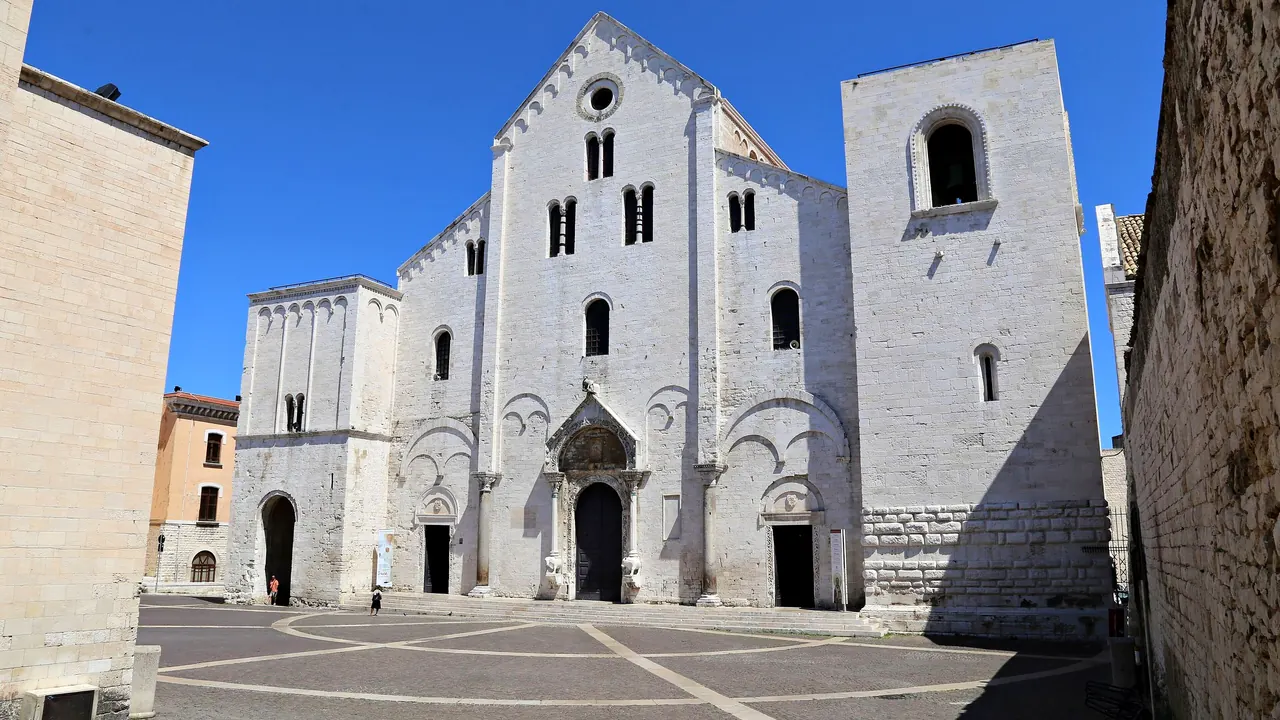
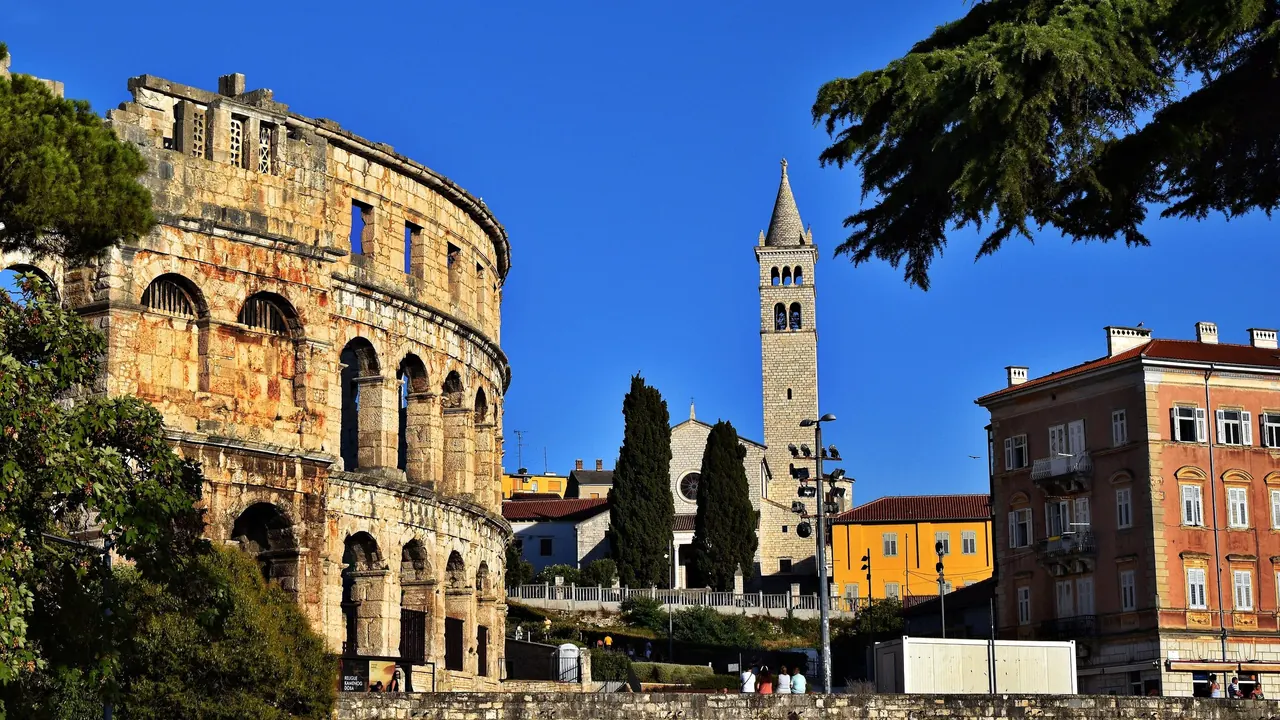
Photos: Bari by Sailko, CC BY-SA 4.0, cropped; Pula by Miroslav.vajdic, CC BY-SA 4.0, cropped.
Bari or Pula?
Our verdict in twelve categories, each scored against the same fixed benchmark cities, and the climate month by month, so you can choose for your trip.
Choose Bari for
- nightlife
- food and drink
- shopping
Bari suits travellers who want to eat well and roam. Its street food and Apulian home cooking go further than anything around Pula's Forum, and evenings in the old-town piazzas run later. Its day trips also cover more ground: Matera's cave dwellings, the trulli of Alberobello and Baroque Lecce are all within reach, and some of them by regional train. It is also the cheaper and easier base for anyone without a car.
Choose Pula for
- nature and the outdoors
- beaches
- families
If the sea and the outdoors come first, pick Pula. The clear water in Cape Kamenjak's wild coves is far better than Bari's ordinary city beach. The protected headland and the Istrian countryside are better for walking, cycling and kayaking, and the sheltered bays at Medulin make beach days with children simpler. It also has one of the best-preserved Roman amphitheatres anywhere, and it makes a quieter, greener summer base, best with a hire car.
Scoreboard
Twelve categories on one fixed scale from 0 to 100. The shaded stretch is the gap between the two.
Your match
Pick a travel style or drag the sliders, and both match scores follow your weighting.
Wins on nightlife and food and drink with your weighting.
Wins on nature and the outdoors and beaches with your weighting.
What matters to you?
Category by category
What the scores mean for a trip.
Beaches & swimming
Bari has the sand. Pane e Pomodoro is a sandy city beach a short walk from the centre, with lidos further along towards Torre Quetta. The town shore is ordinary, though, and the real swimming lies half an hour south at Polignano a Mare and in the coves around Monopoli.
Pula has no sand at all, yet its swimming is better and closer to town. Clear water laps the rock platforms and pebble coves under the pines on Verudela and Stoja, and Cape Kamenjak, about 10km south, has dozens of wild inlets. Pack water shoes because of the sea urchins, and use the shallow bays at Medulin with small children.
Food & drink
Bari is the better place to eat, and its food is part of daily street life. Women roll orecchiette in the doorways of Bari Vecchia, focaccia barese and sgagliozze are sold from kitchen windows, and sea urchins are eaten by the fishermen's pier. All of it comes at fair prices, with Primitivo or Negroamaro to drink.
Istrian cooking is just as distinctive, with truffle pasta, scampi buzara, pršut and Malvazija. In Pula itself, though, the choice is thinner, and the tables by the Arena lean towards tourist menus. The best meals there mean driving out to konobas in the hinterland, while in Bari they are on your doorstep.
Culture & sights
The two are evenly matched for sights, and each takes a day or two, but they come from different eras. Bari is medieval and Romanesque. The Basilica di San Nicola and its pilgrims, the cathedral and the Norman-Swabian castle sit in a maze of whitewashed lanes, and the nineteenth-century Murat grid lies beyond.
Pula is Roman first. The Arena still stands complete above the harbour, the Temple of Augustus is intact on the Forum, and the Arch of the Sergii leads into the old streets. Venetian and Austro-Hungarian naval history is layered on top, from the hilltop fortress to the coastal forts.
Nightlife
Bari goes out more and goes out later. On summer evenings students and young locals fill Piazza Mercantile and Piazza Ferrarese, the bars in the Umbertino streets stay open past midnight, and a few clubs keep going beyond that. In July and August the beach clubs south of the city take over.
Pula's nights are shorter and mostly seasonal: drinks on the terraces around the Forum, beach bars on Verudela and in Medulin, and a handful of small clubs on summer weekends. Both cities quieten out of season, but Pula goes almost completely quiet.
Nature & outdoors
Pula has the better outdoors close at hand. Kamenjak's car-free headland of cliffs, wild flowers and islets suits walking and cycling. The sea offers kayaking, windsurfing and wreck dives, and the Učka range gives real hiking within reach.
Bari's surroundings are flatter and tamer. It has olive groves and its long seafront promenade, and about an hour inland lies the open karst grassland of Alta Murgia for quiet walks and rides, with the Grotte di Castellana below ground. With no mountains nearby, it suits gentle cycling rather than hiking.
Day trips
Both make good touring bases, but Bari reaches further. Matera's cave city, the trulli of Alberobello, the white towns of the Valle d'Itria, Castel del Monte, Trani's cathedral on the sea and Baroque Lecce add up to a week of outings, and several of them can be reached by regional train.
Pula covers Istria well. Rovinj, the Euphrasian Basilica at Poreč and hill towns such as Motovun and Hum, with truffle and wine estates nearby, are all within easy reach, and a boat goes out to Brijuni. The list is shorter, though, and depends more on a car, with Piran and Trieste a longer drive away.
Good for families
Pula is the easier choice with children, mainly because of the sea. The gently shelving bays of Medulin and Premantura suit small swimmers, the aquarium sits inside an old fort on Verudela, and the Arena's underground passages are fun to explore. A dinosaur park, a water park and the Brijuni safari are all within an hour.
Bari is welcoming, with a sandy city beach and traffic-free lanes in the old town, but little is built for children. Outings to the caves or the Fasano safari park have to do most of the work. In both cities summer heat calls for a long midday break.
Getting around
Bari is easier without a car. The old town, the shopping streets and the promenade lie side by side on flat ground, and a rail link reaches the airport. Regional lines run to Polignano, Trani, Matera and Alberobello, even if some of them are slow.
Pula's compact centre is just as easy to walk, and buses go out to Verudela and Premantura. Beyond the city, though, the trains are of little use and regional buses are infrequent. Kamenjak, the hill towns and the wider coast really need a car or a scooter.
Shopping & style
Neither city is a shopping destination, and in both the best buys are edible. Bari has more choice: Via Sparano and the Murat streets carry Italian chains and some upmarket boutiques, and there are dried orecchiette, taralli and Puglian ceramics to take home.
Pula's shops stop at one old-town street of everyday chains and souvenirs. Its real appeal is the market hall and the producers selling olive oil, truffles, rakija and pršut.
Affordability
Bari is the cheaper stay. Street food, trattoria lunches and local wine cost little, and the old town and the basilica are free to explore, though rooms get harder to find in high summer.
Pula is mid-priced and easier on the budget in spring and autumn. In July and August, though, its rooms rise towards Western European coastal levels, and meals near the Arena are priced for tourists. Most of its outings need a car or a boat, so those extras weigh more heavily there.
Live music & performing arts
Bari has a proper stage. The Teatro Petruzzelli, one of Italy's largest opera houses, runs a season of opera, ballet and concerts. In summer there are open-air concerts and a long-running jazz festival in the castle and the piazzas.
Pula's highlight is seasonal but memorable: summer concerts and film festival screenings inside the Roman Arena. Outside summer there is mostly Croatian-language drama at the Istrian National Theatre, so visitors who want opera or classical music should choose Bari.
Wellness & relaxation
Neither city has a spa or bathing tradition, so relaxing here is about the pace of life rather than treatments. In Bari that means long lunches, the afternoon pause and an evening stroll on the seafront, and visitors who want pampering book a stay at a restored country estate outside town.
Pula has the spas of the resort hotels on Verudela and in Medulin, plus coastal paths shaded by pines. That makes it the greener place to unwind outside high summer.
When should you go?
Pick your month. The climate figures are measured averages, not a forecast.
Bari in July
Pula in July
Daytime high, °C
Rainfall in the month, mm
Where the figures come from
Bari has no rain gauge within 25 km of the centre, so its rainfall comes from a gridded climate dataset read at the city rather than from a gauge further away.
Bari's sunshine is measured 77 km from the centre, at Marina Di Ginosa.
Pula's temperatures are measured 87 km from the centre, at Trieste.
Pula has no rain gauge within 25 km of the centre, so its rainfall comes from a gridded climate dataset read at the city rather than from a gauge further away.
Temperature and rainfall are climate normals, averaged over the years shown. Bari: 1991-2020 (sunshine 1961-1990) normals, Bari / Palese Macchie (7 km from centre). Pula: 1991-2020 normals, Trieste (87 km from centre).
Bari has a long, dry, sunny summer. From June to September the sea is warm enough for easy swimming, and in July and August the highs reach about 30°C with hardly any rain, so the middle of the day is too hot for walking the streets. May, June and late September are the comfortable months for sightseeing, and October stays mild. The rain sets in from September and is heaviest in November, but winters are gentle, at around 12°C by day.
In high summer Pula is only about a degree cooler on land and in the sea, with less sunshine and more frequent summer showers, so its beach months from June to September feel a little fresher. The gap widens from October, when Pula cools faster, and by winter its days reach only about 9°C. Rainfall rises in September in both cities, but Pula's autumn is wetter, peaking at 107mm in November. That makes spring and early autumn its best months for walking and cycling.
Which traveller are you?
For a food and nightlife trip, Bari is the clear choice. Hand-rolled orecchiette, focaccia and raw seafood by the old pier cost little, and summer nights in Piazza Mercantile and along the seafront run well past midnight. Pula's evenings stay low-key.
On an outdoors trip, Pula wins. The car-free Kamenjak headland is made for walking and cycling, kayaking and wreck diving are easy to arrange, and the Učka range offers real hiking. Bari has only the flat, open Alta Murgia plateau.
On a beach and sun trip, Pula has the better swimming: clear pebble coves under the pines and dozens of wild inlets at Kamenjak. Bari is sunnier and has a sandy city beach, but its best swimming means a train ride south to Polignano.
Before you go
| Measure | Bari | Pula |
|---|---|---|
| Official language | Italian | Croatian |
| Currency | Euro (EUR) | Euro (EUR) |
| Sockets | CFL230 V, 50 Hz | CF230 V, 50 Hz |
| Driving side | Right | Right |
| Time zone | UTC+1, UTC+2 in summer | UTC+1, UTC+2 in summer |
| Emergency number | 112 | 112 |
| Elevation | 5 m | 5 m |
| Main airport | Bari Karol Wojtyła International Airport (BRI)9 km from centre104 non-stop destinations | Pula Airport (PUY)7 km from centre34 non-stop destinations |
| Public holidays this year | 13 days | 14 days |
By the numbers
| Measure | Bari | Pula |
|---|---|---|
| City population | 315,473 | 52,220 |
| People per km² | 2,687 | 971 |
| Museums within 10 km | 12 | 4 |
| UNESCO World Heritage sites within 50 km | 1 | 1 |
| Swim season, months above 21 °C | 4 months | 4 months |
Where else could you go?
Every comparison below shares a destination with this one, so you can follow Bari or Pula somewhere new.