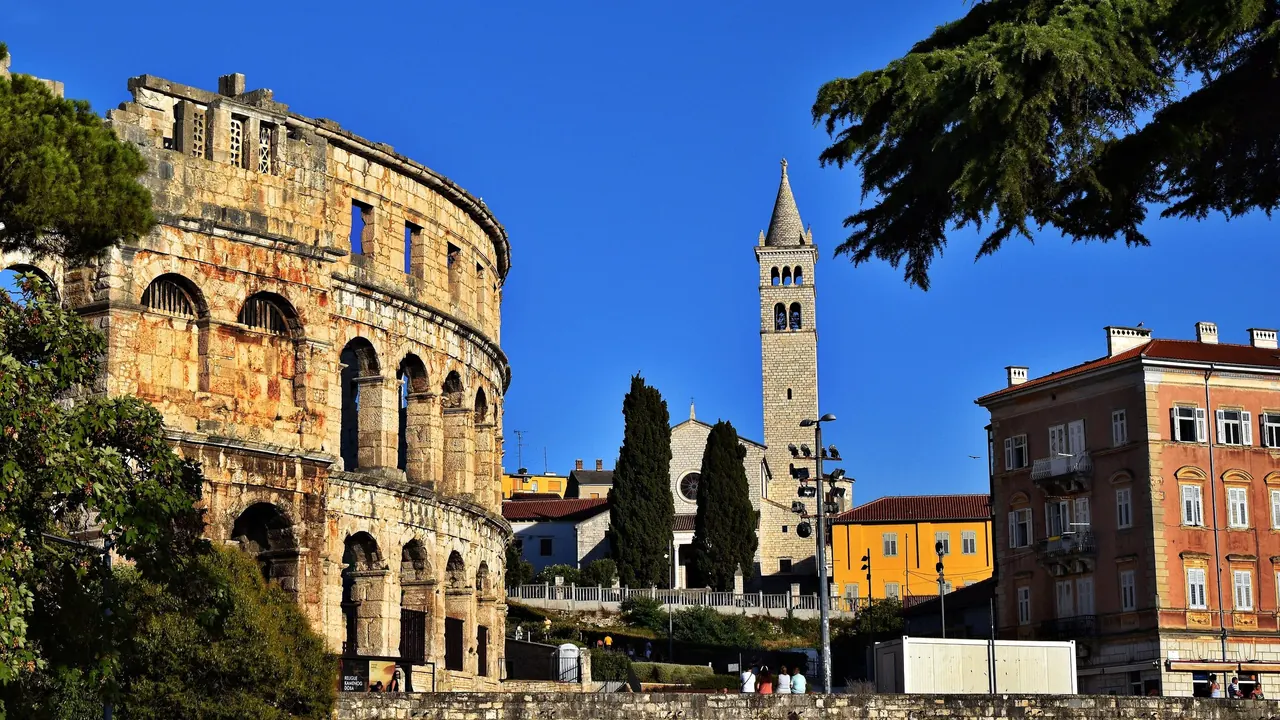
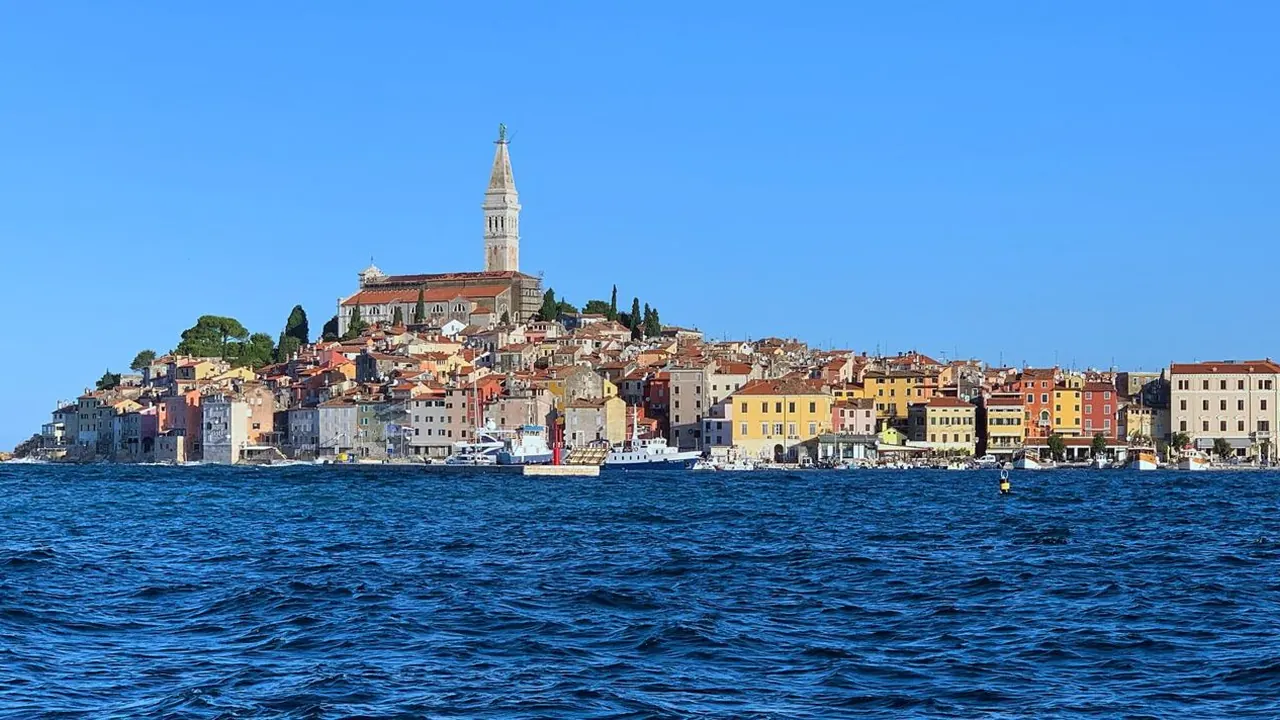
Photos: Pula by Miroslav.vajdic, CC BY-SA 4.0, cropped; Rovinj by Vyacheslav Bukharov, CC BY-SA 4.0, cropped.
Pula or Rovinj?
Our verdict in twelve categories, each scored against the same fixed benchmark cities, and the climate month by month, so you can choose for your trip.
Choose Pula for
- culture and sights
- live music and the arts
- prices
Pula is the better choice for a traveller who wants more to do than swim. It has the Roman Arena, the Forum and its temple, summer concerts under the stone arches, and the Brijuni islands just up the coast. It also sits well for touring the whole of Istria. Rooms and meals cost less, and the evenings are a little livelier, which helps on a longer stay or a family vacation.
Choose Rovinj for
- wellness
- getting around
Couples and anyone who mainly wants to slow down will be happier in Rovinj. The old town is closed to cars and climbs to St Euphemia. You can swim off the rocks below the walls, and the pine paths of the Golden Cape start at the edge of town. You pay more for that setting and get fewer sights and less to do at night. Pula's Roman sights are about forty minutes away if you want them.
Scoreboard
Twelve categories on one fixed scale from 0 to 100. The shaded stretch is the gap between the two.
Your match
Pick a travel style or drag the sliders, and both match scores follow your weighting.
Wins on culture and sights and live music and the arts with your weighting.
Wins on wellness and getting around with your weighting.
What matters to you?
Category by category
What the scores mean for a trip.
Beaches & swimming
Neither town has sand. Both swim off rocks, pebbles and concrete platforms in the same very clear water, so the difference lies in where you swim. Pula's swimming is spread along the peninsulas south of the centre and is best at Cape Kamenjak, a wild protected headland about 10km away with dozens of coves. Medulin's sheltered bays have the shallow water that small children need.
In Rovinj the sea starts at the old town. People slip in off the stones below the walls, ledges run for kilometres into the Golden Cape, and taxi boats cross to quieter coves on St Catherine and Red Island. What Rovinj lacks is gently shelving water for toddlers.
Food & drink
Both cook from the same Istrian larder, with fuži and pljukanci with truffle, scampi buzara, Malvazija and Teran, so the plate is much the same in either town. Pula has the more useful market, a covered hall with open-air stalls around it, though its tables around the Arena and the Forum lean towards tourist menus.
Rovinj has a few ambitious, refined restaurants for a special evening, but its harbourfront is just as geared to passing visitors, and cheap everyday eating is scarce. In both towns the most rewarding meals are a short drive inland, in the family konobas of the hinterland.
Culture & sights
Pula has much more to see. The Arena still has its full three-storey outer ring, the Temple of Augustus stands intact on the Forum, and the Roman town can be traced through gates, mosaics and a small theatre. The Venetian fortress museum and the Austro-Hungarian naval buildings add later chapters.
In Rovinj the town itself is the sight. Its pastel Venetian houses climb to St Euphemia, whose bell tower you can climb, and the lanes around Grisia and the Balbi Arch are among the most photogenic on the coast. Beyond the small town museum and the Batana House there is little else, and a slow afternoon covers it.
Nightlife
Neither town is a place to go out, but Pula offers a little more. Summer evenings move from terraces around the Forum to cocktail and beach bars on Verudela and around Medulin. A few small clubs fill up at weekends, and the university keeps some bars going after the season ends.
Rovinj's night is a long dinner and then a drink on the rocks as the sun sets. A couple of venues for dancing open in high season, but the old town is mostly quiet by midnight and almost shuts down in winter.
Nature & outdoors
Both towns have the same low, pine-covered Istrian coast. Pula's best stretch is Cape Kamenjak, a car-free headland with dinosaur footprints in the shoreline rock, windsurfing in Premantura bay and wreck diving from the naval era. The Učka range, about an hour and a half away, gives it real hiking within reach.
Rovinj's green space is closer to hand. The nineteenth-century Golden Cape park has flat gravel paths that start right at the edge of town. The scatter of islets offshore suits kayaking and paddleboarding, and the steep-sided Lim Fjord is a short drive north.
Day trips
Pula is the better touring base. Boats to the Brijuni islands, with their Roman villa ruins and Tito's safari park, leave from Fažana on its doorstep. Rovinj, Poreč and the hill towns of Motovun, Grožnjan and Hum are all within about an hour. Opatija on the far side of the peninsula comes into reach too.
Rovinj sits in the middle of the same small region, with Pula and Poreč each about forty minutes away. It is a little closer to Piran and Trieste. The main thing it lacks is the pull of Pula's Roman sights, so many of its best excursions lead back south. From either town, buses are limited and a car makes most trips far easier.
Good for families
Pula is easier with children. The shallow bays at Medulin and Premantura suit small swimmers, the aquarium inside an Austro-Hungarian fort on Verudela fills half a day, and children can explore the Arena's underground passages. The flat old town also suits a pram.
Rovinj's strengths are its campsites and resorts, which are built for families and have pools and playgrounds, and the shady flat paths of the Golden Cape. Against that, the shore is all rock, the old town is a climb on polished cobbles, and the town itself has little made for children.
Getting around
Getting around is about equally easy in the two towns, but in different ways. Rovinj is a town to walk in. The old town is closed to cars, a promenade leads to the swimming rocks and the forest park, and taxi boats reach the islands, though the cobbles are steep and slippery. Intercity buses run to Pula, Poreč and Zagreb, but there is no railway.
Pula's centre is flat, and the Arena, the market and the harbour are minutes apart on foot. City buses reach the hotel areas on Verudela and run towards Premantura. Beyond either town, the hill towns and the wider coast really need a car, and parking is tight in summer.
Shopping & style
Pula has the more practical shopping. Its covered market hall and the stalls around it sell olive oil, truffle products, honey and pršut, and the pedestrian street through the old town has the usual fashion chains for anything forgotten at home.
Rovinj has no chains and less choice, especially outside summer, but the small galleries and artists' studios on the steep lane of Grisia give it more character. In both towns the best things to take home are local wine, brandy and oil rather than clothes, and neither has luxury or design shops.
Affordability
Pula is the cheaper stay. It is mid-priced, and private apartments and simple konobas keep costs down. July and August still bring rooms priced like the Western European coasts, and meals near the Arena cost tourist prices.
Rovinj is among the more expensive places on the Croatian coast. Rooms in and near the old town cost as much as a sought-after Mediterranean resort, and fish sold by weight on the harbour adds up fast. Campsites, private apartments and bakery lunches help, and in both towns late spring and September are much easier on the budget.
Live music & performing arts
Pula has the bigger stage. In summer the Roman Arena hosts touring pop and rock acts, classical galas and screenings of the Pula Film Festival. The Istrian National Theatre performs all year, though in Croatian.
Rovinj's live culture is small and seasonal. There are occasional classical concerts in St Euphemia, music on the squares, and sometimes the bitinada, the local tradition of unaccompanied singing. People staying in Rovinj who want a big concert drive down to Pula's Arena.
Wellness & relaxation
Neither town has a bathing or spa tradition of its own, so treatments mean a resort hotel either way. In Pula that means the pools, saunas and massage rooms of the big hotels on Verudela and in Medulin. Away from them, rest comes from long coffees on the Forum and evening walks on the pine-shaded coastal paths, mostly once high summer is over.
Rovinj makes winding down a little easier. Several of the hotel spas along the Golden Cape take visitors who are not staying there, so you can book a sauna or a massage while renting a private apartment. The forest park and the swimming rocks below the walls are a few minutes on foot from the old town, so a quiet day needs no car. In July and August the harbour and the lanes fill up, and finding calm means walking further out along the shore.
When should you go?
Pick your month. The climate figures are measured averages, not a forecast.
Pula in July
Rovinj in July
Daytime high, °C
Rainfall in the month, mm
Where the figures come from
Pula's temperatures are measured 87 km from the centre, at Trieste.
Pula has no rain gauge within 25 km of the centre, so its rainfall comes from a gridded climate dataset read at the city rather than from a gauge further away.
Rovinj's temperatures are measured 64 km from the centre, at Trieste.
Rovinj has no rain gauge within 25 km of the centre, so its rainfall comes from a gridded climate dataset read at the city rather than from a gauge further away.
Temperature and rainfall are climate normals, averaged over the years shown. Pula: 1991-2020 normals, Trieste (87 km from centre). Rovinj: 1991-2020 normals, Trieste (63.7 km from centre).
The two towns share almost exactly the same weather, with the same daytime highs and the same sunshine through the year. The sea is warm enough to swim comfortably from June and stays pleasant through September. In August it reaches about 25°C at Pula and a degree warmer at Rovinj. July and August bring highs of 29°C and the longest sunny days. That is ideal on the rocks but makes midday hard going on Pula's Roman sights or Rovinj's steep cobbled lanes.
May, June and September are the best months for combining swimming with walking, cycling and touring the interior. Rain picks up from September, and Rovinj is a touch wetter than Pula in autumn. In both towns November is the wettest month, at a little over 100mm. Winter highs of around 10°C suit gentle sightseeing but not the sea.
Which traveller are you?
For a culture and arts trip, Pula is the clear pick. The Arena, the Temple of Augustus, the Arch of the Sergii and the fortress museum add up to a day or two of sightseeing. On summer nights the amphitheatre also hosts concerts and film screenings.
On a trip on a tight budget, Pula goes further. It is mid-priced, with private apartments and simple konobas. Rovinj is one of the dearer places on the Croatian coast, with restaurants on the harbour that charge for the view and fish sold by weight.
On a relaxing and wellness trip, Rovinj suits better. The better-equipped resort spas along the Golden Cape are open to outside guests. In early and late summer, long lunches, swims at sunset off the rocks and walks in the pines set a slower pace.
Before you go
| Measure | Pula | Rovinj |
|---|---|---|
| Official language | Croatian | Croatian |
| Currency | Euro (EUR) | Euro (EUR) |
| Sockets | CF230 V, 50 Hz | CF230 V, 50 Hz |
| Driving side | Right | Right |
| Time zone | UTC+1, UTC+2 in summer | UTC+1, UTC+2 in summer |
| Emergency number | 112 | 112 |
| Elevation | 5 m | 0 m |
| Main airport | Pula Airport (PUY)7 km from centre34 non-stop destinations | Pula Airport (PUY)31 km from centre34 non-stop destinations |
| Public holidays this year | 14 days | 14 days |
By the numbers
| Measure | Pula | Rovinj |
|---|---|---|
| City population | 52,220 | 12,968 |
| People per km² | 971 | - |
| Museums within 10 km | 4 | 1 |
| UNESCO World Heritage sites within 50 km | 1 | 1 |
| Swim season, months above 21 °C | 4 months | 4 months |
Where else could you go?
Every comparison below shares a destination with this one, so you can follow Pula or Rovinj somewhere new.