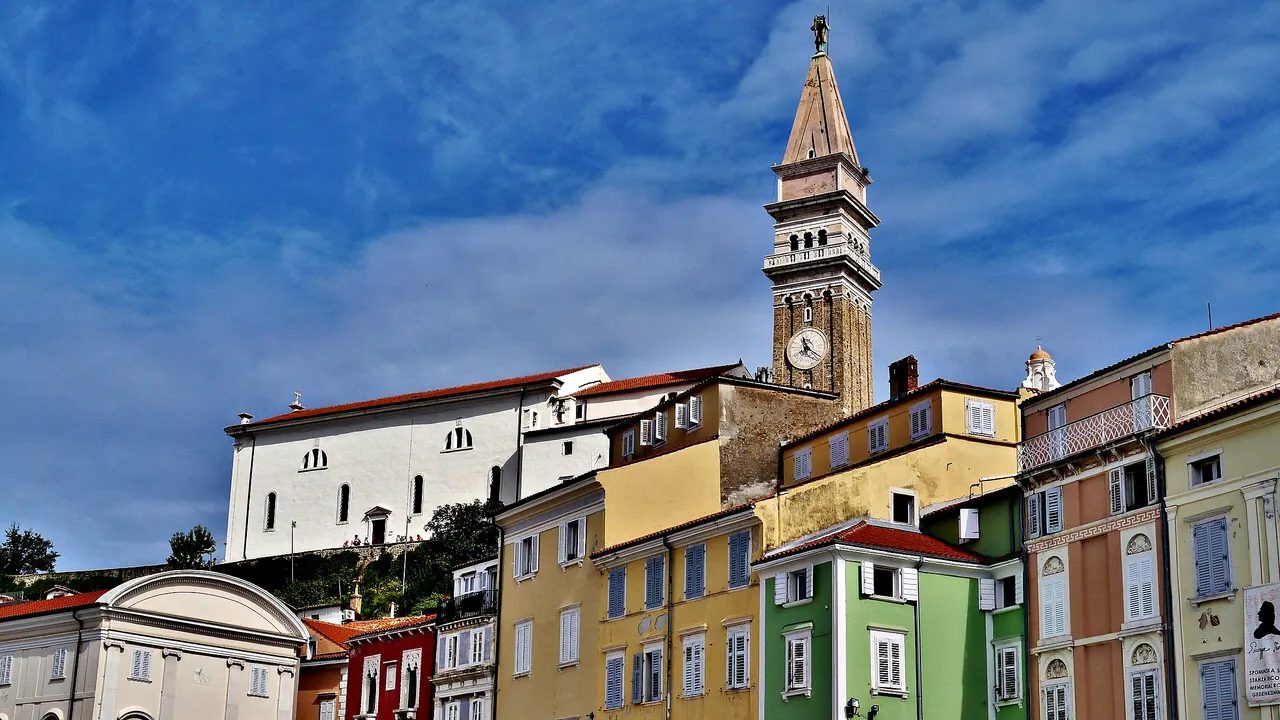
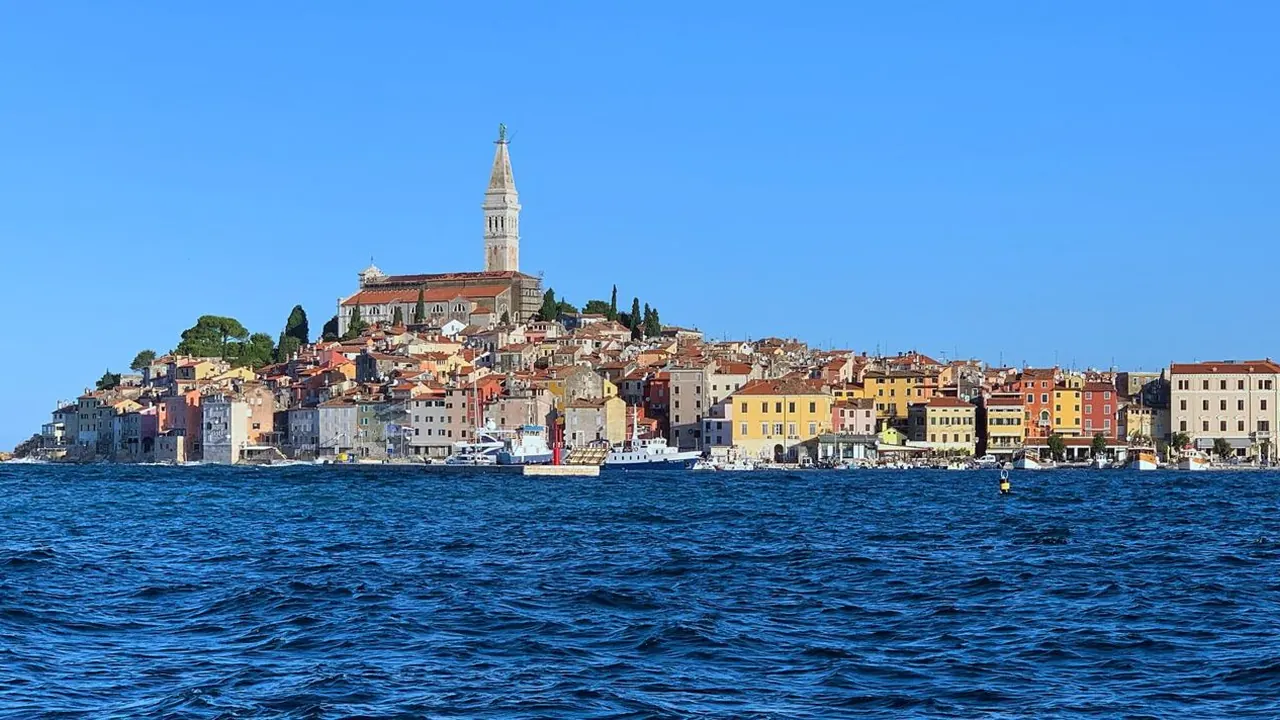
Photos: Piran by Zairon, CC BY-SA 4.0, cropped; Rovinj by Vyacheslav Bukharov, CC BY-SA 4.0, cropped.
Piran or Rovinj?
Our verdict in twelve categories, each scored against the same fixed benchmark cities, and the climate month by month, so you can choose for your trip.
Choose Piran for
- wellness
- prices
- day trips
Piran suits a slower, gentler trip: a car-free old town to wander, seawater spas and salt-mud treatments in the pans next door, and a spot where Slovenia, Italy and Croatia meet that puts Trieste, the Karst caves and the Istrian hill towns within easy reach. It is also the kinder of the two on the wallet, though you swim off ledges and ladders rather than from a proper beach.
Choose Rovinj for
- beaches
- food and drink
- shopping
Swimmers, and people who plan a vacation around long lunches, will be happier in Rovinj. Its shore runs for kilometres of rock and pine shade into the Golden Cape, taxi boats reach coves on the islands, and the food goes further, with truffle pasta and country konobas alongside the fish. Expect to pay more for it, especially in high summer.
Scoreboard
Twelve categories on one fixed scale from 0 to 100. The shaded stretch is the gap between the two.
Your match
Pick a travel style or drag the sliders, and both match scores follow your weighting.
Too close to call, 1 point apart
Wins on wellness and prices with your weighting.
Wins on beaches and food and drink with your weighting.
What matters to you?
Category by category
What the scores mean for a trip.
Beaches & swimming
Neither town has a sandy beach. Piran's swimming is along the seafront below the walls and around the Punta, where you get in off concrete platforms and ladders. Fiesa cove is the only real beach, and for sand you go to the small artificial strip at Portoroz or the quieter shore at Strunjan.
Rovinj gives a swimmer far more shoreline. Several kilometres of limestone ledges, pebble coves and platforms run south into the Golden Cape forest, with pines for shade, and taxi boats take you to the islands when you want more room. Bring water shoes for the urchins and sharp stone.
Food & drink
Piran keeps its cooking simple: grilled fish, squid and mussels in konobas on the Punta, seasoned with salt from its own pans. The harbour menus repeat one another, though, and for real variety you have to leave town.
Rovinj draws more on the inland kitchen of Istria. It adds fuži and pljukanci with truffle to the seafood, and it has a handful of refined restaurants as well as country konobas for slow-cooked meat. Neither town is worth the trip for the food alone, but a week of dinners is more interesting in Rovinj.
Culture & sights
Both old towns are compact and Venetian, and both are best seen on foot. Each has a hilltop church whose bell tower copies the campanile in Venice. Piran has a little more to fill the day: the oval Tartini Square, the medieval walls on the ridge, a maritime museum, an aquarium and the Minorite cloister.
Rovinj's former island of pastel houses climbing to St Euphemia may be the more photogenic of the two. Beyond the small town museum and the Batana House, which tells the story of the local fishing boats, there is less to see.
Nightlife
Both are quiet after dark, and an evening means a glass of wine at sunset rather than a night out. Piran winds down early around Tartini Square and the Punta. For something livelier you go a few minutes along the coast to Portoroz, which has beach bars, a casino and summer clubs.
Rovinj keeps its few cocktail and wine bars inside the old town and around the harbour, and adds a couple of late places for dancing in high season. A summer evening there can stay in town, but the town is still mostly asleep by midnight.
Nature & outdoors
Both coasts are gentle, with no high mountains, and both are best in spring and autumn. Around Piran the landscape is cliffs and wetland: the flysch cliffs and clifftop path at Strunjan, the wading birds of the Secovlje salt pans, the Parenzana cycle route inland, and the Skocjan caves on the Karst about an hour away.
Around Rovinj it is forest and sea. The Golden Cape park starts at the edge of town, the islands are good for kayaking and for diving around reefs and wrecks, and the Lim Fjord is a short drive north.
Day trips
Piran's spot on the border is its great asset. Trieste is under an hour away and Ljubljana under two. Lipica and Predjama Castle are about an hour off, and in summer boats cross to Venice. The Istrian towns to the south come on top of all that.
Rovinj is a very good base for Croatian Istria. Roman Pula and the Euphrasian Basilica in Porec are each about forty minutes away, and the Brijuni islands are close by. Getting to Italy or Slovenia takes about an hour and a half, though. From either town, most outings need a car.
Good for families
Both work equally well for a few calm days with children, and neither has sand on the doorstep or much built for families. Piran has a flat, car-free seafront, a small aquarium and the shallow sandy beach at Portoroz nearby, but swimming from town means ladders and ledges.
Rovinj gives children more room to run about in the shaded Golden Cape park, boat trips to the islands, and big resorts and campsites with pools and playgrounds. On the other hand, its rocky shore calls for water shoes, and its polished cobbles are hard going with a pushchair.
Getting around
Both centres are car-free and easy to walk, and neither has a railway. Piran is the simpler of the two. You leave the car in the garage at the edge of town and take the shuttle in, and the same shuttle and the seafront promenade link it with Portoroz.
Rovinj has bikes and taxi boats for the coast and islands, plus intercity buses to Pula, Porec and Zagreb. Parking is tight in summer, though, and the steep cobbles are slippery. In both towns, exploring further really means hiring a car.
Shopping & style
Neither town is a place to go shopping, and in both the best things to buy are edible. In Piran that means sea salt and salt flower from the Secovlje pans, olive oil and coastal wine, plus a few galleries and the stalls along the harbour.
Rovinj has more to browse. Truffle products, lavender and local brandies sit alongside the oil and wine, and Grisia and the lanes around it have long been home to galleries and artists' studios, which are worth an hour's wander.
Affordability
Piran works out cheaper, and the gap is widest in where you sleep. Both towns charge a premium for old-town rooms in July and August, but Piran has Portoroz a short shuttle ride along the shore as an easy fallback. In Rovinj the main alternatives to the upmarket resort hotels are private apartments and the large campsites outside town.
Eating out follows the same pattern. Harbour tables in both towns charge for the view, but in Piran a simple konoba and a bottle of local wine keep dinner modest. A seafood dinner in Rovinj climbs quickly, and its better meals are in refined restaurants or out in the countryside. Rovinj's bakeries and morning market keep lunch simple, and in both towns late spring and September cost noticeably less than high summer.
Live music & performing arts
Neither town has much live performance, and in both it mostly happens in summer. Piran's is classical and built around Giuseppe Tartini, the violinist born there, with concerts in churches, the monastery cloister and on the square. The small Tartini Theatre adds the occasional play or recital.
Rovinj's offer is more local. Its stage programme is thin, but there are concerts in St Euphemia, open-air music on the harbour and squares, and sometimes the bitinada, the unaccompanied singing tied to the batana boats. For a bigger show, Pula's Roman arena holds large summer concerts within reach.
Wellness & relaxation
Piran has a real spa tradition on its doorstep. Portoroz grew up around seawater treatments, the Secovlje pans have an outdoor thalasso spa where you lie in brine and salt mud among the lagoons, and Strunjan has a seawater health resort.
Rovinj has no spa tradition of its own and relies on the wellness areas of its larger resort hotels, some of them well equipped. Both towns are lovely places to slow down in May, June and September, but in high summer it is harder to find calm in Rovinj's old town.
When should you go?
Pick your month. The climate figures are measured averages, not a forecast.
Piran in July
Rovinj in July
Daytime high, °C
Rainfall in the month, mm
Where the figures come from
Rovinj's temperatures are measured 64 km from the centre, at Trieste.
Rovinj has no rain gauge within 25 km of the centre, so its rainfall comes from a gridded climate dataset read at the city rather than from a gauge further away.
Temperature and rainfall are climate normals, averaged over the years shown. Piran: 2005-2020 (sunshine 1991-2020, rainfall 1991-2020) normals, Portoroz (1.2 km from centre). Rovinj: 1991-2020 normals, Trieste (63.7 km from centre).
The two towns have almost the same summer. In July and August daytime highs are close to 29°C and the sea is about 25°C, so it is warm enough to swim from June to September, and the long sunny days peak in July. May and late September are the best months for walking the steep lanes without the midday heat.
Rain is the difference. Piran turns noticeably wetter from late summer, and September, October and November each bring well over 100mm. Rovinj stays drier through early autumn and only gets that wet in November. Winters in both are mild and often grey, with highs around 10°C. That is fine for a quiet stroll but no season for the sea.
Which traveller are you?
For a beach and sun trip, Rovinj is the better pick. Its rocky shore runs for kilometres into the pine shade of the Golden Cape, and taxi boats go to quieter coves on St Catherine and Red Island. Piran mostly has concrete ledges and one small pebble cove.
On a relaxing and wellness trip, Piran has the edge. Portoroz next door grew up as a spa resort, the salt pans have an outdoor thalasso spa with brine and mud, and the car-free old town keeps a slow pace that Rovinj's crowded summer harbour lacks.
On a trip on a tight budget, Piran makes the money go further. Staying in Portoroz or coming out of season brings costs down to a fair level. Rovinj is one of the dearer places on the Croatian coast, and its fish, sold by weight, adds up fast.
Before you go
| Measure | Piran | Rovinj |
|---|---|---|
| Official language | Slovene | Croatian |
| Currency | Euro (EUR) | Euro (EUR) |
| Sockets | CF230 V, 50 Hz | CF230 V, 50 Hz |
| Driving side | Right | Right |
| Time zone | UTC+1, UTC+2 in summer | UTC+1, UTC+2 in summer |
| Emergency number | 112 | 112 |
| Elevation | 7 m | 0 m |
| Main airport | Trieste Airport (TRS)34 km from centre32 non-stop destinations | Pula Airport (PUY)31 km from centre34 non-stop destinations |
| Public holidays this year | 21 days | 14 days |
By the numbers
| Measure | Piran | Rovinj |
|---|---|---|
| City population | 3,787 | 12,968 |
| People per km² | 85 | - |
| Museums within 10 km | 5 | 1 |
| UNESCO World Heritage sites within 50 km | 4 | 1 |
| Swim season, months above 21 °C | 4 months | 4 months |
Where else could you go?
Every comparison below shares a destination with this one, so you can follow Piran or Rovinj somewhere new.