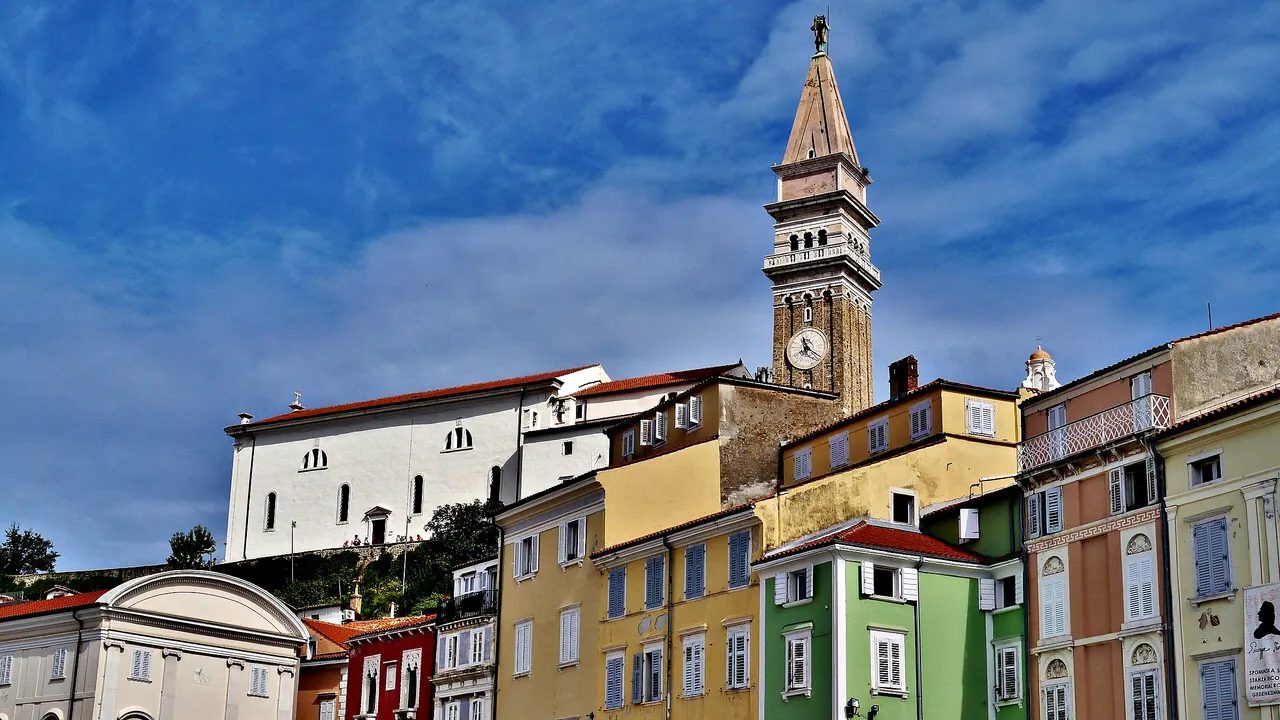
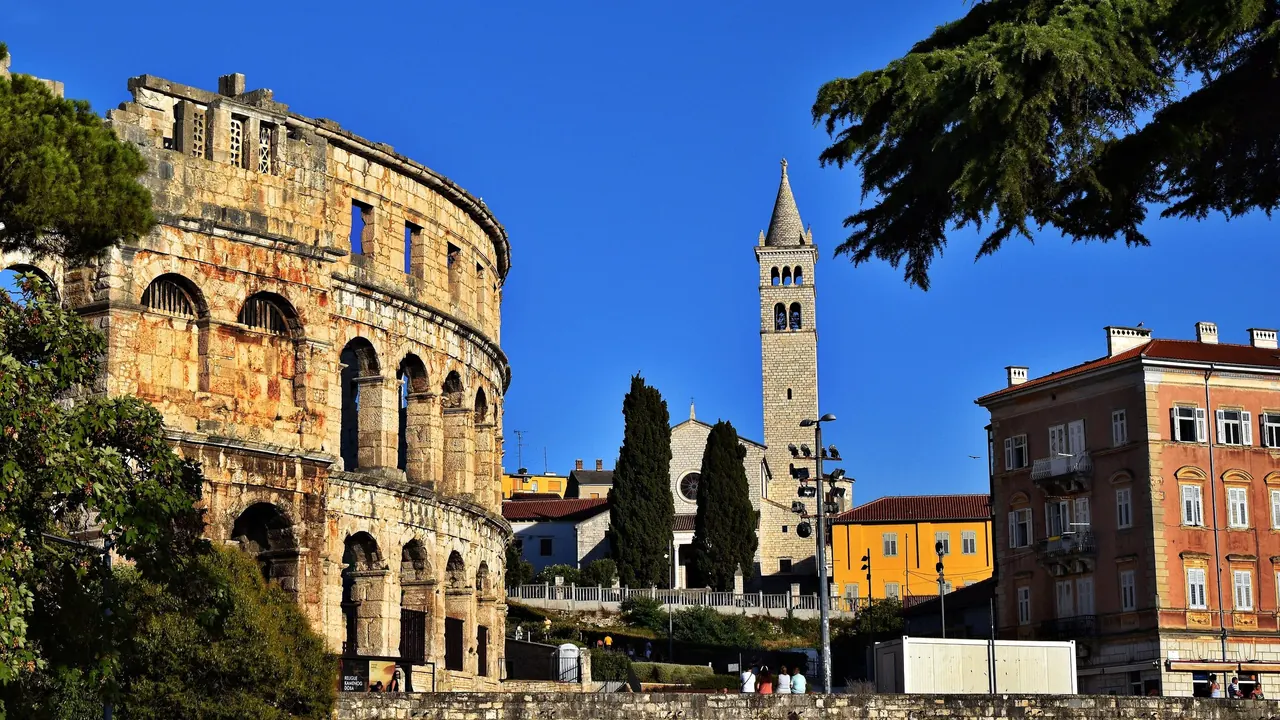
Photos: Piran by Zairon, CC BY-SA 4.0, cropped; Pula by Miroslav.vajdic, CC BY-SA 4.0, cropped.
Piran or Pula?
Our verdict in twelve categories, each scored against the same fixed benchmark cities, and the climate month by month, so you can choose for your trip.
Choose Piran for
- wellness
- getting around
Piran suits a slower, smaller trip. It is a car-free Venetian peninsula you can cross on foot in minutes, with long evenings on the seafront and a real tradition of sea-based spa treatments in Portoroz and the salt pans next door. Choose it if you want to unwind for a few days, swim off the town's platforms and use the place as a quiet base for Trieste, Ljubljana and the Slovenian Karst.
Choose Pula for
- beaches
- nightlife
- culture and sights
Travellers who want more to do will find Pula gives them more. It has a Roman amphitheatre that still stands complete, far better swimming among the wild coves of Cape Kamenjak, a more distinctive Istrian kitchen and summer concerts under the Arena's arches. Evenings are livelier, though still low-key, and families get more to fill the days. It works best for a longer stay with a car and an appetite for sightseeing alongside the sea.
Scoreboard
Twelve categories on one fixed scale from 0 to 100. The shaded stretch is the gap between the two.
Your match
Pick a travel style or drag the sliders, and both match scores follow your weighting.
Wins on wellness and getting around with your weighting.
Wins on beaches and nightlife with your weighting.
What matters to you?
Category by category
What the scores mean for a trip.
Beaches & swimming
Neither town has a sandy beach of its own, but Pula's coast gives you far more choice. South of the centre the Verudela and Stoja peninsulas have pine-shaded rocks and pebble coves. Further on, Cape Kamenjak has dozens of wild inlets and cliff ledges, and the sheltered bays around Medulin suit small children.
In Piran you swim from platforms and ladders below the walls and around the Punta, with the small pebble cove at Fiesa a short walk away. For sunbeds you head to the modest artificial sand at Portoroz or the cliff-backed shore at Strunjan. It is pleasant swimming, but there is much less of it.
Food & drink
Both coasts serve grilled fish, squid, scampi buzara and white Malvazija, but Pula sits in the heart of the Istrian kitchen. That means fuži and pljukanci pasta with truffle or game, cured pršut and a covered market hall that shows what is in season. The best meals are in family taverns inland, but there is more variety within reach.
Piran's eating is narrower: simple seafood konobas on the Punta and around Tartini Square, with harbour menus that repeat one another. The salt from its own pans and the hill country's oil and Refosk are good, but for more ambitious cooking you have to drive out of town.
Culture & sights
Pula offers the bigger sights. Its Arena is one of the best-preserved Roman amphitheatres anywhere, and the Temple of Augustus, the Arch of the Sergii and mosaics tucked into the backstreets make the Roman town easy to trace. The Venetian fortress museum and the Austro-Hungarian naval buildings add later layers, and together they fill a day or two.
Piran's appeal is the townscape itself: Venetian Gothic houses packed onto a peninsula, the oval Tartini Square, and St George's campanile and the old walls above the red roofs. Its museums are small, so it is a place for wandering rather than sightseeing.
Nightlife
Neither is a place to go out, but Pula at least has a summer night out to offer. After terrace drinks around the Forum, people move on to cocktail and beach bars on Verudela and around Medulin, and a few small clubs fill up on warm weekends.
Piran's evenings end with a glass of wine on Tartini Square or a sunset drink on the Punta, and the lanes go quiet early. For anything later you go to Portoroz's beach bars, casino and handful of summer clubs.
Nature & outdoors
Pula's outdoors is more active. Cape Kamenjak is a car-free headland of cliffs, wild flowers and dinosaur footprints, and you can easily arrange kayaking, windsurfing in Premantura bay and wreck diving from the naval era. The Učka range, about an hour and a half away, gives real hiking.
Piran's landscapes are gentler and quieter. You can walk above the tall flysch cliffs of Strunjan, watch wading birds among the Secovlje salt pans, cycle the old Parenzana railway through vineyards, or go down into the Skocjan caves on the Karst.
Day trips
Both are excellent touring bases, but they face different ways. Piran sits where three countries meet. Trieste is under an hour away, Ljubljana and Predjama Castle are within reach, and in summer boats cross the gulf to Venice.
Pula covers southern and central Istria more closely. Rovinj is about 45 minutes away, Poreč's Euphrasian Basilica and the hill towns of Motovun and Hum are around an hour off, and the Brijuni islands are a short boat ride from Fažana. Either way, you will want a car.
Good for families
Pula keeps children busy for longer. They can explore the aquarium inside an Austro-Hungarian fort, scramble through the Arena's underground passages, take the Brijuni boat to the safari park, and visit a dinosaur park and a water park within about an hour. The shallow bays at Medulin and Premantura are good for toddlers, though the heat and long drives take some effort.
Piran is wonderfully easy for a few days: no cars in the old town, a flat seafront and calm water. But beyond the little harbour aquarium and Portoroz's shallow beach there is not much aimed at children, and the steep lanes and ladders into the sea suit older children better than toddlers.
Getting around
Piran is the simpler place to be without wheels. You leave the car in the garage at the edge of town, and from there a shuttle and a seafront promenade link the old town with Portoroz. You can cross the whole peninsula on foot in about a quarter of an hour. It has no railway, though, so exploring further afield means hiring a car.
Pula's centre is just as walkable, but the city spreads out. You need city buses or a bicycle for Verudela and the southern coves, regional buses are infrequent, and parking near the centre is tight in summer.
Shopping & style
Shopping is modest in both, and the best buys in either town are things to eat and drink. Pula has a bit more. Its market hall and delicatessens sell truffle products, rakija, honey and pršut, and the pedestrian street has everyday fashion chains. Piran has a few galleries and craft shops, and its souvenir is salt flower from the Secovlje pans. For anything more, people go to Ljubljana or Trieste.
Affordability
Costs are similar in both, with the same jump in July and August. Piran's tight old town makes rooms scarce in high season and the waterfront restaurants charge for the view. To save money, you can stay in Portoroz, eat in simple konobas and lean on the free pleasures of swimming and walking.
In Pula, private apartments keep a stay reasonable, especially in spring and autumn. The extra costs come from the car hire and boat trips you need to reach Kamenjak and Brijuni.
Live music & performing arts
In both towns the stage comes alive mainly in summer, but Pula's is far grander. The Roman Arena turns into an open-air venue for touring pop and rock acts, classical galas and the long-running Pula Film Festival. The Istrian National Theatre performs year-round, though mostly in Croatian.
Piran's music is smaller and quieter: Tartini concerts in churches, the monastery cloister and on the square named after him, plus the occasional recital at the little Tartini Theatre.
Wellness & relaxation
Piran is the clear choice for wellness, because the sea next door has long been used for healing. Portoroz grew up as a spa resort with seawater pools, brine baths and salt-pan mud. You can also take thalasso treatments outdoors among the Secovlje lagoons, and Strunjan has its own seawater health resort.
Pula has no such tradition, so wellness there means the saunas and massage rooms of the big hotels on Verudela and in Medulin. Its calm comes instead from pine-shaded coastal walks once the summer crowds have gone.
When should you go?
Pick your month. The climate figures are measured averages, not a forecast.
Piran in July
Pula in July
Daytime high, °C
Rainfall in the month, mm
Where the figures come from
Pula's temperatures are measured 87 km from the centre, at Trieste.
Pula has no rain gauge within 25 km of the centre, so its rainfall comes from a gridded climate dataset read at the city rather than from a gauge further away.
Temperature and rainfall are climate normals, averaged over the years shown. Piran: 2005-2020 (sunshine 1991-2020, rainfall 1991-2020) normals, Portoroz (1.2 km from centre). Pula: 1991-2020 normals, Trieste (87 km from centre).
The two towns sit close together at the top of the Adriatic and share almost the same temperatures. Both are pleasant for the beach from June to September, when daytime highs reach about 30°C in July and the sea warms to 25°C by August. Late May and early October are good for walking the old streets but cool for long swims. From November to March both are chilly, grey and quiet, with highs around 10°C, and better for a short off-season visit than a beach trip.
Rain is where they part. Pula stays fairly dry right through the summer, while Piran gets noticeably more rain in May and again from September, reaching about 114mm in September, more than half as much again as Pula. If you are travelling in early autumn, Pula is the safer bet for settled weather. Both get the same long sunshine, peaking in July.
Which traveller are you?
On a relaxing and wellness trip, Piran is the better choice. The car-free lanes set a slow pace, Portoroz has a long spa tradition built on seawater and salt-pan mud, and you can lie in brine among the Secovlje lagoons. Pula only has hotel spas.
For a beach and sun trip, Pula wins clearly. Cape Kamenjak's protected headland has dozens of wild coves and clear water, and the sheltered Medulin bays add calmer swimming. Piran mostly means ladders off concrete and a small artificial beach nearby.
On a culture and arts trip, choose Pula for its Roman amphitheatre, the intact Temple of Augustus and summer concerts and film screenings inside the Arena. Piran's Venetian old town is lovely to wander, but a single day covers it.
Before you go
| Measure | Piran | Pula |
|---|---|---|
| Official language | Slovene | Croatian |
| Currency | Euro (EUR) | Euro (EUR) |
| Sockets | CF230 V, 50 Hz | CF230 V, 50 Hz |
| Driving side | Right | Right |
| Time zone | UTC+1, UTC+2 in summer | UTC+1, UTC+2 in summer |
| Emergency number | 112 | 112 |
| Elevation | 7 m | 5 m |
| Main airport | Trieste Airport (TRS)34 km from centre32 non-stop destinations | Pula Airport (PUY)7 km from centre34 non-stop destinations |
| Public holidays this year | 21 days | 14 days |
By the numbers
| Measure | Piran | Pula |
|---|---|---|
| City population | 3,787 | 52,220 |
| People per km² | 85 | 971 |
| Museums within 10 km | 5 | 4 |
| UNESCO World Heritage sites within 50 km | 4 | 1 |
| Swim season, months above 21 °C | 4 months | 4 months |
Where else could you go?
Every comparison below shares a destination with this one, so you can follow Piran or Pula somewhere new.