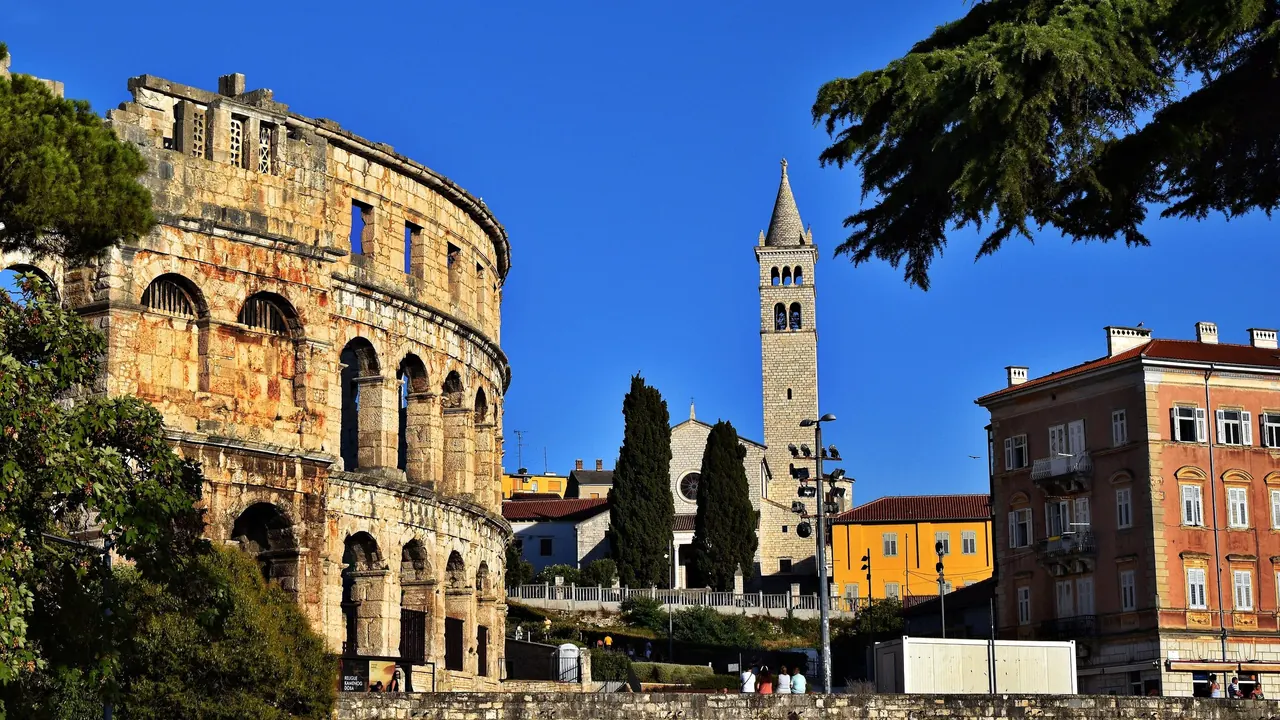
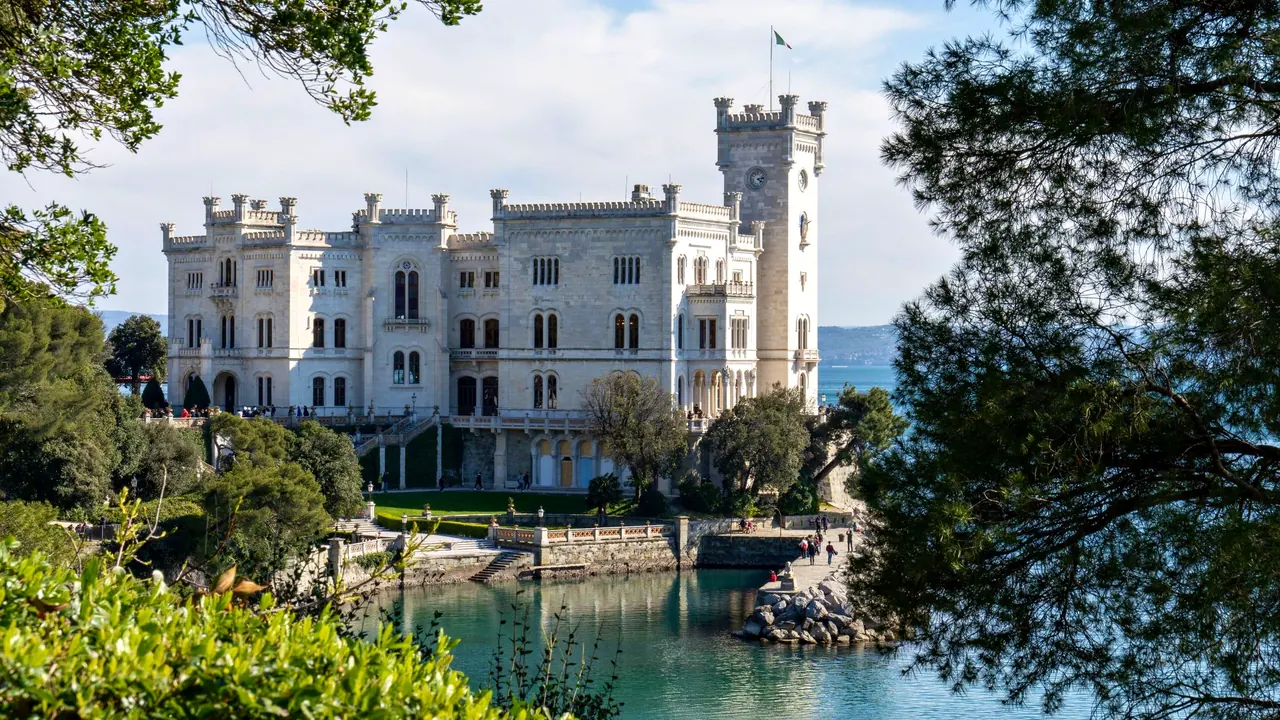
Photos: Pula by Miroslav.vajdic, CC BY-SA 4.0, cropped; Trieste by Tibor Szabo, Pexels License.
Pula or Trieste?
Our verdict in twelve categories, each scored against the same fixed benchmark cities, and the climate month by month, so you can choose for your trip.
Choose Pula for
- beaches
- nightlife
- families
Pula is for a summer by the sea with Roman history on the side. Kamenjak's coves and the sheltered bays around Medulin give it the better swimming, the Arena is worth the trip on its own, and it is a natural base for touring Istria by car, from Rovinj to the truffle villages of the interior.
Choose Trieste for
- getting around
- live music and the arts
- wellness
Trieste works for more of the year and needs less planning. It is far easier to get around without a car, it has a proper opera house and a more unusual food culture of buffets and coffee, and the Karst plateau rises right behind the streets for walks and caves. Swimming there means concrete steps at Barcola rather than wild coves, so it suits travellers who put the town first and the sea second.
Scoreboard
Twelve categories on one fixed scale from 0 to 100. The shaded stretch is the gap between the two.
Your match
Pick a travel style or drag the sliders, and both match scores follow your weighting.
Wins on beaches and nightlife with your weighting.
Wins on getting around and live music and the arts with your weighting.
What matters to you?
Category by category
What the scores mean for a trip.
Beaches & swimming
Neither has sand, but Pula's coast gives far more choice of where to swim. The indented shore around Verudela, Stoja and Medulin is lined with pine-shaded rocks and pebble coves. Cape Kamenjak adds dozens of wild inlets and cliff ledges, and the bays at Medulin are gentle and shallow enough for small children.
Swimming in Trieste is more urban. People lay towels on the stepped concrete at Barcola, climb down ladders into the sea and use old bathing establishments with changing cabins. The coves below Sistiana and Duino are prettier, but this is a city whose people swim, not a beach destination.
Food & drink
Pula cooks from the Istrian countryside and Trieste from a crossroads of empires, and Trieste's is the more unusual table. In Pula that means truffle fuži, scampi buzara, pršut and a glass of Malvazija. The choice in town is modest, though, and the tables around the Arena lean towards tourist menus, so the best meals are often a drive away in the hinterland konobas.
Trieste's buffets carve boiled pork from steaming pots to eat with horseradish and sauerkraut, and jota and sardoni share the menu with presnitz and strudel. Coffee has its own vocabulary, ordered by the glass at standing bars. Up on the Karst, the osmize open for a few weeks at a time to sell their own wine and cheese.
Culture & sights
Pula is a Roman city and Trieste a Habsburg one, and that shapes everything you see. Pula's Arena still has its three-storey outer ring above the harbour, the Temple of Augustus stands on the Forum and the Arch of the Sergii leads into the old streets. The Austro-Hungarian naval forts add a second layer, and it all fits into a day or two.
Trieste's sights belong to an imperial seaport: Piazza Unità opening onto the sea, the Borgo Teresiano grid along the Canal Grande and the white Miramare Castle on the coast. It has more museums and memorials, from the Revoltella to the Risiera di San Sabba, though its Roman theatre is a footnote beside Pula's amphitheatre.
Nightlife
Neither is a place for a big night out, and the difference lies in when and where the evenings happen. Going out in Pula is a summer thing: it moves from terraces by the Forum to beach bars and a few small clubs on Verudela and around Medulin, then fades when the season ends. Trieste revolves around the aperitivo in Piazza Unità and Cavana, and student wine bars keep it going all year, but on winter weeknights the streets are quiet by midnight.
Nature & outdoors
Trieste has the more dramatic outdoors on its doorstep. The Karst rises straight behind the city, with the Strada Napoleonica high above the gulf, the Val Rosandra gorge, the Rilke Path, and caves such as the Grotta Gigante and Škocjan. The Julian Alps are within reach for mountain days.
Pula's landscape is gentler, low macchia and olive groves. Kamenjak is the highlight for walking, cycling and kayaking around the islets, and the wrecks left from the naval era give it a diving draw of its own. Real hills mean a drive of about an hour and a half to Učka.
Day trips
Both are excellent bases, and the difference is the map. From Pula the trips stay mostly within Istria: Rovinj, Poreč's Euphrasian Basilica, the hill towns of Motovun and Grožnjan, and the boat to the Brijuni islands, ideally by car. Trieste reaches into three countries, with Aquileia and Palmanova in Friuli, Piran and Ljubljana in Slovenia and Venice by train, and more of it works without a car.
Good for families
Both are safe, calm places with children, and neither is built around them. Pula's strength is the sea, with shallow bays at Medulin and Premantura. It also has an aquarium inside an old fort, the Arena to clamber around, and a dinosaur park and water park within an hour, although getting to most of it means using a car.
Trieste suits older children better. The Grotta Gigante, the gardens at Miramare and the hands-on science centre are its best outings, but rocky swimming and steep, stepped streets make it harder going with toddlers.
Getting around
Pula leans on a car, and Trieste mostly does not. Pula's walkable core around the Arena, the Forum and the harbour is tiny, and city buses run out to Verudela and towards Premantura. Beyond that, Kamenjak, the hill towns and most of the coast are hard work without a car or scooter, regional buses are infrequent and summer parking near the centre is tight.
In Trieste a dense bus network runs along the coast to Barcola and Miramare and up onto the Karst, and passenger boats cross the bay to Muggia. A car matters only for the wine country and trips over the border. The one real effort is the climb up the steps to San Giusto.
Shopping & style
Neither is a shopping destination, and in both the best things to buy are edible. Trieste has a little more to browse: Italian clothing shops around Corso Italia, antique and second-hand shops in the old town lanes, and coffee from the city's roasters. In Pula the buys are olive oil, truffle products, honey and rakija from the market hall and from producers, and there is little else beyond chain stores and souvenirs on the main street.
Affordability
Pula's prices swing with the season, while Trieste's stay steadier. Pula is good value in spring and autumn, when private apartments and simple konobas keep a stay reasonable. In July and August, though, rooms cost about as much as on the coasts of Western Europe, and car hire and boat trips add up.
Trieste only gets tighter around the Barcolana regatta and in high summer, and many of its best moments cost nothing, from the waterfront and the cathedral hill to walks on the Karst. Its seafood restaurants and smarter hotels still charge ordinary Italian city prices.
Live music & performing arts
Trieste is the place for a night at the theatre. The Teatro Verdi runs a real season of opera and ballet, and operetta is a local Habsburg habit that is rare in Italy. The Politeama Rossetti and the Slovenian-language theatre add drama and musicals.
Pula has one great card, the Arena in summer, when concerts and Pula Film Festival screenings fill the Roman stands. For the rest of the year the Istrian National Theatre plays in Croatian and little else is on.
Wellness & relaxation
Neither city has a bathing culture of its own, so unwinding here is more about pace than treatments. In Pula the spa offer is the pools, saunas and massages of the big resort hotels on Verudela and in Medulin. The slower side of the city shows mostly in spring and autumn, with evening walks on the pine-shaded coastal paths and quiet days among the inland villages.
Trieste is the easier place to slow down. Its old coffee houses are made for a long sitting over a newspaper, its older population sets an unhurried tempo, and the Molo Audace pier is where people go to watch the sun set over the gulf. A few day spas add to the hotel spas, but for proper thermal baths you have to leave the city.
When should you go?
Pick your month. The climate figures are measured averages, not a forecast.
Pula in July
Trieste in July
Daytime high, °C
Rainfall in the month, mm
Where the figures come from
Pula's temperatures are measured 87 km from the centre, at Trieste.
Pula has no rain gauge within 25 km of the centre, so its rainfall comes from a gridded climate dataset read at the city rather than from a gauge further away.
Temperature and rainfall are climate normals, averaged over the years shown. Pula: 1991-2020 normals, Trieste (87 km from centre). Trieste: 1991-2020 normals, Trieste (1.6 km from centre).
The two share almost identical warmth and sunshine. Swimming is good from June to September in both, with daytime highs of 29°C and the sea at about 25°C in July and August. That midsummer heat makes midday walking hard work, so May, June and September are the better months for sightseeing and walking. Winters are cool and grey in both, with highs of around 10°C.
The real difference is rain. Trieste is wetter almost all year. In May it gets about 90mm against under 50mm in Pula, which makes late spring and early summer more settled in Pula. Rain picks up in both from September, and November is the wettest month in each, but Trieste's autumn is the damper of the two.
Which traveller are you?
On a beach and sun trip, Pula is the clear choice. Kamenjak's wild coves, the pine-shaded rocks of Verudela and the shallow bays of Medulin give far more variety than Trieste's concrete platforms at Barcola, and early summer there is drier.
For a culture and arts trip, Trieste fills the evenings as well as the days. Habsburg squares, Miramare Castle and the Revoltella museum come with an opera and ballet season at the Teatro Verdi. Pula's arts calendar rests largely on summer concerts in the Arena.
For a short city break, Trieste is easier to use. The waterfront, the Borgo Teresiano and the museums sit close together, buses and boats reach Miramare and the Karst, and aperitivo hour fills the evenings. Pula's sights fit into a day, but much of the rest needs a car.
Before you go
| Measure | Pula | Trieste |
|---|---|---|
| Official language | Croatian | Italian |
| Currency | Euro (EUR) | Euro (EUR) |
| Sockets | CF230 V, 50 Hz | CFL230 V, 50 Hz |
| Driving side | Right | Right |
| Time zone | UTC+1, UTC+2 in summer | UTC+1, UTC+2 in summer |
| Emergency number | 112 | 112 |
| Elevation | 5 m | 2 m |
| Main airport | Pula Airport (PUY)7 km from centre34 non-stop destinations | Trieste Airport (TRS)31 km from centre32 non-stop destinations |
| Public holidays this year | 14 days | 13 days |
By the numbers
| Measure | Pula | Trieste |
|---|---|---|
| City population | 52,220 | 198,417 |
| People per km² | 971 | 2,332 |
| Museums within 10 km | 4 | 33 |
| UNESCO World Heritage sites within 50 km | 1 | 5 |
| Swim season, months above 21 °C | 4 months | 4 months |
Where else could you go?
Every comparison below shares a destination with this one, so you can follow Pula or Trieste somewhere new.