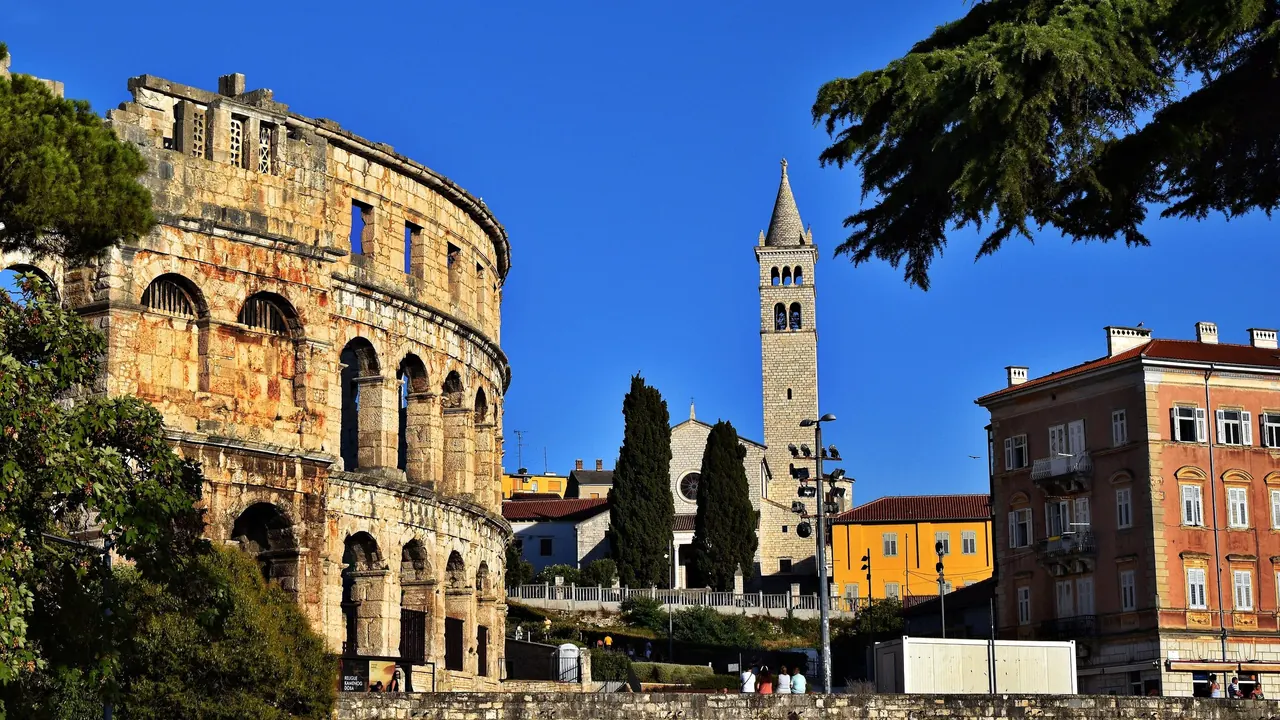
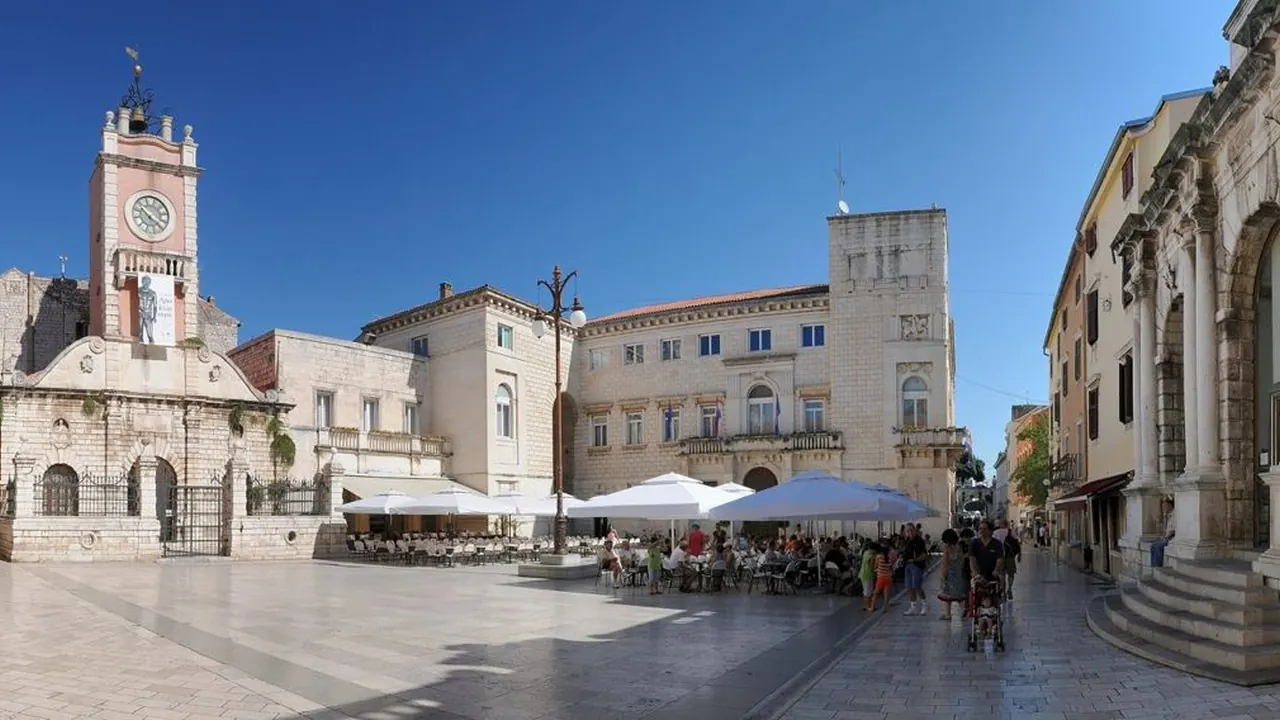
Photos: Pula by Miroslav.vajdic, CC BY-SA 4.0, cropped; Zadar by Böhringer Friedrich, CC BY-SA 2.5, cropped.
Pula or Zadar?
Our verdict in twelve categories, each scored against the same fixed benchmark cities, and the climate month by month, so you can choose for your trip.
Choose Pula for
- food and drink
- day trips
- live music and the arts
Pula is the better pick for travellers who want to tour a region and eat well along the way. It sits at the foot of Istria, so Rovinj, Poreč, the truffle hill towns and the Brijuni islands all make easy days out. The Istrian kitchen of truffle pasta, Malvazija and estate olive oil gives it more depth at the table, and a summer concert in the Roman Arena is something Zadar cannot match.
Choose Zadar for
- nature and the outdoors
- getting around
- wellness
Zadar suits people who come for landscape and the sea beyond the shoreline. The Velebit gorges of Paklenica, the Kornati islands, Krka and Plitvice are all within reach, and ferries leave from the edge of a car-free old town, so island hopping is simple. It also suits anyone who wants to stroll a compact walled peninsula and end each day watching the sunset at the Sea Organ.
Scoreboard
Twelve categories on one fixed scale from 0 to 100. The shaded stretch is the gap between the two.
Your match
Pick a travel style or drag the sliders, and both match scores follow your weighting.
Too close to call, 1 point apart
Wins on food and drink and day trips with your weighting.
Wins on nature and the outdoors and getting around with your weighting.
What matters to you?
Category by category
What the scores mean for a trip.
Beaches & swimming
Neither city has a sandy town beach, and the swimming is about equally good. The difference is where you go for it. In Pula the best water is among the wild coves and cliff ledges of Cape Kamenjak and the pine-backed rocks of Verudela and Stoja, so you need water shoes and some sense of adventure.
In Zadar, swimming is part of town life: people dive off the stone promenade a few minutes from the cathedral. For sand you go out of town, to Nin's long shallow beaches or by ferry to Sakarun on Dugi Otok.
Food & drink
Pula eats better. It belongs to Istria, one of the Adriatic's most distinctive regional kitchens, and truffle pasta, pršut and estate wines from just inland reward anyone who drives out to the village taverns. Around the Arena, though, menus lean towards tourists.
Zadar's Dalmatian cooking is honest and enjoyable, with peka-cooked lamb, black risotto and Pag cheese, and Maraschino is a local speciality to try. But the konobas on the peninsula all serve much the same dishes, so a week here offers less variety at the table.
Culture & sights
The two are close, and the difference is one of character. Pula is above all a Roman city: the three-storey ring of the Arena, the intact Temple of Augustus and the Arch of the Sergii, plus Austro-Hungarian forts from its time as a naval base.
Zadar packs more periods into a smaller space. The round ninth-century St Donatus stands beside the Roman forum, the Venetian walls are UNESCO-listed, and the glass and archaeological museums repay a visit. Then come its modern waterfront pieces, the Sea Organ and the Greeting to the Sun.
Nightlife
Both towns are quiet after dark and come alive only in summer, but the night goes in different directions. In Pula it drifts out of town to cocktail and beach bars on Verudela and around Medulin, with a few small clubs.
Zadar's evening starts with the sunset crowd on the Riva and carries on in café-bars along Kalelarga. Anyone who wants real clubbing makes the hour's trip to Zrće on Pag, which has nothing like it near Pula.
Nature & outdoors
Zadar is much the stronger base for the outdoors. The Velebit rises straight behind it, with Paklenica's gorges for hiking and climbing, and at sea there are the stark Kornati islands and the cliffs and salt lake of Telašćica. Krka, Plitvice and the birdlife at Vrana lake are all within a day.
Pula's landscape is gentler: stony coast, pine and olive groves, with Kamenjak's cliffs and dinosaur footprints for walking, cycling and kayaking. The nearest real mountains, at Učka, are an hour and a half away.
Day trips
Pula has the richer choice of short excursions, because all of Istria is close. Rovinj is under an hour away, Poreč's Byzantine mosaics are about an hour, and the hill towns of Motovun, Grožnjan and Hum add truffles and wine. Brijuni is a short boat ride, and Piran and Trieste even put a second country within reach.
Zadar's best outings are good but more spread out. Šibenik and little Nin are near, while Split and Trogir mean a long day on the motorway. Its strength is the ferries to Ugljan, Pašman and car-free Silba.
Good for families
Both are safe and easy-going with children, and Pula has a little more to do on rainy or restless days. The aquarium in the Verudela fort, the Arena's underground passages and the dinosaur park and water park within an hour fill the gaps between swims in Medulin's shallow bays.
Zadar has no attractions built for children, but its car-free old town and wide promenade are easier with a pushchair. The Sea Organ and the light-up Greeting to the Sun are a hit after dark, and Nin's sandy shallows are the best beach for toddlers in either place.
Getting around
Zadar is the easier place to manage without a car. Its flat pedestrian peninsula takes a quarter of an hour to cross, Kolovare beach is a walk away, and island ferries leave from the edge of the old town.
Pula's centre is just as compact, but most of what makes a stay worthwhile, from Kamenjak to the hill towns and the wider coast, depends on a car or scooter, as buses beyond the city are sparse.
Shopping & style
Neither is a shopping destination, and in both the best souvenirs are edible. Pula's are Istrian truffle products, olive oil and wine, bought at the market hall or from producers. Zadar adds Maraschino, Pag cheese and Pag lace, and Kalelarga has a few jewellers and galleries to browse.
Affordability
The two cost about the same: mid-priced, cheaper than the famous towns further south, and expensive in July and August. Where the money goes differs a little. In Pula car hire and boat trips are the extras that mount up, while in Zadar it is national park entry and island excursions. In both, private apartments in June or September give the best value.
Live music & performing arts
Pula comes out ahead thanks to the Arena. On summer nights touring pop and rock acts, classical galas and the Pula Film Festival fill the Roman stands, which makes for a far bigger occasion than anything in Zadar.
Zadar's offer is smaller and more intimate: early and chamber music in St Donatus and klapa singing in squares and churches. Outside summer, both cities have little more than a local theatre performing in Croatian.
Wellness & relaxation
Neither has a spa tradition, so wellness in both means resort hotel spas, at Verudela and Medulin for Pula and at Borik for Zadar. Zadar has a slight edge for unwinding, with the mineral mud of Nin's lagoon and the evening sunset ritual on the Sea Organ steps. Pula offers pine-shaded coastal walks and quiet days in the Istrian countryside instead.
When should you go?
Pick your month. The climate figures are measured averages, not a forecast.
Pula in July
Zadar in July
Daytime high, °C
Rainfall in the month, mm
Where the figures come from
Pula's temperatures are measured 87 km from the centre, at Trieste.
Pula has no rain gauge within 25 km of the centre, so its rainfall comes from a gridded climate dataset read at the city rather than from a gauge further away.
Zadar has no rain gauge within 25 km of the centre, so its rainfall comes from a gridded climate dataset read at the city rather than from a gauge further away.
Temperature and rainfall are climate normals, averaged over the years shown. Pula: 1991-2020 normals, Trieste (87 km from centre). Zadar: 1999-2020 (rainfall 1991-2020) normals, Zadar / Zemunik (9.9 km from centre).
Both cities have the same short swimming season, from June to September, when the sea is warm enough for a long dip and reaches about 25°C in August. Zadar is the hotter of the two in high summer, with afternoons around 31°C against Pula's 29°C, and it is also the drier, with very little rain in July. Pula gets the most sunshine of the year in July. In both towns midday sightseeing is hard going in July and August.
The seasons part ways in autumn. Rain arrives in Zadar from September and peaks at about 113mm in November, while Pula stays drier into September and its wettest month is November. May and late September are the best months for walking the old streets and the countryside in either city, with warm days and a sea that is still pleasant in September. Winters are cool and grey in both, with highs around 10°C, and Zadar runs slightly milder.
Which traveller are you?
For an outdoors trip, Zadar is the clear choice. Paklenica's limestone gorges and climbing routes are under an hour away, sailing trips head out to the Kornati and Telašćica, and Krka's waterfalls make an easy day. Pula's Kamenjak is lovely, but it is a smaller landscape.
On a food and nightlife trip, Pula has the edge. Istrian cooking, with truffles, fuži pasta, scampi buzara and Teran wine from nearby estates, is richer than Zadar's narrower Dalmatian menus. Evenings are equally low-key in both, but Pula's harbour and beach bars round off a good dinner well.
For a culture and arts trip, Pula wins narrowly. Its Arena is one of the best-preserved Roman amphitheatres anywhere, and in summer it hosts concerts and film screenings. Zadar has fine churches and small museums, but less happens on its stages.
Before you go
| Measure | Pula | Zadar |
|---|---|---|
| Official language | Croatian | Croatian |
| Currency | Euro (EUR) | Euro (EUR) |
| Sockets | CF230 V, 50 Hz | CF230 V, 50 Hz |
| Driving side | Right | Right |
| Time zone | UTC+1, UTC+2 in summer | UTC+1, UTC+2 in summer |
| Emergency number | 112 | 112 |
| Elevation | 5 m | 5 m |
| Main airport | Pula Airport (PUY)7 km from centre34 non-stop destinations | Zadar Airport (ZAD)10 km from centre66 non-stop destinations |
| Public holidays this year | 14 days | 14 days |
By the numbers
| Measure | Pula | Zadar |
|---|---|---|
| City population | 52,220 | 70,779 |
| People per km² | 971 | - |
| Museums within 10 km | 4 | 1 |
| UNESCO World Heritage sites within 50 km | 1 | 2 |
| Swim season, months above 21 °C | 4 months | 4 months |
Where else could you go?
Every comparison below shares a destination with this one, so you can follow Pula or Zadar somewhere new.