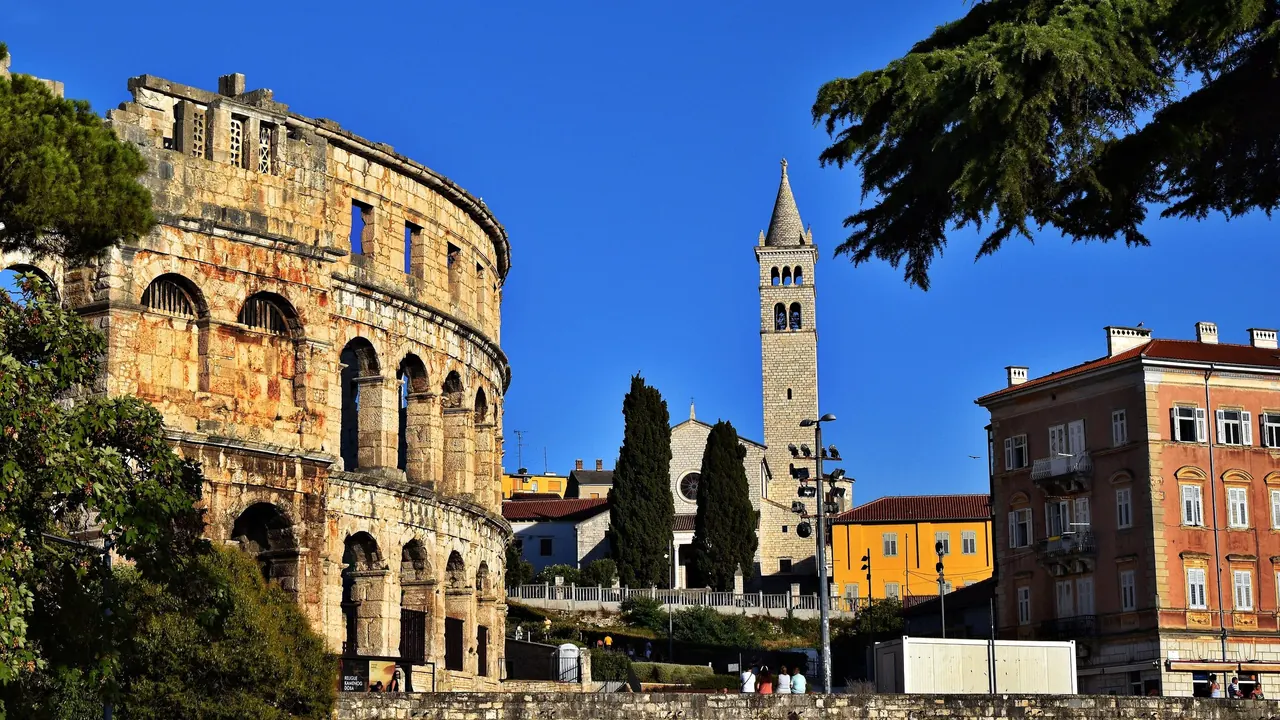
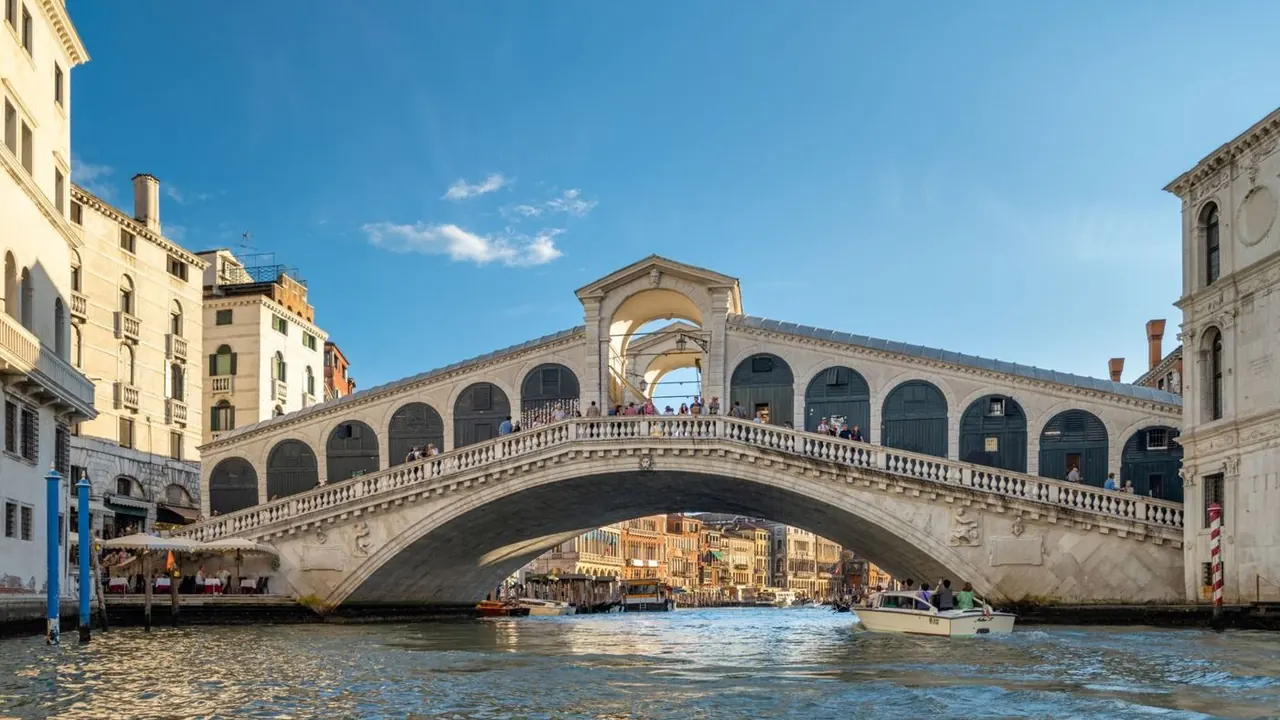
Photos: Pula by Miroslav.vajdic, CC BY-SA 4.0, cropped; Venice by David Vives, Pexels License.
Pula or Venice?
Our verdict in twelve categories, each scored against the same fixed benchmark cities, and the climate month by month, so you can choose for your trip.
Choose Pula for
- prices
- beaches
- nature and the outdoors
Pula suits a summer vacation built around the sea. You get very clear water off rock ledges and pine-fringed coves, the wild headland of Kamenjak, and a Roman arena you can explore between swims. It costs noticeably less than Venice and is easier with young children. With a car it also makes a good base for Rovinj, the Istrian hill towns and the Brijuni islands.
Choose Venice for
- culture and sights
- shopping
- live music and the arts
For art, architecture and music, Venice is in another league. A week of palaces, churches and galleries standing on water still leaves plenty unseen, and La Fenice and the Biennale fill the evenings and seasons. Fast trains reach Padua, Verona and Vicenza with no car needed. The trade-offs are steep prices, bridges that are hard on pushchairs, and a beach that is an afternoon's break rather than the reason to come.
Scoreboard
Twelve categories on one fixed scale from 0 to 100. The shaded stretch is the gap between the two.
Your match
Pick a travel style or drag the sliders, and both match scores follow your weighting.
Wins on prices and beaches with your weighting.
Wins on culture and sights and shopping with your weighting.
What matters to you?
Category by category
What the scores mean for a trip.
Beaches & swimming
Pula is clearly the better place to swim, though not on sand. You swim off rock ledges, concrete platforms and pebble coves around Verudela, Stoja and Medulin, in very clear water with pines close behind. Cape Kamenjak, about 10km south, has dozens of wild inlets for a full day out. Bring water shoes for the urchins.
Venice has the one thing Pula lacks: a long sandy beach on the Lido with shallow, gentle water. But the water is greenish, and much of the beach is laid out in rows of cabanas. It works as a break from sightseeing, with Pellestrina as the quieter option, rather than as a beach vacation.
Food & drink
The two are roughly level, but they are very different kitchens. Pula eats Istrian: fuži with truffle, scampi buzara, pršut, and a glass of Malvazija or Teran. The best meals are often in family konobas in the hinterland or by small harbours, not in town.
Venice eats standing up, with cicchetti and a spritz at the bacari of Cannaregio and Castello, and lagoon dishes such as cuttlefish risotto black with its ink. In both cities the menus by the main monuments, the Arena in one and San Marco in the other, are best avoided.
Culture & sights
Pula's culture is mostly Roman, and it is concentrated. The Arena, its outer ring still standing to the full three storeys above the harbour, is the reason to come. Within a few streets of it you can trace the Roman town through the Temple of Augustus, the Arch of the Sergii and stray floor mosaics, with the fortress museum and the solid Habsburg naval buildings adding a later layer. An afternoon gives you the essentials and two days covers the lot.
Venice has no single monument to aim for, because the whole townscape is the sight: six centuries of palaces and churches on water, with nothing modern in view. Where Pula keeps its highlights close together, Venice scatters them, with masterpieces hanging in ordinary parish churches far from San Marco, and the Grand Canal is best seen slowly from a boat. A short visit to Venice only skims the surface.
Nightlife
Neither is a place for a big night out, but Pula has a little more going on in summer. Drinks on the terraces around the Forum lead on to cocktail and beach bars on Verudela and around Medulin, and a few small clubs fill up on warm weekends.
Venice's busiest hour is the aperitivo, in the bacari and along the Fondamenta della Misericordia. Campo Santa Margherita stays busy a little later, then the canals go quiet around midnight. That silence makes for a lovely late walk, but anyone who wants to dance heads for Jesolo.
Nature & outdoors
Pula has more to do outdoors. Kamenjak's car-free headland is good for walking and cycling, and there is kayaking around the islets, windsurfing at Premantura and diving on naval-era wrecks. The Učka range, about an hour and a half away, has proper hiking.
Venice's outdoors is the lagoon, which is flatter and gentler. You can see herons and flamingos in the marshes around Torcello and Sant'Erasmo, try kayaking or rowing standing up Venetian-style, and cycle along the sea walls of the Lido and Pellestrina. The nearest real mountains are more than two hours away.
Day trips
Both make good bases, but Venice is the richer and easier one. Fast trains reach Padua in about half an hour and Verona in not much over an hour, with Vicenza in between. Murano, Burano and Torcello are just a boat ride across the lagoon.
From Pula the trips are around Istria: Rovinj, Poreč with its Byzantine mosaics, the hill towns of Motovun and Grožnjan, and the Brijuni islands. It is lovely touring country, but buses are infrequent and nearly every trip is easier with a car.
Good for families
Pula is the easier choice for families. There are shallow, sheltered bays at Medulin and Premantura, an aquarium inside an old fort, and an Arena that children can clamber through. A water park and a dinosaur park are within an hour, though you will want a car.
Children love the idea of Venice, with its boats, car-free alleys, glass-blowing on Murano and sand on the Lido. In practice, stepped bridges defeat pushchairs, the summer crowds are heavy, and there are few parks or playgrounds. It works best as a short stay with older children.
Getting around
Venice is simpler to get around once you are there. You walk or take the vaporetto, a car is never needed, and trains and buses drop you at the edge of the centre. The drawbacks are hundreds of stepped bridges, which are hard on luggage and wheels, and alleys that regularly get people lost.
Pula's flat centre takes minutes to cross on foot, and city buses reach Verudela. But Kamenjak's coves, the hill towns and most of the wider coast really need a car or a scooter.
Shopping & style
Venice has far more to buy. There is Murano glass, Burano lace, papier-mâché masks, marbled paper and furlane slippers from workshops in Dorsoduro and Castello, plus the big fashion names on Calle Larga XXII Marzo, though imported fakes crowd the main routes. In Pula the best things to take home are edible: olive oil, truffles, wine and pršut from the market hall, with little else beyond chain fashion.
Affordability
Pula is mid-priced and costs much less, though high summer narrows the gap. In July and August its rooms cost about as much as on the Western European coasts, and the tables near the Arena are pitched at tourists. Even then, a private apartment in Pula comes well short of a hotel room in central Venice. The sights and city buses cost little, and the real extras are a hire car and boat trips out to the coves and islands.
In Venice your room is where the bill really climbs, above all around San Marco, in summer and at carnival. On top of that come water buses priced for visitors and entry fees at most of the churches. Eating is a smaller contrast. A sit-down meal of grilled fish in an Istrian konoba is ordinary value, while in Venice the cheap way to eat is cicchetti standing at a bar counter, and a café table on the main piazza is famously steep. Staying on the mainland at Mestre or coming in late autumn or winter brings the bill down.
Live music & performing arts
Venice has a programme all year. La Fenice and the Malibran stage opera, ballet and symphonic concerts, the Goldoni puts on drama, the Biennale runs its own festivals, and there are Vivaldi concerts in churches most evenings, some much better than others.
Pula's one big draw is seasonal: summer concerts and the Pula Film Festival inside the Arena, a setting you will remember. For the rest of the year there is little beyond the Istrian National Theatre.
Wellness & relaxation
Neither city has a bathing tradition of its own, but Venice has more on offer. There are hotel spas in old palazzi and on the Lido and Giudecca, and the thermal pools and hot mud of Abano Terme are about an hour away. Early and late in the day, Castello, Cannaregio and Giudecca are hushed and restful.
Pula's calm is of a different kind. It has the spas of the big resort hotels on Verudela and in Medulin, evening walks on pine-shaded coastal paths and slow days in the countryside, all easiest outside high summer.
When should you go?
Pick your month. The climate figures are measured averages, not a forecast.
Pula in July
Venice in July
Daytime high, °C
Rainfall in the month, mm
Where the figures come from
Pula's temperatures are measured 87 km from the centre, at Trieste.
Pula has no rain gauge within 25 km of the centre, so its rainfall comes from a gridded climate dataset read at the city rather than from a gauge further away.
Temperature and rainfall are climate normals, averaged over the years shown. Pula: 1991-2020 normals, Trieste (87 km from centre). Venice: 1991-2020 (sunshine 1971-2000, rainfall 1981-2010) normals, Venezia / Tessera (6.7 km from centre).
Both cities sit at the top of the Adriatic and follow a similar curve through the year. July and August reach about 29°C, which makes midday sightseeing hard work in either place, so May, June and September are the most comfortable months for walking. The sea is warm enough to swim from June to September in both, peaking at around 25°C in August.
Where they differ is the rain. Venice is wettest in late spring and early summer, with 96mm in June, and again in October. Pula stays fairly dry and sunnier through the summer, then turns wet in autumn, reaching 107mm in November. Venice is also a little colder in winter, with January highs near 7°C, which suits museums better than long walks.
Which traveller are you?
On a beach and sun trip, Pula is the clear choice. Its water is very clear, its rocky and pebble coves have pine shade down to the shore, and Kamenjak's wild inlets are close by. Venice's Lido has sand, but its greenish water is worth one afternoon.
For a culture and arts trip, Venice wins easily. Its palaces, the Accademia, Titian in the Frari, Tintoretto at San Rocco and the Biennale can fill a week, with opera at La Fenice in the evenings. Pula's Roman sights take a day or two.
On a trip on a tight budget, your money goes much further in Pula. Private apartments, simple konobas and cheap city buses keep costs down, especially outside July and August. In Venice, rooms, water transport and most sights all cost a lot.
Before you go
| Measure | Pula | Venice |
|---|---|---|
| Official language | Croatian | Italian |
| Currency | Euro (EUR) | Euro (EUR) |
| Sockets | CF230 V, 50 Hz | CFL230 V, 50 Hz |
| Driving side | Right | Right |
| Time zone | UTC+1, UTC+2 in summer | UTC+1, UTC+2 in summer |
| Emergency number | 112 | 112 |
| Elevation | 5 m | 2 m |
| Main airport | Pula Airport (PUY)7 km from centre34 non-stop destinations | Venice Marco Polo Airport (VCE)7 km from centre103 non-stop destinations |
| Public holidays this year | 14 days | 13 days |
By the numbers
| Measure | Pula | Venice |
|---|---|---|
| City population | 52,220 | 250,369 |
| People per km² | 971 | 602 |
| Museums within 10 km | 4 | 52 |
| UNESCO World Heritage sites within 50 km | 1 | 5 |
| Swim season, months above 21 °C | 4 months | 4 months |
Where else could you go?
Every comparison below shares a destination with this one, so you can follow Pula or Venice somewhere new.