Photos: Bari by Sailko, CC BY-SA 4.0, cropped; Ohrid by kallerna, CC BY-SA 4.0, cropped.
Bari or Ohrid?
Our verdict in twelve categories, each scored against the same fixed benchmark cities, and the climate month by month, so you can choose for your trip.
Choose Bari for
- day trips
- food and drink
- live music and the arts
Bari suits travellers who want to eat well and use one city as a base for a week of outings. Its Apulian cooking, from focaccia and panzerotti in the old town to raw seafood by the fishermen's pier, gives it a clear lead over Ohrid. Matera, Alberobello, Polignano and Lecce are all within a train ride or a short drive. The evenings are livelier too, and the Teatro Petruzzelli adds a proper opera season.
Choose Ohrid for
- prices
- nature and the outdoors
- culture and sights
Ohrid is the better choice for a slower and cheaper trip built around landscape and medieval churches. The clear lake, the mountains of Galičica and the frescoes of St Sophia give it a setting that Bari's flat coastal plain cannot match, and guesthouses and meals cost noticeably less. It is at its best for walkers and for people who like quiet evenings by the water rather than a busy night out.
Scoreboard
Twelve categories on one fixed scale from 0 to 100. The shaded stretch is the gap between the two.
Your match
Pick a travel style or drag the sliders, and both match scores follow your weighting.
Wins on day trips and food and drink with your weighting.
Wins on prices and nature and the outdoors with your weighting.
What matters to you?
Category by category
What the scores mean for a trip.
Beaches & swimming
Bari has the better swimming. It has the sea, warm and calm in summer, a sandy city beach at Pane e Pomodoro, and the cliff-backed cove at Polignano a Mare and the inlets around Monopoli a short train ride south. Swimming fits easily into a summer stay as a half-day out.
In Ohrid you swim in fresh lake water, very clear and unsalted, from jetties, concrete platforms and short pebble strips below Kaneo, at Potpeš and in the villages to the south. It is lovely on a hot day, but the beaches are small and the water is only properly warm in July and August.
Food & drink
Food is one of the main reasons to choose Bari. Orecchiette rolled in the old town's doorways, focaccia barese, sgagliozze and raw sea urchins by the fishermen's pier give it a street-food culture of its own. Tiella, burrata and Primitivo or Negroamaro wine round out the sit-down meals.
Ohrid's Macedonian cooking is honest and satisfying: tavče gravče, ajvar, sheep's cheese and lake fish such as belvica, with Tikveš wines. But the same menu repeats along the waterfront, so it is worth seeking out family-run places in the upper old town.
Culture & sights
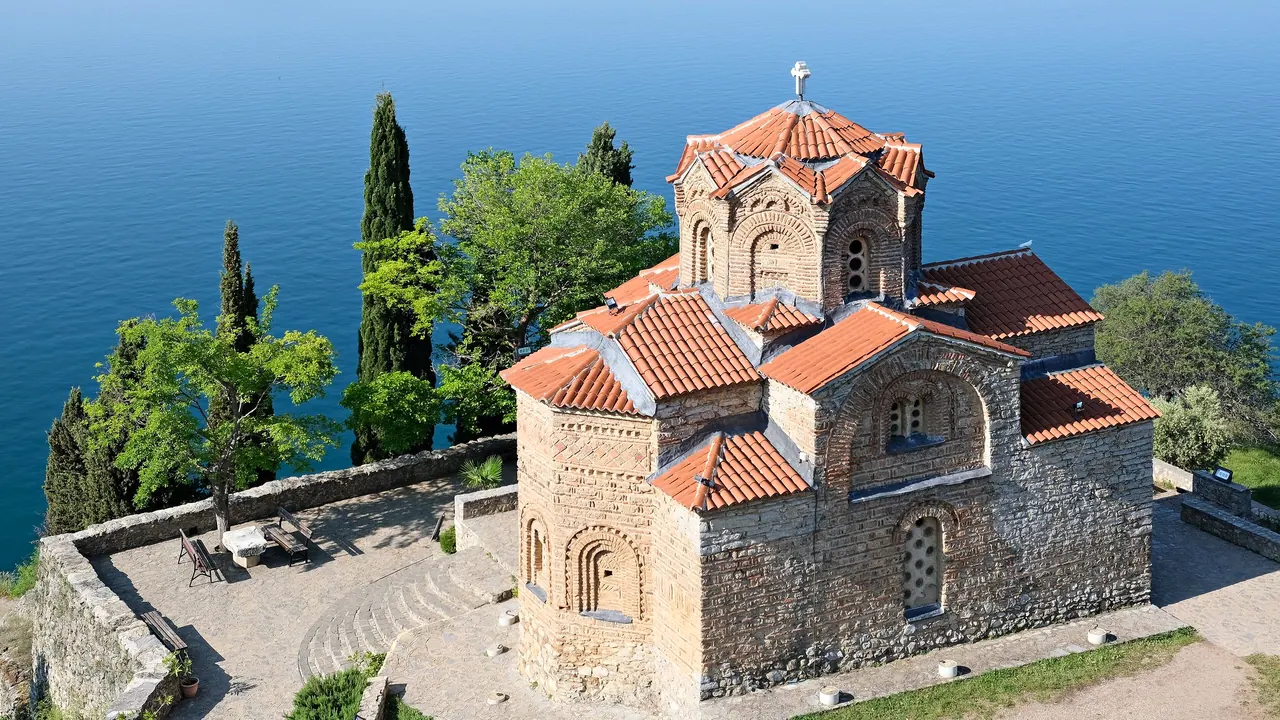
Ohrid has the deeper set of sights. The frescoes of St Sophia, the church of St John on its rock at Kaneo, Samuel's Fortress and the Plaošnik site, with its links to early Cyrillic learning and a Hellenistic theatre below, make the old town an open-air record of Orthodox history. Town and lake are listed together by UNESCO.
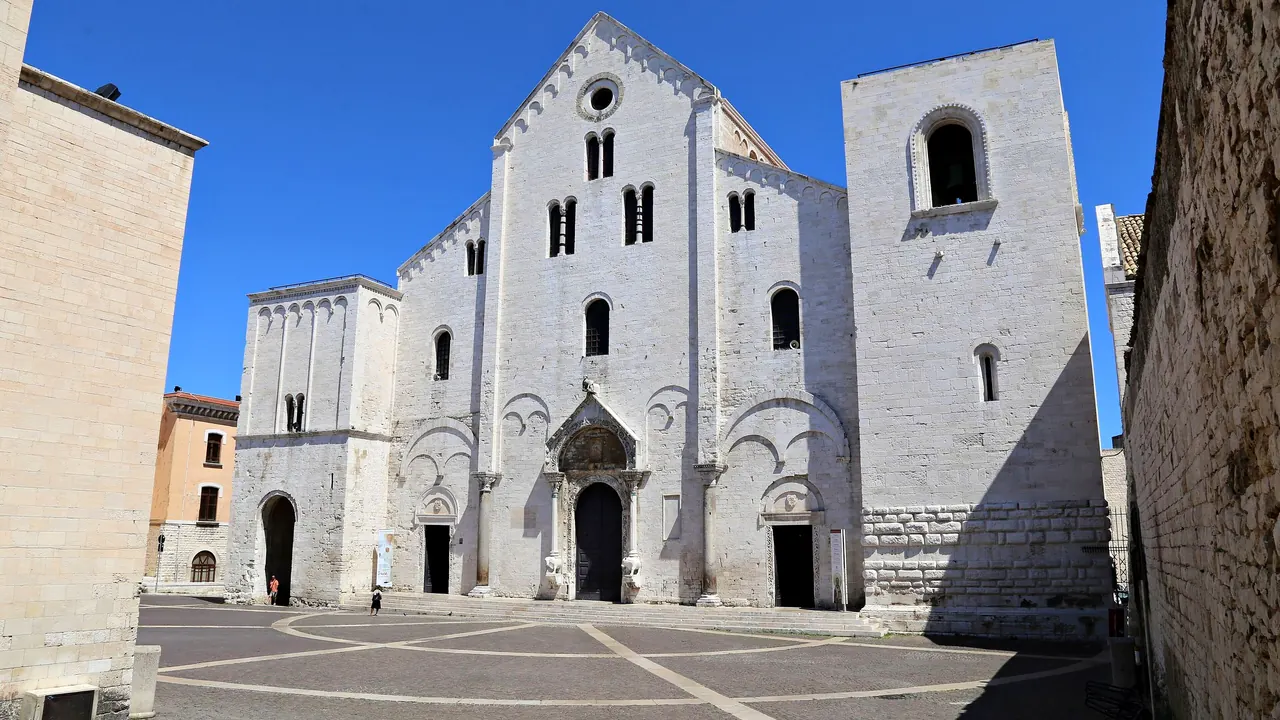
Bari's centrepiece is the Basilica di San Nicola, a fine Apulian Romanesque church and pilgrimage site, with the cathedral and the Norman-Swabian castle close by. The Murat grid and the Pinacoteca add a nineteenth-century and artistic layer, but the whole set is pleasant rather than profound.
Nightlife
Bari is the better place for an evening out. Students and young locals crowd Piazza Mercantile and Piazza Ferrarese, the bars of the Umbertino streets run past midnight, and there are a handful of clubs. The city stays reasonably lively outside summer, even if winter weeknights are quiet.
Ohrid's nightlife exists mainly in July and August, when visitors from Skopje fill the café-bars around the old bazaar and the beach clubs on the southern shore. For the rest of the year an evening usually ends with wine over dinner.
Nature & outdoors
Ohrid wins easily on scenery. The deep, ancient lake is ringed by mountains, Galičica rises steeply to viewpoints over both Ohrid and Prespa, and the spring-fed pool at St Naum is explored by rowing boat. Walking, kayaking and paragliding all start close to town.
Bari sits on a flat plain of olive groves, and its main outdoor space is the seafront promenade. The open karst of Alta Murgia, the Grotte di Castellana and gentle cycling in the Valle d'Itria are worthwhile, but none of it is wild.
Day trips
Day trips are where Bari pulls furthest ahead. Matera's cave dwellings, the trulli of Alberobello, the white towns of Ostuni and Locorotondo, Frederick II's Castel del Monte, Trani's seafront cathedral and Baroque Lecce are all within a day, many of them by train. It is a base you could fill a fortnight from.
Ohrid's outings are good but fewer: St Naum by boat or road, Struga, Bitola with the mosaics of Heraclea Lynkestis, and Korçë across the Albanian border. Roads are slow and buses are thin, so a car or a driver is close to essential.
Good for families
Bari is slightly easier with children. The sandy city beach, the flat, traffic-free lanes of the old town and outings to the Grotte di Castellana and the Fasano safari park give more variety, though the midday summer heat calls for a long break.
Ohrid works well for families happy to spend their days in the lake, with boat rides and the prehistoric pile village at the Bay of Bones as extras. The steep, cobbled old town is hard going with a pushchair, and neither place has much built specifically for children.
Getting around
Both centres are easy to manage on foot, but in different ways. Bari's old town, Murat quarter and promenade lie on flat ground, a train runs to the airport, and regional railways head out to the coast and inland, even if some lines are slow.
Ohrid is smaller but steep, with cobbles and stairs in the old town. Cheap, plentiful taxis do the work that Bari's trains do, since the buses and summer boats to the southern shore cannot be relied on.
Shopping & style
Bari offers more to browse. Via Sparano and the Murat streets carry Italian fashion chains and a few boutiques, and the delicatessens sell dried orecchiette, taralli, olive oil and Puglian ceramics to take home.
Ohrid's shopping centres on one craft, the Ohrid pearl, made by a few families from a lustre of lake-fish scales. Buy from an established workshop in the bazaar streets rather than a stall. Woodcarving, icons and filigree silver complete a small but distinctive range.
Affordability
Ohrid is clearly cheaper. Guesthouse rooms, full meals with Macedonian wine, taxis and church entry fees all cost little, and late spring or early autumn gives the lowest prices with good weather.
Bari is good value by Italian standards, with cheap street food, inexpensive local wine and a free old town and basilica. Beach clubs and car hire for the Valle d'Itria push the bill up, and in both places rooms tighten in July and August.
Live music & performing arts
Bari has a real year-round stage in the Teatro Petruzzelli, one of Italy's largest opera houses, with opera, ballet and symphonic concerts. A summer jazz festival in the piazzas and the castle adds to it, although much of the theatre is in Italian.
Ohrid's offer is almost entirely the Ohrid Summer Festival, whose concerts and opera in St Sophia and the ancient theatre make memorable settings. Outside the festival there is little beyond folk music in restaurants.
Wellness & relaxation
Neither is a spa destination. Both lack a bathing tradition and rely on hotel spas, so relaxation comes from the pace of the place.
In Bari that means long lunches, the afternoon break and the evening walk on the promenade, with restored country estates inland for proper pampering. Ohrid's calm is the lake itself, especially in May, June and September, when slow mornings by the water are at their best.
When should you go?
Pick your month. The climate figures are measured averages, not a forecast.
Bari in July
Ohrid in July
Daytime high, °C
Rainfall in the month, mm
Where the figures come from
Bari has no rain gauge within 25 km of the centre, so its rainfall comes from a gridded climate dataset read at the city rather than from a gauge further away.
Bari's sunshine is measured 77 km from the centre, at Marina Di Ginosa.
Ohrid has no rain gauge within 25 km of the centre, so its rainfall comes from a gridded climate dataset read at the city rather than from a gauge further away.
Temperature and rainfall are climate normals, averaged over the years shown. Bari: 1991-2020 (sunshine 1961-1990) normals, Bari / Palese Macchie (7 km from centre). Ohrid: 1999-2017 (rainfall 1991-2020) normals, Ohrid (0.2 km from centre).
Bari is the warmer of the two all year. Beach weather runs from June into September, with highs around 30°C in July and August and the sea at its warmest, about 26°C, in August. Summer is long, sunny and nearly dry, though the middle of the day is too hot for comfortable sightseeing. The rain returns in September and is heaviest in November, at about 83mm, while winters stay mild enough for walking the old town.
Ohrid's warm season is shorter and a little cooler. July and August are the months for swimming in the lake, with highs in the high twenties, and May, June and September suit walking and sightseeing. Winters are properly cold, around 6°C in January, and late autumn into December is the wettest stretch. The two are closest in high summer and furthest apart in winter, when Ohrid is several degrees colder. In spring Ohrid is also much wetter, with roughly twice Bari's rain in March and May.
Which traveller are you?
On a food and nightlife trip, Bari is the clear choice. An evening can run from raw seafood by the fishermen's pier to orecchiette with a glass of Primitivo, then late drinks on the steps of the old-town piazzas. Ohrid only comes alive in high summer.
For an outdoors trip, Ohrid is the better base. Your days can run from the lakeshore up to mountain viewpoints and back down for a swim, and spring and September are ideal for walking. Bari's flat olive country suits gentle cycling, not climbs.
On a trip on a tight budget, Ohrid makes the money last. You can afford a family guesthouse, a sit-down dinner every night and taxis for short hops, and the sights are all within walking distance. In Bari, saving mostly means eating street food from the old-town windows.
Before you go
| Measure | Bari | Ohrid |
|---|---|---|
| Official language | Italian | Albanian, Macedonian |
| Currency | Euro (EUR) | Denar (MKD) |
| Sockets | CFL230 V, 50 Hz | CF230 V, 50 Hz |
| Driving side | Right | Right |
| Time zone | UTC+1, UTC+2 in summer | UTC+1, UTC+2 in summer |
| Emergency number | 112 | 112 |
| Elevation | 5 m | 695 m |
| Main airport | Bari Karol Wojtyła International Airport (BRI)9 km from centre104 non-stop destinations | Ohrid St. Paul the Apostle Airport (OHD)9 km from centre14 non-stop destinations |
| Public holidays this year | 13 days | 12 days |
By the numbers
| Measure | Bari | Ohrid |
|---|---|---|
| City population | 315,473 | 38,818 |
| People per km² | 2,687 | 100 |
| Museums within 10 km | 12 | 11 |
| UNESCO World Heritage sites within 50 km | 1 | 2 |
| Swim season, months above 21 °C | 4 months | - |
Where else could you go?
Every comparison below shares a destination with this one, so you can follow Bari or Ohrid somewhere new.