Photos: Ohrid by kallerna, CC BY-SA 4.0, cropped; Saranda by Sharon Hahn Darlin, CC BY 2.0, cropped.
Ohrid or Saranda?
Our verdict in twelve categories, each scored against the same fixed benchmark cities, and the climate month by month, so you can choose for your trip.
Choose Ohrid for
- culture and sights
- live music and the arts
- shopping
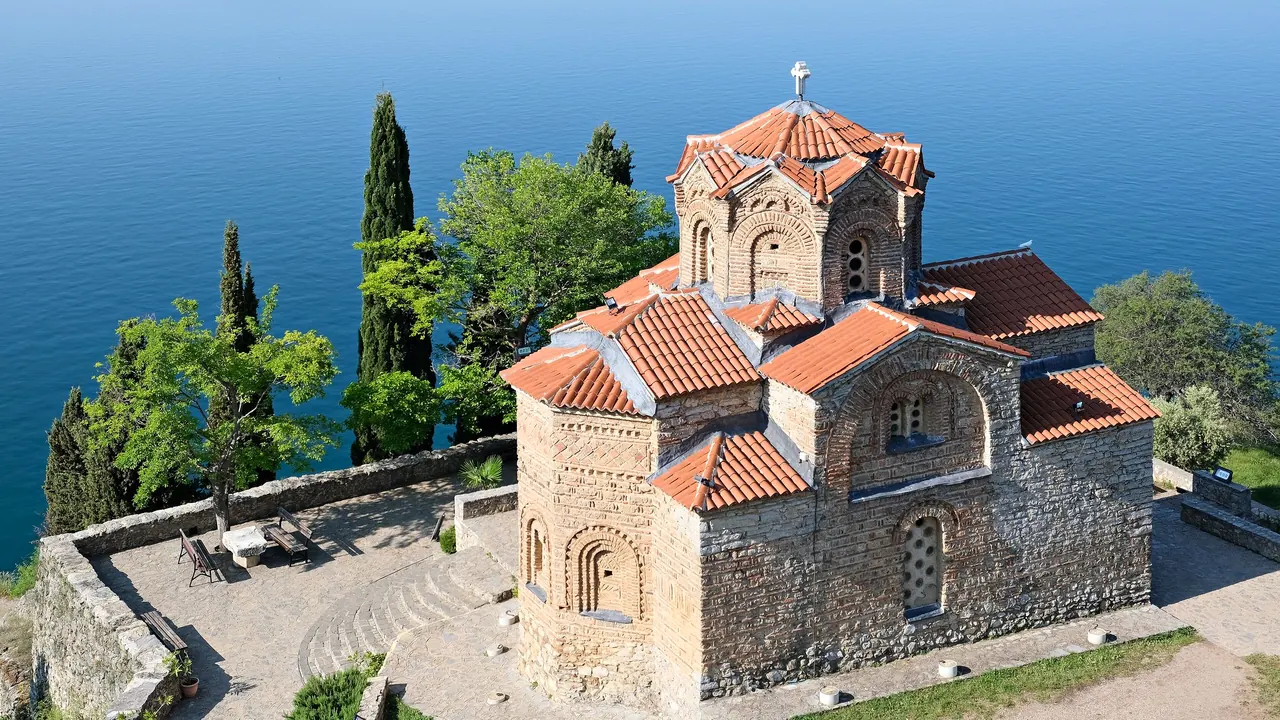
Ohrid is the better pick for travellers who want history they can walk through. Frescoed churches, Samuel's Fortress and the chapel of St John at Kaneo all stand above a clear mountain lake, and Galičica rises behind the town for hiking. It is cheaper, easier to get around on foot and has a real summer festival. The trade-off is fresh-water swimming and a short beach season.
Choose Saranda for
- beaches
- day trips
- nightlife
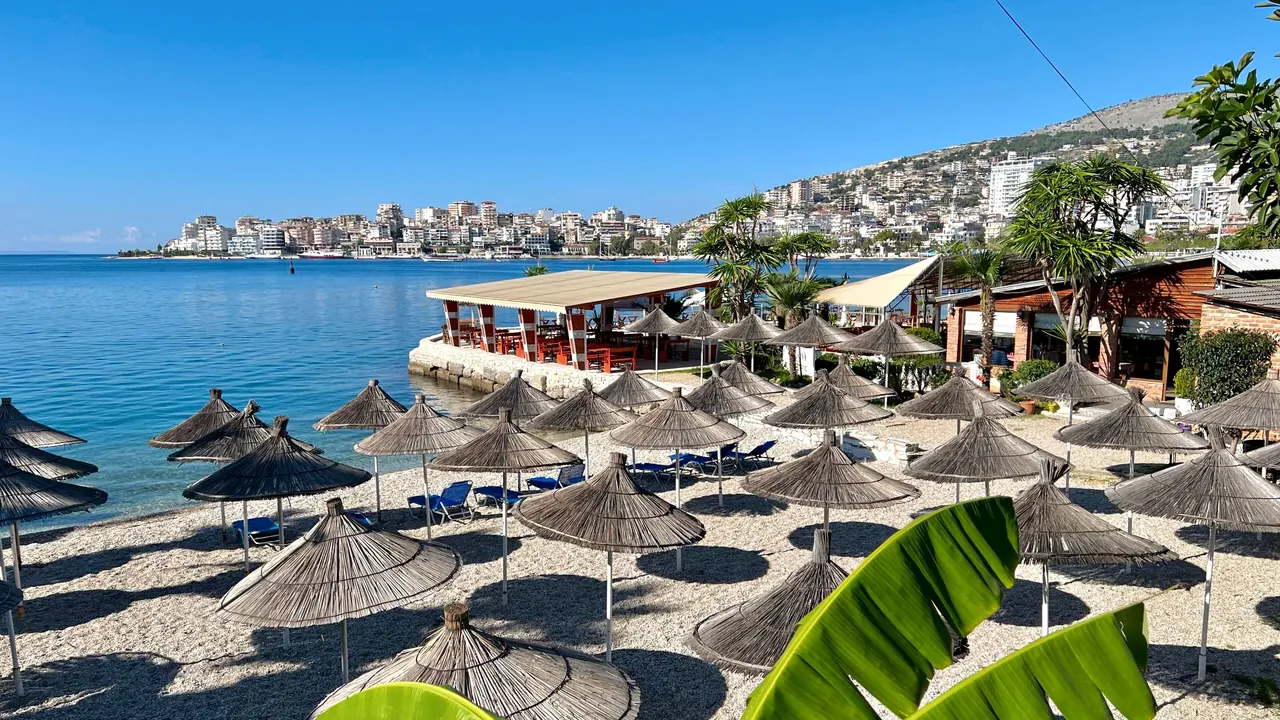
Choose Saranda when the sea is the point of the trip. The Ionian coves at Ksamil and the quieter bays up the Riviera give a longer and warmer swimming season than any lake can. The town itself has little to see, but it makes an excellent base for Butrint, Gjirokaster and a ferry hop to Corfu.
Scoreboard
Twelve categories on one fixed scale from 0 to 100. The shaded stretch is the gap between the two.
Your match
Pick a travel style or drag the sliders, and both match scores follow your weighting.
Wins on culture and sights and live music and the arts with your weighting.
Wins on beaches and day trips with your weighting.
What matters to you?
Category by category
What the scores mean for a trip.
Beaches & swimming
Saranda is the stronger choice for swimming. Ohrid offers lake water that is famously clear and calm, entered from concrete platforms, jetties and short pebble strips below Kaneo, at Potpeš and further south at Lagadin. Its season runs only from late June to mid-September.
Saranda has the Ionian. Twenty minutes south, Ksamil's pale coves and small islets are the main draw, and Lukova and Borsh up the Riviera give longer, quieter bays backed by olive groves. Both get crowded in August, but at Saranda a boat to the islets or a drive north still finds space.
Food & drink
The two are evenly matched, simple home cooking with a narrow range, and they differ mainly in what comes out of the water. Ohrid serves lake fish such as belvica alongside tavče gravče, stuffed peppers and ajvar, with honest Tikveš wine. Saranda serves the sea: mussels from the Butrint lagoon, grilled octopus and squid, and salads soaked in olive oil, with raki rather than wine at the centre. In both towns the family-run places away from the waterfront cook better than the promenade terraces.
Culture & sights
Ohrid is far richer here. Its old town is one of the great places of Slavic Orthodox history. St Sophia's frescoes, St John at Kaneo on its rock, Plaošnik's church and mosaics, the ancient theatre and Samuel's Fortress all lie within a slow day or two on foot, and the town and lake are listed together by UNESCO.
Saranda is a modern resort town. The mosaic floors of the old synagogue-church, a few stretches of city wall and the views from Lekuresi Castle make an afternoon at most, so history lovers based here spend their time at the sites outside town.
Nightlife
Both are summer-only scenes of similar size, but Saranda's is louder. In July and August its promenade turns from a family stroll into cocktail bars playing music past midnight, and DJs run later at the beach clubs around Ksamil, with a young Albanian and Kosovar crowd.
Ohrid's summer evenings centre on the lakefront walk and café-bars around the old bazaar, with beach clubs on the southern shore for those who want to stay out. Outside the season, both towns go quiet and evenings end over a drink by the water.
Nature & outdoors
Ohrid has the slight edge, mainly because of its mountains. Galičica National Park climbs from the lake to summits above 2,000m, with viewpoints over both Ohrid and Prespa, paragliding from the ridge and easy kayaking on the deep, still lake.
Saranda's setting is a limestone bay looking across to Corfu. The lagoon and oak woods of Butrint National Park are good for birdwatching, the Blue Eye spring lies inland, and the Riviera is good for sea kayaking and boat trips to caves. Its trails are largely unmarked, and the summer heat cuts walking short.
Day trips
Saranda has the better outings. Butrint, half an hour away, layers a Greek theatre, Roman baths and Venetian walls in lagoon woodland. Gjirokaster's stone-roofed tower houses are just over an hour inland, and Corfu's Venetian old town is less than an hour away by ferry.
Ohrid's list is longer but less striking. The boat to St Naum, market day in Struga, and Bitola with the mosaics of Heraclea Lynkestis are the highlights, and Korçë across the Albanian border makes a good extra day. Slow roads mean a car or driver helps from either base.
Good for families
Neither town has zoos or theme parks, so for children it comes down to fresh water or salt. Ohrid's lake is calm and clean, and the reconstructed pile village at the Bay of Bones and the boat rides add a little variety, though the cobbled old town is hard work with a pushchair.
Saranda's sheltered coves at Ksamil suit small swimmers, and the promenade has rides and ice cream in the evening. Steep streets, patchy pavements and chaotic summer traffic make the town itself more tiring than Ohrid's lakefront.
Getting around
Ohrid is easier. The promenade, the old bazaar and the main churches are a short walk apart, with only the old town's stairs to slow you down, and cheap taxis cover the rest.
Saranda's seafront promenade links the port, beaches and restaurants, but many hotels sit high on the slopes above it. Buses to Ksamil and Butrint run without printed timetables, and summer traffic clogs the narrow coast road. For the Blue Eye or the Riviera, plan on a car or an organised trip.
Shopping & style
Ohrid has something particular to buy. The Ohrid pearl, made with a lustre from lake-fish scales by a few long-established workshop families, is sold in the old bazaar streets, alongside filigree silver, icons and carved wood.
Saranda offers beachwear and souvenirs. The best things to take home there are edible, such as olive oil, mountain honey, raki and dried herbs, and for crafts the bazaar in Gjirokaster is the better stop.
Affordability
Both towns are inexpensive by European standards, and Ohrid is cheaper again. Guesthouse rooms, lakeside meals with local wine, cheap buses and low entry fees at the churches and fortress keep daily costs very modest.
In July and August both cost more, and in Saranda the sunbeds at Ksamil and the seafront hotels add up quickly. Ohrid's late spring and early autumn bring low prices and good weather for walking, though the lake is cool outside high summer. In Saranda, June and September are the months to aim for, with the sea still warm enough for long swims and rooms costing far less than in August.
Live music & performing arts
Ohrid is well ahead. The Ohrid Summer Festival, held every year since the early 1960s, stages opera, classical concerts and theatre inside St Sophia and in the ancient theatre, and a choral festival adds sacred and folk singing.
Saranda has little beyond the odd seafront concert, an occasional summer performance at Butrint and live Albanian music in restaurants. Anyone curious about southern Albanian polyphonic singing should look inland around Gjirokaster.
Wellness & relaxation
Neither town has a spa or bathing tradition, so wellness in both means a hotel pool or a massage. Ohrid is the more restful of the two. The stillness of the lake and quiet mornings by the water in May, June and September make it an easy place to slow down.
Saranda is loud in July and August, with music and traffic into the night. In early summer and late September, long lunches and evening walks around the bay make it calm enough to unwind.
When should you go?
Pick your month. The climate figures are measured averages, not a forecast.
Ohrid in July
Saranda in July
Daytime high, °C
Rainfall in the month, mm
Where the figures come from
Ohrid has no rain gauge within 25 km of the centre, so its rainfall comes from a gridded climate dataset read at the destination rather than from a gauge further away.
Saranda's temperatures are measured 30 km from the centre, at Kerkyra Airport.
Saranda has no rain gauge within 25 km of the centre, so its rainfall comes from a gridded climate dataset read at the destination rather than from a gauge further away.
Temperature and rainfall are climate normals, averaged over the years shown. Ohrid: 1999-2017 (rainfall 1991-2020) normals, Ohrid (0.2 km from centre). Saranda: 1991-2020 normals, Kerkyra Airport (29.8 km from centre).
Ohrid has a mountain climate. Winters are cold and grey, with highs around 6°C in January and the wettest weather from October to December. Spring and early autumn are mild and good for walking the old town and the hills. July and August peak near 29°C, warm enough for the lake, but summer is short and swimming is really a July and August affair.
Saranda is warmer all year and much hotter in high summer, reaching about 32°C in July and August, which is tiring for walks or the climb to the castle. It is also very sunny then. The sea passes 22°C from June to October, so swimming lasts well beyond Ohrid's lake season. Winter is mild but very wet, with up to 234mm in December, so in practice both towns are best from May to early October. Choose Ohrid for the hottest weeks and Saranda for June and September.
Which traveller are you?
For a beach and sun trip, Ohrid's lake platforms and brief July and August season lose out to Saranda. Ksamil's pale coves and islets, the Riviera's pebble bays and an Ionian warm enough from June into October make it the clear choice.
On a culture and arts trip, Ohrid is the place. St Sophia's medieval frescoes, St John at Kaneo, Plaošnik and the fortress fill a compact old town, and the Summer Festival puts concerts and theatre inside those historic settings.
On a trip with a tight budget, Ohrid stretches the money further. Guesthouses, meals with local wine and church entry fees cost little, while Saranda's best outings, to the Blue Eye or up the Riviera, usually mean paying for a car or a tour.
Before you go
| Measure | Ohrid | Saranda |
|---|---|---|
| Official language | Albanian, Macedonian | Albanian |
| Currency | Denar (MKD) | Lek (ALL) |
| Sockets | CF230 V, 50 Hz | CF220 V, 50 Hz |
| Driving side | Right | Right |
| Time zone | UTC+1, UTC+2 in summer | UTC+1, UTC+2 in summer |
| Emergency number | 112 | 112 |
| Elevation | 695 m | 0 m |
| Main airport | Ohrid St. Paul the Apostle Airport (OHD)9 km from centre14 non-stop destinations | Corfu Ioannis Kapodistrias International Airport (CFU)32 km from centre88 non-stop destinations |
| Public holidays this year | 12 days | 14 days |
By the numbers
| Measure | Ohrid | Saranda |
|---|---|---|
| Population | 38,818 | 22,613 |
| People per km² | 100 | 383 |
| Museums within 10 km | 11 | 0 |
| UNESCO World Heritage sites within 50 km | 2 | 3 |
| Swim season, months above 21 °C | - | 5 months |
Where else could you go?
Every comparison below shares a destination with this one, so you can follow Ohrid or Saranda somewhere new.