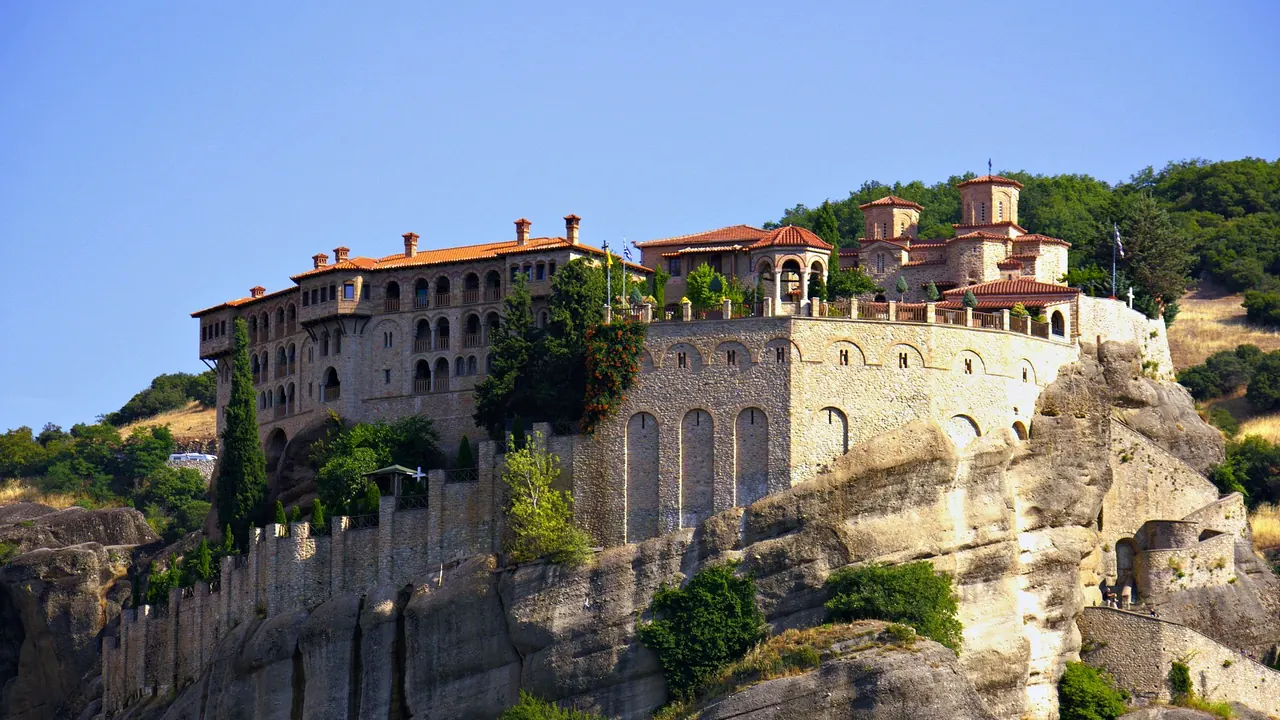
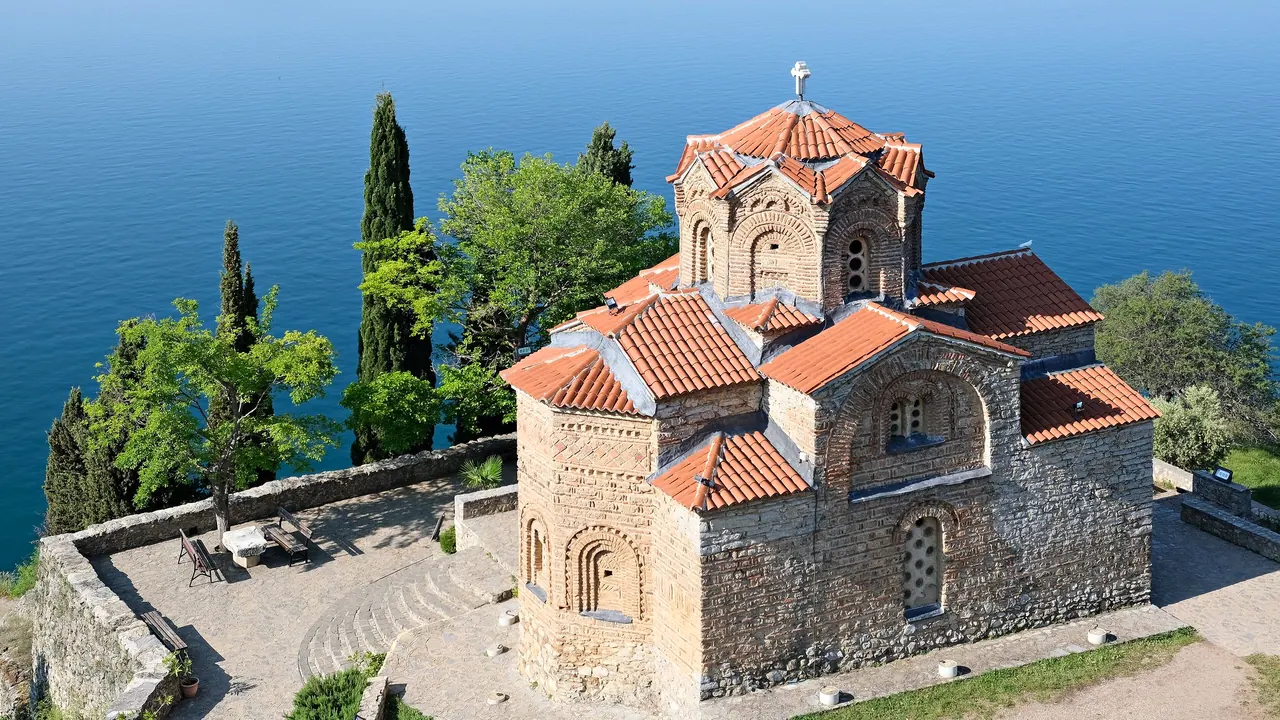
Photos: Kalambaka by José Barbosa, Pexels License; Ohrid by kallerna, CC BY-SA 4.0, cropped.
Kalambaka or Ohrid?
Our verdict in twelve categories, each scored against the same fixed benchmark cities, and the climate month by month, so you can choose for your trip.
Choose Kalambaka for
- nature and the outdoors
Kalambaka is for travellers who want to be on their feet in extraordinary scenery. The Meteora pillars begin at the edge of town, so you can walk old monks' paths up to the monasteries, climb the rock with a guide or drive west into the Pindos forests. It works best as two or three nights on a wider trip through mainland Greece, with quiet evenings and plain, hearty tavernas.
Choose Ohrid for
- beaches
- nightlife
- shopping
Ohrid suits a longer, easier stay. A clear lake to swim in through the summer, a hillside old town full of medieval churches and frescoes, and lively promenade evenings in July and August make it a fuller place to spend a week. It is also the cheaper of the two and the gentler choice for families, though its mountains are a backdrop more than the main event.
Scoreboard
Twelve categories on one fixed scale from 0 to 100. The shaded stretch is the gap between the two.
Your match
Pick a travel style or drag the sliders, and both match scores follow your weighting.
Wins on nature and the outdoors with your weighting.
Wins on beaches and nightlife with your weighting.
What matters to you?
Category by category
What the scores mean for a trip.
Beaches & swimming
There is no real swimming in Kalambaka. The sea is more than two hours away, so a dip means a hotel pool or a cold mountain river in the Pindos.
Ohrid has a proper summer swimming scene, though in a lake rather than the sea. The water is very clear and calm, with small coves below Kaneo and the town beach at Potpeš within walking distance, and longer shores with loungers at Lagadin and Gradište. The beaches are pebbly or concrete platforms and the season runs only from late June to mid-September, but on a hot day it beats anything near Kalambaka.
Food & drink
Both towns serve plain, generous home cooking with little fine dining or international food, but Ohrid has a little more to discover. Kalambaka's tavernas in town and in Kastraki keep to the central Greek repertoire of grilled lamb and pork, bean soups, pies and tsipouro with meze, and the view of the rocks at sunset is often the best part of the meal.
Ohrid adds a lakeside speciality: fish such as belvica, alongside tavče gravče, ajvar and Macedonian wines from Tikveš. The waterfront menus repeat themselves too, but the family places in the upper old town and the shore villages, plus morning burek from the bakeries, give a bit more range.
Culture & sights
Kalambaka has one great sight, and it is a spectacular one: the monasteries of Meteora, perched on sandstone pillars, with frescoed churches, refectories and icon collections reached by rock-cut steps. Apart from the Byzantine church of the Dormition, though, the town itself is modern and plain, and the monasteries are spread along a road high above it.
Ohrid offers more depth and variety in one walkable old town. The frescoes of St Sophia, St John at Kaneo on its rock above the water, Plaošnik with its links to the Cyrillic tradition, a Hellenistic theatre, Samuel's Fortress and streets of Ottoman-era houses add up to a richer day or two of exploring.
Nightlife
Kalambaka goes to bed early. A drink at a café-bar on the central square after dinner is about as far as it goes, and anyone wanting more drives half an hour to Trikala.
Ohrid has a real summer night scene. In July and August the promenade and the streets around the old bazaar stay busy late, and beach clubs on the southern shore play music into the small hours. Out of season it is almost as quiet as Kalambaka, and neither town has a serious club scene.
Nature & outdoors
Kalambaka has the more remarkable landscape. The grey Meteora pillars, some around 400m high, rise straight from the back streets, with footpaths through oak woods and ravines between them and long bolted climbing routes on the rock. West of town, the Pindos brings fir forests around Pertouli, rafting in the Aspropotamos valley and small ski slopes near Metsovo.
Ohrid's appeal is gentler and built around water. You can kayak on the clear lake, walk the shore path, or head up into Galičica National Park, where the summit trails go above 2,000m and paragliders launch above Lake Prespa. It is lovely, but it lacks the drama of walking from your hotel to the clifftops of Meteora.
Day trips
Both towns offer an equally good range of outings, but they lead to very different places. From Kalambaka they head into Greek mountain and river country: Trikala's Varousi quarter, the stone village of Metsovo over the Pindos, Ioannina's lake and castle quarter, and the Zagori villages at the edge of a long day.
From Ohrid the most popular trip is by boat to St Naum at the end of the lake. Beyond that there is Struga, Bitola with the mosaics of Heraclea Lynkestis, and easy hops into Albania to Pogradec and Korçë. In both places a car makes life much easier.
Good for families
Kalambaka suits children old enough to walk the monks' paths or try a beginners' climbing session on the rocks, ideally in spring or autumn before the trails get hot. Younger ones have a harder time. The monasteries mean long flights of steps, hushed interiors and dress rules, and apart from hotel pools and the town playgrounds there is little made for them, so a night or two is usually enough.
Ohrid is the easier place to spend a longer stretch with young children. A lakeside apartment puts the water right outside the door, an ice cream on the promenade rounds off the evening, and Macedonians are relaxed and welcoming towards children in restaurants. It has no zoos or theme parks either, and the old town's steep cobbled lanes are hard going with a pushchair.
Getting around
Ohrid is the easier base without a car. The promenade, bazaar and old town sights are close together, though the cobbled lanes are steep, and cheap taxis cover short hops. Summer boats and local buses run along the shore, if not very reliably.
Kalambaka's town is flat and quick to walk, and it has a rail link towards Athens and Thessaloniki. The catch is that the monasteries lie several kilometres up a winding road with an infrequent bus. Unless you hike up the old paths in about an hour, you will need a car, taxi or tour.
Shopping & style
Ohrid has something worth buying: the Ohrid pearl, a lustre-coated bead made in a few family workshops in the old bazaar, along with carved wood and filigree silver. It is worth buying from an established workshop rather than a stall.
Kalambaka's single souvenir street sells painted icons, honey, herbs and tsipouro, and the monasteries sell their own religious items. Neither town has boutiques or fashion streets.
Affordability
A stay in Kalambaka costs noticeably less than one in the big Greek cities or on the islands, but Ohrid is cheaper again. In Kalambaka the monastery entry fees are small and taverna meals are generous. Rooms with direct views of the rocks cost more, though, and the town fills with Greek visitors over Orthodox Easter and the feast-day weekends. Car hire or a guided tour to reach the monasteries also adds to the bill.
Ohrid is one of the cheapest lake towns in Europe. Guesthouse rooms, a full meal with local wine, taxis and entry to the churches and fortress all cost little. Only July and August push up the price of lakefront rooms, so late spring and early autumn give the best value.
Live music & performing arts
Ohrid has a real reason to plan around the summer: the long-running Ohrid Summer Festival, with concerts, opera and theatre staged in St Sophia and the ancient theatre, plus a choral festival. The rest of the year there is little on.
Kalambaka has essentially no stage. The closest thing is the Byzantine chant at a monastery service, which is worship and should be attended in that spirit, plus the odd summer folk evening.
Wellness & relaxation
Neither town has a bathing or spa tradition, and both offer only a few hotel pools, saunas and massage rooms. The difference is the kind of calm. Kalambaka's comes from a small town that sleeps early and the slow light over the rocks at dawn and dusk. In Ohrid it is mornings beside a still lake, best in May, June and September, as August brings crowds and noise.
When should you go?
Pick your month. The climate figures are measured averages, not a forecast.
Kalambaka in July
Ohrid in July
Daytime high, °C
Rainfall in the month, mm
Where the figures come from
Kalambaka's temperatures are measured 68 km from the centre, at Larissa Airport.
Kalambaka's station stands 164 m below the city centre, so the centre is likely a little cooler than the figures say.
Kalambaka has no rain gauge within 25 km of the centre, so its rainfall comes from a gridded climate dataset read at the city rather than from a gauge further away.
Ohrid has no rain gauge within 25 km of the centre, so its rainfall comes from a gridded climate dataset read at the city rather than from a gauge further away.
Temperature and rainfall are climate normals, averaged over the years shown. Kalambaka: 1991-2020 normals, Larissa Airport (68.1 km from centre). Ohrid: 1999-2017 (rainfall 1991-2020) normals, Ohrid (0.2 km from centre).
Kalambaka has the hotter, sunnier summer. From June to August afternoons reach around 34°C and July brings about 343 hours of sunshine, too hot for the exposed trails among the rocks. April, May, late September and October are the walking and climbing months, warm but not punishing. Rain builds from autumn and peaks in December at around 104mm, and winter days are cool.
Ohrid is cooler all year because of its height and the lake. July and August peak at about 29°C, which is the swimming season, and June and September are pleasant for the old town and the hills. Winter is colder than in Kalambaka, with January highs around 6°C and a wet November and December, so neither town is at its best between late autumn and early spring.
Which traveller are you?
On a beach and sun trip, Ohrid is the clear pick. Its lake is clean, calm and warm enough to swim in high summer, with coves below Kaneo and longer shores to the south, while Kalambaka has only hotel pools and cold river dips.
For an outdoors trip, Kalambaka wins. Footpaths lead from town to the Meteora clifftops, the conglomerate pillars are a renowned climbing area, and the Pindos adds fir forests, rafting and hiking. Galičica above Ohrid is fine walking, but the landscape here is more dramatic.
On a family trip with children, Ohrid is easier. Children can spend whole days in the lake, with boat rides and the pile village at the Bay of Bones in between, whereas Kalambaka's monasteries mean long stairways and silent interiors.
Before you go
| Measure | Kalambaka | Ohrid |
|---|---|---|
| Official language | Greek | Albanian, Macedonian |
| Currency | Euro (EUR) | Denar (MKD) |
| Sockets | CF230 V, 50 Hz | CF230 V, 50 Hz |
| Driving side | Right | Right |
| Time zone | UTC+2, UTC+3 in summer | UTC+1, UTC+2 in summer |
| Emergency number | 112 | 112 |
| Elevation | 237 m | 695 m |
| Main airport | Thessaloniki Macedonia International Airport (SKG)146 km from centre90 non-stop destinations | Ohrid St. Paul the Apostle Airport (OHD)9 km from centre14 non-stop destinations |
| Public holidays this year | 15 days | 12 days |
By the numbers
| Measure | Kalambaka | Ohrid |
|---|---|---|
| City population | 8,372 | 38,818 |
| People per km² | 4,925 | 100 |
| Museums within 10 km | 0 | 11 |
| UNESCO World Heritage sites within 50 km | 1 | 2 |
Where else could you go?
Every comparison below shares a destination with this one, so you can follow Kalambaka or Ohrid somewhere new.