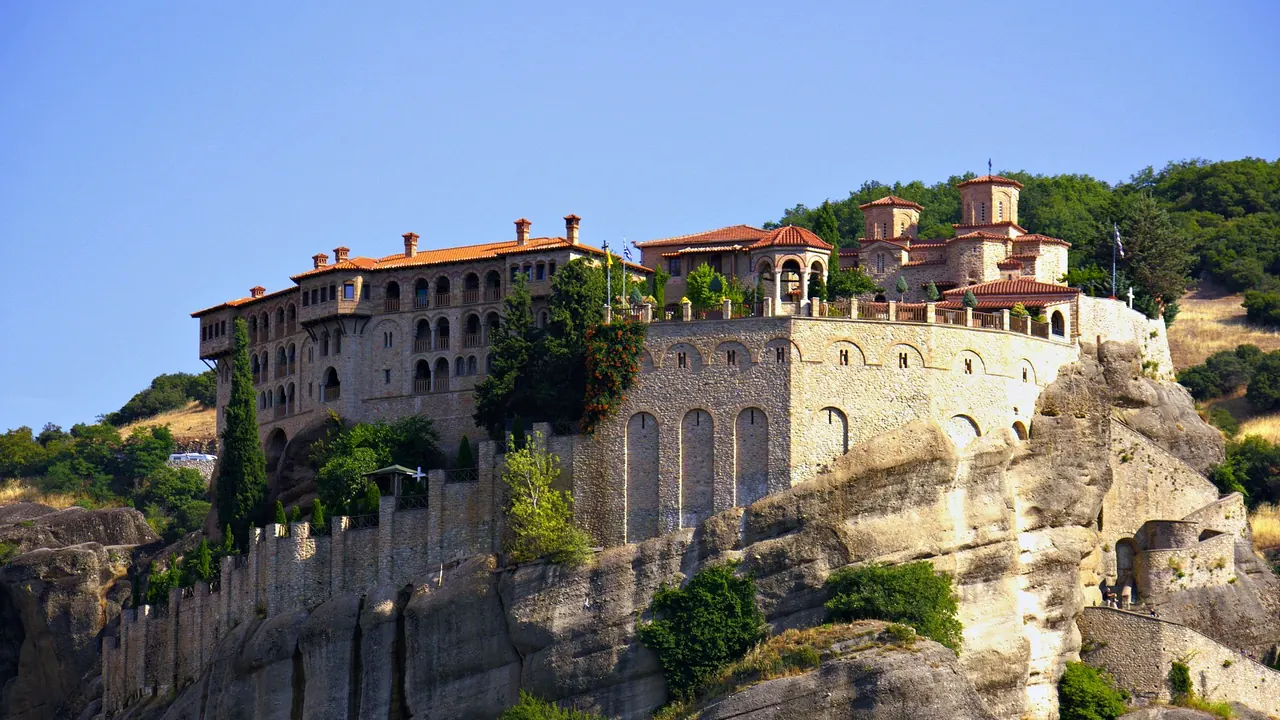
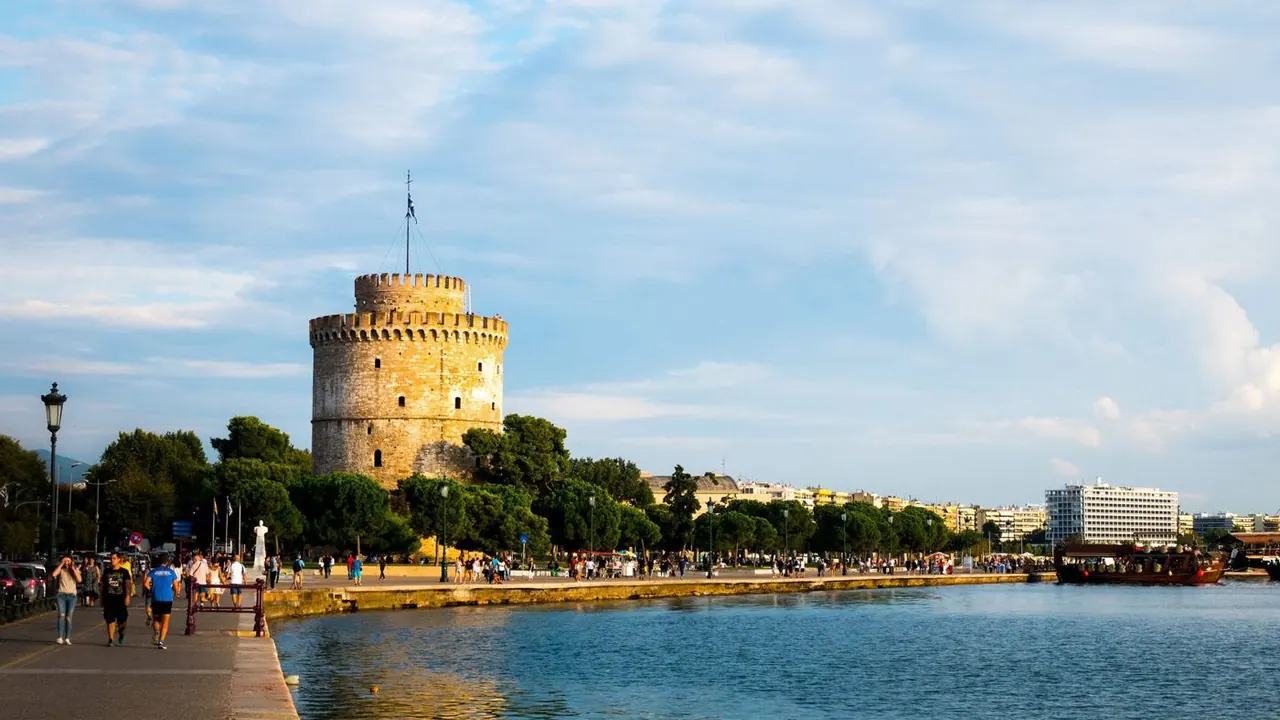
Photos: Kalambaka by José Barbosa, Pexels License; Thessaloniki by Destinygreece, CC BY-SA 4.0, cropped.
Kalambaka or Thessaloniki?
Our verdict in twelve categories, each scored against the same fixed benchmark cities, and the climate month by month, so you can choose for your trip.
Choose Kalambaka for
- nature and the outdoors
Kalambaka is for travellers who come for the landscape: walkers, climbers and anyone who wants to stand among the Meteora pillars at dawn and climb up to monasteries built on their summits. It is a quiet, inexpensive stop of two or three nights, best fitted into a road trip through central Greece, and evenings there are no more than a long taverna dinner.
Choose Thessaloniki for
- nightlife
- beaches
- food and drink
Thessaloniki is the better choice for almost every other kind of trip. It is a proper city, with Byzantine churches and major museums, some of the best everyday eating in Greece and late nights in Ladadika and Valaoritou. The royal tombs at Vergina and the coves of Halkidiki are both within reach. Pick it for a city break with an appetite, or as a base for northern Greece.
Scoreboard
Twelve categories on one fixed scale from 0 to 100. The shaded stretch is the gap between the two.
Your match
Pick a travel style or drag the sliders, and both match scores follow your weighting.
Wins on nature and the outdoors with your weighting.
Wins on nightlife and beaches with your weighting.
What matters to you?
Category by category
What the scores mean for a trip.
Beaches & swimming
Neither is a beach town, but only Thessaloniki has the sea within easy reach. Kalambaka lies deep inland, so swimming there means a hotel pool or a cold dip in a Pindos river.
Thessaloniki's own waterfront is for strolling, and the suburban beaches at Perea and Agia Triada are ordinary. Kassandra in Halkidiki, though, is about an hour's drive away, with clear water and fine coves. It works as a day out or as the next stop on the trip.
Food & drink
Kalambaka feeds visitors well and simply: grilled lamb and pork, bean soups, pies and tsipouro in family tavernas, with tables in Kastraki that look out at the rocks. The menus are much the same from one door to the next, though, and there is no market or café life to explore.
Thessaloniki is worth visiting for its food alone. The cooking carries Ottoman, Sephardic and Anatolian influences, the Kapani and Modiano markets are working markets with tavernas between the stalls, and the meze tables at the ouzeri in Ladadika and Ano Poli turn every meal into a long one.
Culture & sights
Kalambaka's culture is a single extraordinary group of sights: the six active Meteora monasteries, with frescoed churches, refectories and icon collections on top of the pillars. It is unforgettable, but once you have seen them and the town's church of the Dormition, two days have covered it.
Thessaloniki has more depth and variety. There are fifteen UNESCO-listed early Christian and Byzantine monuments, including the Rotunda and Agios Dimitrios, Roman remains around the Arch of Galerius, the Macedonian gold in the Archaeological Museum and the Museum of Byzantine Culture. The sights are scattered through a largely modern centre rather than gathered in one setting.
Nightlife
Here the two could hardly be further apart. In Kalambaka the evening ends with a drink at a café-bar on the central square, and anyone who wants more drives to Trikala. Thessaloniki's students go out at eleven and stay out past three, weeknights included, and the night moves from the bars of Ladadika and Valaoritou to the outdoor tables of the Bit Bazaar and, in summer, open-air clubs.
Nature & outdoors
Kalambaka has the more remarkable landscape on its doorstep. The Meteora pillars, some around 400m high, begin at the edge of town, with monks' paths through oak woods, long bolted climbing routes and sunset viewpoints. The fir forests and rafting rivers of the Pindos are close behind.
In Thessaloniki, everyday nature means the Seich Sou pine forest and the long seafront promenade. Its bigger draws, Mount Olympus with the Enipeas gorge and the Halkidiki coast, are a car journey away rather than a walk from the hotel.
Day trips
Thessaloniki sits in the heart of ancient Macedonia, and that gives it the stronger choice of outings: the royal tombs at Vergina, Alexander's birthplace at Pella and Dion below Olympus. Veria, the waterfalls of Edessa and the vineyards of Naoussa add more, and intercity buses reach most of them.
From Kalambaka the best trips lead west across the Pindos, to the stone village of Metsovo, to Ioannina on its lake and to the edge of Zagori, with the river town of Trikala close by. Buses are sparse, so these trips depend on a car.
Good for families
Neither is built around children, but Thessaloniki copes better. Its seafront promenade has playgrounds and space to run, the Noesis science centre and planetarium can fill a morning, and families can add beach days in Halkidiki.
Kalambaka is safe and easy, and older children who can hike or try a beginners' climb will love the rocks. Younger ones may struggle with the long monastery stairs, the hushed interiors and the dress rules, so a night or two is usually enough.
Getting around
You can walk across Kalambaka in a quarter of an hour, but the monasteries lie along a winding road above the town with an infrequent bus, so most people hike up, take taxis or hire a car. Thessaloniki's main sights sit in a flat strip near the waterfront, all within about half an hour's walk of each other. A metro line, buses and plentiful taxis cover the rest, and the steep climb to Ano Poli is the only real effort.
Shopping & style
Kalambaka's shops are for souvenirs: painted icons, carvings, honey, herbs and tsipouro, plus religious items sold at the monasteries. Thessaloniki has a proper high street along Tsimiski and malls on the edge of town. Better still are the Kapani and Modiano food markets, where spices, olives, cheeses and loukoumi make the best things to carry home.
Affordability
Both are good value by Western European standards, and the difference lies in where the money goes. In Kalambaka the extra costs are guided tours, car hire and the hotels with direct views of the rocks, which fill up over Orthodox Easter. In Thessaloniki eating and going out cost little because the city is priced for students and locals, and the main extra is a hire car for day trips.
Live music & performing arts
Kalambaka has almost nothing on stage, and the Byzantine chant heard at a monastery service is worship, not a show. Thessaloniki has the Concert Hall with the State Orchestra, the National Theatre of Northern Greece (mostly in Greek) and summer concerts in the open-air theatre on the hill at Dasos. For most visitors, though, the highlight is rebetiko and laika played late into the night in the tavernas.
Wellness & relaxation
Kalambaka offers the calm of the countryside and Thessaloniki the calm of a city, and neither gives you much in the way of treatments. Kalambaka goes to sleep early, the dawn light over the rocks makes for slow morning walks, and a few hotels have saunas and massage rooms.
Thessaloniki's Ottoman hammams, such as the Bey Hamam, survive as monuments rather than working baths. The simple spring-fed baths at Lagadas are half an hour away, though. Back in town, the most relaxing part of the day is a long iced coffee at a seafront café.
When should you go?
Pick your month. The climate figures are measured averages, not a forecast.
Kalambaka in July
Thessaloniki in July
Daytime high, °C
Rainfall in the month, mm
Where the figures come from
Kalambaka's temperatures are measured 68 km from the centre, at Larissa Airport.
Kalambaka's station stands 164 m below the city centre, so the centre is likely a little cooler than the figures say.
Kalambaka has no rain gauge within 25 km of the centre, so its rainfall comes from a gridded climate dataset read at the city rather than from a gauge further away.
Temperature and rainfall are climate normals, averaged over the years shown. Kalambaka: 1991-2020 normals, Larissa Airport (68.1 km from centre). Thessaloniki: 1991-2020 normals, Thessaloniki Airport (14 km from centre).
The two share the same broad pattern of hot, sunny summers and cool, damp winters, but Kalambaka has the more extreme climate. Inland on the Thessalian plain, it reaches about 34°C in July, too hot for the exposed monastery trails in the middle of the day. From October to March it is noticeably wetter, and December is the rainiest month at around 104mm. May and the weeks from late September into early October are its best times: warm, sunny and comfortable for walking between the rocks.
Thessaloniki is a couple of degrees cooler in summer, at around 32°C, and its winters are much drier, so a city visit works in most months. For swimming, the sea warms up from June and reaches about 27°C in August, staying warm through September. Spring and autumn are the most pleasant seasons for sightseeing on foot.
Which traveller are you?
For an outdoors trip, Kalambaka is the clear pick. Footpaths start in the town's back streets and climb between the Meteora pillars to the monasteries, the rocks are a celebrated climbing area, and the Pindos forests and the Aspropotamos valley lie just to the west.
On a food and nightlife trip, Thessaloniki wins easily. Meze at the ouzeri, bougatsa for breakfast and the Kapani and Modiano markets fill the days. The bars of Ladadika and Valaoritou keep going past three, while Kalambaka goes quiet after dinner.
For a beach and sun trip, choose Thessaloniki, though not for its own waterfront. Kassandra in Halkidiki is about an hour's drive away, with clear, warm water and some of Greece's best coves. From Kalambaka the sea is well over two hours away.
Before you go
| Measure | Kalambaka | Thessaloniki |
|---|---|---|
| Official language | Greek | Greek |
| Currency | Euro (EUR) | Euro (EUR) |
| Sockets | CF230 V, 50 Hz | CF230 V, 50 Hz |
| Driving side | Right | Right |
| Time zone | UTC+2, UTC+3 in summer | UTC+2, UTC+3 in summer |
| Emergency number | 112 | 112 |
| Elevation | 237 m | 6 m |
| Main airport | Thessaloniki Macedonia International Airport (SKG)146 km from centre90 non-stop destinations | Thessaloniki Macedonia International Airport (SKG)14 km from centre90 non-stop destinations |
| Public holidays this year | 15 days | 15 days |
By the numbers
| Measure | Kalambaka | Thessaloniki |
|---|---|---|
| City population | 8,372 | 309,617 |
| People per km² | 4,925 | 16,042 |
| Museums within 10 km | 0 | 32 |
| UNESCO World Heritage sites within 50 km | 1 | 1 |
| Swim season, months above 21 °C | - | 5 months |
Where else could you go?
Every comparison below shares a destination with this one, so you can follow Kalambaka or Thessaloniki somewhere new.
- Ohridvs Kalambaka
- Ohridvs Thessaloniki
- Skopjevs Thessaloniki
- Plovdivvs Thessaloniki
- Sofiavs Thessaloniki
- Tiranavs Kalambaka