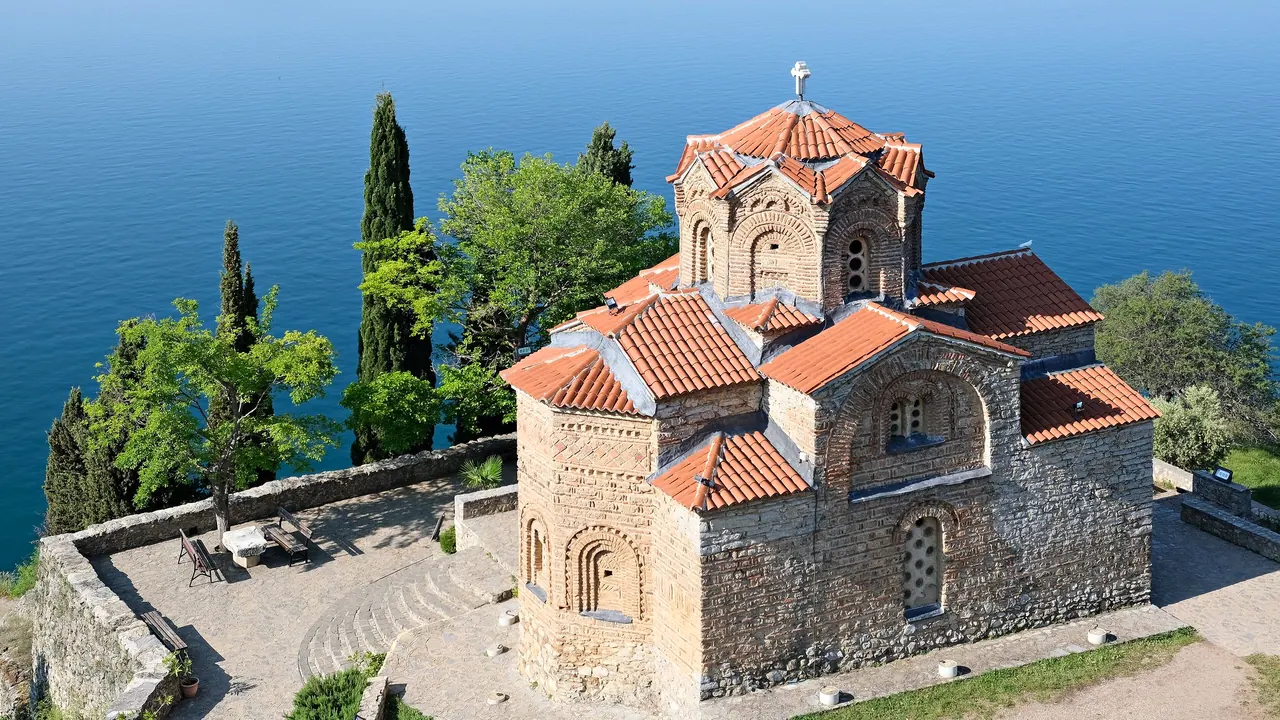
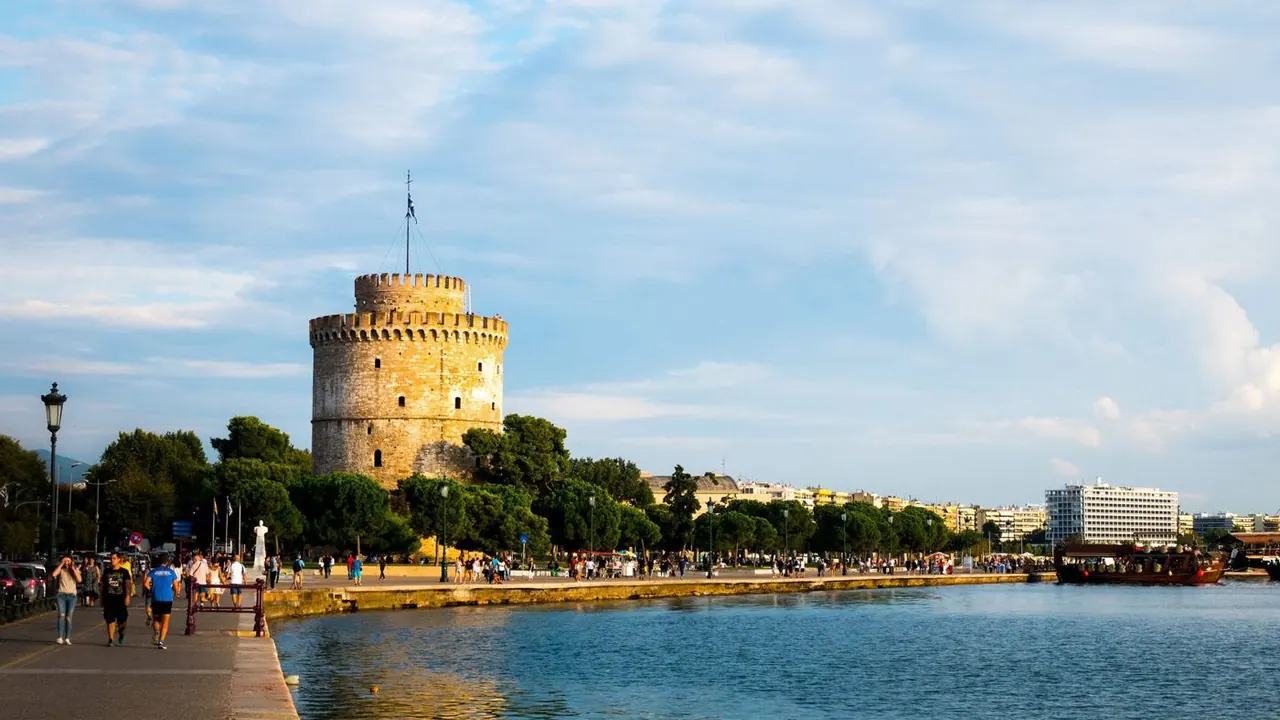
Photos: Ohrid by kallerna, CC BY-SA 4.0, cropped; Thessaloniki by Destinygreece, CC BY-SA 4.0, cropped.
Ohrid or Thessaloniki?
Our verdict in twelve categories, each scored against the same fixed benchmark cities, and the climate month by month, so you can choose for your trip.
Choose Ohrid for
- prices
- nature and the outdoors
Ohrid suits a slower, cheaper trip built around a lake and a small, intact old town. You swim in clear fresh water a short walk from medieval churches, walk up into Galičica, and spend the evenings on the promenade. It works best for couples and anyone who wants scenery and quiet more than variety, and who won't mind the same few dishes on every menu or towns that go quiet after dark.
Choose Thessaloniki for
- nightlife
- food and drink
- live music and the arts
Travellers who measure a trip by its meals and its evenings will be happier in Thessaloniki. It is a real Greek city, with meze tables, markets, late bars and taverna music most nights of the week. It also has the bigger museums, its UNESCO-listed Byzantine churches, and the royal tombs and ancient sites of Macedonia within day-trip range. You give up the lake on the doorstep, as the good beaches are an hour away in Halkidiki, and you pay a little more for everything.
Scoreboard
Twelve categories on one fixed scale from 0 to 100. The shaded stretch is the gap between the two.
Your match
Pick a travel style or drag the sliders, and both match scores follow your weighting.
Wins on prices and nature and the outdoors with your weighting.
Wins on nightlife and food and drink with your weighting.
What matters to you?
Category by category
What the scores mean for a trip.
Beaches & swimming
These two are broadly level for swimming, but in quite different ways. In Ohrid you swim in the lake itself, in calm, clear fresh water. The coves below Kaneo and the town beach at Potpeš are a short walk from your room, with longer stretches south at Lagadin and Gradište.
Thessaloniki doesn't swim off its own waterfront, and the nearby suburban beaches are only ordinary. The real prize is Halkidiki, about an hour away, where the coves and warm, clear sea are far better than anything at Ohrid. Going there means a day trip or moving on rather than a swim before lunch.
Food & drink
Thessaloniki is the far better city for eating. Its cooking draws on Ottoman, Sephardic and Anatolian traditions, and it shows in the meze spreads with tsipouro, in the spiced kebabs and soutzoukakia, and in the market tavernas wedged between the stalls of Kapani and Modiano. Breakfast is flaky bougatsa.
Ohrid offers honest Macedonian home cooking, such as tavče gravče, ajvar and lake belvica. The same short menu runs along the whole waterfront, though, and the best meals take some searching in the upper old town or the shore villages.
Culture & sights
Thessaloniki has more to see and more to learn. The Rotunda's mosaics, Agios Dimitrios and the Arch of Galerius are among its UNESCO-listed and Roman monuments. The Archaeological Museum and the Museum of Byzantine Culture give it a depth Ohrid has no answer to. Because the centre was rebuilt after 1917, these sights are scattered through a modern city.
Ohrid wins on setting. St Sophia's frescoes, Plaošnik and St John at Kaneo above the water all sit within one intact hillside old town, which you can walk slowly in a day or two.
Nightlife
If going out matters, Thessaloniki is in another league. A large student population keeps Ladadika, the bars around Valaoritou and the tables of the Bit Bazaar crowded late into the night, on weeknights as well as weekends. In summer, open-air clubs on the edge of the city carry on until dawn.
Ohrid only comes alive in July and August, when visitors from across the region fill the café-bars on the promenade and the beach clubs to the south. For the rest of the year, an evening usually ends with wine over dinner.
Nature & outdoors
Both have fine landscapes, but you reach them differently. In Ohrid the scenery begins at the waterfront. You can take a kayak or small boat out on the deep, clear lake, and Galičica rises behind the town, with trails to summits above 2,000m and a ridge where paragliders launch. The spring-fed pool at St Naum is a separate outing at the far end of the lake.
Thessaloniki has the Seich Sou pine forest just behind Ano Poli, but its bigger landscapes take a car. Mount Olympus and the Enipeas gorge are about an hour and a half away, and in winter Kaimaktsalan has skiing, something Ohrid doesn't offer.
Day trips
Thessaloniki has the stronger list of day trips, centred on ancient Macedonia. The royal tombs at Vergina, Alexander's birthplace at Pella and the sanctuary at Dion are all within easy reach. Beyond them lie the waterfalls of Edessa, the vineyards of Naoussa and boat trips along the coast of Mount Athos.
Ohrid has good outings too, but fewer of them. You can go by boat to St Naum, see Heraclea's mosaics near Bitola, or cross into Albania for Korçë. The roads are slow and buses are scarce, so you need a driver to manage them.
Good for families
Neither city is built around children, and they come out about even. Ohrid's appeal is safe, simple lake days in calm water, with boat rides and the pile village at the Bay of Bones to break them up. The steep cobbled old town is hard going with a pushchair.
Thessaloniki has more made for children, with the Noesis science centre and the playgrounds along its seafront. Heavy traffic, crowded pavements and summer heat count against it, and families wanting a beach usually stay in Halkidiki.
Getting around
Getting around is about as easy in both, for different reasons. Ohrid is a small town you cross on foot in minutes, with cheap taxis for short trips. Only the stairs of the old town and the patchy buses to the southern shore slow you down.
Thessaloniki is bigger but laid out in a long, flat strip along the water. A metro line runs under the centre and buses cover the rest, though they get stuck in traffic. In both places, a hire car is the sensible choice for anything further out.
Shopping & style
Thessaloniki is the better place to shop. Tsimiski has the high-street fashion and shoe shops, the malls sit on the edge of the city, and the Kapani and Modiano markets are full of spices, olives, cheeses and tsipouro to take home.
Ohrid has one speciality the other lacks, the Ohrid pearl, made by a few families from the scales of a lake fish. Buy it from an established workshop, not a stall. Beyond that and some filigree silver, Ohrid's shops sell souvenirs.
Affordability
Both are easy on a budget, but Ohrid is cheaper still. Guesthouse rooms, full meals with Macedonian wine and church entry fees cost very little, and the only real exception is lakefront rooms on summer weekends.
Thessaloniki is priced for students and locals rather than visitors, so tavernas and nights out stay reasonable. Its hotels are mid-range rather than cheap, though, and day trips usually add the cost of a hire car.
Live music & performing arts
Thessaloniki has live performance all year, which Ohrid doesn't. The State Orchestra plays at the concert hall on the waterfront and the National Theatre of Northern Greece runs full seasons, though nearly all in Greek. For most visitors the best of it is rebetiko and laika played late in the tavernas.
In Ohrid the arts mean the Summer Festival. Concerts and opera inside St Sophia or in the ancient theatre are a memorable setting, but plan around them, because there is little outside summer.
Wellness & relaxation
Neither has a spa culture to speak of, so they are broadly level, and in both places rest comes from the pace of life. Ohrid's version is the still lake in May, June and September, with slow coffees by the water. August is too crowded for real calm.
Thessaloniki relaxes on long iced coffees along the seafront. It also has the simple thermal baths at Lagadas half an hour away, whereas Ohrid's nearest springs are a long drive into the mountains.
When should you go?
Pick your month. The climate figures are measured averages, not a forecast.
Ohrid in July
Thessaloniki in July
Daytime high, °C
Rainfall in the month, mm
Where the figures come from
Ohrid has no rain gauge within 25 km of the centre, so its rainfall comes from a gridded climate dataset read at the city rather than from a gauge further away.
Temperature and rainfall are climate normals, averaged over the years shown. Ohrid: 1999-2017 (rainfall 1991-2020) normals, Ohrid (0.2 km from centre). Thessaloniki: 1991-2020 normals, Thessaloniki Airport (14 km from centre).
Ohrid is a summer town with a short season. July and August reach about 29°C, which is warm enough for long days in the lake, and June and early September are pleasant for walking the old town. From October the rain picks up, peaking near 94mm a month in November and December, and winter is cold, with January highs around 6°C. That makes it a poor choice from late autumn to early spring.
Thessaloniki is warmer and drier all year. In July and August highs reach 32°C, too hot for walking the streets at midday, but the sea in Halkidiki is at its warmest, around 27°C. Spring and autumn are the easy months for sightseeing, with long sunny days and little rain. Winters are mild enough for a city break, so Thessaloniki is the more reliable choice outside summer.
Which traveller are you?
On a trip on a tight budget, Ohrid lets you fill whole days for almost nothing: swimming off the jetties at Potpeš, walking the lakeshore path south of town and climbing the old town to Samuel's Fortress. Thessaloniki's bougatsa breakfasts and student-priced nights out run it close.
For a food and nightlife trip, Thessaloniki wins easily. You get meze at the ouzeri in Ladadika, bougatsa for breakfast, market tavernas in Kapani, and bars that fill around Valaoritou until well past three. Ohrid's narrow menus and summer-only evenings can't compete.
On a culture and arts trip, Thessaloniki offers more depth. It has UNESCO-listed Byzantine churches, two major museums, a concert hall, a national theatre and rebetiko played in its tavernas. Ohrid's compact old town and frescoes are lovely, but you can see them in a day or two.
Before you go
| Measure | Ohrid | Thessaloniki |
|---|---|---|
| Official language | Albanian, Macedonian | Greek |
| Currency | Denar (MKD) | Euro (EUR) |
| Sockets | CF230 V, 50 Hz | CF230 V, 50 Hz |
| Driving side | Right | Right |
| Time zone | UTC+1, UTC+2 in summer | UTC+2, UTC+3 in summer |
| Emergency number | 112 | 112 |
| Elevation | 695 m | 6 m |
| Main airport | Ohrid St. Paul the Apostle Airport (OHD)9 km from centre14 non-stop destinations | Thessaloniki Macedonia International Airport (SKG)14 km from centre90 non-stop destinations |
| Public holidays this year | 12 days | 15 days |
By the numbers
| Measure | Ohrid | Thessaloniki |
|---|---|---|
| City population | 38,818 | 309,617 |
| People per km² | 100 | 16,042 |
| Museums within 10 km | 11 | 32 |
| UNESCO World Heritage sites within 50 km | 2 | 1 |
| Swim season, months above 21 °C | - | 5 months |
Where else could you go?
Every comparison below shares a destination with this one, so you can follow Ohrid or Thessaloniki somewhere new.