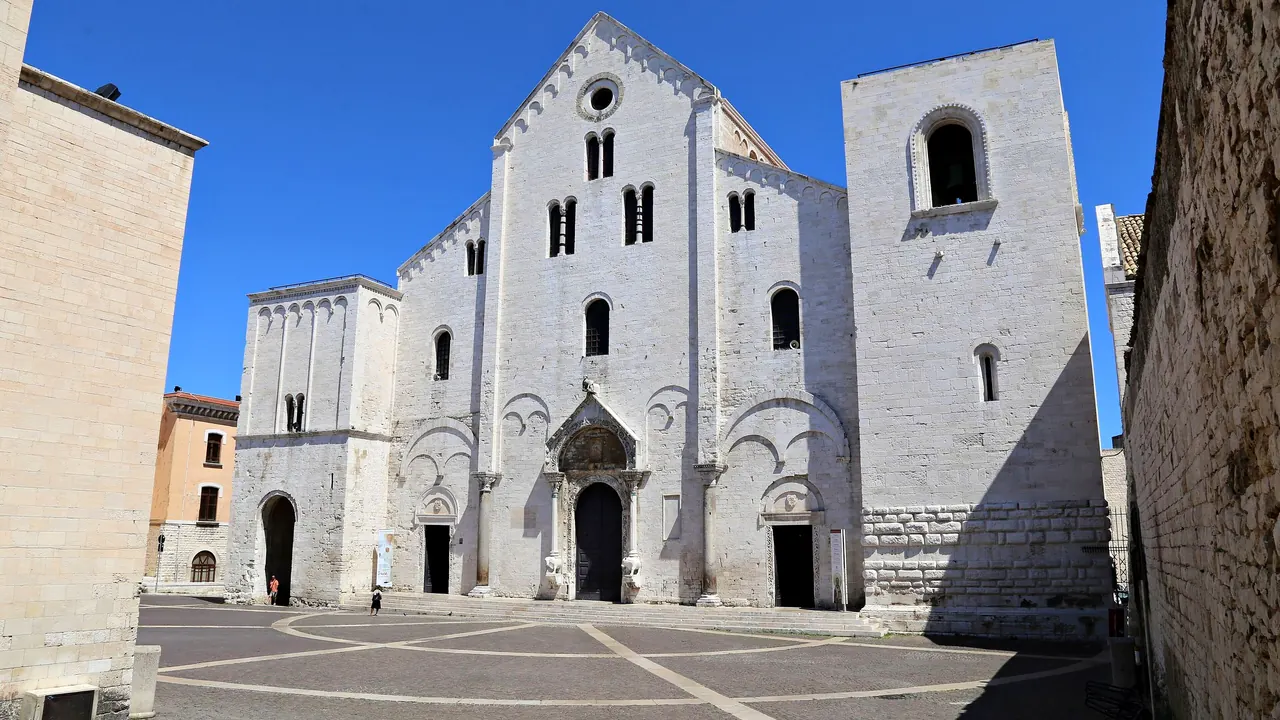
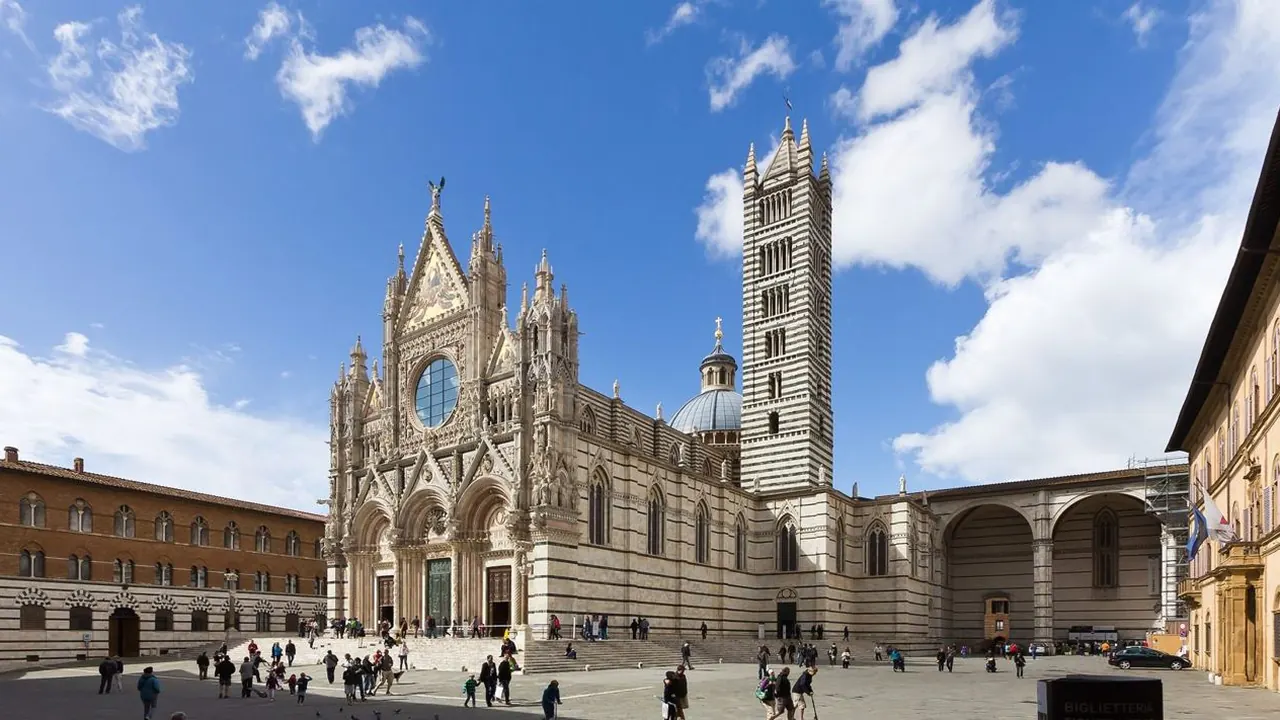
Photos: Bari by Sailko, CC BY-SA 4.0, cropped; Siena by Raimond Spekking, CC BY-SA 4.0, cropped.
Bari or Siena?
Our verdict in twelve categories, each scored against the same fixed benchmark cities, and the climate month by month, so you can choose for your trip.
Choose Bari for
- beaches
- nightlife
- prices
Bari is the better pick for a warm-weather trip that mixes the sea, street food and late evenings outdoors. It has a sandy beach in town and clear coves a short train ride away, its piazzas fill with people after dark, and it costs noticeably less. It is also a strong base for Puglia, from the trulli to Matera, and suits families who want easy beaches and relaxed evenings.
Choose Siena for
- wellness
- culture and sights
- nature and the outdoors
Travellers who care most about art, architecture and landscape will get more from Siena. Its medieval centre and Sienese painting go deeper than anything in Bari. The clay hills of the Crete Senesi begin south-east of town, and the Val d'Orcia is a drive further south. Thermal pools are within easy reach, and evenings are quiet and built around wine. Choose it for slow days, hill towns and cycling rather than nightlife or the beach.
Scoreboard
Twelve categories on one fixed scale from 0 to 100. The shaded stretch is the gap between the two.
Your match
Pick a travel style or drag the sliders, and both match scores follow your weighting.
Wins on beaches and nightlife with your weighting.
Wins on wellness and culture and sights with your weighting.
What matters to you?
Category by category
What the scores mean for a trip.
Beaches & swimming
The sea is part of daily life in Bari. There is a sandy city beach and rocky swimming platforms towards Torre Quetta, and the better water is at the cliff coves of Polignano a Mare and the inlets around Monopoli, an easy train ride away. Swimming fits into half-days rather than taking over the trip.
Siena is inland, and the sea plays no part in a stay there. The nearest decent beaches are on the Maremma coast, well over an hour's drive, so for most visitors a swim means the pool at an agriturismo.
Food & drink
Both serve rooted regional cooking with little international choice, but Bari has the edge, mostly because of its street food. You can watch orecchiette being rolled in Bari Vecchia's doorways, eat focaccia barese and fried sgagliozze from kitchen windows, and try raw sea urchins at the fishermen's pier.
Siena's strengths are pici, cinta senese pork, panforte and other baked goods, and its wine. Chianti Classico and Brunello are grown on either side of the town. Meals there tend to be sit-down dinners in family osterie, while in Bari much of the best eating happens standing up by the sea.
Culture & sights
Siena has much more to see. The Campo and Palazzo Pubblico, the striped Duomo with its inlaid floor, and the Sienese school of painting in the Pinacoteca and the Museo dell'Opera add up to one of Europe's most complete medieval cities. The seventeen contrade still give each neighbourhood its own church, fountain and flag.
Bari's sights are fewer and quicker to see. They centre on the Romanesque Basilica di San Nicola and the whitewashed lanes of Bari Vecchia, with the castle and the nineteenth-century Murat quarter close by. They are characterful, but a day or two covers them, where Siena repays two or three full days.
Nightlife
Bari is the place for a night out. In summer, students and young locals crowd the steps of Piazza Mercantile and Piazza Ferrarese, the bars of the Umbertino streets stay open past midnight, and in July and August the crowd moves to beach clubs south of the city.
In Siena, an evening means dinner, a glass on the Campo and a walk through the lit streets. The centre is quiet before midnight except on the nights around the Palio.
Nature & outdoors
Bari's surroundings are flatter and gentler. Beyond the olive groves and stone walls of the coastal plain, the nearest open country is the karst plateau of Alta Murgia, about an hour inland, which is good for quiet walks and cycling. The Valle d'Itria is easy riding too, and the coast to the south adds sailing.
Siena has the stronger countryside. The bare clay hills of the Crete Senesi spread out south-east of town, and a longer drive south brings you to the rolling fields and hilltop towns of the Val d'Orcia. The white gravel strade bianche start at the edge of town and draw serious cyclists, while walkers can follow stretches of the Via Francigena or explore the wooded Montagnola. Neither city has high mountains, but Monte Amiata, about an hour and a half from Siena, has beech forest and a little winter skiing.
Day trips
Both are excellent bases, and Siena has slightly more within reach. Florence, San Gimignano, the Chianti villages, Montalcino, Pienza and abbeys such as Sant'Antimo and San Galgano are all close, so there is a different hill town or winery for every day.
Bari's trips are more varied in landscape. You can see Matera's cave dwellings, the trulli of Alberobello, Ostuni's white streets, Trani's cathedral by the sea and the Baroque city of Lecce. In both regions a car makes the inland towns much easier, though Bari's coastal trains handle the seaside trips well.
Good for families
Bari works better with children, mainly because of the sandy city beach, the flat traffic-free lanes and the seafront passeggiata full of local families. Easy outings include the Grotte di Castellana and the Fasano safari park.
Siena suits older children, who enjoy climbing the Torre del Mangia and seeing the contrada drummers. Its steep stepped streets are hard going with a pushchair, though, and there are no attractions built for children, so many families stay at a farmhouse with a pool and come into town for half days.
Getting around
Both centres are easy to explore on foot, but they feel different to walk. Bari's old town, shopping grid and promenade sit side by side on flat ground, and a rail link runs to the airport.
Siena is car-free inside the walls but stands on three ridges, so you climb a lot, and escalators lift you up from the station below. For travel beyond the city, Bari's regional railways cover the coast, while Siena relies on buses for Florence. In both places most visitors hire a car for the countryside.
Shopping & style
Bari has a little more range, with Italian chains and a few upmarket boutiques along the pedestrian Via Sparano. The best things to bring home are taralli, dried orecchiette, olive oil and Puglian ceramics.
Siena is smaller and more traditional. Banchi di Sopra has leather and stationery shops, and the local specialities are majolica, contrada scarves, panforte and pecorino, with a large weekly market by the Fortezza. Neither city will satisfy a serious shopper.
Affordability
Bari is the cheaper stay. Street food and trattoria lunches cost little, local wine is cheap, and the basilica and old town are free, although rooms get tighter in July and August.
Siena is moderately expensive. There are few rooms inside the walls, prices jump around the Palio, and the cathedral complex and civic museums both charge for entry. Simple osteria meals keep food costs down, and staying in an agriturismo outside town often saves money.
Live music & performing arts
Bari offers more of an evening out, thanks to the Teatro Petruzzelli, one of Italy's largest opera houses, with a full season of opera, ballet and symphonic concerts. In summer there are open-air concerts and a jazz festival in the piazzas and the castle.
Siena's musical life is built around its schools. The Accademia Chigiana holds summer concerts in palaces and churches, and Siena Jazz puts on smaller performances. These are rewarding, but for opera you would need to go to Florence.
Wellness & relaxation
Bari has nothing to compare with Siena's hot springs. Rest there means the sea, whether that is an afternoon on the rocky platforms towards Torre Quetta or a calm swim in summer, along with the easy pace of the city. That makes for a lazy week by the water, but not a spa break.
Siena has thermal water within reach in several directions. Rapolano's travertine pools are close enough for an afternoon. Further south, steam rises from the medieval bath in the middle of Bagno Vignoni, Bagni San Filippo's white pools sit in the woods, and Petriolo has a hot sulphur river. Combined with a farmhouse stay in the hills, they make a proper wellness trip.
When should you go?
Pick your month. The climate figures are measured averages, not a forecast.
Bari in July
Siena in July
Daytime high, °C
Rainfall in the month, mm
Where the figures come from
Bari has no rain gauge within 25 km of the centre, so its rainfall comes from a gridded climate dataset read at the city rather than from a gauge further away.
Bari's sunshine is measured 77 km from the centre, at Marina Di Ginosa.
Siena's temperatures are measured 45 km from the centre, at Arezzo.
Siena has no rain gauge within 25 km of the centre, so its rainfall comes from a gridded climate dataset read at the city rather than from a gauge further away.
Temperature and rainfall are climate normals, averaged over the years shown. Bari: 1991-2020 (sunshine 1961-1990) normals, Bari / Palese Macchie (7 km from centre). Siena: 2006-2017 (rainfall 1991-2020) normals, Arezzo (45 km from centre).
Bari is a summer city. From June to September the Adriatic is warm enough for proper swimming, peaking around 26°C in August, and the summer months are close to dry. July and August reach about 30°C, so sightseeing works best early or late in the day. The rain arrives in autumn and is heaviest in November. Winters are mild but grey, which makes them better for food and day trips than for the coast.
Siena is at its best in spring and early autumn, when the hills are green or gold and the steep streets are comfortable to walk. High summer reaches about 31°C, which is hard work on its ridges, and there is no sea nearby to cool off in. Autumn is wetter than in Bari, peaking at around 127mm in November. Winter days of about 9°C are colder than Bari's but often clear.
Which traveller are you?
On a beach and sun trip, Bari is the clear choice. You can swim at Pane e Pomodoro in town, and Polignano and Monopoli are half an hour south. From Siena, the Maremma coast takes a full day there and back, so a pool is the realistic alternative.
For a culture and arts trip, Siena wins. Its whole centre is a UNESCO-listed medieval city, with the Duomo, Lorenzetti's frescoes and Duccio's Maestà. Bari's old town and basilica are characterful, but most visitors see them in a day or two.
On a relaxing and wellness trip, Siena is the better base. The warm travertine pools at Rapolano are half an hour away, with Bagno Vignoni and Bagni San Filippo further south. Bari has no bathing tradition, and its idea of relaxing is a long lunch and the evening stroll.
Before you go
| Measure | Bari | Siena |
|---|---|---|
| Official language | Italian | Italian |
| Currency | Euro (EUR) | Euro (EUR) |
| Sockets | CFL230 V, 50 Hz | CFL230 V, 50 Hz |
| Driving side | Right | Right |
| Time zone | UTC+1, UTC+2 in summer | UTC+1, UTC+2 in summer |
| Emergency number | 112 | 112 |
| Elevation | 5 m | 322 m |
| Main airport | Bari Karol Wojtyła International Airport (BRI)9 km from centre104 non-stop destinations | Florence Airport, Peretola (FLR)55 km from centre46 non-stop destinations |
| Public holidays this year | 13 days | 13 days |
By the numbers
| Measure | Bari | Siena |
|---|---|---|
| City population | 315,473 | 52,812 |
| People per km² | 2,687 | 446 |
| Museums within 10 km | 12 | 30 |
| UNESCO World Heritage sites within 50 km | 1 | 5 |
| Swim season, months above 21 °C | 4 months | - |
Where else could you go?
Every comparison below shares a destination with this one, so you can follow Bari or Siena somewhere new.