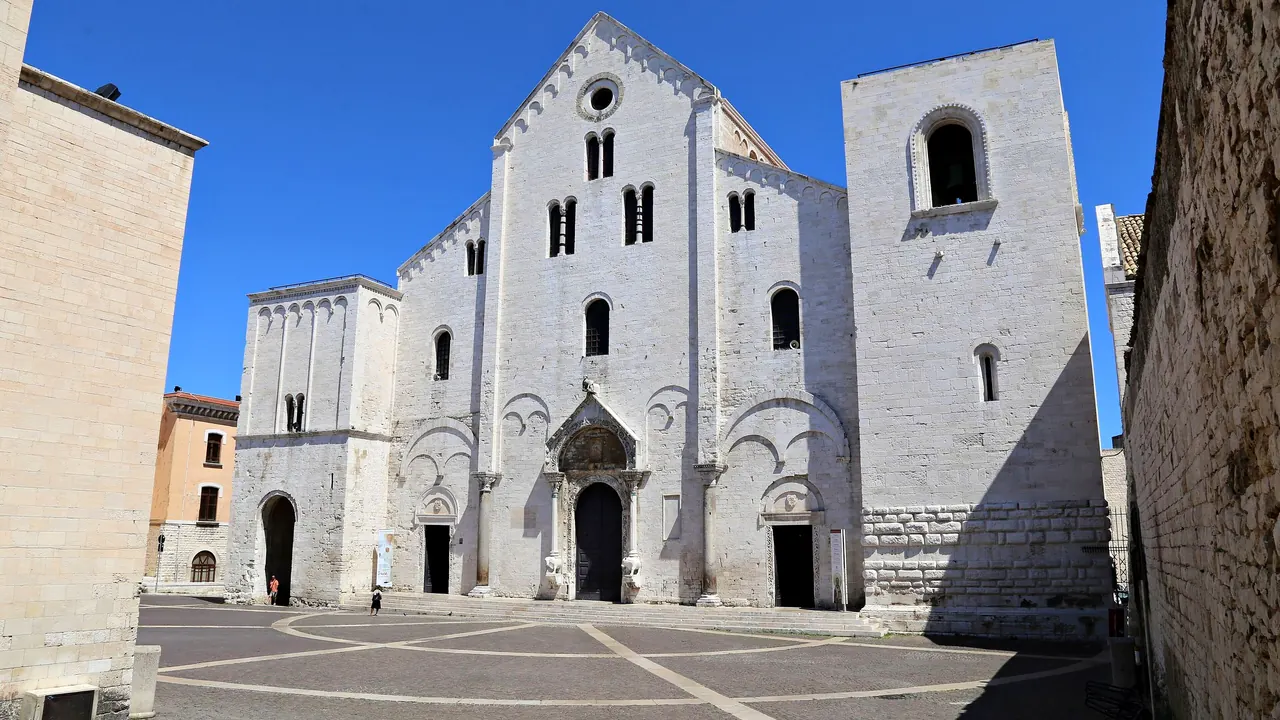
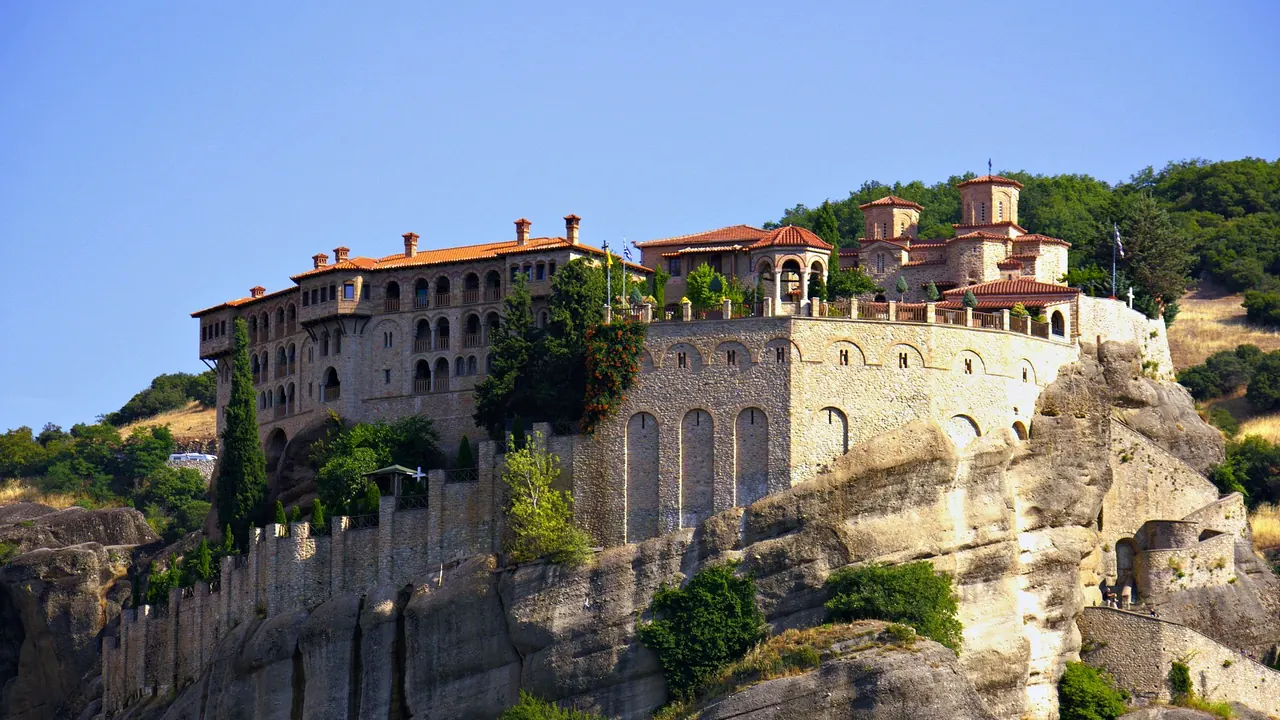
Photos: Bari by Sailko, CC BY-SA 4.0, cropped; Kalambaka by José Barbosa, Pexels License.
Bari or Kalambaka?
Our verdict in twelve categories, each scored against the same fixed benchmark cities, and the climate month by month, so you can choose for your trip.
Choose Bari for
- beaches
- nightlife
- live music and the arts
Bari suits a summer trip that mixes sea, food and movement. It has a sandy beach of its own, with much better coves a short train ride south at Polignano and Monopoli. Apulian street food and late outdoor evenings in the old-town piazzas fill the rest of the day. It is also the far stronger base for touring, with Matera, Alberobello, the Valle d'Itria and Lecce all within reach for a day out.
Choose Kalambaka for
- nature and the outdoors
- prices
Kalambaka is the choice for someone who has come to see one extraordinary place up close and walk around it. The Meteora monasteries stand on rock pillars directly behind the town, and the monks' footpaths and climbing routes start from its back streets. The Pindos forests begin just to the west. Two or three quiet nights here, ideally in spring or autumn, reward a walker far more than a beachgoer or a night owl.
Scoreboard
Twelve categories on one fixed scale from 0 to 100. The shaded stretch is the gap between the two.
Your match
Pick a travel style or drag the sliders, and both match scores follow your weighting.
Wins on beaches and nightlife with your weighting.
Wins on nature and the outdoors and prices with your weighting.
What matters to you?
Category by category
What the scores mean for a trip.
Beaches & swimming
There is no real contest. Bari has Pane e Pomodoro, a sandy beach just beyond the centre, and rocky lidos towards Torre Quetta. The clear water of the Polignano and Monopoli coves is a short train ride away.
Kalambaka sits deep inland on the Thessalian plain, more than two hours from the sea. Swimming means a hotel pool or a chilly dip in a Pindos river, so beach days belong elsewhere on the itinerary.
Food & drink
Bari is the one to plan meals around. Its street food is particular to the city, from focaccia barese and panzerotti to fried sgagliozze. Nothing inland matches the raw sea urchins and octopus at the fishermen's pier. Sit-down meals of tiella and orecchiette with turnip tops come with Primitivo or Negroamaro.
Kalambaka feeds you well but simply, with grilled lamb and pork, bean soups, pies and tsipouro with meze in family tavernas. The menus repeat from one place to the next. What it adds is the view of the pillars at sunset from the tables in Kastraki.
Culture & sights
Each gives about two days of strong sightseeing, but of very different kinds. Bari's is an urban old town. The Romanesque Basilica di San Nicola and its pilgrims, the cathedral and the Norman-Swabian castle sit inside the whitewashed lanes of Bari Vecchia, with the nineteenth-century Murat grid and the Pinacoteca beyond.
Kalambaka's culture is almost entirely Meteora, a group of working monasteries on sandstone pillars. Their frescoed churches, refectories and icon collections are reached by rock-cut steps. It is one single, astonishing sight rather than a town to wander, and it asks for modest dress.
Nightlife
Bari has a genuine night out and Kalambaka does not. In Bari the evening starts late in Piazza Mercantile and Piazza Ferrarese and carries on in the Umbertino bars and along the seafront. In high summer it moves to beach clubs down the coast.
Kalambaka winds down after dinner with a drink at the café-bars on the central square. Anyone wanting more has to drive half an hour to Trikala's bar street.
Nature & outdoors
Here Kalambaka is far ahead. The Meteora rocks begin where the town ends, with footpaths through oak woods and ravines and some of Europe's best-known conglomerate climbing. To the west lie the Pindos fir forests, rafting in the Aspropotamos valley and Metsovo's small ski slopes.
Bari's outdoors is gentler and further off. It has the long seafront promenade, the open karst grassland of Alta Murgia about an hour inland, the Grotte di Castellana and easy cycling in the Valle d'Itria. With no mountains near, it suits a stroll or a bike ride rather than a serious hike.
Day trips
Bari is a natural base for excursions, and its range is far wider than Kalambaka's. Matera's cave city, the trulli of Alberobello, the white towns of the Valle d'Itria, Castel del Monte, Trani's cathedral on the sea and Baroque Lecce each fit into a day.
Kalambaka's outings are pleasant but fewer: riverside Trikala, the stone village of Metsovo over the Pindos, and Ioannina on its lake, with Zagori at the outer edge. A car helps from both, but from Kalambaka it is close to a requirement.
Good for families
Bari is the easier family choice. Children get a sandy city beach, traffic-free lanes, gelato and the evening passeggiata. Outings to the Grotte di Castellana and the Fasano safari park make up for how little in the city is built for them.
Kalambaka works for older children who can manage the trails or a beginners' climb. For younger ones, the monasteries mean long staircases, hushed interiors and dress rules. Most families keep it to a night or two.
Getting around
Bari is simpler to manage without a car. The old town, the Murat streets and the seafront lie side by side on flat ground, and a train runs to the airport. Regional lines reach Polignano, Trani and Matera, if slowly.
Kalambaka's town is small and walkable, and its rail branch connects to the Athens to Thessaloniki line. The catch is the monasteries, strung along a winding road several kilometres above town with an infrequent bus. Unless they hike up, most visitors rely on a hire car, taxis or a tour.
Shopping & style
Neither is a shopping destination. Bari at least has a real high street in Via Sparano, with Italian chains and a few smarter boutiques. Its best buys are edible ones like dried orecchiette, taralli and olive oil, along with Puglian ceramics.
Kalambaka has a souvenir street of painted icons, carvings, honey, herbs and tsipouro, plus religious items sold by the monasteries themselves. It is fine for a gift but not worth an afternoon.
Affordability
Both are easy on the wallet, and Kalambaka is a little cheaper day to day. Its family guesthouses and taverna meals cost little and the monasteries ask only small entry fees. Prices rise at the rooms facing the rocks and over Orthodox Easter.
Bari is good value for Italy, with cheap street food, local wine and a free old town and basilica. Rooms get harder to find in July and August, though, and beach clubs and car hire for day trips add up.
Live music & performing arts
Bari offers a real evening out at the Teatro Petruzzelli, one of Italy's largest opera houses, with seasons of opera, ballet and symphonic music. In summer there are concerts in the piazzas and at the castle, and a long-running jazz festival.
Kalambaka has almost nothing on stage. Its most memorable music is Byzantine chant at a monastery service, which is worship to attend respectfully rather than a show.
Wellness & relaxation
Neither is a spa destination, and in both, treatments mean a hotel facility. The calm they offer differs. Bari's is a sociable southern rhythm of long lunches, the afternoon break and the seafront stroll at dusk, with restored country estates nearby for anyone who wants pampering.
Kalambaka's is silence. The town sleeps early, and the dawn and evening light on the rocks sets the pace for slow mornings. It suits a couple of quiet nights rather than a long restorative stay.
When should you go?
Pick your month. The climate figures are measured averages, not a forecast.
Bari in July
Kalambaka in July
Daytime high, °C
Rainfall in the month, mm
Where the figures come from
Bari has no rain gauge within 25 km of the centre, so its rainfall comes from a gridded climate dataset read at the city rather than from a gauge further away.
Bari's sunshine is measured 77 km from the centre, at Marina Di Ginosa.
Kalambaka's temperatures are measured 68 km from the centre, at Larissa Airport.
Kalambaka's station stands 164 m below the city centre, so the centre is likely a little cooler than the figures say.
Kalambaka has no rain gauge within 25 km of the centre, so its rainfall comes from a gridded climate dataset read at the city rather than from a gauge further away.
Temperature and rainfall are climate normals, averaged over the years shown. Bari: 1991-2020 (sunshine 1961-1990) normals, Bari / Palese Macchie (7 km from centre). Kalambaka: 1991-2020 normals, Larissa Airport (68.1 km from centre).
Bari is a summer coast city. From June to September it is warm enough for the beach, with the sea at about 26°C in August and very little rain through the hottest months. July and August reach 30°C, so the middle of the day is for shade. Rain arrives in September and builds to 83mm in November. Winter stays mild and grey rather than cold, which is fine for sightseeing but not for swimming.
Kalambaka runs hotter in summer and colder and wetter in winter. July climbs to 34°C, which makes the exposed trails between the rocks hard going, and December is the wettest month at 104mm. May, late September and October are the best times for walking, with warm, mostly dry days and none of the midsummer heat. Bari's milder, drier winters make it the easier off-season choice of the two.
Which traveller are you?
On a beach and sun trip, Bari is the obvious pick. It has a sandy beach in town and clear coves around Polignano a Mare and Monopoli half an hour south. Kalambaka is hours from any sea and offers only hotel pools and cold river dips.
For an outdoors trip, Kalambaka wins clearly. You can walk from your room onto old monks' paths between the Meteora pillars, climb bolted routes with a local guide, or head into the Pindos fir forests to hike and raft. Bari's flat coastal plain cannot compete.
On a food and nightlife trip, choose Bari. Hand-rolled orecchiette, focaccia barese and raw seafood by the fishermen's pier lead into late nights in Piazza Mercantile and the seafront bars. Kalambaka offers hearty taverna grills and a town that goes quiet early.
Before you go
| Measure | Bari | Kalambaka |
|---|---|---|
| Official language | Italian | Greek |
| Currency | Euro (EUR) | Euro (EUR) |
| Sockets | CFL230 V, 50 Hz | CF230 V, 50 Hz |
| Driving side | Right | Right |
| Time zone | UTC+1, UTC+2 in summer | UTC+2, UTC+3 in summer |
| Emergency number | 112 | 112 |
| Elevation | 5 m | 237 m |
| Main airport | Bari Karol Wojtyła International Airport (BRI)9 km from centre104 non-stop destinations | Thessaloniki Macedonia International Airport (SKG)146 km from centre90 non-stop destinations |
| Public holidays this year | 13 days | 15 days |
By the numbers
| Measure | Bari | Kalambaka |
|---|---|---|
| City population | 315,473 | 8,372 |
| People per km² | 2,687 | 4,925 |
| Museums within 10 km | 12 | 0 |
| UNESCO World Heritage sites within 50 km | 1 | 1 |
| Swim season, months above 21 °C | 4 months | - |
Where else could you go?
Every comparison below shares a destination with this one, so you can follow Bari or Kalambaka somewhere new.