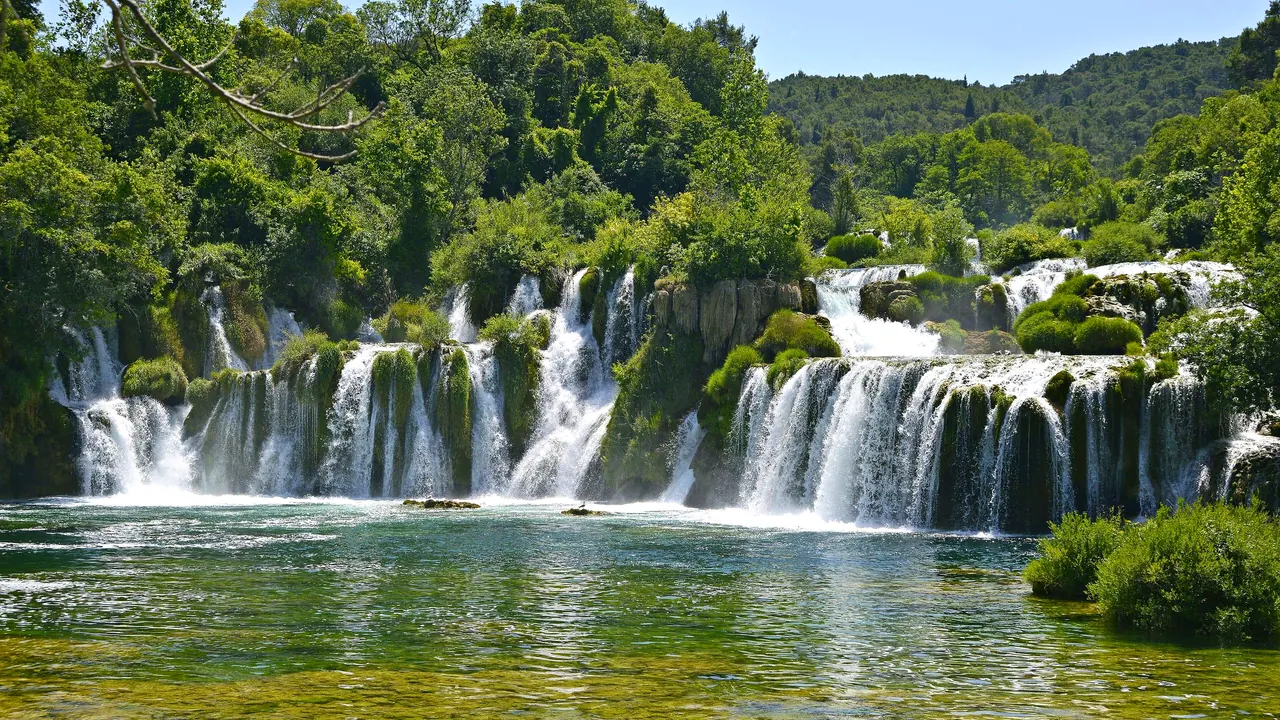
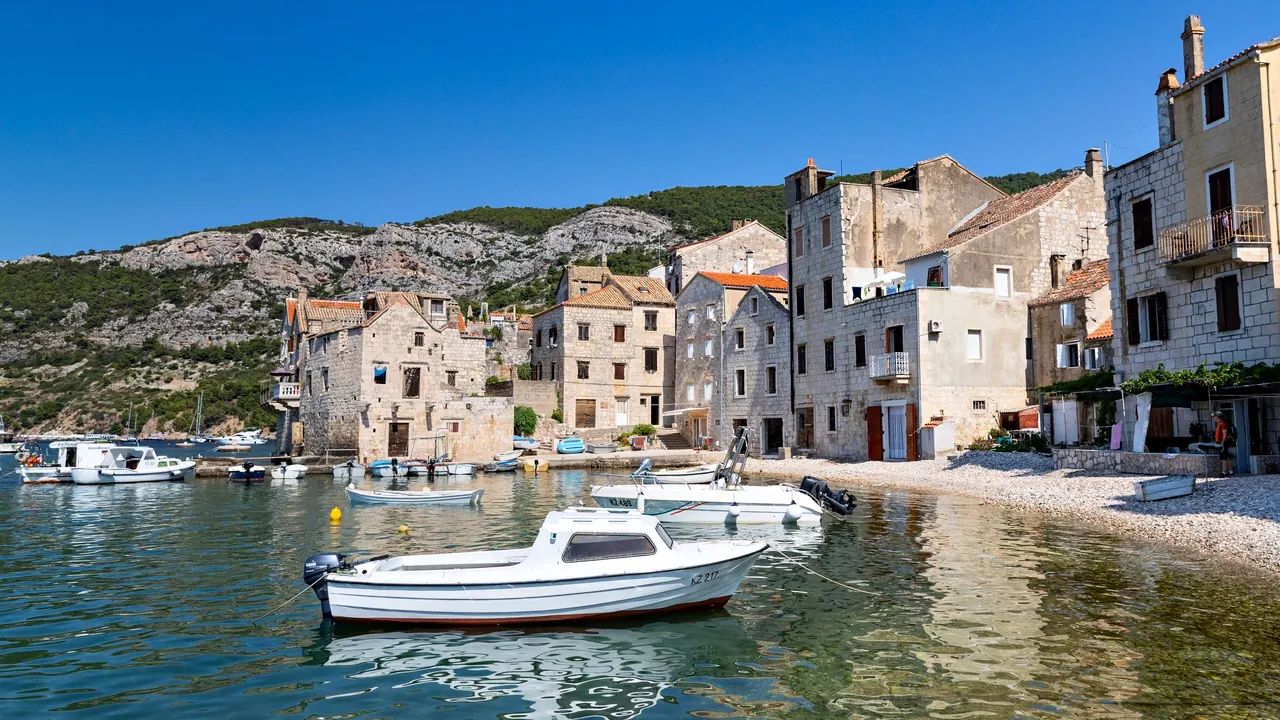
Photos: Krka by Alberto-g-rovi, CC BY 4.0, cropped; Vis by dronepicr, CC BY 2.0, cropped.
Krka or Vis?
Our verdict in twelve categories, each scored against the same fixed benchmark cities, and the climate month by month, so you can choose for your trip.
Choose Krka for
- day trips
- culture and sights
- getting around
Krka suits travellers who want to see things and move around. The waterfalls at Skradinski Buk, the monastery islet of Visovac and the UNESCO-listed stone of Šibenik give a week real variety, and Trogir, Split and Zadar are close enough for easy day trips. It is a mainland base with a car, where the sea is an afternoon out rather than the main event.
Choose Vis for
- beaches
- wellness
Vis is for people who want to stop. It sits far out in the Adriatic, a long ferry from Split, and its days are about clear water: Stiniva and the southern coves, boat trips to the Blue Cave, a dive off the cliffs, then dinner at a harbour table in Komiza. You give up sights and side trips, and in return you get an island that feels genuinely remote.
Scoreboard
Twelve categories on one fixed scale from 0 to 100. The shaded stretch is the gap between the two.
Your match
Pick a travel style or drag the sliders, and both match scores follow your weighting.
Wins on day trips and culture and sights with your weighting.
Wins on beaches and wellness with your weighting.
What matters to you?
Category by category
What the scores mean for a trip.
Beaches & swimming
At Krka the water is for looking at. Swimming under Skradinski Buk is not allowed, so a swim means driving or taking a boat down to Šibenik's pebble coves at Banj and Solaris, heading to the bays around Primošten, or catching a ferry to the quiet rocks of Zlarin and Prvić.
On Vis the sea is the reason to come. Stiniva sits between its two cliffs, Srebrna and Milna are wider bays, Stoncica has shallow water, and boats run to the outer islets where the water is emptiest. Expect pebble, little shade and a scooter or taxi boat to reach the best coves.
Food & drink
Both come down to family konobas and plain Dalmatian cooking, but the menus lean different ways. Around Krka the hinterland shows: lamb and veal under the iron bell, prosciutto and sheep's cheese, Skradin's slow-cooked risotto, mussels and oysters from the estuary and dark Babić wine. Šibenik's old town adds the more serious tables.
Vis looks to its boats, with fish and lobster, the anchovy pogaca of Komiza and Vis town, and Vugava and Plavac poured by growers at their farms. Many places close once summer ends.
Culture & sights
Krka has far more heritage. Šibenik at the river mouth has two UNESCO-listed sites, the Cathedral of St James with its frieze of carved faces and the sea fortress of St Nicholas. Upriver you find the island monastery at Visovac, the catacombs of the Krka Monastery and the Roman arches of Burnum.
Vis has a smaller history, but an unusual one: the remains of Greek Issa, a harbour museum holding a bronze Greek head, British forts from the Napoleonic wars, and the tunnels and submarine pens of a long-closed military island. It is enough for a couple of curious afternoons, not a culture trip.
Nightlife
Neither is a place to go out, and evenings on both mean a long dinner by the water. Around Krka, Skradin's harbour is quiet once the meal is over, and anyone wanting a few bars drives into Šibenik's old town lanes. On Vis the late drinks stay in Vis town and Komiza, with an occasional weekend party at a beach bar in high summer.
Nature & outdoors
Krka has the more striking landscape on land. A deep karst canyon falls over travertine terraces at Skradinski Buk and spreads into dozens of cascades at Roški Slap, with boardwalks through the spray, trails on the canyon rim and calm stretches of upper river to kayak. Boats from the coast also reach the bare Kornati.
The nature on Vis lies mostly offshore: volcanic islets in a geopark, the Green Cave on Ravnik, and some of the Adriatic's best diving along walls and wrecks. Inland, the dry plateau and Hum are good walking in spring and autumn.
Day trips
From a base on the Krka, much of central Dalmatia is an easy drive. Trogir and Split lie to the south, Zadar's Roman forum to the north, Primošten closer still, and the fortress at Knin inland. Ferries from Šibenik reach Zlarin and Prvić, and Murter is the way into the Kornati.
Vis offers almost the opposite. Outings are boat trips to Bisevo's Blue Cave, Ravnik and Budikovac, plus a visit to the island's other town. The mainland is too far for a day there and back, so any heritage sightseeing has to come before or after the island.
Good for families
Krka gives children a real adventure: walkways over rushing water and fish-filled pools, and boat rides to Visovac. Families who stay near Šibenik also get resort hotels with pools and play areas. In July and August the loop gets hot and crowded, and buggies struggle in places.
Vis offers freedom in small, safe harbour towns and shallow water at Stoncica, but little else for children. Many coves need steep paths or a boat, shade is scarce and nothing has been built with children in mind.
Getting around
Krka is easier to reach and to get around. The motorway runs close to the Lozovac entrance, and inside the park, buses and boats link the falls, Visovac and Roški Slap. You still need a car or a tour to reach the upper river, though.
Vis starts with a crossing of over two hours by car ferry from Split, or a shorter catamaran with few sailings. A bus covers the 10km between Vis town and Komiza. The coves need a scooter or car on narrow, winding roads, or a taxi boat.
Shopping & style
Neither is somewhere to shop, but Krka has a little more. Šibenik's old town has a few craft and jewellery shops, and Zlarin's coral work is a real local craft. On Vis it comes down to groceries and growers selling wine, carob and herbal brandies, so bring anything else across on the ferry.
Affordability
Krka is the easier of the two on a budget. Private apartments in the villages around Lozovac and inland cost less than anything on the water, and konoba portions are generous. The park entrance is the main expense, and it is lowest outside high summer.
Vis adds costs that come with being remote: fish and lobster priced by weight, ferry tickets, scooter hire, taxi boats to the coves and island shop prices. On both, June and September are kinder than July and August.
Live music & performing arts
Around Krka, a summer evening can end at a concert in the fortresses above Šibenik, the town at the river mouth where nearly all the region's stage life happens. Šibenik also has a small nineteenth-century theatre and the long-running International Children's Festival in early summer. Along the river itself there is almost nothing to attend.
Vis has no theatre or concert life at all. Music there is something you come across, not something you plan an evening around: klapa groups singing in the harbours, the occasional open-air concert and the fishermen's feast days in Komiza. Klapa also turns up at village festivities around Krka, but on Vis it is most of what there is.
Wellness & relaxation
Neither has a spa tradition. Spa treatments mean a few resort hotels near Šibenik on one side and a handful of massage rooms on Vis on the other. The quiet is different, though. On the Krka it comes in pockets, at early mornings on the river and dusk in Skradin, before and after the park crowds.
On Vis the whole island slows down. There is little traffic, lunches run long and evenings end early, which suits switching off for a week.
When should you go?
Pick your month. The climate figures are measured averages, not a forecast.
Krka in July
Vis in July
Daytime high, °C
Rainfall in the month, mm
Where the figures come from
Krka's temperatures are measured 53 km from the centre, at Split / Marjan.
Krka has no rain gauge within 25 km of the centre, so its rainfall comes from a gridded climate dataset read at the destination rather than from a gauge further away.
Krka's sunshine is measured 53 km from the centre, at Split / Marjan.
Vis's temperatures are measured 55 km from the centre, at Split / Marjan.
Vis has no rain gauge within 25 km of the centre, so its rainfall comes from a gridded climate dataset read at the destination rather than from a gauge further away.
Vis's sunshine is measured 55 km from the centre, at Split / Marjan.
Temperature and rainfall are climate normals, averaged over the years shown. Krka: 1991-2020 (sunshine 1971-2000) normals, Split / Marjan (52.9 km from centre). Vis: 1991-2020 (sunshine 1971-2000) normals, Split / Marjan (54.8 km from centre).
The two share the same warmth through the year. Days are mild from April, hot from June, and reach 31°C in July and August, when walking the Krka boardwalks or crossing the Vis plateau at midday is hard going. On both, the sea is warm enough to swim from June to September. Vis keeps its water a touch warmer into autumn, still around 23°C in September, so early October swims there are more realistic than at the river mouth.
Rain is where they part. Both have very dry summers, but Vis gets less rain all year, while around Krka the wet season comes in harder and peaks at about 106mm in November. For Krka, late spring is the sweet spot: the falls are at their fullest and the heat has not yet set in. For Vis, June and September give warm sea without the hottest weeks.
Which traveller are you?
For a beach and sun trip, Vis is the clear choice. Its days revolve around some of the clearest water in the Adriatic, with Stiniva, Srebrna and Stoncica within reach. At Krka you can't swim under the falls, so you have to drive down to the Šibenik coast.
On a culture and arts trip, choose Krka. Šibenik's cathedral and sea fortress, the monasteries at Visovac and on the upper river and Roman Burnum outweigh what Vis offers, and Trogir and Split are within a day's drive.
On an outdoors trip, Krka has the stronger landscape: a limestone canyon, travertine falls, trails along the rim and kayaking on the upper river. Divers are the exception. For them, Vis wins outright, with wrecks, walls and sea caves around the geopark islets.
Before you go
| Measure | Krka | Vis |
|---|---|---|
| Official language | Croatian | Croatian |
| Currency | Euro (EUR) | Euro (EUR) |
| Sockets | CF230 V, 50 Hz | CF230 V, 50 Hz |
| Driving side | Right | Right |
| Time zone | UTC+1, UTC+2 in summer | UTC+1, UTC+2 in summer |
| Emergency number | 112 | 112 |
| Main airport | Split Saint Jerome Airport (SPU)69 non-stop destinations | Split Saint Jerome Airport (SPU)69 non-stop destinations |
| Public holidays this year | 14 days | 14 days |
By the numbers
| Measure | Krka | Vis |
|---|---|---|
| Swim season, months above 21 °C | 4 months | 4 months |
Where else could you go?
Every comparison below shares a destination with this one, so you can follow Krka or Vis somewhere new.