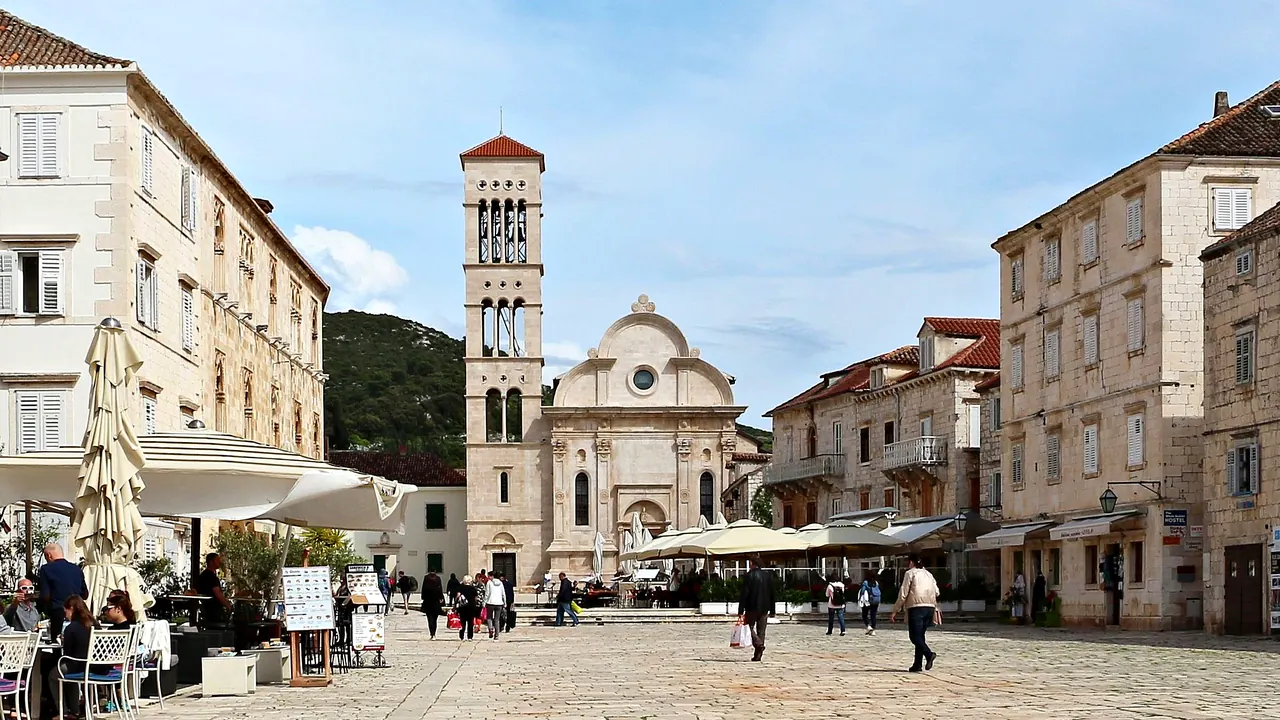
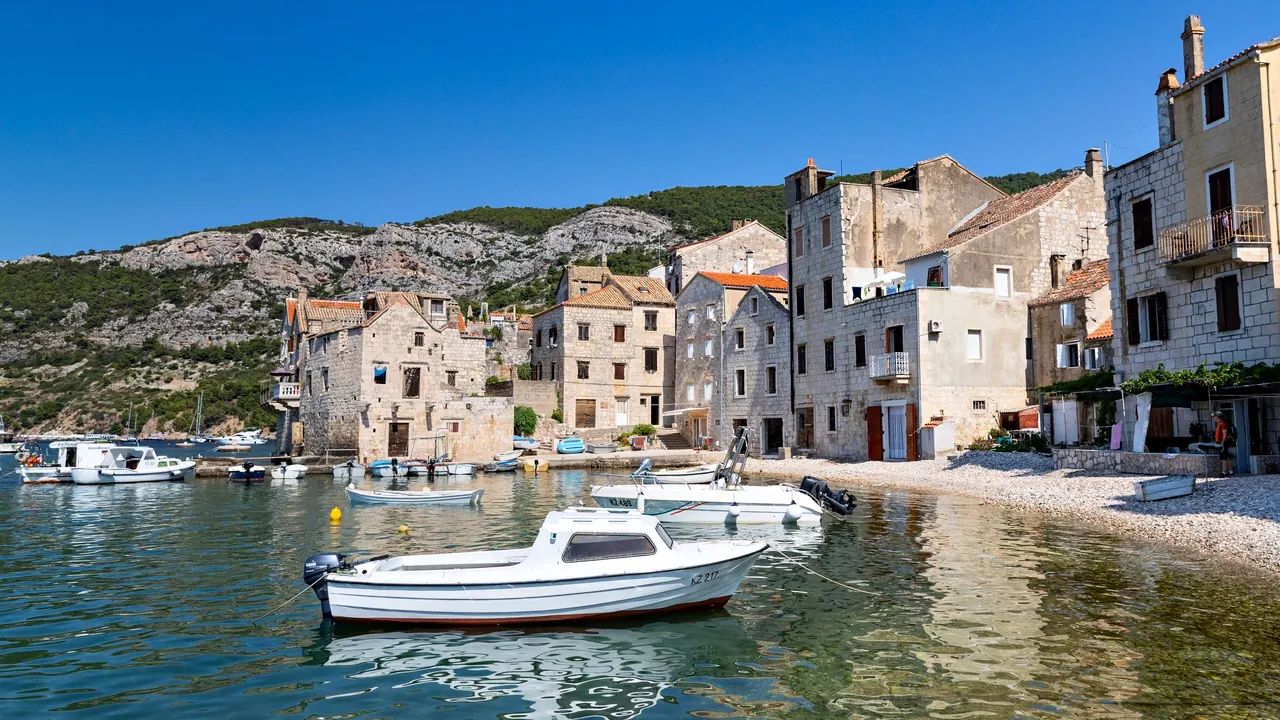
Photos: Hvar by Bernard Gagnon, CC BY-SA 4.0, cropped; Vis by dronepicr, CC BY 2.0, cropped.
Hvar or Vis?
Our verdict in twelve categories, each scored against the same fixed benchmark cities, and the climate month by month, so you can choose for your trip.
Choose Hvar for
- nightlife
- day trips
- culture and sights
Hvar suits travellers who want an island with plenty going on. Hvar Town gives you a Venetian square, a fortress and one of the Adriatic's best-known summer party scenes, while Stari Grad and Jelsa offer a quieter base on the same island. You also get the better food and wine, the richer set of sights and catamarans that make Split, Korčula and Brač easy outings. The cost is crowds and high prices in midsummer, at least around Hvar Town.
Choose Vis for
- nature and the outdoors
- prices
Vis is for people who want to get away from all that. It lies further out to sea and was long closed to visitors, so it has no party scene and few distractions. In their place you get dramatic coves like Stiniva, sea caves, wreck diving and odd relics of its military past. It works best when you plan to stay put, since the mainland and the neighbouring islands are too far for a day out.
Scoreboard
Twelve categories on one fixed scale from 0 to 100. The shaded stretch is the gap between the two.
Your match
Pick a travel style or drag the sliders, and both match scores follow your weighting.
Wins on nightlife and day trips with your weighting.
Wins on nature and the outdoors and prices with your weighting.
What matters to you?
Category by category
What the scores mean for a trip.
Beaches & swimming
The swimming is about equally good on both islands: very clear water, almost all of it lapping against pebble and rock, with no long sandy beaches. Hvar's strength is choice close at hand. Taxi boats carry you from Hvar Town to the pine-backed bays of the Pakleni Islands, and the north-side towns of Jelsa, Vrboska and Stari Grad have calm, shallow water right on their doorstep, though in midsummer the famous bays fill with yachts.
Vis is wilder. Its signature cove, Stiniva, is closed in by two cliffs and takes a steep path or a boat to reach, and the emptiest water is found on boat trips to the outer islets. There is little shade, and you will need a scooter, a car or a taxi boat to reach most coves.
Food & drink
Hvar eats better and with more variety. Its wine is serious, with Plavac Mali from the steep slopes at Ivan Dolac and Bogdanjuša from the plain behind Stari Grad. Hill villages such as Pitve and Velo Grablje cook lamb and vegetables from their own land, and Hvar Town has the island's most ambitious kitchens.
Vis keeps to a tighter repertoire: lobster and fish from the boats, peka dishes and the anchovy-filled pogača of Komiža, with Vugava poured at small farms. It is good honest eating, but there are few markets and little street food once you leave the konobas.
Culture & sights
Hvar has more to see. Hvar Town alone has its white stone square, St Stephen's Cathedral, the Arsenal with its 1612 theatre and the Fortica above the harbour. On top of that come Greek-founded Stari Grad, the Tvrdalj and a UNESCO-listed plain still divided along ancient field lines.
The sights on Vis are fewer but unusual. There are the remains of Greek Issa and a bronze Greek head in the harbour fortress museum, plus British forts from the Napoleonic wars. Strangest of all are Tito's wartime cave on Hum and the submarine pens and tunnels left from the island's decades as a closed military zone.
Nightlife
Few pairs of islands this close together differ so sharply after dark. In July and August, Hvar Town packs its harbour bars and stepped lanes with yacht crews and young travellers. Day parties on the Pakleni Islands carry on into the night, with taxi boats shuttling people back and forth.
Vis has nothing of the kind. Evenings mean a long dinner at a harbour table in Komiža or Vis town and perhaps a late glass of wine. There are no clubs, and the island is asleep long before dawn.
Nature & outdoors
Vis is the more dramatic island. Its remote position shows in the southern cliffs, the high plateau of vineyards and the view from Hum over open sea. The surrounding islets form a geopark of volcanic rock and sea caves, and the wrecks and walls offshore make it the better choice for divers.
Hvar is gentler. There is a walk up Sveti Nikola from Sveta Nedjelja, lavender fields around Velo Grablje in early summer, abandoned stone villages, and kayaking and snorkelling around the Pakleni Islands. It is a lovely setting, but a softer one.
Day trips
Hvar is far better placed for outings. Catamarans reach Split and Diocletian's Palace in about an hour, and walled Korčula, Brač and even Vis are within reach. The island's own towns, Stari Grad, Jelsa and inlet-side Vrboska, also make easy days out from one another.
Vis faces the open sea, and its outings stay local: the Blue Cave on Biševo, the islets of Ravnik and Budikovac, and on calm days distant Svetac or Jabuka. Anything on the mainland belongs before or after your stay.
Good for families
Neither island has anything built for children, so both suit families content with simple sea days. Hvar's north-side towns make it a little easier: Jelsa, Stari Grad and Vrboska have shallow bays, some fine gravel and promenades for evening strolls, though Hvar Town itself, with its steps and party nights, is best avoided.
On Vis the shallow water is at Stončica and a few bays near Komiža. Many of the best coves involve steep paths or a boat, and shade is scarce, but children get real freedom in its quiet harbour towns.
Getting around
Hvar is the easier island to reach and to move around. Car ferries from Split land at Stari Grad, catamarans serve Hvar Town and Jelsa, and buses run along the island's spine, if not often. A car still helps for the south coast and the hill villages.
Vis takes more commitment. The car ferry from Split takes over two hours, and there are few sailings a day. On the island, a bus covers the 10km between Vis town and Komiža, but the coves and the interior mean hiring a scooter or catching a taxi boat.
Shopping & style
Neither island is a shopping destination, but Hvar gives you a little more. There is lavender oil from the harbour stalls, lace made by Benedictine nuns, wine from family cellars, and linen and jewellery boutiques aimed at the yacht crowd in Hvar Town. On Vis there are only grocery shops, a few souvenir stalls and producers selling carob, herbal brandies, oil and wine, so bring what you need.
Affordability
Both islands cost about the same in summer, and on both June and September are much easier on the wallet than July and August. On Hvar the cost depends on where you stay. Hvar Town is priced for yachts, while family apartments in Jelsa or Vrboska and cellar-door wine keep things reasonable.
Vis has no luxury hotspot to avoid, but distance makes everything cost more. Lobster sold by weight, the ferry, scooter hire and taxi boats all add up.
Live music & performing arts
Klapa, the unaccompanied Dalmatian harmony singing, is the music you are most likely to hear on either island. On Hvar it turns up at village feasts and in the harbour towns. Hvar also has a summer run of chamber and classical concerts in its churches, the Franciscan cloister and its squares, although its 1612 Arsenal theatre does not host a regular season.
Vis has only klapa groups in its harbours, the odd open-air concert and the fishermen's feast days in Komiža. They are nice to come across, but not worth planning a trip around.
Wellness & relaxation
Both islands restore you through their slow pace rather than any spa culture. Hvar has the larger hotels in Hvar Town and Jelsa with treatments and seasonal yoga, but for real calm you have to stay in Vrboska, Stari Grad or the hill villages rather than the party town.
Vis has only a few massage rooms, but its quiet is everywhere: little traffic, long lunches and evenings that end early wherever you stay.
When should you go?
Pick your month. The climate figures are measured averages, not a forecast.
Hvar in July
Vis in July
Daytime high, °C
Rainfall in the month, mm
Where the figures come from
Hvar's temperatures are measured 38 km from the centre, at Split / Marjan.
Hvar has no rain gauge within 25 km of the centre, so its rainfall comes from a gridded climate dataset read at the destination rather than from a gauge further away.
Hvar's sunshine is measured 38 km from the centre, at Split / Marjan.
Vis's temperatures are measured 55 km from the centre, at Split / Marjan.
Vis has no rain gauge within 25 km of the centre, so its rainfall comes from a gridded climate dataset read at the destination rather than from a gauge further away.
Vis's sunshine is measured 55 km from the centre, at Split / Marjan.
Temperature and rainfall are climate normals, averaged over the years shown. Hvar: 1991-2020 (sunshine 1971-2000) normals, Split / Marjan (38.2 km from centre). Vis: 1991-2020 (sunshine 1971-2000) normals, Split / Marjan (54.8 km from centre).
Measured around their main towns, the two islands have almost identical weather. The sea is warm enough for a proper swim from June, when it reaches about 22°C, and stays that way until late September, warmest in August. July and August bring daytime highs of 31°C and the most sunshine of the year. That is fine for the beach, but too hot for walking or cycling except early in the morning. May and June are the comfortable months for exploring on foot, with warm days and only light rain.
September is still warm and the sea still inviting, but it is the month the rain returns, and the wettest stretch follows from October to December. Hvar is a little wetter throughout, with November reaching 116mm against 94mm on Vis. Winters on both are mild but grey, and with much of each island closed outside summer, there is little reason to go between November and March.
Which traveller are you?
On a food and nightlife trip, Hvar is the clear choice. Its harbour cocktail bars and the Pakleni beach clubs run late all summer, and its wine country around Ivan Dolac and its village konobas give you more to eat and drink than Vis can.
For an outdoors trip, Vis has the edge. The island and its islets form a geopark of cliffs, volcanic rock and sea caves, and its wrecks and underwater walls make for some of the best diving in the Adriatic. Hvar is pleasant outdoors but less dramatic.
On a culture and arts trip, choose Hvar. You get Hvar Town's cathedral, the 1612 Arsenal theatre and the Fortica, plus Greek Stari Grad and its UNESCO-listed plain, along with summer concerts in churches and cloisters. Vis offers absorbing ruins and military tunnels, but less of them.
Before you go
| Measure | Hvar | Vis |
|---|---|---|
| Official language | Croatian | Croatian |
| Currency | Euro (EUR) | Euro (EUR) |
| Sockets | CF230 V, 50 Hz | CF230 V, 50 Hz |
| Driving side | Right | Right |
| Time zone | UTC+1, UTC+2 in summer | UTC+1, UTC+2 in summer |
| Emergency number | 112 | 112 |
| Main airport | Split Saint Jerome Airport (SPU)69 non-stop destinations | Split Saint Jerome Airport (SPU)69 non-stop destinations |
| Public holidays this year | 14 days | 14 days |
By the numbers
| Measure | Hvar | Vis |
|---|---|---|
| Swim season, months above 21 °C | 4 months | 4 months |
Where else could you go?
Every comparison below shares a destination with this one, so you can follow Hvar or Vis somewhere new.