Croatia
Vis
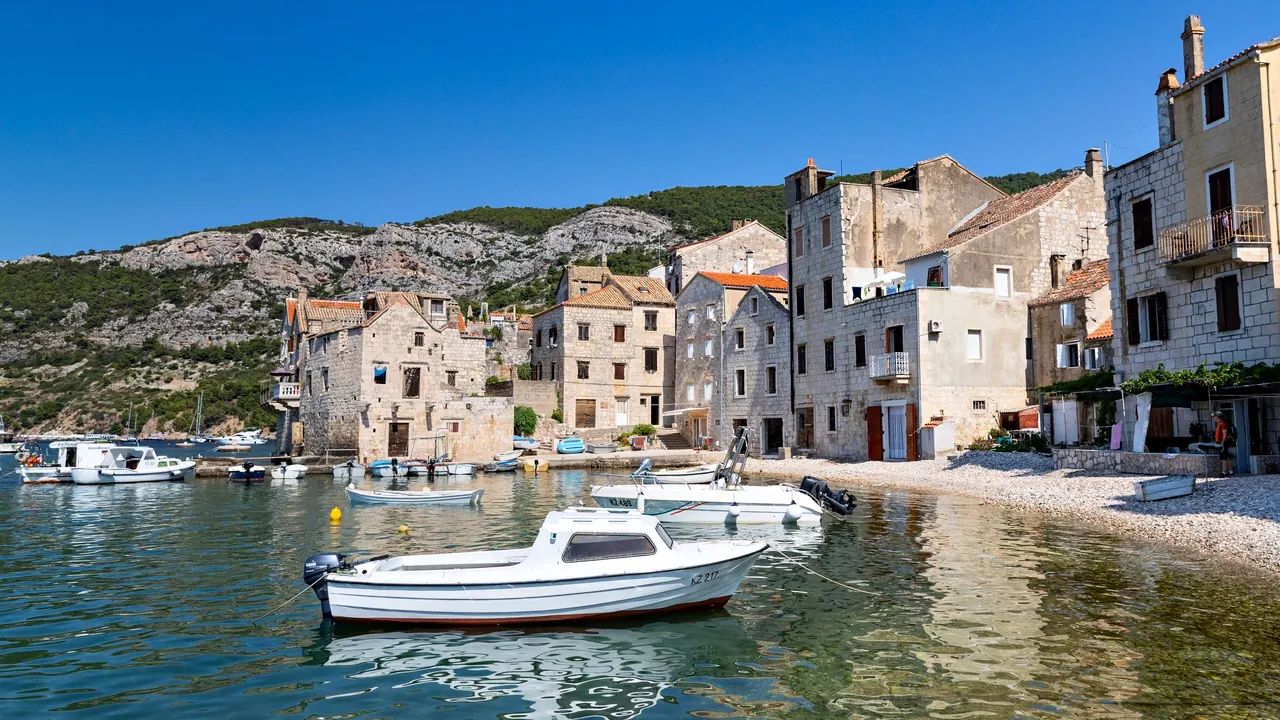
Boats in the harbour at Komiza below old stone houses
- Beaches78
- Nature & outdoors60
- Food & drink45
Vis lies in Dalmatia, which has its own page.
Match
34
Every category weighted equally
- Beach & sun42
- Culture & arts29
- Food & nightlife30
- Family trip41
- Outdoors40
- Relax & unwind40
- Shopping & style29
- On a budget35
Vis in twelve categories
Our verdict on each, scored 0 to 100 against the same fixed benchmark cities, so a score means the same thing on every page.
Beaches & swimming. Scores 78 out of 100.
Food & drink. Scores 45 out of 100.
Culture & sights. Scores 30 out of 100.
Nightlife. Scores 18 out of 100.
Nature & outdoors. Scores 60 out of 100.
Day trips. Scores 22 out of 100.
Good for families. Scores 40 out of 100.
Getting around. Scores 32 out of 100.
Shopping & style. Scores 7 out of 100.
Affordability. Scores 38 out of 100.
Live music & performing arts. Scores 8 out of 100.
Wellness & relaxation. Scores 35 out of 100.
Vis category by category
Beaches & swimming
78Vis is an island of coves rather than long beaches, and the water is some of the clearest in the Adriatic, reaching about 24°C in August and warm enough to swim from June to early October. Stiniva on the south coast is the famous one, a pebble bay closed off by two cliffs and reached by a steep path or by boat. Srebrna and Milna nearby are wider, Stoncica in the east has shallow water and fine shingle, and the bays around Komiza and the sandy patches of the southern inlets fill out the list.
Almost everything is pebble or rock, shade is scarce and the best coves need a scooter, a car or a taxi boat. Days here are built around the sea, with boat trips to the outer islets for the emptiest water.
Food & drink
45Eating on Vis means konobas: family taverns serving fish and lobster from the boats, slow-cooked peka dishes and the island's own savoury pies, the anchovy-filled pogaca of Komiza and Vis. Local white Vugava and red Plavac come from small vineyards in the inland fields, and some growers pour them at their farms. Komiza has the fishing tradition and harbour tables, the town of Vis a few more ambitious restaurants along its long waterfront. The range ends there: little street food, no markets to speak of, and many places close outside the summer months.
Culture & sights
30Vis has a long, layered history in miniature. The town of Vis grew from Issa, a Greek colony whose walls, theatre traces and cemetery lie on the edge of town. The archaeological museum, in a 19th-century Austrian fortress on the harbour, keeps a bronze Greek head and a large collection of amphorae. The stone houses of Kut, the fishing museum in the Venetian tower at Komiza, and the British forts and naval cemetery from the Napoleonic wars add character.
The twentieth century left the most unusual sights: Tito's wartime cave on Hum, and the tunnels, submarine pens and gun emplacements of an island that was long a closed military zone, which guides take visitors through.
Nightlife
18Evenings on Vis are spent at harbour tables in Vis town and Komiza, with a few cocktail and wine bars staying open late in July and August and the odd beach bar holding a party on summer weekends. There is no club scene and the island is quiet well before dawn. It suits people who want a long dinner and a drink by the water, not a night out.
Nature & outdoors
60Vis is one of the most remote inhabited Adriatic islands and its landscape shows it: a high, dry plateau of vineyards and abandoned terraces, steep southern cliffs, and Hum rising behind Komiza with views over open sea. The island and its islets form a geopark, with volcanic rock on Brusnik and Jabuka and sea caves around the coast, the Green Cave on Ravnik among them.
The sea is the main outdoor draw. Diving is excellent, with wrecks and walls, and kayaking, sailing and boat trips round the coves are easy to arrange. Walking and cycling across the interior are pleasant in spring and autumn, but summer heat makes midday outings hard.
Day trips
22Outings from Vis are mostly by boat to the small islands around it: Bisevo with its Blue Cave, the islets of Ravnik and Budikovac, and on calm days far-off Svetac or Jabuka. The other town on the island is worth a day from whichever one you stay in. Split and the neighbouring islands are a long ferry crossing away and impractical for a day, so visitors who want towns and heritage sites should plan them before or after the island.
Good for families
40Vis is safe, quiet and slow, and children have freedom in the small harbour towns. Stoncica and some bays near Komiza have shallow water suited to small swimmers, but many of the best coves are reached by steep paths or boat, beaches are pebble with little shade, and there is nothing built for children: no aquarium, park or attractions. It suits families who want simple sea days, not ones who need organised entertainment.
Getting around
32Getting to Vis takes effort: the car ferry from Split takes over two hours and the faster catamaran about an hour and a half, with few sailings a day. On the island, Vis town and Komiza are about 10km apart and linked by bus, and each harbour is easy on foot. Reaching the coves and the interior means hiring a scooter or car on narrow, winding roads, or taking taxi boats, which is how most visitors get to Stiniva and the southern bays.
Shopping & style
7Shopping amounts to small grocery stores, a few souvenir stalls and local producers selling wine, olive oil, carob and herbal brandies. Anything more must be bought before taking the ferry.
Affordability
38Vis is not a budget island in summer. Rooms are mostly private apartments and small guesthouses, which keep stays manageable, but fish and lobster priced by weight, taxi boats, scooter hire and the ferry add up, and island shops carry the cost of being far out at sea. June and September are noticeably easier on the wallet than July and August.
Live music & performing arts
8There is no theatre or concert life on Vis. Summer brings occasional open-air concerts, klapa groups singing in the harbours and the fishermen's feast days in Komiza, which are pleasant to come across but not a reason to visit.
Wellness & relaxation
35Vis has no spa or bathing tradition, and treatments are limited to a few massage rooms and small hotel offers. What it does have is a slow pace: long lunches, quiet harbour towns, little traffic and evenings that end early. Visitors come here to switch off rather than to be pampered.
Where to stay in Vis
Most visitors stay in one of the island's two harbour towns. They are only about 10km apart and linked by bus, so one base is enough for a whole trip. The town of Vis, where the ferries and catamarans arrive, is the practical choice for a first visit. Its long waterfront of restaurants, the museum in the old fortress and the Greek remains of Issa are all within walking distance. The stone lanes of Kut at its eastern end are quieter and suit an evening stroll and a slower stay. It is a good fit for couples, food lovers and anyone arriving without a car.
Komiza, on the west coast below Hum, is smaller and more of a fishing town, with dinner at harbour tables and swimming bays close by. Boats to Bisevo and the outer islets leave from its quay. It suits families with small children, divers and people who want simple sea days with little else to plan.
For a quiet stay, apartments around the southern inlets near Milna and Srebrna put you close to the best coves. You will need a scooter or car for meals and shopping, though. Wherever you stay, set aside a day to see the other town.
When should you go?
Pick a month to see what it is like. The climate figures are measured averages, not a forecast.
Vis in July
Daytime high, °C
Rainfall in the month, mm
The whole year
Shaded against this destination’s own year: the deepest cell is its best month for that figure and the palest its weakest.
Where the figures come from
Vis's temperatures are measured 55 km from the centre, at Split / Marjan.
Vis has no rain gauge within 25 km of the centre, so its rainfall comes from a gridded climate dataset read at the destination rather than from a gauge further away.
Vis's sunshine is measured 55 km from the centre, at Split / Marjan.
Temperature and rainfall are climate normals, averaged over the years shown. Vis: 1991-2020 (sunshine 1971-2000) normals, Split / Marjan (54.8 km from centre).
Before you go
| Measure | Vis |
|---|---|
| Official language | Croatian |
| Currency | Euro (EUR) |
| Sockets | CF230 V, 50 Hz |
| Driving side | Right |
| Time zone | UTC+1, UTC+2 in summer |
| Emergency number | 112 |
| Main airport | Split Saint Jerome Airport (SPU)69 non-stop destinations |
| Public holidays this year | 14 days |
By the numbers
| Measure | Vis |
|---|---|
| Swim season, months above 21 °C | 4 months |
Compare Vis with
Every comparison with a written verdict behind it.