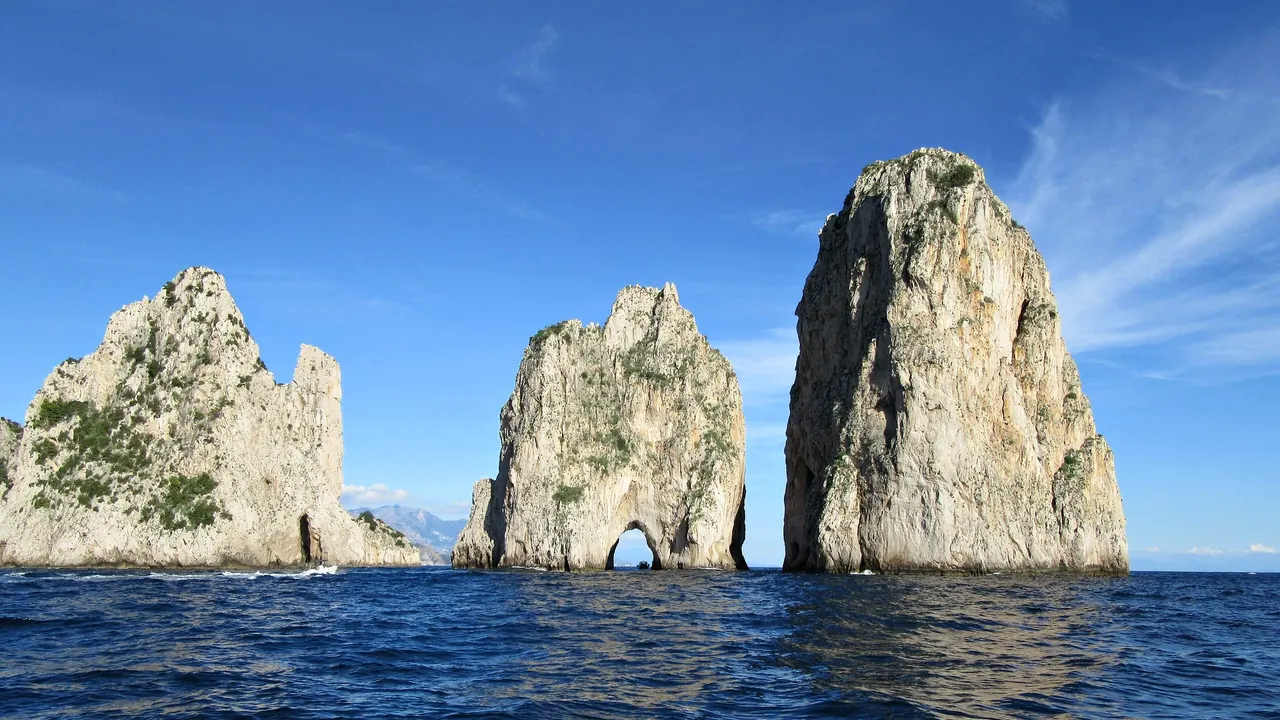
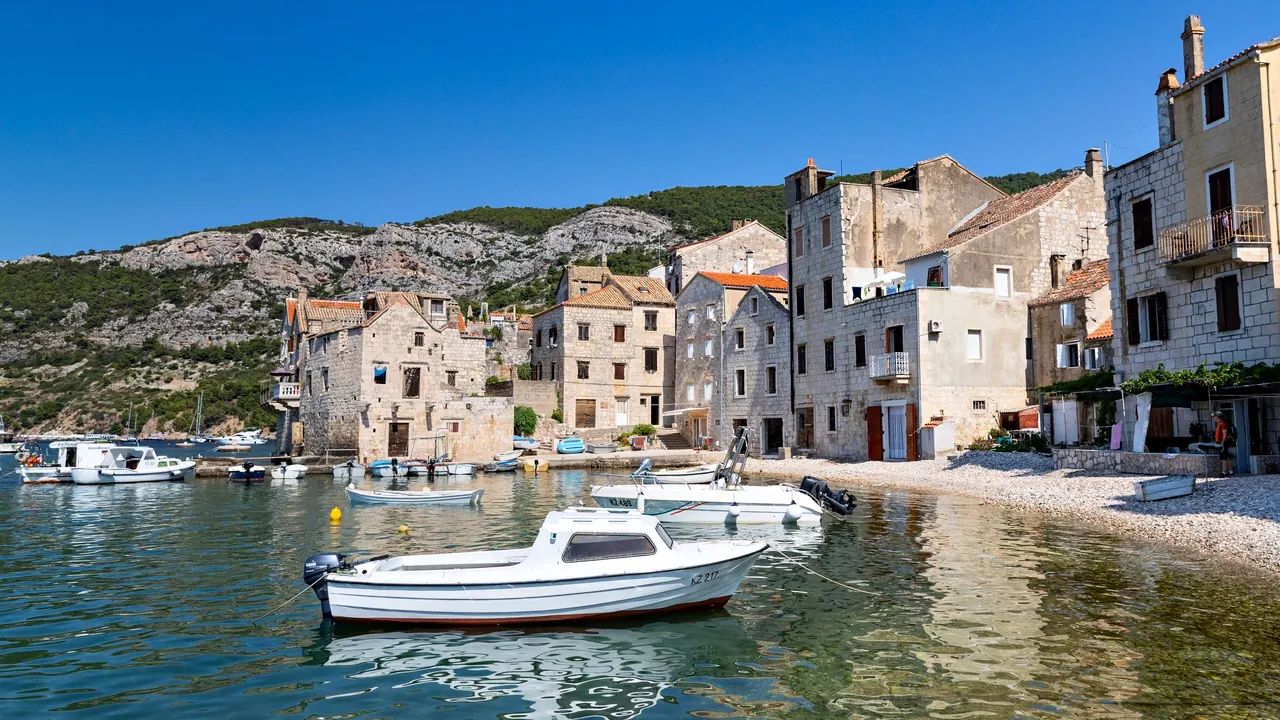
Photos: Capri by Sheeba Samuel, CC BY-SA 4.0, cropped; Vis by dronepicr, CC BY 2.0, cropped.
Capri or Vis?
Our verdict in twelve categories, each scored against the same fixed benchmark cities, and the climate month by month, so you can choose for your trip.
Choose Capri for
- day trips
- shopping
- getting around
Capri suits a short, polished stay where the setting matters as much as the swimming. Its sights run from Tiberius's villa to Villa San Michele, evenings are spent dressed up on the Piazzetta, and its lanes are lined with boutiques. Above all, the whole Bay of Naples is a boat ride away, so Naples, Sorrento, Pompeii and the Amalfi Coast can all fit into the same trip. You pay heavily for this, and in summer you share the island with crowds of day-trippers.
Choose Vis for
- prices
- families
- beaches
Travellers who want the sea itself and very little else will be happier on Vis. Its coves are more numerous and more varied, spread around a remote coast, and the diving on wrecks and walls is excellent. Evenings end early at a konoba table by the harbour, the bill is lighter, and families with small children have shallow bays and quiet harbour towns. In return, getting there means a long ferry from Split and there is hardly any shopping. Outings also stay within the island's own waters: boats to Bisevo's Blue Cave and the outer islets, or a day in the island's other town, while Split and the mainland are too far for a day out.
Scoreboard
Twelve categories on one fixed scale from 0 to 100. The shaded stretch is the gap between the two.
Your match
Pick a travel style or drag the sliders, and both match scores follow your weighting.
Wins on day trips and shopping with your weighting.
Wins on prices and families with your weighting.
What matters to you?
Category by category
What the scores mean for a trip.
Beaches & swimming
Neither island has a sandy beach, so the choice comes down to the kind of swimming you want. Capri's bathing is concentrated in a few places: the small pebble coves at Marina Piccola and Marina Grande, and rock or concrete platforms with ladders into deep water, mostly run as bathing clubs. The finest spot is off the rocks at Punta Carena, and space runs short in high summer.
Vis has more coves and more variety, which puts it ahead. There is Stiniva, enclosed by its cliffs, wider bays at Srebrna and Milna, and shallow shingle at Stoncica, with outer islets for the emptiest water. The cost is getting there, since the best coves need a scooter or a taxi boat and there is little shade once you arrive.
Food & drink
The two islands eat about equally well within narrow limits, but in different ways. Capri has dishes known across Italy, such as insalata caprese, ravioli capresi and torta caprese, along with lemon granita and limoncello. The good meals are in Anacapri's family trattorias, while the tables around the Piazzetta mostly charge for the view.
Vis is about fish and lobster straight from the boats, peka cooked slowly under a lid, and the anchovy pogaca of Komiza. Vugava and Plavac are poured at the farms where they are grown. Many places close outside summer.
Culture & sights
Capri's sights are fewer than a historic town would offer, but they are finer than Vis's. Tiberius's Villa Jovis sits above its sheer drop, Villa San Michele has antiquities and gardens, and the Certosa and the Gardens of Augustus round out a good two days.
Vis tells a stranger story on a smaller scale. There are the remains of Greek Issa, a bronze Greek head in the harbour fortress museum, British forts from the Napoleonic wars, and Tito's wartime cave on Hum. Guides also lead visitors through the tunnels and submarine pens of a former military zone.
Nightlife
Capri has the livelier evenings, although neither island has clubs. Once the last ferries leave, the Piazzetta fills with dressed-up aperitivo drinkers, and the piano taverns keep the singing and table-dancing going late into the night. It is glamorous rather than wild, and it lasts from May to September.
Vis offers a long dinner at the harbour in Komiza or Vis town, a few cocktail and wine bars in high summer and the occasional weekend beach party. Little is still open by the small hours.
Nature & outdoors
Both islands are strong outdoors, in different ways. Capri is a single limestone block, with famous scenery packed into short walks: the Faraglioni from the Pizzolungo path, the Arco Naturale, the Sentiero dei Fortini and the chairlift up Monte Solaro.
Vis feels more remote and less visited. It has a dry plateau of vineyards and old terraces, volcanic islets within a geopark, and the Green Cave on Ravnik. The diving on its wrecks and walls goes well beyond the snorkelling around Capri, and its interior is better suited to cycling in spring and autumn.
Day trips
This is where Capri pulls furthest ahead. Fast boats reach Sorrento in about half an hour and Naples in under an hour, and in season they run to Positano and Amalfi as well. Ischia is close by, and Pompeii and Herculaneum make a long but workable day. All of this depends on calm seas.
Vis offers boat trips to its own islets, Bisevo's Blue Cave and, in good weather, distant Svetac or Jabuka. Split is too far away for a day out, so any towns or heritage sites belong before or after your stay on the island.
Good for families
Vis is the gentler choice with children. The harbour towns are safe and slow, giving children room to roam, and Stoncica and some bays near Komiza have shallow water for small swimmers. It suits families who are happy with simple sea days, because there are no organised attractions.
Capri is hard work with young children. Its steps and lanes are tough with a pushchair, the swimming means ladders into deep water, and the buses are crowded in summer. Older children who swim well will enjoy the Blue Grotto, the chairlift and snorkelling, ideally with a base in Anacapri.
Getting around
Capri is the easier island to manage without a car. A funicular climbs from Marina Grande to the town in minutes, and small buses and open-topped taxis link everything else. The catches are steep walking and long summer queues, which are easiest to avoid by going out early or late.
Vis takes more effort from the start, with a ferry or catamaran from Split and few sailings a day. A bus covers the 10km between Vis town and Komiza, but reaching the coves means hiring a scooter or car on winding roads, or taking a taxi boat.
Shopping & style
On shopping the two are worlds apart. A few lanes on Capri, with Via Camerelle and Via Vittorio Emanuele at their heart, hold a remarkable number of luxury and resort-fashion boutiques. The island also has its own crafts: sandals made by hand while you wait, ceramics, lemon soaps and perfumes made from local flowers.
On Vis there are groceries, a few souvenir stalls and producers selling wine, olive oil, carob and herbal brandies. Anything else needs packing before the ferry.
Affordability
Vis costs considerably less, although it is not cheap in summer. Private apartments and guesthouses keep the cost of a room reasonable. Lobster sold by weight, taxi boats, scooter hire and the ferry soon add up, and June and September are kinder to the wallet than high summer.
Capri is a different order of expense. Hotel rooms are scarce and command top rates in summer, and the view-side restaurants, Piazzetta cocktails and bathing-club sunbeds are priced for a wealthy crowd. Buses, walks and Anacapri trattorias soften the cost a little.
Live music & performing arts
Neither island is a place to go for performances. On summer evenings Capri sometimes holds concerts in the Certosa cloisters or at Villa San Michele, and Neapolitan song fills the piano taverns late at night. Opera is a boat ride away in Naples.
On Vis, music is something you happen upon. Klapa groups sing in the harbours and Komiza holds its fishermen's feast days, but there is no stage to plan around.
Wellness & relaxation
Neither island has thermal springs, so the difference lies in where the calm comes from. On Capri it comes from upmarket hotel spas and from the quiet hours at either end of the day, when the day-trippers have gone and the lanes smell of lemon and jasmine. Ischia's thermal baths are just across the bay.
Vis has only a few massage rooms, but it stays slow all day long, with little traffic, long lunches and early nights.
When should you go?
Pick your month. The climate figures are measured averages, not a forecast.
Capri in July
Vis in July
Daytime high, °C
Rainfall in the month, mm
Where the figures come from
Capri has no rain gauge within 25 km of the centre, so its rainfall comes from a gridded climate dataset read at the destination rather than from a gauge further away.
Capri's sunshine is measured 58 km from the centre, at Grazzanise.
Vis's temperatures are measured 55 km from the centre, at Split / Marjan.
Vis has no rain gauge within 25 km of the centre, so its rainfall comes from a gridded climate dataset read at the destination rather than from a gauge further away.
Vis's sunshine is measured 55 km from the centre, at Split / Marjan.
Temperature and rainfall are climate normals, averaged over the years shown. Capri: 2005-2025 (sunshine 1991-2020, rainfall 1991-2020) normals, Capri (3.6 km from centre). Vis: 1991-2020 (sunshine 1971-2000) normals, Split / Marjan (54.8 km from centre).
The two islands follow much the same calendar. The sea is warm enough for swimming from June to early October, and the peak in July and August is hot for steep walking, with highs around 30°C on Capri and 31°C on Vis. Capri's sea is a shade warmer in late summer, reaching about 26°C. Vis gets slightly more sunshine through most of the year, though the gap is small. May and late September are the best months on both islands for the cliff paths and Vis's inland plateau, when the days are warm without being draining.
They differ most once summer ends. Capri turns noticeably wet from September, and November brings about 146mm, the wettest month on either island. Vis stays drier through autumn and winter, peaking at about 94mm in November. Neither island is a winter beach destination, and both are cooler and quieter from November to March.
Which traveller are you?
On a shopping trip, Capri is the clear choice. Via Camerelle and the lanes off the Piazzetta pack in luxury boutiques, and the island's own crafts include made-to-measure sandals, linen and local perfumes. Vis has little more than grocery stores and farm wine.
On a trip on a tight budget, Vis is far easier to manage. Private apartments and guesthouses keep the cost of a stay down, especially in June and September. Capri is among Italy's most expensive islands, and staying on the mainland to save money means missing its evenings.
For a food and nightlife trip, Capri has more going on after dinner. Aperitivo on the Piazzetta leads on to piano taverns where Neapolitan songs carry on into the early hours. Vis eats just as well in its konobas, but the island goes quiet early.
Before you go
| Measure | Capri | Vis |
|---|---|---|
| Official language | Italian | Croatian |
| Currency | Euro (EUR) | Euro (EUR) |
| Sockets | CFL230 V, 50 Hz | CF230 V, 50 Hz |
| Driving side | Right | Right |
| Time zone | UTC+1, UTC+2 in summer | UTC+1, UTC+2 in summer |
| Emergency number | 112 | 112 |
| Main airport | Naples International Airport (NAP)131 non-stop destinations | Split Saint Jerome Airport (SPU)69 non-stop destinations |
| Public holidays this year | 13 days | 14 days |
By the numbers
| Measure | Capri | Vis |
|---|---|---|
| Population | 12,903 | - |
| People per km² | 1,241 | - |
| Swim season, months above 21 °C | 5 months | 4 months |
Where else could you go?
Every comparison below shares a destination with this one, so you can follow Capri or Vis somewhere new.