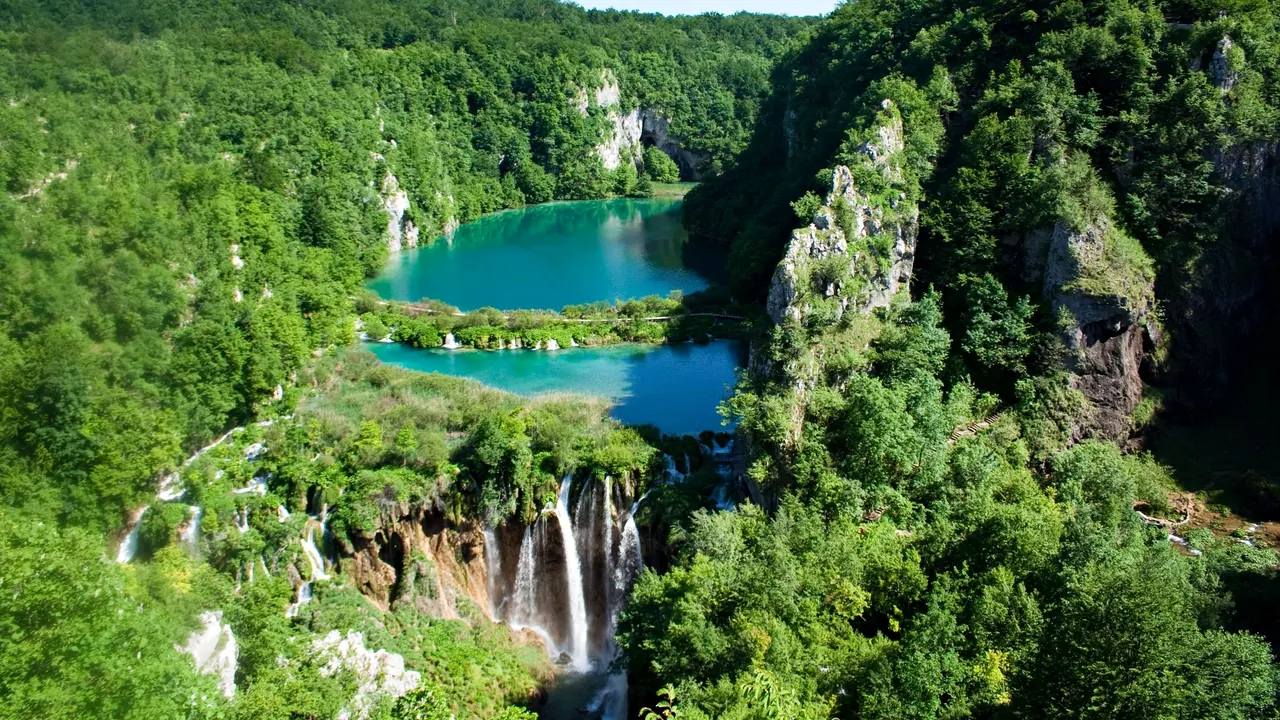
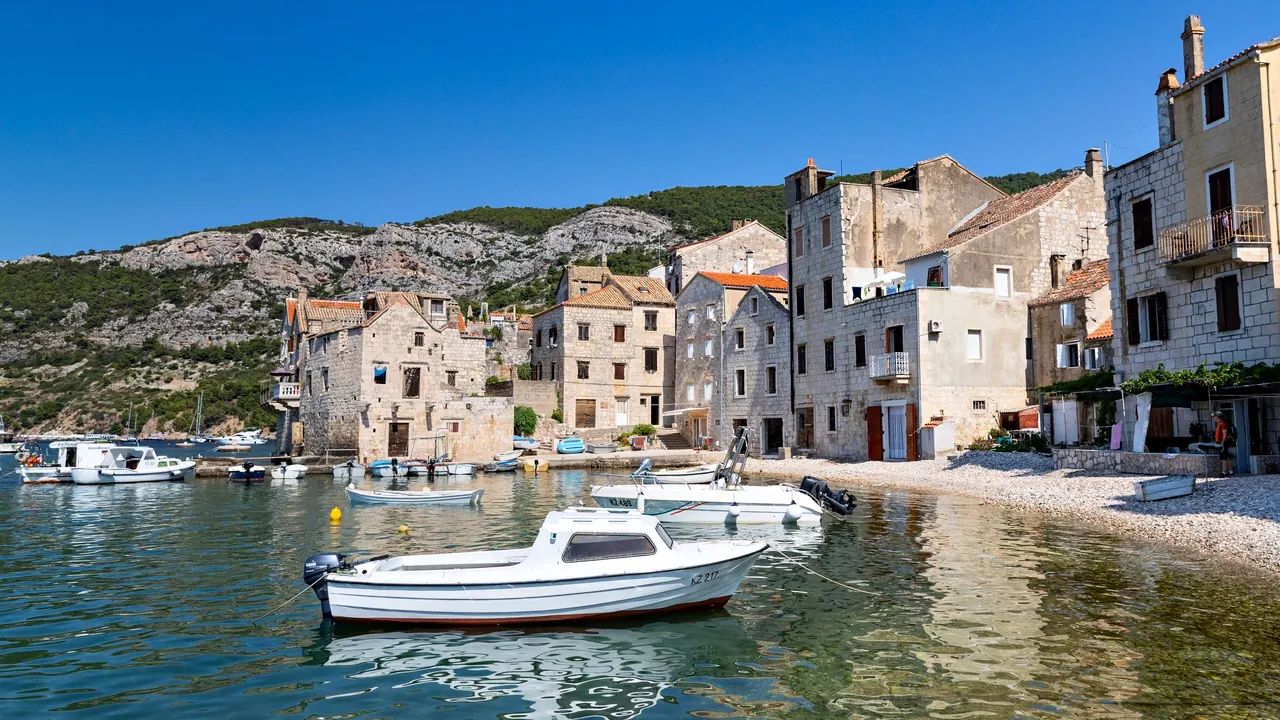
Photos: Plitvice Lakes by Pablo BM from London, England, CC BY 2.0, cropped; Vis by dronepicr, CC BY 2.0, cropped.
Plitvice Lakes or Vis?
Our verdict in twelve categories, each scored against the same fixed benchmark cities, and the climate month by month, so you can choose for your trip.
Choose Plitvice Lakes for
- nature and the outdoors
- day trips
- getting around
Plitvice Lakes is for travellers who want to spend their days walking through scenery: terraced lakes, boardwalks over waterfalls and beech and fir forest, with caves, river rafting and Velebit hikes nearby. Most people give it a night or two between Zagreb and the coast. It is easier to reach by road and cheaper to stay in, but you can't swim in the lakes and there is nothing to do once evening comes.
Choose Vis for
- beaches
- food and drink
- culture and sights
Choose Vis for a slow vacation by the sea. You get some of the clearest coves in the Adriatic, boat trips to the outer islets, fish dinners in konobas, and a past that runs from a Greek colony to Cold War tunnels. The price is a long ferry crossing, higher summer costs and an island you need a scooter or boat to explore.
Scoreboard
Twelve categories on one fixed scale from 0 to 100. The shaded stretch is the gap between the two.
Your match
Pick a travel style or drag the sliders, and both match scores follow your weighting.
Wins on nature and the outdoors and day trips with your weighting.
Wins on beaches and food and drink with your weighting.
What matters to you?
Category by category
What the scores mean for a trip.
Beaches & swimming
At Plitvice you are surrounded by water but can't swim in any of it: bathing is banned throughout the park. In summer people swim in the cool, clear Korana river instead, near Korana village and Slunj. The nearest sea beaches are at Senj or Zadar, roughly two hours away over the mountains.
On Vis the sea is the whole point. There are pebble coves like Stiniva between its cliffs, the wider bays at Srebrna and Milna, and shallow Stoncica in the east. You will need to bring your own shade and some way of getting to the better coves.
Food & drink
Vis eats better and with more variety. Its konobas serve fish and lobster landed by the local boats, peka dishes and the anchovy-filled pogaca of Komiza, with Vugava and Plavac wines from the island's own vineyards. Many places close outside summer, though.
At Plitvice you get Lika country cooking at roadside inns: lamb and suckling pig on the spit, river trout, dishes slow-cooked under the iron bell, local cheese and brandy. It is filling but always much the same, and much of it is cooked for tour groups.
Culture & sights
Neither place is a culture trip, but Vis offers far more. In Vis town you can see the walls and cemetery of the Greek colony of Issa, and a bronze Greek head in the archaeological museum, which is housed in an Austrian fortress. Komiza has a fishing museum in its Venetian tower. Guides also take visitors to Tito's wartime cave and to the tunnels and submarine pens left from the island's decades as a closed military zone.
Around Plitvice the heritage takes an afternoon: the water mills of Rastoke, the ruined Drežnik fortress above the Korana canyon, and memorials to the first deaths of the 1991 war.
Nightlife
Plitvice has no evening scene at all. You have dinner at a guesthouse or roadside inn, perhaps with a glass of local brandy, and the villages fall silent soon after dark because everyone plans to be on the trails at opening time.
Vis gives you more reason to stay up, though it still isn't a night out. In July and August people linger at harbour tables in Vis town and Komiza, a few wine and cocktail bars stay open late, and a beach bar may hold a party on a summer weekend. There are no clubs, and the island is asleep well before dawn.
Nature & outdoors
Plitvice's landscape is the whole reason to go. Sixteen turquoise and emerald lakes step down a limestone valley, joined by waterfalls that end at the Veliki slap. Around them are forests where bears and lynx live, the Barać caves, and the Velebit ridges for longer hikes. Its weak point is the summer crowds, which fill the boardwalks by mid-morning.
On Vis, nature mostly means the sea. You can dive wrecks and walls, take a boat to the Green Cave on Ravnik, or kayak along the cliffs of the geopark. On land, the climb up Hum above Komiza and the terraced plateau are worth it, but only outside the summer heat.
Day trips
Plitvice works better as a base for outings because it is on the road network. Rastoke is half an hour away, and Bihać and the Una falls in Bosnia are within an hour. The Tesla memorial at Smiljan makes a good half day, and Karlovac, Senj and even Zadar are possible as long days.
From Vis, day trips mean boats: to the Blue Cave on Bisevo, to Ravnik and Budikovac, and on calm days out to Svetac. The mainland is too far by ferry for a day, so see Split before or after your stay.
Good for families
Both work for children, in different ways. At Plitvice school-age children love the boardwalks, the fish in the clear water, the electric boat and the little train. But the paths are narrow and wet with no railings, so toddlers need constant watching and a carrier is better than a pushchair.
Vis gives children freedom in its small harbour towns and shallow water at Stoncica. Elsewhere the best coves need steep paths or a boat, shade is scarce and nothing is built for children. It suits a family that is happy with simple sea days.
Getting around
Plitvice is the easier of the two to reach. Intercity buses between Zagreb and the coast stop at the park gates, and inside the park you get walking circuits plus boats and trains. Many guesthouses are within walking distance of an entrance, but anything further afield really needs a car.
Getting to Vis means a ferry or catamaran from Split, with only a few sailings a day. Once there, a bus links Vis town and Komiza, about 10km apart, while the coves are reached by scooter on winding roads or by taxi boat.
Shopping & style
There is almost no shopping in either place. At Plitvice the best things to take home come from farmers' roadside stalls: sheep's cheese, honey, jams and fruit brandy. On Vis, local producers sell their own wine, olive oil, carob and herbal brandies. Buy anything else before you get on the ferry.
Affordability
Plitvice is the cheaper stay. Village guesthouses a little way from the gates are reasonably priced and the country inns serve hearty meals, although the park entrance fee is steep in summer and hotels right by the gates charge for their location.
Vis costs more in high season. Apartments and guesthouses are fair enough, but the ferry, scooter hire, taxi boats and fish priced by weight all add up. Both places are clearly better value in spring or early autumn.
Live music & performing arts
Around Plitvice, live music means at most some traditional Lika folk tunes at a village festival or an evening at an inn. For concerts or theatre you would have to drive to Zagreb or Zadar.
Vis has a little more to come across in summer. Klapa groups sing unaccompanied in the harbours, there is the odd open-air concert, and Komiza holds its fishermen's feast days. They are a pleasure if you happen on them, but not something to plan a trip around.
Wellness & relaxation
Plitvice's quiet is the stillness of the forest. You stay in farmhouse guesthouses among meadows and fir trees, breathe clean mountain air, and the evenings have hardly a sound once the coach parties leave. The lakes themselves are anything but restful at midday in summer, so stay in an outlying village and walk the boardwalks early.
On Vis the calm comes from the island's slow pace instead: long lunches, swims in clear coves, harbour towns with little traffic and nights that end early. Spa facilities are thin in both places, no more than a few hotel saunas and massage rooms, so go to switch off rather than to be pampered.
When should you go?
Pick your month. The climate figures are measured averages, not a forecast.
Plitvice Lakes in July
Vis in July
Daytime high, °C
Rainfall in the month, mm
Where the figures come from
Plitvice Lakes has no weather station within reach, so its figures come from a gridded climate model rather than a measured record, and read a broad area rather than one spot.
Vis's temperatures are measured 55 km from the centre, at Split / Marjan.
Vis has no rain gauge within 25 km of the centre, so its rainfall comes from a gridded climate dataset read at the destination rather than from a gauge further away.
Vis's sunshine is measured 55 km from the centre, at Split / Marjan.
Temperature and rainfall are climate normals, averaged over the years shown. Plitvice Lakes: 2001-2020 normals, NASA POWER reanalysis grid, no weather station within 90 km. Vis: 1991-2020 (sunshine 1971-2000) normals, Split / Marjan (54.8 km from centre).
Plitvice sits inland in the mountains, so the seasons are sharp. July and August reach about 27°C, which is pleasant for walking the trails. Winter days stay close to freezing and the falls can ice over. Rain is spread through the year, but autumn is wettest, with about 140mm in both September and November. Spring brings the fullest waterfalls, and autumn the coloured forest.
Vis has a warm Mediterranean climate and is much drier and sunnier. From June to early October the sea is warm enough to swim, peaking at about 25°C in August. July and August are almost rainless and reach about 31°C, which is good for the beach but too hot for midday walks across the island. Spring and autumn suit walking on Vis. Its rain arrives from October and is heaviest in November, the same late-autumn spell when Plitvice is soaked too.
Which traveller are you?
For a beach and sun trip, Vis is the obvious choice. It has clear pebble coves such as Stiniva and Srebrna, warm sea from June into October, and taxi boats out to empty islets. At Plitvice the lakes are off limits to swimmers, and the coast is two hours away.
For an outdoors trip, Plitvice wins. You can walk the boardwalks over sixteen lakes and their waterfalls, climb forest trails to viewpoints, visit the Barać caves, raft the Korana and hike on Velebit. Vis is mostly about the sea, with good diving, while its dry interior is best walked in spring or autumn.
For a trip on a tight budget, Plitvice is cheaper. Village guesthouses are reasonably priced and country inns serve big portions without coastal prices, especially if you avoid the summer park fees. On Vis, the ferry, scooter hire, taxi boats and fish sold by weight add up quickly in summer.
Before you go
| Measure | Plitvice Lakes | Vis |
|---|---|---|
| Official language | Croatian | Croatian |
| Currency | Euro (EUR) | Euro (EUR) |
| Sockets | CF230 V, 50 Hz | CF230 V, 50 Hz |
| Driving side | Right | Right |
| Time zone | UTC+1, UTC+2 in summer | UTC+1, UTC+2 in summer |
| Emergency number | 112 | 112 |
| Main airport | Zagreb Franjo Tuđman International Airport (ZAG)66 non-stop destinations | Split Saint Jerome Airport (SPU)69 non-stop destinations |
| Public holidays this year | 14 days | 14 days |
By the numbers
| Measure | Plitvice Lakes | Vis |
|---|---|---|
| Swim season, months above 21 °C | - | 4 months |
Where else could you go?
Every comparison below shares a destination with this one, so you can follow Plitvice Lakes or Vis somewhere new.