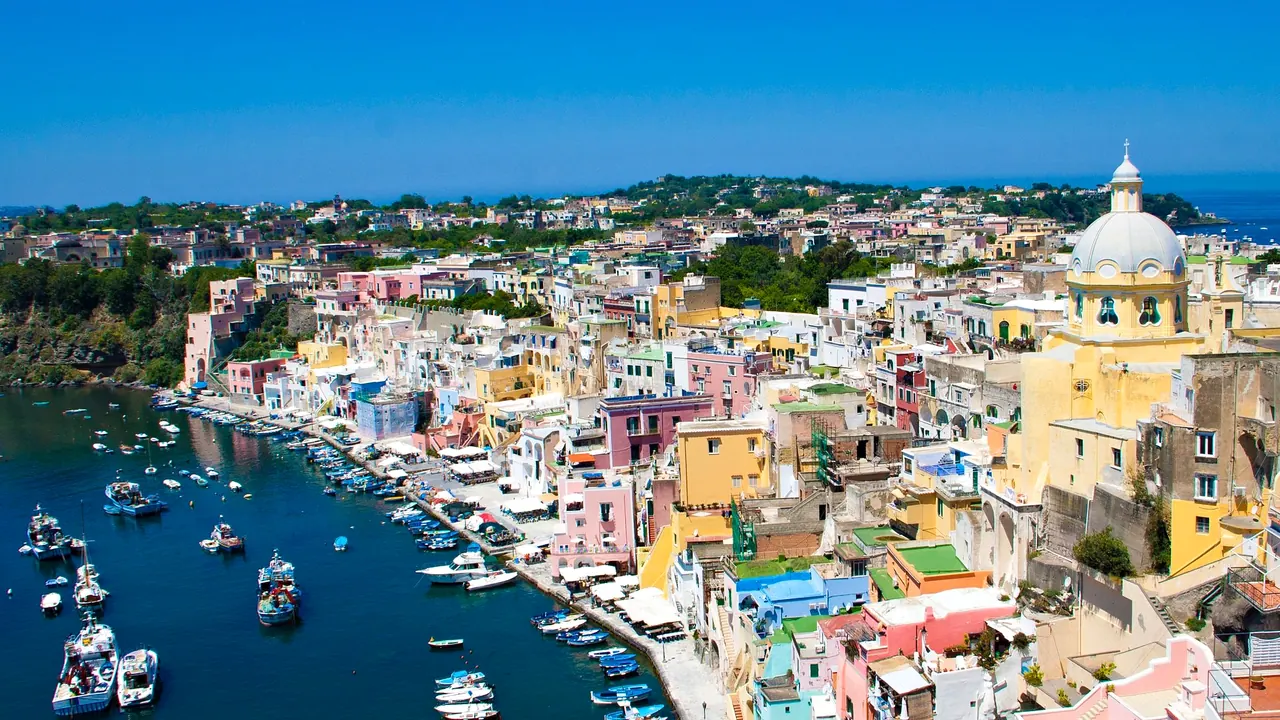
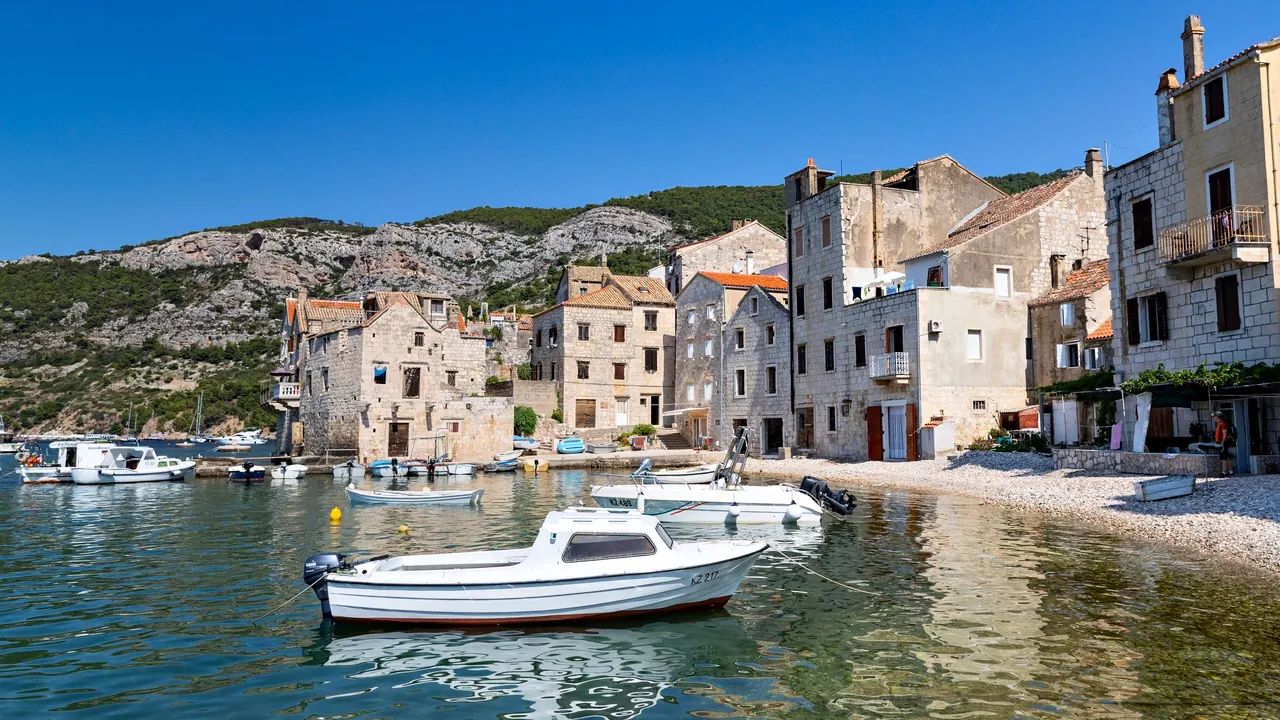
Photos: Procida by DIANA.GRYGAROVA, CC BY-SA 4.0, cropped; Vis by dronepicr, CC BY 2.0, cropped.
Procida or Vis?
Our verdict in twelve categories, each scored against the same fixed benchmark cities, and the climate month by month, so you can choose for your trip.
Choose Procida for
- day trips
- getting around
- wellness
Procida suits travellers who want a small, slow island with the whole Bay of Naples within reach. Ischia's thermal gardens, the Roman ruins at Pozzuoli and Baia, Naples itself and Herculaneum can all be reached by ferry, and the island is easy to get around once you land. You give up some wildness and the clearest water, but you gain a base with far more to do beyond its shores.
Choose Vis for
- nature and the outdoors
- beaches
- nightlife
Vis is for people who want to be properly far out at sea and stay there. Its water is clearer, its coves are more dramatic, and the cliffs, sea caves and dive sites give an active traveller more to explore. In return you face a long crossing from Split, you will need a scooter or taxi boat to reach the best bays, and the trip is built around the island alone.
Scoreboard
Twelve categories on one fixed scale from 0 to 100. The shaded stretch is the gap between the two.
Your match
Pick a travel style or drag the sliders, and both match scores follow your weighting.
Wins on day trips and getting around with your weighting.
Wins on nature and the outdoors and beaches with your weighting.
What matters to you?
Category by category
What the scores mean for a trip.
Beaches & swimming
Vis has the stronger beaches. Its water is clearer, and its coves are more striking: Stiniva is closed in by two cliffs, Srebrna and Milna are wider, and Stoncica has shallow water over fine shingle. Boat trips to the outer islets find the emptiest water of all. The catch is that almost everything is pebble or rock, shade is scarce, and the best bays need a scooter or a taxi boat.
Procida's beaches are dark volcanic sand, which is softer underfoot, and the bus runs to Chiaiolella and Ciraccio. Chiaia, down its long flight of steps, and sheltered Pozzo Vecchio are the quieter choices. None of them is large, though, and in August they fill early.
Food & drink
Neither island has a wide range of food, and on both many kitchens close out of season. What sets them apart is flavour. Procida cooks with its big sweet lemons: in a salad with mint and chilli, and in lingua, a lemon-cream pastry eaten on the Marina Grande waterfront, alongside the seafood linguine at the harbour trattorias of Corricella.
On Vis the table is the konoba's. There is lobster, slow-cooked peka and the anchovy pogaca of Komiza, and the island makes its own Vugava and Plavac wines, which some growers pour at their farms in the inland fields.
Culture & sights
Each island has a day or two of sights, but from very different periods. Procida's heritage is medieval and picturesque: the walled village of Terra Murata, with its abbey and the former prison of Palazzo d'Avalos, and below it the pastel houses stacked around Corricella harbour.
Vis covers a longer stretch of history. There are the remains of the Greek colony of Issa, a bronze Greek head in the harbour fortress museum and British forts from the Napoleonic wars. Most unusual are its twentieth-century relics: Tito's wartime cave on Hum and the tunnels and submarine pens left from its years as a closed military zone.
Nightlife
Neither island has clubs, but Vis has a little more going on after dinner. In July and August a few cocktail and wine bars in Vis town and Komiza stay open late, and the odd beach bar holds a party on summer weekends.
Procida's evenings end at the waterfront bars of Marina Grande and Chiaiolella, which are lively until around midnight in high summer. For anything more you need the ferry to Ischia or Naples, and a plan for getting back.
Nature & outdoors
Vis is wilder and has much more to offer outdoors. A high plateau of vineyards and abandoned terraces ends in steep southern cliffs. Hum looks out over open sea, and the geopark takes in the volcanic islets of Brusnik and Jabuka and sea caves such as the Green Cave on Ravnik. The diving on wrecks and walls is excellent, and kayaking and sailing are easy to arrange.
Procida is low and gentle, with lemon gardens behind walls and viewpoints rather than trails. Its standout is Vivara, the crescent-shaped reserve, which can only be visited on limited guided openings. A few days covers the island.
Day trips
This is where the two islands differ most. Procida sits in the middle of the Bay of Naples. Ischia is a quarter of an hour away by boat, Pozzuoli about half an hour, with Baia's submerged villas and Greek Cuma just beyond, and Naples under an hour by hydrofoil. Herculaneum and even Pompeii can be done in a day, as long as you watch the last boat back.
Vis offers boat outings to the islets around it, above all the Blue Cave on Bisevo and on calm days distant Svetac or Jabuka, plus a day in whichever of its two towns you are not staying in. Split is too far for a day trip.
Good for families
Both islands suit families who are happy with simple sea days, and neither has anything built for children. Procida has the easier beaches for small swimmers, with soft volcanic sand sloping gently at Chiaiolella and Ciraccio and short distances everywhere. Its drawback is the narrow lanes, which have no pavements and carry steady traffic, making pushchairs hard work.
Vis has quieter streets and gives children freedom in its harbour towns. Shallow Stoncica is good for little ones, but many coves mean steep paths or a boat, and pebbles with little shade.
Getting around
Procida is much easier both to reach and to move around. Ferries and hydrofoils to Naples, Pozzuoli and Ischia are frequent. Once there, the island is only a few kilometres across and covered by small buses and three-wheeled taxis from Marina Grande. Walking is less pleasant than the distances suggest, though, because of the walled lanes and the steps down to Corricella.
Vis takes effort from the start: over two hours by car ferry from Split, or about an hour and a half by catamaran, with few sailings a day. Vis town and Komiza are 10km apart and linked by bus, but the coves and the interior need a hired scooter or car on winding roads, or a taxi boat.
Shopping & style
Procida's Via Roma at Marina Grande sells hand-painted ceramics, limoncello and other lemon products, linen and beachwear, which makes for a pleasant browse on the way to the ferry. For real shopping, Naples is a short crossing away. Vis has even less: grocery stores, a few souvenir stalls and producers selling their own wine, olive oil, carob and herbal brandies, so anything else should be packed before you sail.
Affordability
On Procida the money goes on rooms and on the harbour trattorias, which charge island prices. Pastries, pizzas and the buses are cheap, though, and a beach day costs little if you skip the sunbed concessions, so overall it is a little easier on the budget.
On Vis the extras are what add up: fish and lobster priced by weight, taxi boats to the coves, scooter hire and the ferry from Split. On both islands the rooms are mostly guesthouses and apartments, and June and September are noticeably kinder than July and August.
Live music & performing arts
Procida's great performance is the Good Friday procession of the Misteri. Hooded confraternities and brass bands carry hand-built biblical tableaux from Terra Murata down to the sea. Beyond that there are occasional summer concerts in the squares, and opera in Naples is a ferry ride away, although getting back after a performance is difficult.
On Vis the music comes from klapa groups singing in the harbours, a few open-air summer concerts and the fishermen's feast days in Komiza. These are lovely to come across, but on neither island is there a theatre or concert hall to plan a trip around.
Wellness & relaxation
Both islands are made for slowing down, with long lunches, quiet lanes and early evenings, but Procida has the edge because of Ischia. Its hot springs, thermal gardens and pools are about a quarter of an hour away by boat, so you can spend a day soaking and be back for dinner overlooking Corricella.
Vis has no bathing tradition and only a few massage rooms. Its appeal is simply being far out at sea, where switching off comes easily.
When should you go?
Pick your month. The climate figures are measured averages, not a forecast.
Procida in July
Vis in July
Daytime high, °C
Rainfall in the month, mm
Where the figures come from
Procida's temperatures are measured 32 km from the centre, at Grazzanise.
Vis's temperatures are measured 55 km from the centre, at Split / Marjan.
Vis has no rain gauge within 25 km of the centre, so its rainfall comes from a gridded climate dataset read at the destination rather than from a gauge further away.
Vis's sunshine is measured 55 km from the centre, at Split / Marjan.
Temperature and rainfall are climate normals, averaged over the years shown. Procida: 1991-2020 (rainfall 1971-2000) normals, Grazzanise (32.2 km from centre). Vis: 1991-2020 (sunshine 1971-2000) normals, Split / Marjan (54.8 km from centre).
Through the summer the two islands are almost twins. Both reach 31°C in July and August, both are dry from June to August, and on both the sea is warm enough to swim from June. Vis is the slightly sunnier of the two at the height of summer. In both places the midday heat makes July and August better for the water than for walking, and May and early June are the pleasant months for exploring on foot.
They part ways in autumn. Procida holds its warmth longer, with September around 28°C against 25°C on Vis and the sea still warm into October. But its rain arrives harder, with about 153mm in October and more in November. Vis cools sooner and stays much drier through the autumn and winter, though its sea drops below comfortable swimming after early October. On Procida, September is the sweet spot. On Vis, June and the first half of September are the best months.
Which traveller are you?
On a culture and arts trip, Procida is the better base. Its own sights are modest, but Naples and its museums, Herculaneum, Pompeii and the Roman ruins at Pozzuoli and Baia are all reachable by ferry. From Vis, the mainland is too far for a day out.
For an outdoors trip, choose Vis. There is diving on wrecks and walls, kayaking past sea caves, the geopark islets and walks across the high plateau to Hum. Procida's low craters and viewpoints can be covered in a few days.
On a relaxing and wellness trip, Procida comes out ahead. Both islands are slow and quiet, but from Procida the hot springs and thermal gardens of Ischia are about a quarter of an hour away by boat. Vis offers only a few massage rooms.
Before you go
| Measure | Procida | Vis |
|---|---|---|
| Official language | Italian | Croatian |
| Currency | Euro (EUR) | Euro (EUR) |
| Sockets | CFL230 V, 50 Hz | CF230 V, 50 Hz |
| Driving side | Right | Right |
| Time zone | UTC+1, UTC+2 in summer | UTC+1, UTC+2 in summer |
| Emergency number | 112 | 112 |
| Main airport | Naples International Airport (NAP)131 non-stop destinations | Split Saint Jerome Airport (SPU)69 non-stop destinations |
| Public holidays this year | 13 days | 14 days |
By the numbers
| Measure | Procida | Vis |
|---|---|---|
| Population | 10,092 | - |
| People per km² | 2,347 | - |
| Swim season, months above 21 °C | 5 months | 4 months |
Where else could you go?
Every comparison below shares a destination with this one, so you can follow Procida or Vis somewhere new.