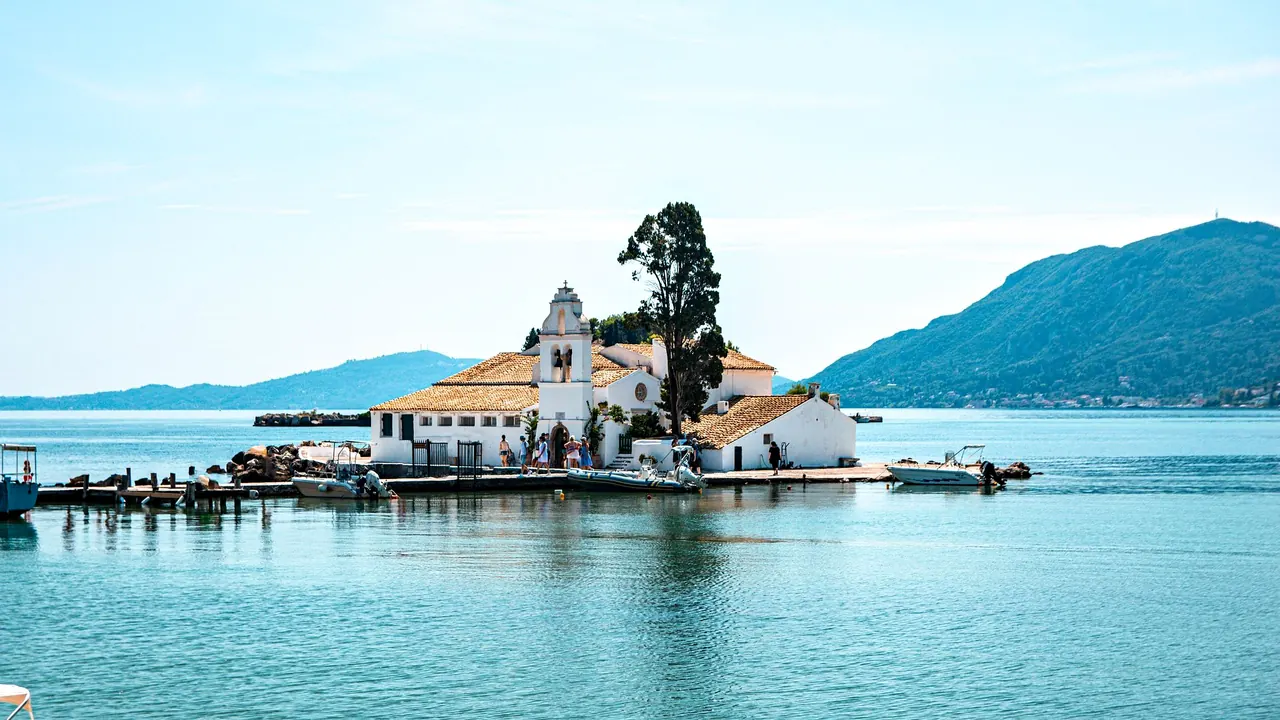
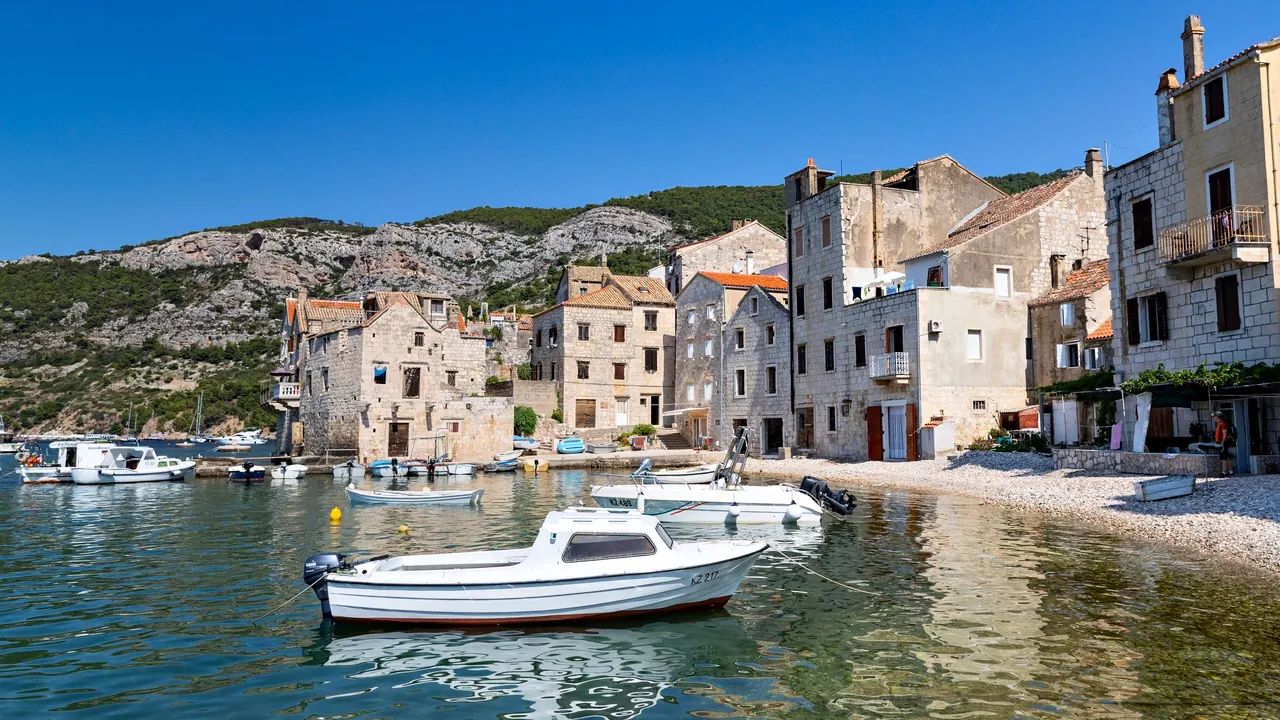
Photos: Corfu by Nico Hartnauer, Pexels License; Vis by dronepicr, CC BY 2.0, cropped.
Corfu or Vis?
Our verdict in twelve categories, each scored against the same fixed benchmark cities, and the climate month by month, so you can choose for your trip.
Choose Corfu for
- nightlife
- day trips
- culture and sights
Corfu suits travellers who want beach days plus a real town to come back to. You get the Venetian old town of Corfu Town with its fortresses and the Liston, cooking with a distinct Italian streak, evenings that range from quiet tavernas to the clubs of Kavos, and boat outings to Paxos or across to Butrint in Albania. Families also have an easier time, with gently shelving sandy bays and resorts built around pools.
Choose Vis for
- nature and the outdoors
Vis is for people who want to leave most of that behind. It is farther out, harder to reach and costs more for what it offers. In return, its coves have some of the clearest water in the Adriatic, the harbour towns of Vis and Komiza stay quiet, and the sea around the outer islets, with diving on wrecks and walls, is the whole point of the stay. Choose it for a slow week built around the sea, not for sights or nights out.
Scoreboard
Twelve categories on one fixed scale from 0 to 100. The shaded stretch is the gap between the two.
Your match
Pick a travel style or drag the sliders, and both match scores follow your weighting.
Wins on nightlife and day trips with your weighting.
Wins on nature and the outdoors with your weighting.
What matters to you?
Category by category
What the scores mean for a trip.
Beaches & swimming
Both islands are built around the sea, and the real difference is sand against pebble. Corfu has long sandy beaches on its west coast, such as Glyfada and the dune-backed Issos and Halikounas. The north has shallow sands, the northeast has calm pebble bays, and the coves at Paleokastritsa have very clear water.
Vis is all coves, mostly pebble and rock with little shade. Its water is among the clearest in the Adriatic, though, and Stiniva, enclosed by its two cliffs, is a sight in itself. You reach the best coves by scooter or taxi boat, while on Corfu you can often walk from your resort straight onto the sand.
Food & drink
Corfu gives you more to explore at the table. Its cooking was shaped by Venice: pastitsada, veal sofrito and bourdeto, with kumquat liqueur and the island's own ginger beer alongside. It is at its best in Corfu Town's lanes and the inland villages, once you step away from the resort menus.
Vis is simpler and narrower. Its konobas serve fish and lobster, slow-cooked peka dishes and the anchovy pogaca of Komiza, and growers pour their own Vugava and Plavac. That makes a fine week of seafood dinners, but there is little beyond it, and many kitchens close outside summer.
Culture & sights
Corfu Town alone outweighs everything on Vis. It has a UNESCO-listed Venetian old town around the Liston and the Spianada, two fortresses, the Church of Agios Spyridon and a museum holding the Gorgon pediment. Beyond the town are the Achilleion and the clifftop ruin of Angelokastro.
Vis has a smaller but unusual story, from the walls of Greek Issa and the amphorae in its harbour museum to Tito's cave and the tunnels and submarine pens left from its years as a closed military zone. It rewards curiosity for a day or two, but it will not shape the trip.
Nightlife
Corfu has nightlife for several tastes. Kavos runs bars and clubs until dawn for young visitors, Ipsos and Dassia have a smaller run of beach bars, and Corfu Town has grown-up cocktails under the Liston arcades.
Vis has none of that. There are harbour tables in Vis town and Komiza, a few bars that stay open late in high summer, and an island that is asleep long before dawn. If going out matters to you, this decides it.
Nature & outdoors
The two are close here, but their landscapes could hardly be more different. Corfu is green, with old olive groves, cypresses and spring flowers. You can climb Mount Pantokrator, walk the Corfu Trail the length of the island, or watch birds at the Korission lagoon.
Vis is dry and stark: a plateau of vineyards and abandoned terraces above high southern cliffs, forming a geopark with volcanic islets and sea caves. Its edge is under the water. Diving on wrecks and walls, and kayaking round remote coves, feel much more like the open sea than anything off Corfu.
Day trips
Corfu offers real choices by boat: Paxos and the bays of Antipaxos, Parga and Sivota on the mainland, and a short crossing to Saranda for the ruins of Butrint in Albania. Most of these run only in the main season.
From Vis the outings stay close to home: the Blue Cave on Bisevo, Ravnik and, on calm days, the far-off islets, or simply the island's other town. Split is too far for a day, so plan any towns and heritage sites before or after your stay.
Good for families
Corfu is the easier family island. It has sandy, gently shelving beaches at Roda, Acharavi, Issos and Agios Georgios, resorts with pools and kids' clubs, a large water park and pirate-style boat trips. Just keep away from Kavos and Ipsos.
Vis is safe, children can roam freely in its harbour towns, and Stoncica has shallow water. But most coves are pebble with little shade and are reached by steep paths or by boat, and nothing on the island is built for children. It suits families who are happy with simple days by the sea.
Getting around
Neither island is easy without your own wheels, but Corfu is the simpler of the two. It has its own airport, an old town best seen on foot and buses to the main resorts. Most visitors still hire a car for the western beaches and put up with narrow roads and summer traffic.
Vis starts with a ferry or catamaran from Split lasting well over an hour, with few sailings a day. On the island, a bus links Vis town and Komiza, about 10km apart. Beyond that you need a scooter, a car on winding roads or a taxi boat to the coves.
Shopping & style
Corfu at least has a shopping street. The lanes of Corfu Town around Nikiforou Theotoki sell olive-wood bowls, kumquat liqueur, soaps and handmade jewellery, and there are Greek clothing chains in the newer part of town. Vis has grocery stores, a few souvenir stalls and producers selling wine, oil and herbal brandies, so bring anything else with you.
Affordability
Corfu is the cheaper island for a stay. Taverna meals and buses are fairly priced and the package resorts of the north and east have reasonable rooms. Only the villas around Kassiopi and Corfu Town in high summer push costs up.
Vis keeps its rooms modest, mostly apartments and guesthouses, but its remoteness shows in the bill: fish priced by weight, taxi boats, scooter hire, the ferry and island shop prices. On both islands your money goes noticeably further outside July and August.
Live music & performing arts
Corfu has a genuine musical tradition from its Venetian past. Philharmonic bands play in the Spianada and village squares, kantades are sung in tavernas, and the Easter processions fill Corfu Town, with some classical evenings in the Old Fortress in summer. Vis offers klapa singing in its harbours, the odd open-air concert and the fishermen's feast days in Komiza, which are pleasant to stumble on but nothing to plan around.
Wellness & relaxation
Neither island has a spa tradition, but Corfu offers a little more. There are spas in the larger resort hotels and yoga retreats in the olive groves, and hill villages and the northeast coast make restful bases. Vis has only a few massage rooms and small hotel offers. What it has instead is quiet across the whole island, with little traffic and early nights, so there is no busy resort strip to avoid.
When should you go?
Pick your month. The climate figures are measured averages, not a forecast.
Corfu in July
Vis in July
Daytime high, °C
Rainfall in the month, mm
Where the figures come from
Vis's temperatures are measured 55 km from the centre, at Split / Marjan.
Vis has no rain gauge within 25 km of the centre, so its rainfall comes from a gridded climate dataset read at the destination rather than from a gauge further away.
Vis's sunshine is measured 55 km from the centre, at Split / Marjan.
Temperature and rainfall are climate normals, averaged over the years shown. Corfu: 1991-2020 normals, Kerkyra Airport (0.9 km from centre). Vis: 1991-2020 (sunshine 1971-2000) normals, Split / Marjan (54.8 km from centre).
The two islands share a swimming season, June to early October. The sea is warmest in August, about 26°C off Corfu and a degree cooler at Vis. July and August are hot on both, with highs around 32°C on Corfu and a little lower on Vis, and that makes walking at midday hard. Keep those months for the beach and shade, and save old towns and hill walks for May, early June and late September.
The two part ways in autumn and winter. Corfu is much the wetter island. Rain picks up from September and peaks in November at about 188mm, which is why the island stays so green. Vis is drier and sunnier through the winter months, though also cooler, so neither suits a beach trip outside summer. For walking in spring, Vis's lighter rain gives it a small edge.
Which traveller are you?
On a food and nightlife trip, Corfu wins with little contest. Its cooking has a Venetian accent found nowhere else in Greece, and after dinner you can pick the kind of evening you want, from a quiet drink in town to a resort that dances until morning. On Vis the night ends with the meal.
For an outdoors trip spent mostly on the water, Vis is the stronger pick. Corfu's green hills are better for spring walkers, but Vis sits in one of the remotest corners of the Adriatic, where the week fills with diving, kayaking and boat days out to empty islets.
On a trip with a tight budget, Corfu makes your money go further. You can base yourself in one of its large resorts and get around by bus without adding much on top. Vis charges for its remoteness at every turn, from the crossing out to every outing, so it suits a treat more than a saving.
Before you go
| Measure | Corfu | Vis |
|---|---|---|
| Official language | Greek | Croatian |
| Currency | Euro (EUR) | Euro (EUR) |
| Sockets | CF230 V, 50 Hz | CF230 V, 50 Hz |
| Driving side | Right | Right |
| Time zone | UTC+2, UTC+3 in summer | UTC+1, UTC+2 in summer |
| Emergency number | 112 | 112 |
| Main airport | Corfu Ioannis Kapodistrias International Airport (CFU)88 non-stop destinations | Split Saint Jerome Airport (SPU)69 non-stop destinations |
| Public holidays this year | 15 days | 14 days |
By the numbers
| Measure | Corfu | Vis |
|---|---|---|
| Population | 100,854 | - |
| People per km² | 161 | - |
| Swim season, months above 21 °C | 5 months | 4 months |
Where else could you go?
Every comparison below shares a destination with this one, so you can follow Corfu or Vis somewhere new.