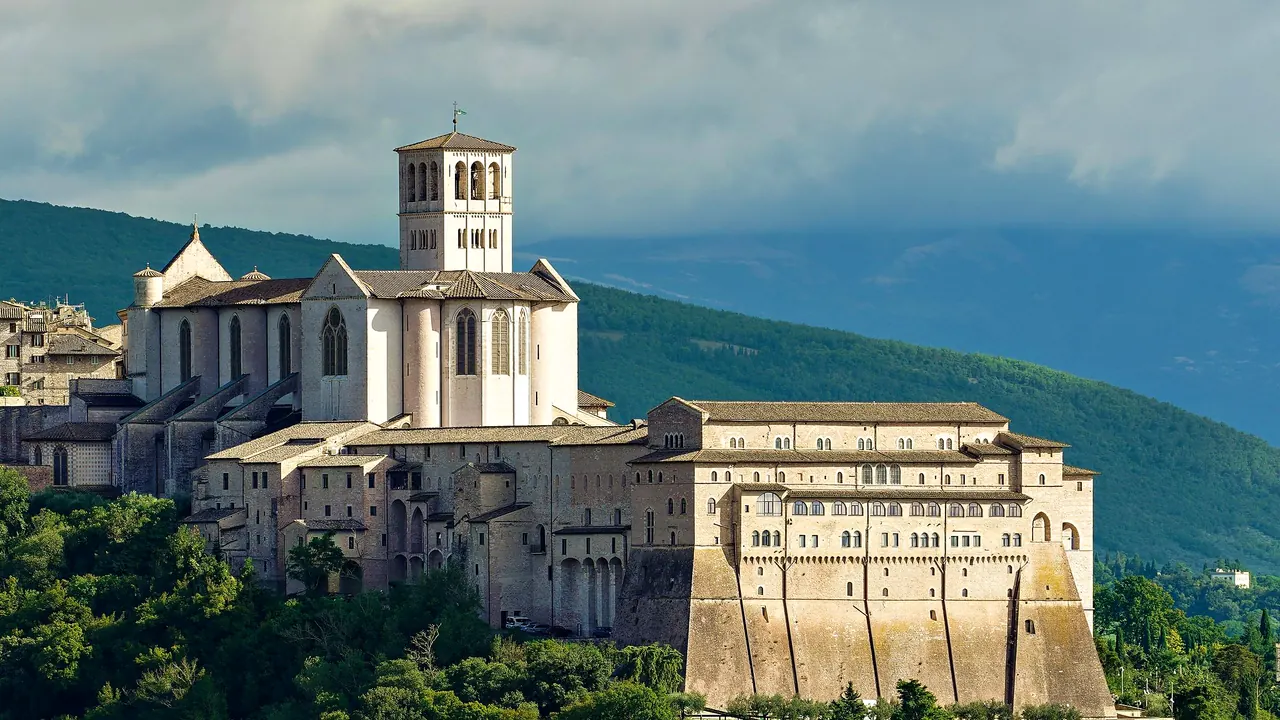
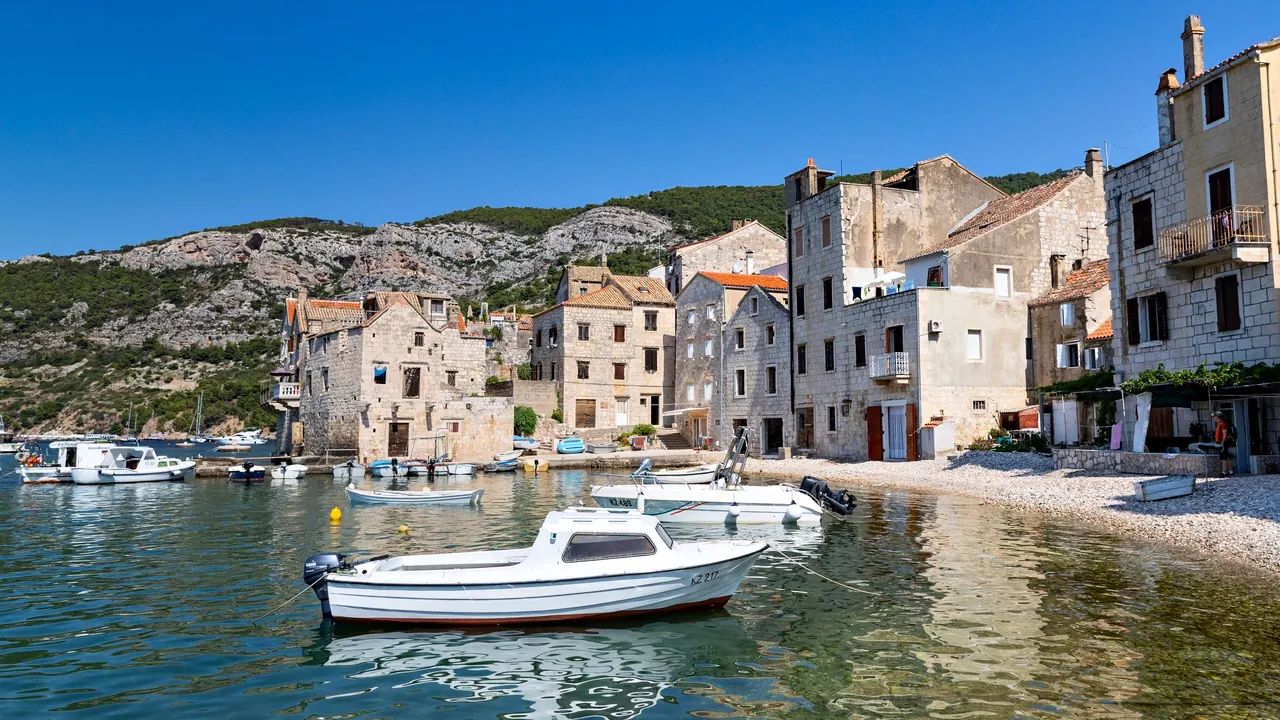
Photos: Umbria by Tagooty, CC BY-SA 4.0, cropped; Vis by dronepicr, CC BY 2.0, cropped.
Umbria or Vis?
Our verdict in twelve categories, each scored against the same fixed benchmark cities, and the climate month by month, so you can choose for your trip.
Choose Umbria for
- day trips
- culture and sights
- live music and the arts
Umbria suits a trip that moves from town to town. You stay in a farmhouse in green hills and see a different medieval centre each day, from Giotto's frescoes in Assisi to Orvieto's cathedral on its cliff. Lunches are long, with truffle pasta and Sagrantino. It costs less than Vis, it is easier to get around, and it has summer festivals in Perugia and Spoleto. The one thing it cannot give you is the sea.
Choose Vis for
- beaches
Pick Vis if your vacation is really about the water. Its coves are some of the clearest swimming in the Adriatic. Boats run out to the Blue Cave and the outer islets, the diving is good on wrecks and underwater walls, and evenings are spent over fish at harbour tables in Komiza. The price is isolation: there is a long ferry crossing from Split, little to visit beyond the island itself and only a handful of sights for days out of the water.
Scoreboard
Twelve categories on one fixed scale from 0 to 100. The shaded stretch is the gap between the two.
Your match
Pick a travel style or drag the sliders, and both match scores follow your weighting.
Wins on day trips and culture and sights with your weighting.
Wins on beaches with your weighting.
What matters to you?
Category by category
What the scores mean for a trip.
Beaches & swimming
For swimming, the two are about as far apart as they could be. Umbria has no coast. The lidos on Lake Trasimeno at Castiglione del Lago and Passignano are warm and calm, but the water is often cloudy and the bottom muddy, so most visitors end up swimming in the farmhouse pool. The nearest sea is a drive of two hours or more.
Vis is built around the sea. Stiniva is a pebble cove closed in by two cliffs, Srebrna and Milna are wider bays, and Stoncica has shallow water for gentler swimming. Taxi boats run out to the islets, though shade is scarce and nearly everything underfoot is pebble or rock.
Food & drink
Umbria eats far more widely. There is black truffle over strangozzi, the pork butchery of Norcia, porchetta from vans at markets and Castelluccio lentils. You can taste Sagrantino and Orvieto whites at the estates, and Perugia has the best choice of restaurants. Its weak point is fish, which happens to be exactly where Vis is strong.
On Vis the table is narrower but fresh. Konobas serve lobster and fish off the boats, slow-cooked peka and the anchovy-filled pogaca, with Vugava and Plavac from the inland vineyards. There are no markets or street food to fill the gaps, and many places close outside summer.
Culture & sights
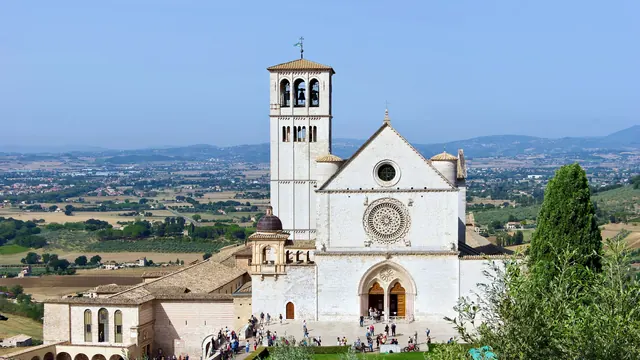
For art and architecture, Umbria is in another league. There is Assisi's basilica with frescoes by Giotto and Cimabue, Orvieto's mosaic façade and Signorelli's Last Judgement, and the Galleria Nazionale in Perugia. A chain of hill towns from Gubbio to Spello means any day can be a sightseeing day.
The history on Vis is smaller and more unusual. You can see the remains of Greek Issa and the bronze head in the museum in the harbour fortress. Then there is Tito's cave on Hum, and guides lead visitors through the tunnels and submarine pens of what was long a closed military island. That fills a half day or two, but it is not the reason to go.
Nightlife
Neither is a place for clubbing, but Umbria has more going on after dark thanks to Perugia. Students fill its main street and cathedral steps on warm evenings, and wine bars keep the old lanes lively. Vis has only a few cocktail bars in Vis town and Komiza in high summer and the odd beach-bar party, so the night out is a drink by the harbour.
Nature & outdoors
Umbria has the wider range of landscapes on land. The Monti Sibillini rise above 2,000m, and the high plain of Castelluccio flowers in early summer. The Valnerina has rafting and canyoning, there are the Marmore Falls, and cyclists ride the old Spoleto to Norcia railway path.
On Vis the nature is mostly at the shoreline and below it. The geopark takes in volcanic islets and sea caves, the diving on wrecks and walls is very good, and kayaks and sailing boats explore the coves. The dry plateau and the climb up Hum make good walks, but only outside the midday summer heat.
Day trips
Day trips are Umbria's strongest point and the weakest on Vis. From a base near Perugia or Spoleto you can reach Gubbio, Todi, Spello, Bevagna and the Montefalco wine hills easily. Cortona and Montepulciano are just over the Tuscan border, and Rome is a little over an hour by train from Orvieto.
From Vis, outings are by boat: the Blue Cave on Bisevo, the islets of Ravnik and Budikovac, or a day in the island's other town. Split is too far by ferry for a day trip, so save mainland sights for before or after the island.
Good for families
Both suit a quiet family vacation rather than one built around attractions. What differs is the kind of day. Umbria offers farmhouse pools and animals, shallow water at Trasimeno, the Marmore Falls and an amusement park near Perugia, but its steep, cobbled towns are hard work with a pushchair.
Vis gives children sea days and freedom in small, safe harbour towns, with shallow water at Stoncica. However, the best coves need steep paths or boats, the pebble beaches have little shade, and nothing on the island is built for children.
Getting around
Umbria is the easier of the two to get around, though a car is still the sensible choice. The roads are good, distances are short, and escalators and funiculars carry you from car parks up into Perugia, Orvieto and Spoleto. Without a car, a regional train links Perugia, Assisi, Spello and Spoleto.
Vis starts with a ferry crossing of over two hours from Split, or a somewhat faster catamaran, and there are few sailings. A bus links Vis town and Komiza, about 10km apart. To reach the coves and the interior you need a scooter or car on winding roads, or a taxi boat.
Shopping & style
Umbria has real things to bring home. There is painted majolica from Deruta, hand-loomed linen from Montefalco and Bevagna, cashmere outlets near Perugia, and hams and truffles in Norcia. What it lacks is luxury streets. On Vis there is little beyond groceries, a few stalls and farm-gate wine, olive oil, carob and herbal brandy, so buy anything else before the ferry.
Affordability
Umbria is the easier on the wallet. Farmhouse stays cost less than across the Tuscan border, village set lunches and local wine are good value, and most sights are churches. The money goes on the hire car and on truffle dishes.
Vis in high summer costs more than its simple style suggests. Fish and lobster priced by weight, taxi boats, scooter hire and the ferry all add up, and island shops charge for being so far out at sea. June and September are noticeably cheaper.
Live music & performing arts
Umbria has two summer festivals worth planning a trip around. Umbria Jazz takes over Perugia in July, with free bands in the squares, and Spoleto's Festival dei Due Mondi brings opera, theatre and dance from late June. Vis has no theatre or concert life at all, only klapa singers in the harbours, the odd open-air concert and Komiza's fishermen's feast days.
Wellness & relaxation
Both are slow places, but Umbria offers more ways to rest. Country houses have pools, massage and yoga, and the hermitages on Monte Subasio are there for silence. There are small historic spas at San Gemini and Nocera Umbra, even if the thermal bathing is modest.
On Vis, relaxing means switching off rather than being pampered. There are only a few massage rooms. The restful part is the quiet harbour towns, the light traffic, the swimming and evenings that end early.
When should you go?
Pick your month. The climate figures are measured averages, not a forecast.
Umbria in July
Vis in July
Daytime high, °C
Rainfall in the month, mm
Where the figures come from
Umbria's temperatures are measured 53 km from the centre, at Frontone.
Umbria has no rain gauge within 25 km of the centre, so its rainfall comes from a gridded climate dataset read at the destination rather than from a gauge further away.
Vis's temperatures are measured 55 km from the centre, at Split / Marjan.
Vis has no rain gauge within 25 km of the centre, so its rainfall comes from a gridded climate dataset read at the destination rather than from a gauge further away.
Vis's sunshine is measured 55 km from the centre, at Split / Marjan.
Temperature and rainfall are climate normals, averaged over the years shown. Umbria: 1991-2020 normals, Frontone (52.9 km from centre). Vis: 1991-2020 (sunshine 1971-2000) normals, Split / Marjan (54.8 km from centre).
Umbria's figures are measured in its central hill country. The best months for walking the towns are May, June, September and early October. Days are warm then without the valley heat of July, which reaches about 30°C. Rain builds through autumn to around 97mm in November, and winter is cold enough to make the hill towns feel raw. Lake Trasimeno is only really warm enough for swimming in midsummer.
Vis is milder all year and much drier in summer. July brings only about 14mm of rain and the longest, sunniest days. The sea is about 22°C in June and peaks near 25°C in August, so June to September is the beach season, with early October still possible. Spring and autumn are better for walking the dry interior. Winter is gentler than in Umbria, but November is wet on both.
Which traveller are you?
For a culture and arts trip, Umbria is far ahead. Giotto in Assisi, Signorelli in Orvieto and Perugino in Perugia are all in hill towns a short drive apart. Vis offers two small museums, the remains of Greek Issa and wartime tunnels.
On a beach and sun trip, landlocked Umbria has only lake lidos at Trasimeno and farmhouse pools. Vis is the obvious choice, with clear Adriatic coves from Stiniva to Stoncica, swimming from June to early October and long, dry summer days.
On a trip on a tight budget, Umbria goes further if you skip the truffle dishes, avoid Assisi in summer and travel by regional train between Perugia, Spello and Spoleto. Vis is manageable mainly in June or September, staying in a private apartment and taking the island bus.
Before you go
| Measure | Umbria | Vis |
|---|---|---|
| Official language | Italian | Croatian |
| Currency | Euro (EUR) | Euro (EUR) |
| Sockets | CFL230 V, 50 Hz | CF230 V, 50 Hz |
| Driving side | Right | Right |
| Time zone | UTC+1, UTC+2 in summer | UTC+1, UTC+2 in summer |
| Emergency number | 112 | 112 |
| Main airport | Perugia San Francesco d'Assisi – Umbria International Airport (PEG)17 non-stop destinations | Split Saint Jerome Airport (SPU)69 non-stop destinations |
| Public holidays this year | 13 days | 14 days |
By the numbers
| Measure | Umbria | Vis |
|---|---|---|
| Population | 852,085 | - |
| People per km² | 101 | - |
| Swim season, months above 21 °C | - | 4 months |
Where else could you go?
Every comparison below shares a destination with this one, so you can follow Umbria or Vis somewhere new.