Tuscany or Umbria?
Our verdict in twelve categories, each scored against the same fixed benchmark cities, and the climate month by month, so you can choose for your trip.
Choose Tuscany for
- beaches
- shopping
- wellness
Tuscany suits the traveller who wants several kinds of vacation in one region: the great galleries and churches of Florence, wine country in Chianti and the Val d'Orcia, a week on Elba's beaches, and warm springs such as Saturnia and Bagno Vignoni. It also has more to buy, more to hear and more life after dark. You pay for that range, especially in Florence and on the Versilia coast.
Choose Umbria for
- prices
If you are happy to trade the sea and the big city for a slower circuit of hill towns, Umbria is the better choice. Assisi, Orvieto, Gubbio and Spoleto give you first-rate frescoes and medieval streets with less of the summer crush, and truffles, Norcia pork and Sagrantino give you plenty to eat and drink. Rooms and meals cost noticeably less. Evenings are quiet, children have less to do, and the nearest swimming is a lake.
Scoreboard
Twelve categories on one fixed scale from 0 to 100. The shaded stretch is the gap between the two.
Your match
Pick a travel style or drag the sliders, and both match scores follow your weighting.
Wins on beaches and shopping with your weighting.
Wins on prices with your weighting.
What matters to you?
Category by category
What the scores mean for a trip.
Beaches & swimming
Tuscany gives you a real choice of coastline. Elba has the clearest water and sandy bays like Fetovaia and Cavoli, the Maremma has wilder pine-backed strands and the cove of Cala Violina, and Versilia offers miles of sand lined with organised beach clubs.
Umbria has no sea at all. Swimming means the small lidos on Lake Trasimeno, where the water is warm and shallow but often cloudy and muddy underfoot, or else the farmhouse pool. The sea is a drive of two hours or more.
Food & drink
Both regions cook hearty country food and grow serious wine, but Tuscany has more of both. Florence adds a city food culture with the San Lorenzo and Sant'Ambrogio market halls, lampredotto carts and Oltrarno trattorias. The wine route runs from Chianti through Montalcino and Montepulciano to Bolgheri, and the coast adds fish stew.
Umbria's table is narrower but very focused: black truffle shaved over strangozzi, the pork butchery of Norcia, Castelluccio lentils and tannic Sagrantino from Montefalco. Seafood is the obvious gap, and Tuscany fills it.
Culture & sights
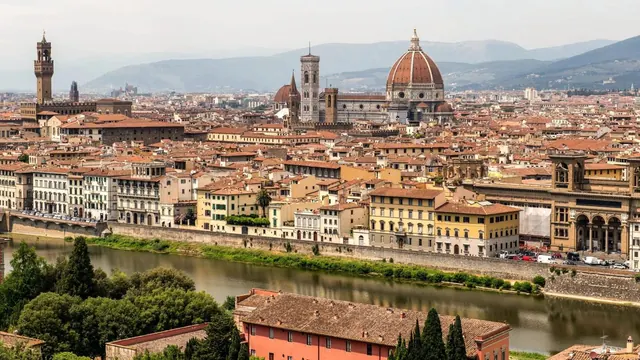
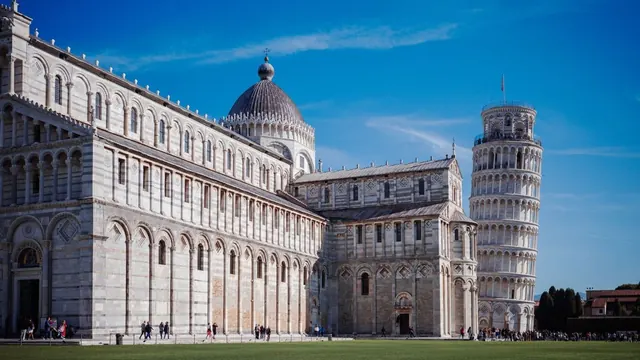
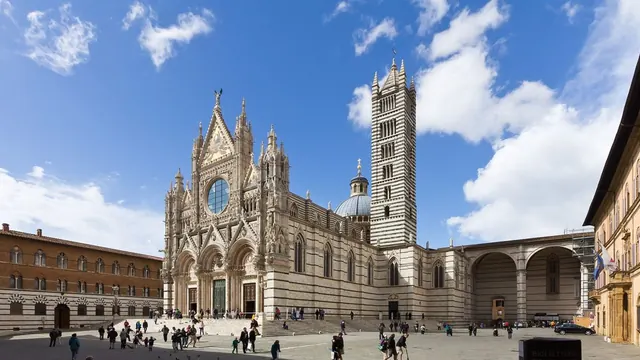
Tuscany has one of the great concentrations of art anywhere. The Uffizi, the Accademia, the Bargello and Brunelleschi's dome all sit in one walkable centre in Florence, and Siena's Campo and Pisa's marble square are close by. The cost is heavy summer crowds in Florence.
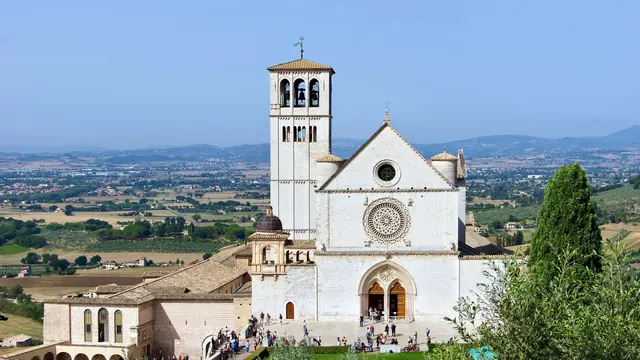
Umbria offers first-rate art in smaller settings. Giotto's frescoes in the basilica at Assisi, Orvieto's mosaic-fronted cathedral and Perugia's gallery of Perugino are the peaks. There are few big museums, so the pleasure is in moving from one intact hill town to the next.
Nightlife
Neither region is a party destination, but Tuscany has more going on. Students fill the steps of Santo Spirito in Florence, Oltrarno has plenty of wine bars, and in summer the beach clubs and dance halls of Versilia run until dawn.
Umbria's only lively evenings are in Perugia, where university and language students gather on the main street and cathedral steps. There are no clubs, and the rest of the region goes quiet after dinner.
Nature & outdoors
Tuscany's countryside is the classic farmed one of cypress lanes and gold wheat over the Crete Senesi, ideal for gentle cycling. It also has a wilder side in the marble peaks of the Apuan Alps, the Maremma park and the sailing and diving waters around Elba.
Umbria is greener and more wooded, and its most dramatic scenery is inland. The Monti Sibillini and the flowering plain of Castelluccio lie in the east, there is rafting and canyoning in the Valnerina, and the Marmore Falls make a striking stop. What Umbria lacks is Tuscany's coast.
Day trips
Tuscany's day trips cover more ground and include bigger names. From Florence, Siena, Lucca, Pisa and San Gimignano are all easy to reach. Bologna is under an hour by fast train, and the Cinque Terre are about an hour from Pisa. From the south of the region you can drive to Assisi and Orvieto, and from the coast the ferry runs to Elba or Giglio.
Umbria's outings are shorter hops. From a base near Perugia or Spoleto you can see a different hill town each day, such as Gubbio, Todi, Spello or Norcia, with little time in the car. Cortona and Montepulciano lie just over the border, and from Orvieto the train reaches Rome in a little over an hour.
Good for families
Tuscany gives children more variety. You can split the stay between an agriturismo and the shallow, lifeguarded beaches of Versilia or Elba. Add the Pinocchio park at Collodi, a climb up the leaning tower and bike rides along Lucca's walls.
Umbria works for a quiet farmhouse week with a pool, a paddle in Lake Trasimeno, the Marmore Falls and an amusement park near Perugia. After that, the frescoed churches and steep cobbled streets offer young children little, and pushchairs struggle.
Getting around
Getting around is about as easy in either region, but in different ways. In Tuscany you can travel without a car along the rail line linking Florence, Pisa, Lucca and Viareggio. Chianti, the Val d'Orcia and the Maremma need a car on winding roads, and the islands need ferry planning.
Umbria is easier to drive, with short distances and light traffic. Escalators, lifts and funiculars carry you from car parks up into Perugia, Orvieto and Spoleto. A single rail line covers Perugia, Assisi and Spoleto, but buses to Gubbio or Todi are infrequent.
Shopping & style
Tuscany is the stronger shopping destination by a wide margin, and Florence is why. It has leather workshops around Santa Croce, goldsmiths on the Ponte Vecchio, bookbinders in Oltrarno and luxury houses on Via de' Tornabuoni. The Arno valley outlets and the summer boutiques of Forte dei Marmi add more.
Umbria sells crafts and food rather than fashion. You can buy painted majolica in Deruta, cashmere from outlets around Perugia, and hams and truffles in Norcia. There are no luxury streets.
Affordability
Tuscany is the more expensive of the two in season, and some places cost far more than others. Hotels in central Florence from spring to autumn, villas in Chianti and beach-club umbrellas in Versilia are the big costs, and Forte dei Marmi is one of Italy's most expensive resorts. You can bring the bill down by staying in Lucca, Arezzo, Pistoia, the Maremma or the Garfagnana, and by going in spring or autumn rather than July and August.
Umbria costs less overall, and you can see its expensive spots coming: rooms in Assisi and Orvieto in summer and around religious festivals, and any meal built around truffles. In both regions most visitors need a hire car, and that adds noticeably to the bill.
Live music & performing arts
Tuscany's stage life is mostly opera and lasts through the year. Florence has the Maggio Musicale with its own opera house, Lucca holds Puccini recitals, and his operas are staged by the lake at Torre del Lago in summer.
Umbria's music comes mainly in two major summer festivals. Umbria Jazz fills Perugia's streets in July, and the Festival dei Due Mondi brings opera, dance and theatre to Spoleto. Outside that window there is much less to see.
Wellness & relaxation
Tuscany is built on hot springs. You can bathe free in Saturnia's terraced cascades, see the steaming medieval pool at Bagno Vignoni, find the white limestone pools of Bagni San Filippo, or visit the grand pump rooms of Montecatini.
Umbria's calm comes from its slow pace and quiet rather than from bathing. Its spas, such as San Gemini and Nocera Umbra, are small. Its strengths are the silence of Assisi's hermitages on Monte Subasio and country houses offering yoga or massage. Visitors who want warm open-air pools drive over the border to Tuscany.
When should you go?
Pick your month. The climate figures are measured averages, not a forecast.
Tuscany in July
Umbria in July
Daytime high, °C
Rainfall in the month, mm
Where the figures come from
Tuscany has no rain gauge within 25 km of the centre, so its rainfall comes from a gridded climate dataset read at the destination rather than from a gauge further away.
Tuscany's sunshine is measured 71 km from the centre, at Pisa / S. Giusto.
Umbria's temperatures are measured 53 km from the centre, at Frontone.
Umbria has no rain gauge within 25 km of the centre, so its rainfall comes from a gridded climate dataset read at the destination rather than from a gauge further away.
Temperature and rainfall are climate normals, averaged over the years shown. Tuscany: 1995-2020 (sunshine 1991-2020, rainfall 1991-2020) normals, Firenze / Peretola (5.6 km from centre). Umbria: 1991-2020 normals, Frontone (52.9 km from centre).
Tuscany is the warmer of the two in every month. May, June and September are the best months for walking the towns, and it is warm enough for the beach from June to late September. July and August reach 32°C to 33°C, which makes Florence's streets hard going in the afternoon. The rain picks up in September and peaks in November at 124mm, while winter days are cool rather than cold.
Umbria follows the same pattern but runs a few degrees cooler through the year. Summer tops out around 30°C, so the hill towns are a little easier in July. January highs of about 7°C make winter noticeably chillier, though. Spring and September are the best times for walking. Autumn is wet in both regions, but Umbria's rain is a little lighter.
Which traveller are you?
On a beach and sun trip, Tuscany is the only real option. Elba's clear bays, the pine-backed sand of the Maremma and the long Versilia shore give you a proper summer coast. Landlocked Umbria offers only Lake Trasimeno's murky shallows and farmhouse pools.
On a trip on a tight budget, Umbria makes your money go further. Farmhouse stays and town hotels cost less than across the border, village set lunches and local wine are cheap, and most of the great sights are churches that charge little or nothing.
For a relaxing and wellness trip, Tuscany has the clear advantage. You can bathe in open-air thermal pools at Saturnia, Bagno Vignoni and Bagni San Filippo, then retreat to a Val d'Orcia farmhouse. Umbria offers calm and silence but only modest spas.
Before you go
| Measure | Tuscany | Umbria |
|---|---|---|
| Official language | Italian | Italian |
| Currency | Euro (EUR) | Euro (EUR) |
| Sockets | CFL230 V, 50 Hz | CFL230 V, 50 Hz |
| Driving side | Right | Right |
| Time zone | UTC+1, UTC+2 in summer | UTC+1, UTC+2 in summer |
| Emergency number | 112 | 112 |
| Main airport | Florence Airport, Peretola (FLR)46 non-stop destinations | Perugia San Francesco d'Assisi – Umbria International Airport (PEG)17 non-stop destinations |
| Public holidays this year | 13 days | 13 days |
By the numbers
| Measure | Tuscany | Umbria |
|---|---|---|
| Population | 3,729,641 | 852,085 |
| People per km² | - | 101 |
Where else could you go?
Every comparison below shares a destination with this one, so you can follow Tuscany or Umbria somewhere new.
- Cinque Terrevs Tuscany
- Lake Gardavs Tuscany
- Cinque Terrevs Umbria
- Corsicavs Tuscany
- Lake Comovs Tuscany
- Ischiavs Umbria