Italy
Siena
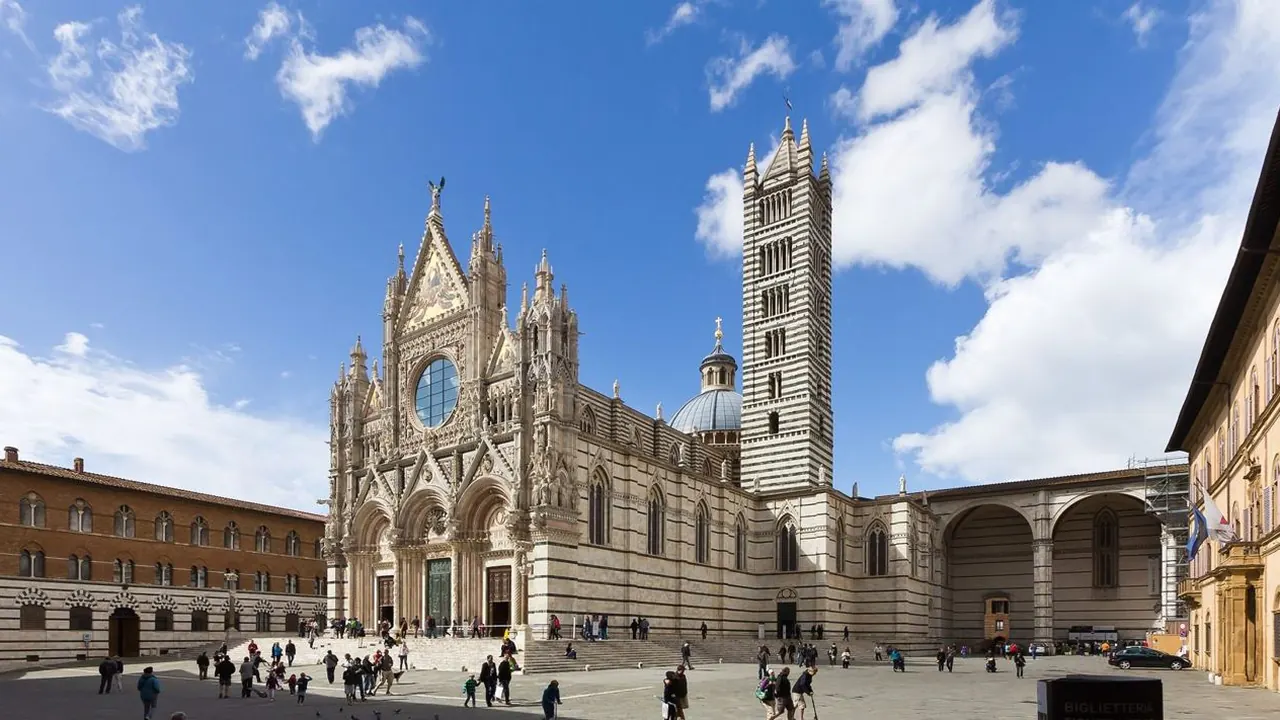
The cathedral facade
- Day trips94
- Culture & sights78
- Nature & outdoors65
Photo: Raimond Spekking, CC BY-SA 4.0, cropped
Match
51
Every category weighted equally
- Beach & sun47
- Culture & arts57
- Food & nightlife49
- Family trip51
- Outdoors57
- Relax & unwind51
- Shopping & style50
- On a budget50
Siena in twelve categories
Our verdict on each, scored 0 to 100 against the same fixed benchmark cities, so a score means the same thing on every page.
Beaches & swimming. Scores 14 out of 100.
Food & drink. Scores 62 out of 100.
Culture & sights. Scores 78 out of 100.
Nightlife. Scores 27 out of 100.
Nature & outdoors. Scores 65 out of 100.
Day trips. Scores 94 out of 100.
Good for families. Scores 38 out of 100.
Getting around. Scores 60 out of 100.
Shopping & style. Scores 35 out of 100.
Affordability. Scores 42 out of 100.
Live music & performing arts. Scores 36 out of 100.
Wellness & relaxation. Scores 55 out of 100.
Siena category by category
Beaches & swimming
14Siena is a hill town in the heart of Tuscany, and the sea plays no part in a stay here. The nearest good beaches are on the Maremma coast around Castiglione della Pescaia and Follonica, where the water reaches about 25°C in high summer. They are well over an hour away by car, so a swim there takes a full day. If beaches matter, spend a few nights on the coast. In Siena itself, swimming means a hotel or agriturismo pool.
Food & drink
62Food here means Sienese and Tuscan cooking, and it is good. Pici, the thick hand-rolled pasta, comes with garlic and tomato or a duck ragù. Ribollita and pappa al pomodoro are the winter staples, and cinta senese pork and wild boar feature in salumi and stews. Siena also has a long baking tradition. Panforte, ricciarelli almond biscuits and cavallucci fill the bakery windows, and pastry shops that have been going for generations still sell them.
Wine is a real strength. Chianti Classico is grown just to the north and Brunello and Vino Nobile to the south, and enoteche across town pour both by the glass. The best eating is in family osterie on the side streets of the contrade, away from the restaurants facing the Campo. What Siena lacks is variety. Beyond its own cooking there is little international food and not much fine dining.
Culture & sights
78Siena is one of the most complete medieval cities in Europe, and its whole historic centre is UNESCO-listed. The shell-shaped Piazza del Campo slopes down to the Palazzo Pubblico and the slender Torre del Mangia. Inside the palace, Ambrogio Lorenzetti's frescoes of Good and Bad Government count among the great works of medieval painting. The Duomo has striped marble, an inlaid marble floor, the Piccolomini Library and Pisano's pulpit, and it is the main sight here.
Around the Duomo there is more. The Museo dell'Opera holds Duccio's Maestà and gives access to the unfinished façade of a planned larger cathedral, with views across the rooftops. Santa Maria della Scala, a former hospital, is now a large museum complex, and the Pinacoteca holds the Sienese school of painting. The seventeen contrade, each with its own church, fountain and flag, keep the neighbourhoods distinct. Two or three days cover the main sights well.
Nightlife
27Evenings in Siena mean a long dinner, a glass of wine on the Campo and a walk through the lit streets. The university brings students and a handful of pubs and wine bars, but there are almost no clubs, and the centre is quiet before midnight for most of the year. The exception is the nights around the Palio, when the contrade hold long outdoor dinners and the streets fill until late. Anyone who wants a proper night out would need Florence, and even that is not a club city.
Nature & outdoors
65Siena's countryside is the classic Tuscan landscape. South-east of town the Crete Senesi spread out as bare clay hills, green in spring and pale gold after the harvest, with cypress-lined lanes and lone farmhouses. Further south, the Val d'Orcia is a UNESCO-listed landscape of rolling fields and hilltop towns. Spring and autumn are the best seasons. Summer is hot, and winter is quiet but often clear.
Cycling is the main outdoor activity. The white gravel strade bianche used by famous races run straight from the edge of town, and road and gravel riders come here for them. Walkers can follow sections of the Via Francigena pilgrim route or the wooded Montagnola hills to the west, and Monte Amiata, an extinct volcano with beech forest and a little winter skiing, is about an hour and a half away. What the area lacks is high mountains, coastline and true wilderness.
Day trips
94Siena sits in the middle of one of the richest regions in Europe for day trips. Florence is about an hour and a quarter away by fast bus. San Gimignano and its towers, the walled Monteriggioni, the Chianti wine villages of Castellina, Radda and Gaiole, and the Etruscan hill town of Volterra are all close. To the south are Pienza, Montalcino with its Brunello cellars, Montepulciano and the hot-spring hamlet of Bagno Vignoni.
The abbeys add more. Monte Oliveto Maggiore has its frescoed cloister, Sant'Antimo stands in a valley among olive groves, and the roofless San Galgano has a sword set in stone in a chapel nearby. Arezzo and Cortona are reachable to the east, and Lucca and Pisa at the edge of a long day. The one drawback is transport. Florence and a few towns are served by bus or train, but the hill towns and wineries are much easier with a car.
Good for families
38Siena is safe, compact and mostly free of cars, and children are welcome in every trattoria. Older children often enjoy the town's medieval character: climbing the Torre del Mangia, standing on the façade of the unfinished cathedral, and seeing the contrada flags and drummers. But there are no zoos, aquariums or attractions made for children, and the streets climb and fall steeply, which is hard work with a pushchair. Families tend to do better with a farmhouse stay with a pool in the countryside, coming into town for half days.
Getting around
60Inside the walls Siena is a walking town. The centre is largely closed to traffic, and everything from the Campo to the Duomo is a few minutes apart, though the three ridges the city stands on make for steep climbs and stepped lanes. The railway station sits in the valley below, linked to the upper town by a chain of escalators. Regional trains are slow and few. Buses are the better link to Florence and some nearby towns. To explore the hill towns and wine country properly, most visitors hire a car and leave it in a car park outside the walls.
Shopping & style
35Shopping in Siena is pleasant but modest. Banchi di Sopra and Via di Città have Italian clothing and shoe shops, leather goods and stationers. Hand-painted majolica ceramics, contrada scarves and flags, and food to take home are the local specialities: panforte, ricciarelli, pecorino and wine. A large weekly market fills the area around the Fortezza Medicea. There are no luxury streets or department stores worth seeking out, and the lanes off the Campo are mostly souvenir shops.
Affordability
42Siena is a moderately expensive Italian town. Rooms inside the walls are few and in demand, and prices climb sharply around the Palio and through the summer. Eating is better value: a simple osteria lunch with house wine costs much less than a meal on the Campo, and you can walk everywhere in the centre. The cathedral complex and the civic museums each charge for entry, which adds up over a visit. Staying in an agriturismo or in a town outside Siena often costs less than staying in the centre.
Live music & performing arts
36For its size, Siena has a serious musical life. The Accademia Chigiana, a respected school for classical musicians, holds a summer season of concerts and masterclasses in palaces and churches. Siena Jazz, a well-known jazz school, adds concerts by its teachers and students. The Teatro dei Rinnovati, inside the Palazzo Pubblico, and the Teatro dei Rozzi stage drama and music through the winter. Even so, this is a provincial programme. Opera and major orchestras mean a trip to Florence.
Wellness & relaxation
55Siena is calm rather than restorative in its own right. Evenings slow down once the day visitors leave, but in summer the centre is crowded by day. The real draw is the thermal water nearby. Rapolano Terme, about half an hour east, has travertine pools fed by warm springs. Further south, Bagno Vignoni has a steaming medieval bath at the centre of the village and spa pools beside it, and Bagni San Filippo has free white limestone pools in the woods. Petriolo's hot sulphur river is also within reach. Many visitors combine this with a stay at a farmhouse or rural spa hotel among the hills.
When should you go?
Pick a month to see what it is like. The climate figures are measured averages, not a forecast.
Siena in July
Daytime high, °C
Rainfall in the month, mm
The whole year
Shaded against this city’s own year: the deepest cell is its best month for that figure and the palest its weakest.
Where the figures come from
Siena's temperatures are measured 45 km from the centre, at Arezzo.
Siena has no rain gauge within 25 km of the centre, so its rainfall comes from a gridded climate dataset read at the city rather than from a gauge further away.
Temperature and rainfall are climate normals, averaged over the years shown. Siena: 2006-2017 (rainfall 1991-2020) normals, Arezzo (45 km from centre).
Before you go
| Measure | Siena |
|---|---|
| Official language | Italian |
| Currency | Euro (EUR) |
| Sockets | CFL230 V, 50 Hz |
| Driving side | Right |
| Time zone | UTC+1, UTC+2 in summer |
| Emergency number | 112 |
| Elevation | 322 m |
| Main airport | Florence Airport, Peretola (FLR)55 km from centre46 non-stop destinations |
| Public holidays this year | 13 days |
By the numbers
| Measure | Siena |
|---|---|
| City population | 52,812 |
| People per km² | 446 |
| Museums within 10 km | 30 |
| UNESCO World Heritage sites within 50 km | 5 |
Compare Siena with
Every comparison with a written verdict behind it.
- Amalfi
- Antibes
- Bled
- Bologna
- Cannes
- Catania
- Como
- Florence
- Genoa
- Innsbruck
- Interlaken
- La Spezia
- Ljubljana
- Lucerne
- Marseille
- Milan
- Monaco
- Naples
- Nice
- Palermo
- Pisa
- Portofino
- Positano
- Rome
- Rovinj
- Saint-Tropez
- Salerno
- Sorrento
- Split
- Turin
- Venice
- Verona
- Zadar
- Zagreb