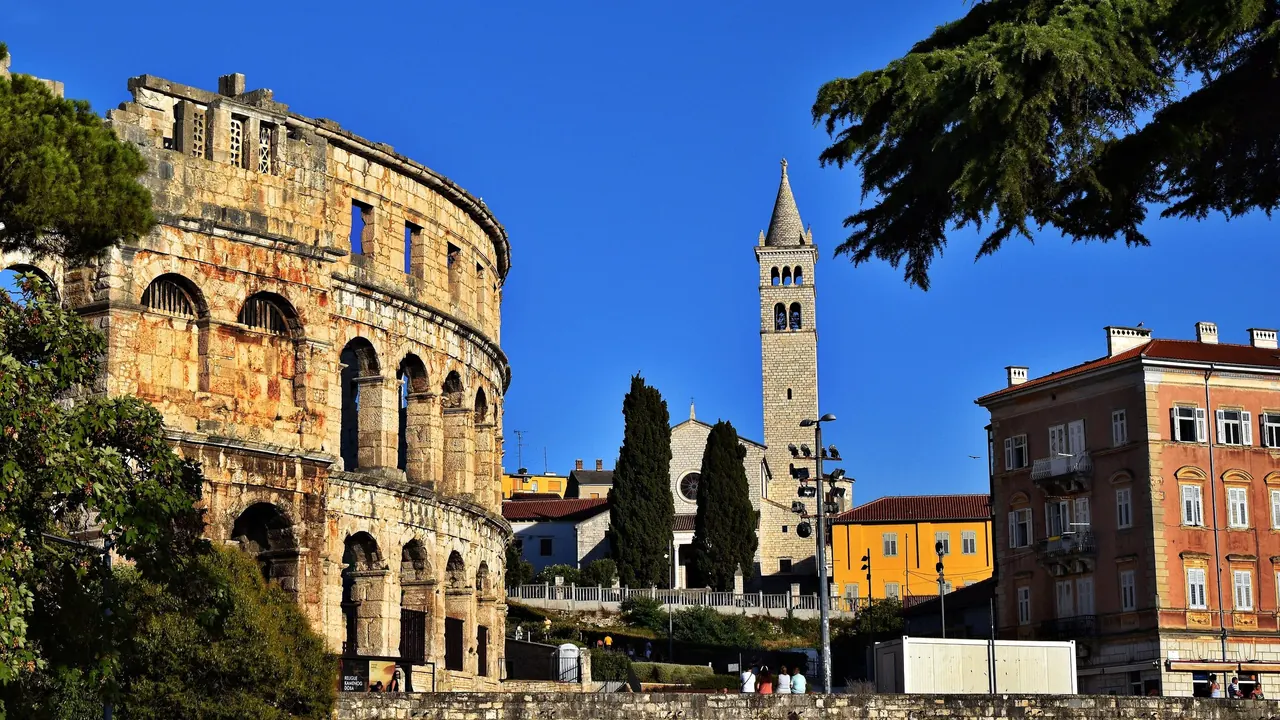
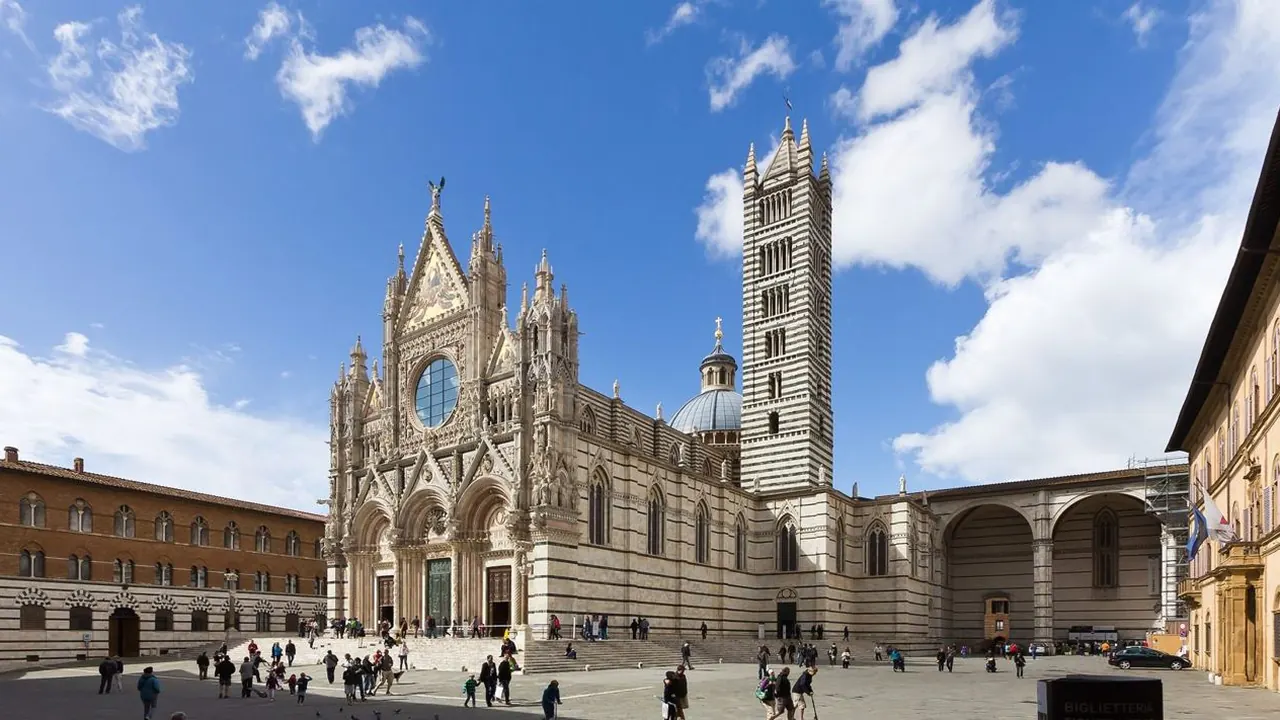
Photos: Pula by Miroslav.vajdic, CC BY-SA 4.0, cropped; Siena by Raimond Spekking, CC BY-SA 4.0, cropped.
Pula or Siena?
Our verdict in twelve categories, each scored against the same fixed benchmark cities, and the climate month by month, so you can choose for your trip.
Choose Pula for
- beaches
- families
- nightlife
Pula suits a summer trip built around the sea. You get clear water off rocks and pine-shaded coves, the wild headland of Kamenjak, and a Roman amphitheatre to round off the day. It is also easier with children, livelier on a warm weekend evening and kinder to the budget outside July and August.
Choose Siena for
- wellness
- culture and sights
- day trips
For art, medieval streets and countryside full of famous towns, Siena is the stronger choice. The Duomo, the Campo and the Sienese painters go much deeper than Pula's Roman sights. The hill towns and wine villages around it make excellent day trips, and the thermal pools to the south suit a slow, restorative stay. Just don't expect a beach.
Scoreboard
Twelve categories on one fixed scale from 0 to 100. The shaded stretch is the gap between the two.
Your match
Pick a travel style or drag the sliders, and both match scores follow your weighting.
Too close to call, 1 point apart
Wins on beaches and families with your weighting.
Wins on wellness and culture and sights with your weighting.
What matters to you?
Category by category
What the scores mean for a trip.
Beaches & swimming
This is where Pula is clearly stronger. It has no sand, but there are rock platforms and pebble coves a short ride away around Verudela, Stoja and Medulin, with pine shade almost to the water. The wild coves and cliff ledges of Kamenjak alone make it worth staying on this coast.
Siena has no sea at all. The Maremma beaches near Castiglione della Pescaia are well over an hour away, so a swim takes up a whole day. In town, the only place to swim is a hotel or agriturismo pool.
Food & drink
Both cities eat regionally rather than internationally, and both kitchens rely on hand-made pasta, cured pork and good local wine. Siena has the edge, with pici with duck ragù, cinta senese pork, a baking tradition of panforte and ricciarelli, and Chianti Classico, Brunello and Vino Nobile poured by the glass in enoteche across town.
Pula's Istrian cooking is distinctive, with truffle pasta, scampi buzara, Malvazija and Teran. But the town has fewer places to eat, and the restaurants around the Arena lean towards tourist menus. The best Istrian meals are often a drive away in hinterland villages, while Siena's good osterie are on the side streets of its contrade.
Culture & sights
Pula has one superb monument, the Arena, whose three-storey outer ring still stands complete. Around it are the Temple of Augustus, the Arch of the Sergii and the Austro-Hungarian forts, and all of it fits into a day or two.
Siena goes much deeper. The whole centre is a UNESCO-listed medieval city. The Duomo with its inlaid floor and Piccolomini Library, Lorenzetti's frescoes in the Palazzo Pubblico, Duccio's Maestà and the Sienese school in the Pinacoteca make it a place to travel to for art in a way Pula is not. The seventeen contrade also give each neighbourhood its own character.
Nightlife
Neither is a place for a big night out, but Pula has more going on in summer. Drinks on the terraces around the Forum lead on to cocktail bars and beach bars on Verudela and around Medulin, and on warm weekends a few small clubs fill up.
Siena's evenings mean a long dinner, wine on the Campo and a walk through the lit streets. There are almost no clubs, and the centre is quiet before midnight. The exception is the Palio, when the contrade hold outdoor dinners that run late. Out of season both towns go quiet, and a few student pubs keep things going.
Nature & outdoors
Both have gentle, farmed countryside rather than wilderness, and both are best for walking and cycling in spring and autumn. The difference is the setting. Pula's is coastal: the car-free Kamenjak headland, sea kayaking among the islets, windsurfing at Premantura and diving on wrecks from the naval era.
Siena's is the Tuscan hill country of the Crete Senesi and the Val d'Orcia. The strade bianche gravel roads draw serious cyclists, and walkers can follow the Via Francigena. Choose Pula for anything on the water and Siena for long rides through farmland.
Day trips
Pula is a good base for Istria. Rovinj, the Byzantine mosaics of Poreč, the hill towns of Motovun and Grožnjan and the Brijuni islands are all close, and Piran and Trieste are about two hours away.
Siena's surroundings are richer still. Florence is a bus ride away, and San Gimignano, Monteriggioni, Volterra and the Chianti villages are close by. To the south lie Pienza, Montalcino and Montepulciano, along with abbeys such as Sant'Antimo and San Galgano, so you could spend a week here without running short of places to see.
Good for families
Pula is the easier choice with children. The shallow, sheltered bays of Medulin and Premantura, the aquarium inside a fort on Verudela, the underground passages of the Arena and the Brijuni safari park fill the days easily. A dinosaur park and a water park are both within about an hour.
Siena is safe and largely car-free, and older children enjoy climbing the Torre del Mangia. But it has nothing made for children, and its steep streets are hard work with a pushchair. Families there usually stay in a farmhouse with a pool and come into town for half days.
Getting around
Both centres are compact, but they feel different on foot. Pula's is small and flat. Siena's stands on three ridges with steep, stepped lanes, though it is largely closed to traffic and escalators connect it to the station below.
Siena has better connections beyond its walls, with buses to Florence and nearby towns. From Pula, the rail line is of little use and regional buses are infrequent, so Kamenjak and the Istrian hill towns really need a car or scooter. Either way, you will want a car for the countryside.
Shopping & style
Neither is a shopping destination, and in both the best things to buy are edible. Pula offers Istrian olive oil, truffle products, wine and pršut from the market hall and from producers inland. Siena adds crafts to its panforte and pecorino, with majolica ceramics, contrada scarves and leather goods along Banchi di Sopra, and its large weekly market by the Fortezza Medicea is the more interesting place to browse.
Affordability
Pula is the cheaper of the two, especially in spring and autumn, when a private apartment and meals in simple konobas keep costs down. Its sights and city buses cost little, while in Siena the cathedral complex and the civic museums each need a ticket, and rooms inside the walls are scarce for most of the year.
In high summer the gap narrows. Pula's rooms in July and August cost about as much as on the Western European coasts, and Siena's rise steeply around the Palio. The savings also come in different places. In Siena, food is the good-value part of a stay, with osteria lunches far cheaper than the Campo, and a room in the countryside saves money too. In Pula, car hire and boat trips are what push the cost up.
Live music & performing arts
Pula's performing arts come down to one great stage. On summer nights the Roman Arena hosts touring pop and rock acts, classical galas and the Pula Film Festival screenings under its stone arches. The rest of the year the Istrian National Theatre puts on drama in Croatian.
Siena's music is quieter and more serious. The Accademia Chigiana holds summer concerts and masterclasses in palaces and churches, Siena Jazz adds concerts by its teachers and students, and in winter the Teatro dei Rinnovati and the Teatro dei Rozzi stage drama and music. Choose Pula for a big open-air night and Siena for chamber music in a palace. For opera, Siena sends you on to Florence.
Wellness & relaxation
Siena has the real wellness offer, thanks to the thermal springs nearby. Rapolano Terme's travertine pools are about half an hour away. Further south are the medieval bath at Bagno Vignoni, the free white pools of Bagni San Filippo and the hot river at Petriolo, all easy to combine with a rural spa hotel.
Pula has no bathing tradition, and spa time means the resort hotels on Verudela or in Medulin. Its restful side is simpler: pine-shaded coastal paths, slow coffees on the Forum and a calm pace once summer ends.
When should you go?
Pick your month. The climate figures are measured averages, not a forecast.
Pula in July
Siena in July
Daytime high, °C
Rainfall in the month, mm
Where the figures come from
Pula's temperatures are measured 87 km from the centre, at Trieste.
Pula has no rain gauge within 25 km of the centre, so its rainfall comes from a gridded climate dataset read at the city rather than from a gauge further away.
Siena's temperatures are measured 45 km from the centre, at Arezzo.
Siena has no rain gauge within 25 km of the centre, so its rainfall comes from a gridded climate dataset read at the city rather than from a gauge further away.
Temperature and rainfall are climate normals, averaged over the years shown. Pula: 1991-2020 normals, Trieste (87 km from centre). Siena: 2006-2017 (rainfall 1991-2020) normals, Arezzo (45 km from centre).
Pula's year is shaped by the sea. From June to September the water stays at 22°C or warmer and peaks in August, and July is the sunniest month, with long dry days. Rain arrives in autumn and November is the wettest month. Winter is mild but grey and quiet. May and late September are the best times for walking the old town and Kamenjak without the midday heat.
Siena is hotter inland. July and August reach 31°C, which makes the steep lanes tiring in the afternoon, although these are also its driest months. Spring and early autumn are best for exploring the town and the countryside on foot, and November brings the heaviest rain of the year at 127mm. Both cities have cool winters of around 9°C, so neither works for winter sun.
Which traveller are you?
For a beach and sun trip, Pula is the clear choice. Siena's nearest beaches are over an hour away, so it cannot match the clear water off rocks and pebble coves, the wild inlets of Cape Kamenjak or Pula's long swimming season.
On a family trip with young children, Pula is easier. The shallow bays around Medulin, the aquarium in an old fort and the passages under the Arena keep children busy. Siena has nothing built for them, and its steep lanes are hard with a pushchair.
For a relaxing and wellness trip, Siena is better. The warm springs at Rapolano Terme, the steaming medieval pool at Bagno Vignoni and the free limestone pools of Bagni San Filippo pair well with a farmhouse stay. In Pula, wellness rarely goes beyond hotel spas.
Before you go
| Measure | Pula | Siena |
|---|---|---|
| Official language | Croatian | Italian |
| Currency | Euro (EUR) | Euro (EUR) |
| Sockets | CF230 V, 50 Hz | CFL230 V, 50 Hz |
| Driving side | Right | Right |
| Time zone | UTC+1, UTC+2 in summer | UTC+1, UTC+2 in summer |
| Emergency number | 112 | 112 |
| Elevation | 5 m | 322 m |
| Main airport | Pula Airport (PUY)7 km from centre34 non-stop destinations | Florence Airport, Peretola (FLR)55 km from centre46 non-stop destinations |
| Public holidays this year | 14 days | 13 days |
By the numbers
| Measure | Pula | Siena |
|---|---|---|
| City population | 52,220 | 52,812 |
| People per km² | 971 | 446 |
| Museums within 10 km | 4 | 30 |
| UNESCO World Heritage sites within 50 km | 1 | 5 |
| Swim season, months above 21 °C | 4 months | - |
Where else could you go?
Every comparison below shares a destination with this one, so you can follow Pula or Siena somewhere new.