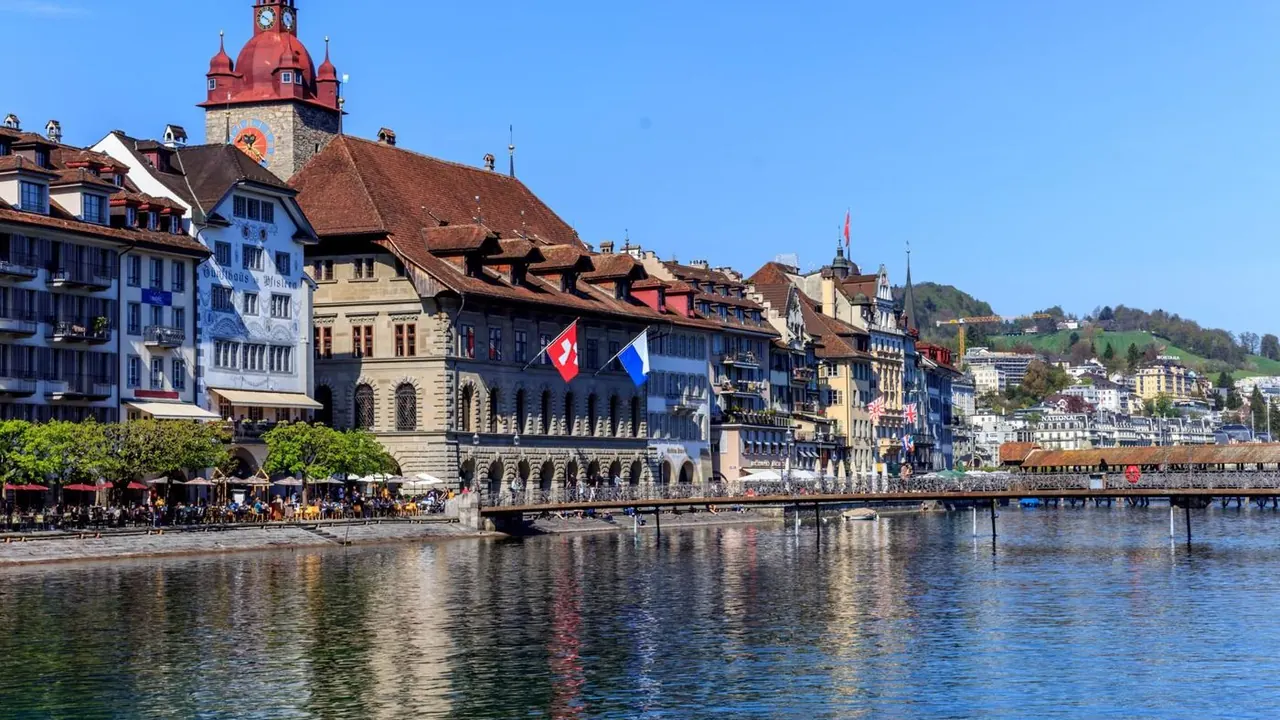
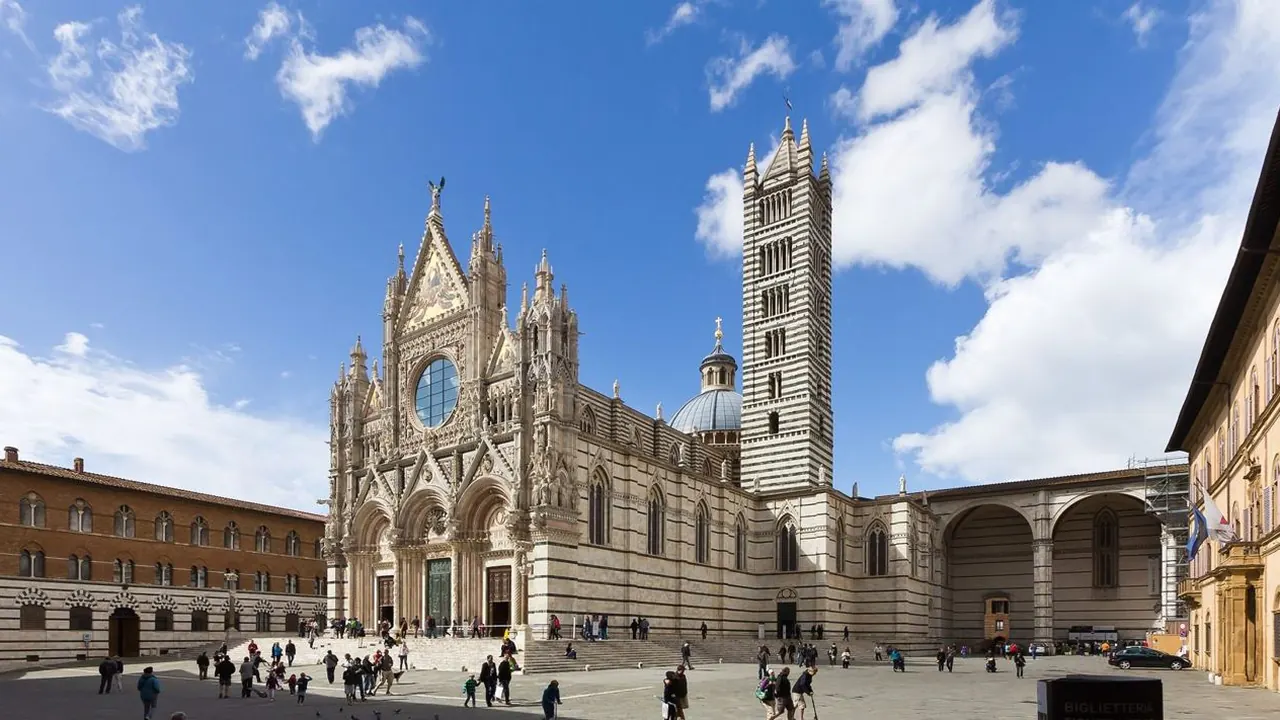
Photos: Lucerne by ILOVESwitzerland, Pexels License; Siena by Raimond Spekking, CC BY-SA 4.0, cropped.
Lucerne or Siena?
Our verdict in twelve categories, each scored against the same fixed benchmark cities, and the climate month by month, so you can choose for your trip.
Choose Lucerne for
- live music and the arts
- families
- nature and the outdoors
Lucerne is the pick for a trip built around mountains and water. Pilatus, Rigi and the lake steamers are right there and work as one connected network, so you never need a car. Children have the Transport Museum and the cogwheel trains, and music lovers can plan a visit around the festival. It is very expensive, though, and the food is unlikely to be what you remember.
Choose Siena for
- prices
- food and drink
- culture and sights
Choose Siena if you want a medieval city that rewards slow looking, proper Tuscan cooking and wine, and a countryside of hill towns, abbeys and hot springs for the days in between. It costs noticeably less. The best of the region really needs a hire car, and the steep lanes and lack of anything built for children make it a better fit for adults.
Scoreboard
Twelve categories on one fixed scale from 0 to 100. The shaded stretch is the gap between the two.
Your match
Pick a travel style or drag the sliders, and both match scores follow your weighting.
Wins on live music and the arts and families with your weighting.
Wins on prices and food and drink with your weighting.
What matters to you?
Category by category
What the scores mean for a trip.
Beaches & swimming
Neither city is a beach destination, but in Lucerne you can at least swim close to your hotel. The Lido, the old wooden lake baths and the lawns at Ufschötti give you a summer dip in clean water with mountains behind it, though you swim from grass and jetties, not sand.
Siena has no water of its own. Swimming means a pool at your hotel or agriturismo, or a full day out to the Maremma coast around Castiglione della Pescaia, which is well over an hour away by car.
Food & drink
Siena is the place to eat well. Hand-rolled pici, ribollita, cinta senese pork and a baking tradition of panforte and ricciarelli give it cooking with deep local roots. Chianti Classico, Brunello and Vino Nobile are all made nearby, and the best meals are in family osterie in the contrade.
Lucerne serves sound Swiss dishes, from Chügelipastete to fondue and lake perch in the guild-house taverns. The range is narrow, though, and many places near the Chapel Bridge cater to coach groups. Neither city has much international food.
Culture & sights
Siena has far more to see. Its whole medieval centre is UNESCO-listed. The Campo, Lorenzetti's frescoes in the Palazzo Pubblico, the Duomo's inlaid floor and Duccio's Maestà make two or three days of first-rate art and architecture.
Lucerne's sights are fewer and quicker to see: the Chapel Bridge and Water Tower, the towers of the Musegg Wall, the Lion Monument, and the Picasso and Klee works of the Rosengart Collection. It is a handsome old town to walk through more than a city of great paintings, and a day or two covers it.
Nightlife
Both towns go quiet early, and neither suits a big night out. Lucerne has a little more going on after dark, with cocktail bars and a small club scene in the Neustadt and near the station. At Fasnacht the whole town is out in costume until dawn.
Siena has almost no clubs. Its evenings are wine on the Campo and a few student pubs. Its one great late night comes with the Palio, when the contrade eat together outdoors and the streets stay full.
Nature & outdoors
Lucerne's setting is far more dramatic. A branching lake is ringed by peaks, Pilatus, Rigi and the Stanserhorn are reached by cogwheel train and cable car, and the glacier on Titlis is about an hour away. That means real mountain walking in summer and skiing in winter, with low cloud as the one risk.
Siena's countryside is gentler: the clay hills of the Crete Senesi and the UNESCO-listed Val d'Orcia, best explored by bike on the strade bianche or on foot along the Via Francigena. It is beautiful farmland, but there are no high mountains or wild country.
Day trips
Siena has the richer choice close by. San Gimignano, Monteriggioni, the Chianti villages, Volterra, Pienza, Montalcino and Montepulciano are all near, with abbeys such as Monte Oliveto Maggiore and San Galgano in between. Florence is about an hour and a quarter away. The catch is that most of these places really need a car.
Lucerne has fewer outings, but they take no effort. Fast trains reach Zurich, Bern and Basel in under an hour, and boats run down the lake to the Rütli meadow and Altdorf, so every trip works without a car.
Good for families
Lucerne is the better bet with children. The Swiss Museum of Transport gives them a full day of hands-on trains, planes and a planetarium. The Glacier Garden and the Goldau wildlife park are close, and the safe riverside and lakeside lawns make breaks easy. The limits are rainy days and the cost of the mountain trips.
Siena welcomes children in every trattoria, and older ones enjoy climbing the Torre del Mangia. There is nothing built for them, though, and the steep streets are tough with a pushchair. Many families stay at a farmhouse with a pool instead and come into town for half days.
Getting around
Getting around Lucerne takes almost no effort. The station, boat piers and Old Town sit together on the lakefront, and most walks are short and flat. Steamers, trains and cable cars all run on one integrated ticket system, so you never need a car.
Siena's centre is just as compact, but it is much harder on the legs. It spreads over three ridges with stepped lanes, and escalators climb up from the station. Beyond the walls the trains are slow and infrequent, so most visitors hire a car for the hill towns.
Shopping & style
Lucerne has more pull for one kind of buyer. Watch and jewellery houses line Schwanenplatz and the lakefront, alongside shops selling army knives, chocolate and cuckoo clocks, though fashion and design are thin.
Siena is more modest still. There are Italian shoes and clothes on Banchi di Sopra, majolica ceramics, contrada scarves and food to take home. A large weekly market by the Fortezza Medicea adds some local colour.
Affordability
Siena is much easier on the wallet. Rooms inside the walls get expensive around the Palio and in summer. But osteria lunches are good value, you can walk everywhere in the centre, and staying at an agriturismo outside town cuts costs further.
Lucerne is very expensive on every front: central hotels, even simple meals, and the mountain railways that are the reason to go. A Swiss travel pass and picnics by the lake help a little, but there is no way to do it cheaply.
Live music & performing arts
For music, Lucerne is the clear choice. The Lucerne Festival brings leading orchestras and soloists to Jean Nouvel's lakefront hall, famous for its acoustics. The hall keeps a year-round programme with the Lucerne Symphony Orchestra, and the city theatre adds opera and dance.
Siena has a real musical life, just a smaller one. The Accademia Chigiana holds summer concerts in palaces and churches, Siena Jazz adds concerts by its teachers and students, and the Teatro dei Rinnovati and Teatro dei Rozzi run winter seasons. For opera or a major orchestra you would go to Florence.
Wellness & relaxation
Siena has thermal springs nearby. Rapolano Terme is about half an hour away. Further south are Bagno Vignoni's steaming medieval pool, the free limestone pools of Bagni San Filippo and Petriolo's hot river, so soaking in warm water becomes a natural part of a stay.
Lucerne has no bathing tradition of its own beyond hotel spas and Mario Botta's mineral bath high on the Rigi. Its calm comes from quiet evenings, lakeside promenades and slow afternoons on a steamer. Both centres are crowded with day visitors in the middle of the day.
When should you go?
Pick your month. The climate figures are measured averages, not a forecast.
Lucerne in July
Siena in July
Daytime high, °C
Rainfall in the month, mm
Where the figures come from
Lucerne has no rain gauge within 25 km of the centre, so its rainfall comes from a gridded climate dataset read at the city rather than from a gauge further away.
Lucerne's sunshine is measured 42 km from the centre, at Zurich Town / Ville..
Siena's temperatures are measured 45 km from the centre, at Arezzo.
Siena has no rain gauge within 25 km of the centre, so its rainfall comes from a gridded climate dataset read at the city rather than from a gauge further away.
Temperature and rainfall are climate normals, averaged over the years shown. Lucerne: 2005-2025 (sunshine 1991-2020, rainfall 1991-2020) normals, Emmen (4.2 km from centre). Siena: 2006-2017 (rainfall 1991-2020) normals, Arezzo (45 km from centre).
Lucerne is a summer city. July and August reach about 24°C, which is warm enough to swim from the lake baths and gives the longest, sunniest days for clear views from the peaks. May to August is also the wettest part of the year, at around 141mm a month, so plan for some lost days. From November to February it is cold and dim, with very little sun in December. That suits snow in the mountains better than lingering in the Old Town.
Siena is several degrees warmer all year, so its best months come earlier and later. Highs of about 31°C in July and August make the steep streets hard going in the afternoon. April, May, late September and October are the best months for walking the town and the countryside. July and August are its driest months, and November is the wettest at about 127mm. Winter is mild next to Lucerne, around 10°C in December, which is quiet but fine for museums.
Which traveller are you?
On a family trip with children, Lucerne is the easier choice. The Swiss Museum of Transport fills a day, and the steamers and cogwheel trains are adventures in themselves. The flat lakeside centre suits pushchairs, while Siena's steep lanes and lack of children's attractions are hard work.
For an outdoors trip, Lucerne wins clearly. Pilatus, Rigi, the Stanserhorn and the Titlis glacier put real mountain hiking and winter skiing within reach of the station. Siena's gentle Crete Senesi suit gravel cycling on the strade bianche far better than walking at altitude.
On a trip on a tight budget, Siena is the only realistic option of the two. Osteria lunches with house wine and a bed at an agriturismo keep costs moderate. In Lucerne, hotels, meals and the mountain railways all weigh heavily.
Before you go
| Measure | Lucerne | Siena |
|---|---|---|
| Official language | French, German, Italian, Romansh | Italian |
| Currency | Swiss Franc (CHF) | Euro (EUR) |
| Sockets | CJ230 V, 50 Hz | CFL230 V, 50 Hz |
| Driving side | Right | Right |
| Time zone | UTC+1, UTC+2 in summer | UTC+1, UTC+2 in summer |
| Emergency number | 112 | 112 |
| Elevation | 436 m | 322 m |
| Main airport | Zürich Airport (ZRH)49 km from centre226 non-stop destinations | Florence Airport, Peretola (FLR)55 km from centre46 non-stop destinations |
| Public holidays this year | 12 days | 13 days |
By the numbers
| Measure | Lucerne | Siena |
|---|---|---|
| City population | 86,234 | 52,812 |
| People per km² | 2,963 | 446 |
| Museums within 10 km | 14 | 30 |
| UNESCO World Heritage sites within 50 km | 1 | 5 |
Where else could you go?
Every comparison below shares a destination with this one, so you can follow Lucerne or Siena somewhere new.