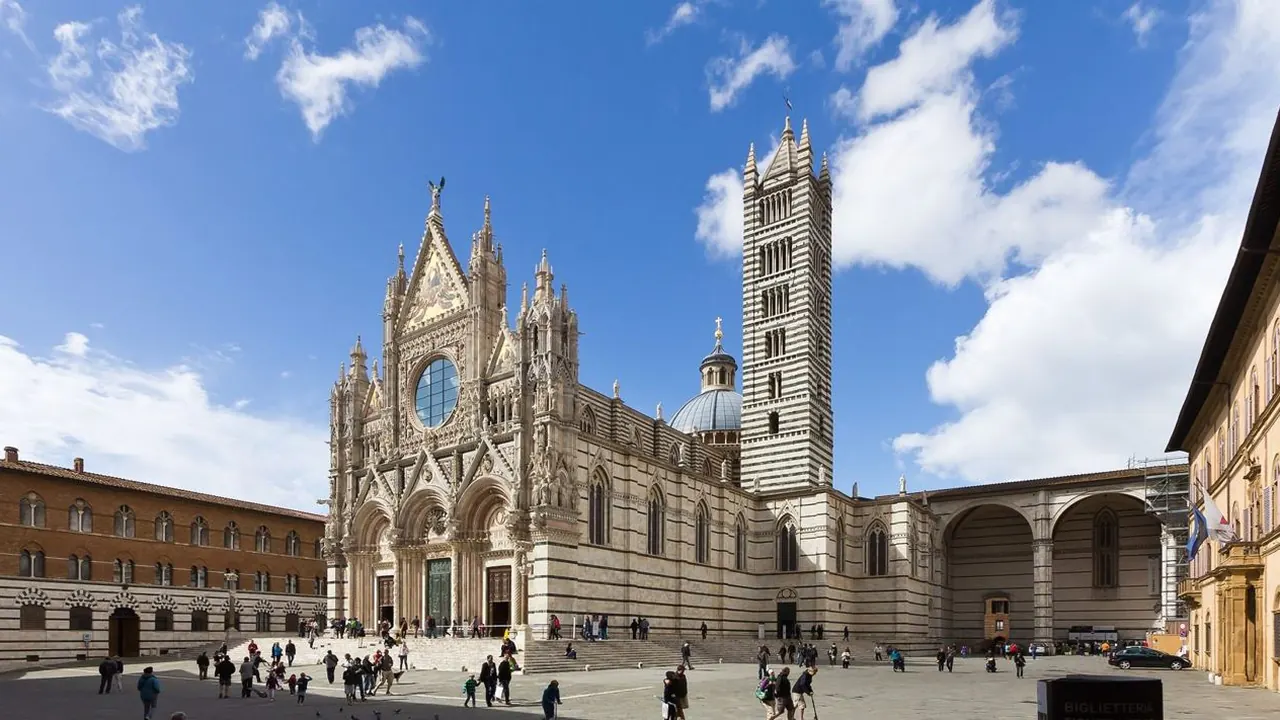
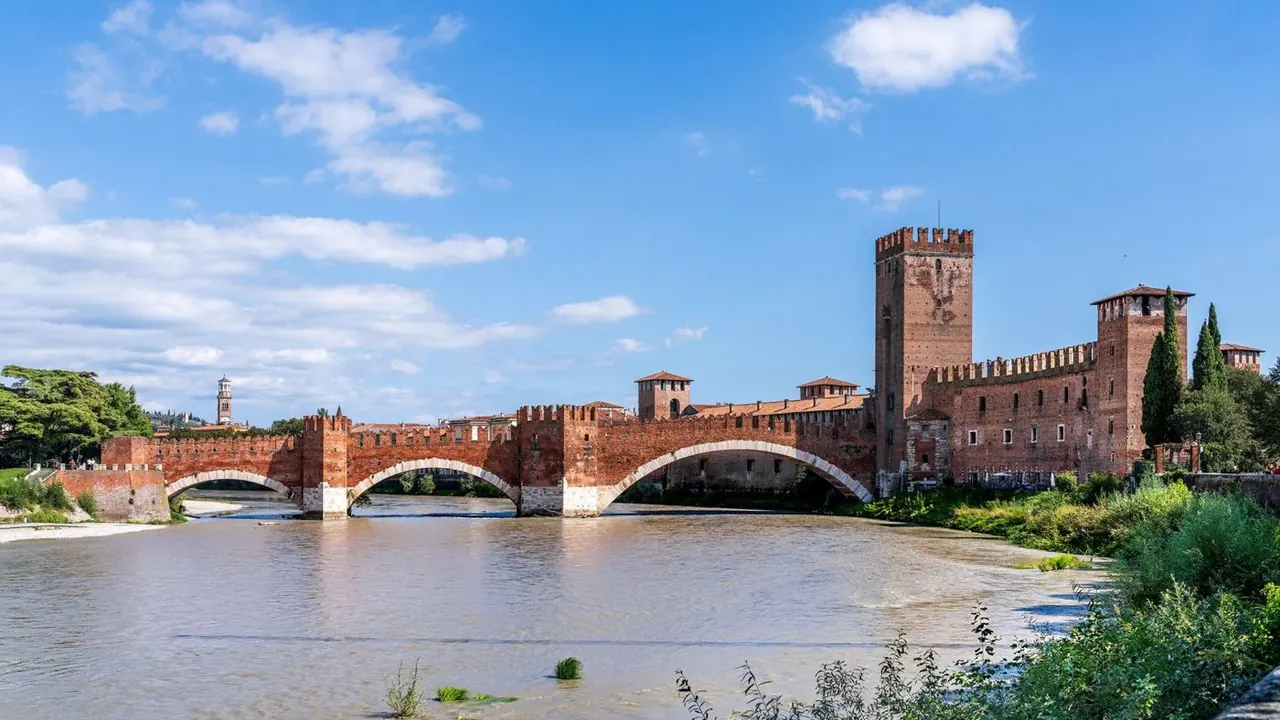
Photos: Siena by Raimond Spekking, CC BY-SA 4.0, cropped; Verona by NorbertNagel, CC BY-SA 4.0, cropped.
Siena or Verona?
Our verdict in twelve categories, each scored against the same fixed benchmark cities, and the climate month by month, so you can choose for your trip.
Choose Siena for
- wellness
- culture and sights
- day trips
Siena suits travellers who want to sink into Tuscany: a single, intact medieval city of Gothic painting and striped marble, then days among the clay hills, wine villages and abbeys with a hire car. Its warm springs in the countryside, from Bagno Vignoni to the free pools of Bagni San Filippo, make it the better choice for a slow, restorative trip, provided quiet evenings and steep lanes suit you.
Choose Verona for
- beaches
- live music and the arts
- families
Verona is the more rounded base, especially for families and anyone who likes an evening out. Summer opera in the Roman Arena, Lake Garda with its lidos and theme parks half an hour away, a flat centre easy with a pushchair and fast trains to Venice, Padua and Vicenza give it more range, and its streets carry more life after dinner than Siena's.
Scoreboard
Twelve categories on one fixed scale from 0 to 100. The shaded stretch is the gap between the two.
Your match
Pick a travel style or drag the sliders, and both match scores follow your weighting.
Wins on wellness and culture and sights with your weighting.
Wins on beaches and live music and the arts with your weighting.
What matters to you?
Category by category
What the scores mean for a trip.
Beaches & swimming
Siena is a hill town far from water, and reaching the Maremma beaches at Castiglione della Pescaia or Follonica means well over an hour each way, so a swim costs a full day and a pool is the realistic option.
Verona has no coast either, but Lake Garda's southern shore is about half an hour by car or train, with lidos, lawns to the water and Sirmione's flat limestone shelves. It stays a summer side trip on busy, narrow beaches, yet it makes swimming a genuine part of a stay in a way Siena cannot.
Food & drink
Both cities eat well on their own regional cooking and both lack international range, so the difference is one of character. Siena means Tuscan dishes such as pici with duck ragù, ribollita and cinta senese pork, plus a baking tradition of panforte and ricciarelli, with Chianti Classico and Brunello poured in the enoteche.
Verona looks to the Veneto plain: risotto with Amarone, bollito misto with peppery pearà and the old horse stew pastissada. Its evening habit of a spritz or Valpolicella with snacks at a counter is more sociable than Siena's long sit-down dinners in contrada osterie.
Culture & sights
Both are UNESCO-listed centres worth two or three days, but they tell different stories. Siena is a single medieval vision, the shell-shaped Campo, the Palazzo Pubblico with Lorenzetti's Good and Bad Government, and a Duomo whose inlaid floor and Duccio's Maestà make it a city for lovers of early painting.
Verona is a city of layers, from the Roman Arena and the hillside theatre to the Scaliger tombs and the Romanesque San Zeno, with Castelvecchio's art collection in Carlo Scarpa's setting. Pick Siena for Gothic art in one piece, Verona for two thousand years in a river bend.
Nightlife
Verona keeps going a little later. Aperitivo tables fill Piazza delle Erbe and the lanes around Corso Porta Borsari, Veronetta's student bars stay busy in term time, and in summer the opera crowd spilling out near midnight gives the centre a second wind.
Siena's evenings are mostly dinner, a glass of wine on the Campo and a stroll, with the centre quiet before midnight except around the Palio. Neither city is a place for clubbing.
Nature & outdoors
Siena looks out on gentle farmland. The bare clay hills of the Crete Senesi and the rolling fields of the Val d'Orcia are made for slow walks along cypress lanes and for cycling, and the white gravel strade bianche bring road and gravel riders from the edge of town. Monte Amiata's beech woods, about an hour and a half south, are as wild as it gets.
Verona has mountains and a lake within reach. Valpolicella's vineyards suit easy rides, but Monte Baldo rises above Lake Garda with ridge walks and paragliding, the northern end of the lake has reliable wind for sailing and windsurfing, and the Lessinia plateau adds gorges and high pastures.
Day trips
From Siena, a hire car opens up the best days out. San Gimignano's towers, Montalcino's Brunello cellars, Pienza and the Chianti villages are all close, as are the abbeys of Sant'Antimo and San Galgano. Florence is an easy bus ride, but the hill towns and wineries are awkward without your own wheels.
Verona's best trips run by train instead. Venice is close enough for an early start and a late return, Vicenza's Palladian buildings and Padua's Scrovegni Chapel are short hops, Mantua is under an hour away, and Sirmione and Soave are nearer still. Siena suits a slow drive through wine country, Verona a run of great art cities without a car.
Good for families
Verona is far better with children. Gardaland, the water parks around southern Garda and the safari section of Parco Natura Viva are about half an hour out, the lake offers calm shallow swimming, and the centre is flat enough for a pushchair, though most of these attractions need a car or transfer.
Siena is safe and car-free but has no attractions aimed at children, and its steep streets wear out small legs. Older children enjoy climbing the Torre del Mangia, and families usually do best in a countryside farmhouse with a pool.
Getting around
Both centres are walked rather than ridden, but Verona's is easier. Its river loop is flat and compact, Porta Nuova station is a short bus ride or walk away, and fast trains run to Venice, Milan and the lake.
Siena sits on three ridges, so walking means climbs and stepped lanes, and the station in the valley links to town by escalators. Regional trains are slow and sparse, buses are the better link to Florence, and the hill towns really need a hire car parked outside the walls.
Shopping & style
Verona gives shoppers more to do. Marble-paved Via Mazzini carries Italian fashion and accessory labels, Corso Porta Borsari and Corso Sant'Anastasia add jewellers and boutiques, and Amarone, Garda olive oil and pandoro make good things to take home, though serious shoppers still head to Milan.
Siena's offer is smaller and more local: clothing and leather on Banchi di Sopra and Via di Città, hand-painted majolica, contrada scarves, panforte and pecorino, and the weekly market around the Fortezza Medicea.
Affordability
Neither is a budget destination, and costs run along similar lines. In Siena the strain comes from few rooms inside the walls, steep summer and Palio rates and separate entry charges for the cathedral and civic museums, while an agriturismo or a nearby town keeps things down.
In Verona the pressure points are opera nights and trade fairs, when central hotels become scarce, and the restaurants facing the Arena. Veronetta's student osterie, wine counters with snacks and rooms by the station or across the river help most.
Live music & performing arts
Verona is in another league here. Summer opera in the Roman Arena, grand Verdi, Puccini and Bizet before thousands on the ancient stone, runs most evenings from June to early September, the Roman theatre hosts Shakespeare, dance and jazz under the stars, and the Teatro Filarmonico carries a season through the cooler months.
Siena's music is serious but small in scale: the Accademia Chigiana's summer concerts in palaces and churches, performances from Siena Jazz, and winter drama at the Rinnovati and the Rozzi. For opera, Sienese visitors go to Florence.
Wellness & relaxation
Siena has the richer thermal country. Rapolano's travertine pools are half an hour away, and further south lie Bagno Vignoni's medieval bath, the free white pools of Bagni San Filippo in the woods and Petriolo's hot sulphur river, all easy to pair with a rural spa or farmhouse stay.
Verona's springs are more organised: Sirmione's spa waters piped into pools facing the lake, a thermal park near Lazise in an old villa garden and the springs at Caldiero. In town, calm comes from riverside walks and the Giardino Giusti's terraces rather than anywhere to bathe.
When should you go?
Pick your month. The climate figures are measured averages, not a forecast.
Siena in July
Verona in July
Daytime high, °C
Rainfall in the month, mm
Where the figures come from
Siena's temperatures are measured 45 km from the centre, at Arezzo.
Siena has no rain gauge within 25 km of the centre, so its rainfall comes from a gridded climate dataset read at the city rather than from a gauge further away.
Temperature and rainfall are climate normals, averaged over the years shown. Siena: 2006-2017 (rainfall 1991-2020) normals, Arezzo (45 km from centre). Verona: 1991-2020 normals, Verona / Villafranca (11.6 km from centre).
The two share a calendar in broad strokes. July and August are hot in both, around 31°C in Siena and 30°C in Verona, which makes midday sightseeing on foot hard going, although Verona's long sunny summer, with some 310 hours of sun in July, is the season for swimming in Lake Garda from June to September. For walking the streets and the countryside, May, late September and October are the most comfortable months in both cities, and spring is when Siena's Crete turn green.
The difference lies in the wet months. Siena gets far more rain from autumn into winter, peaking at 127mm in November, and March and May can also be damp. Verona's winters are drier but slightly colder and grey, with short, dull days from November to January, so a winter visit there suits museums and opera houses better than the hills.
Which traveller are you?
On a family trip with young children, Verona is the easier choice. Gardaland, Parco Natura Viva and shallow lake swimming are within half an hour, and the flat centre suits a pushchair, while Siena has steep streets and nothing built for children.
For a relaxing and wellness trip, Siena has the edge. Rapolano's travertine pools, the steaming square of Bagno Vignoni and the wild limestone pools of Bagni San Filippo pair naturally with a farmhouse stay among the hills, and town evenings are quiet.
Opera lovers should head for Verona without hesitation. Grand summer productions of Verdi and Puccini on the stone tiers of the Roman Arena are the reason many people come at all, whereas Siena offers chamber concerts and sends opera-goers to Florence.
Before you go
| Measure | Siena | Verona |
|---|---|---|
| Official language | Italian | Italian |
| Currency | Euro (EUR) | Euro (EUR) |
| Sockets | CFL230 V, 50 Hz | CFL230 V, 50 Hz |
| Driving side | Right | Right |
| Time zone | UTC+1, UTC+2 in summer | UTC+1, UTC+2 in summer |
| Emergency number | 112 | 112 |
| Elevation | 322 m | 59 m |
| Main airport | Florence Airport, Peretola (FLR)55 km from centre46 non-stop destinations | Verona Villafranca Valerio Catullo Airport (VRN)10 km from centre96 non-stop destinations |
| Public holidays this year | 13 days | 13 days |
By the numbers
| Measure | Siena | Verona |
|---|---|---|
| City population | 52,812 | 255,588 |
| People per km² | 446 | 1,285 |
| Museums within 10 km | 30 | 18 |
| UNESCO World Heritage sites within 50 km | 5 | 5 |
Where else could you go?
Every comparison below shares a destination with this one, so you can follow Siena or Verona somewhere new.