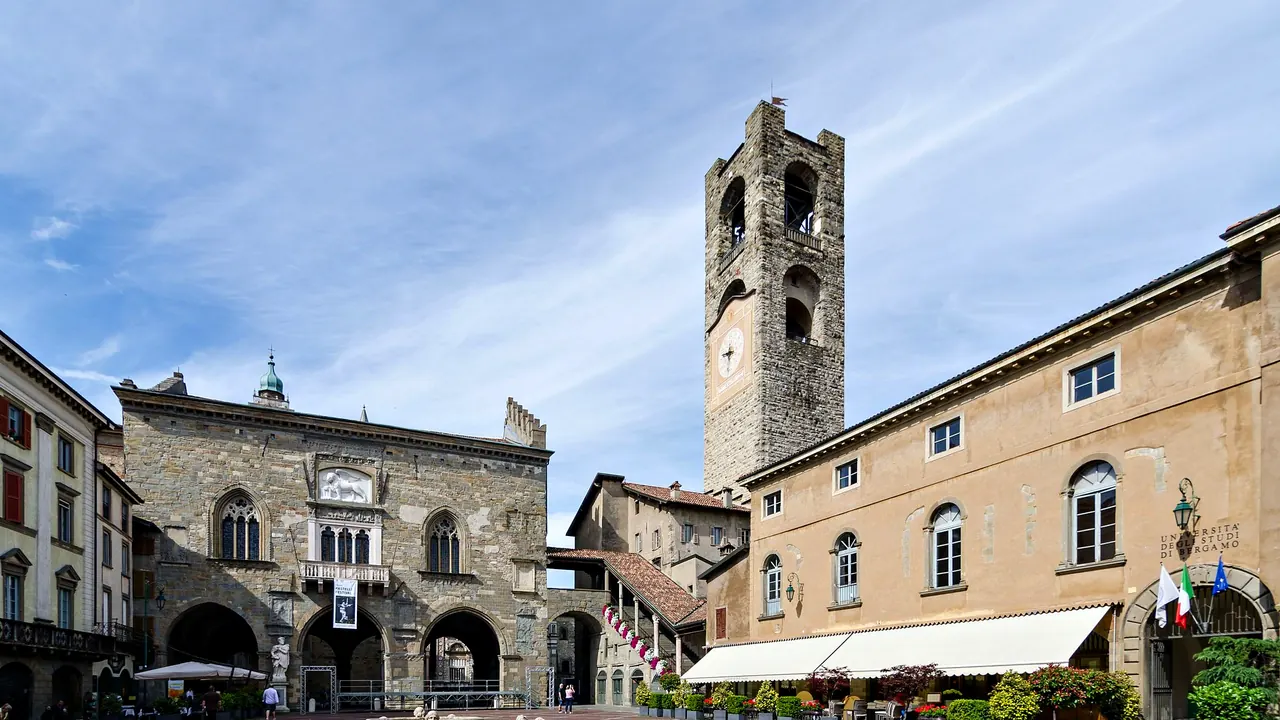
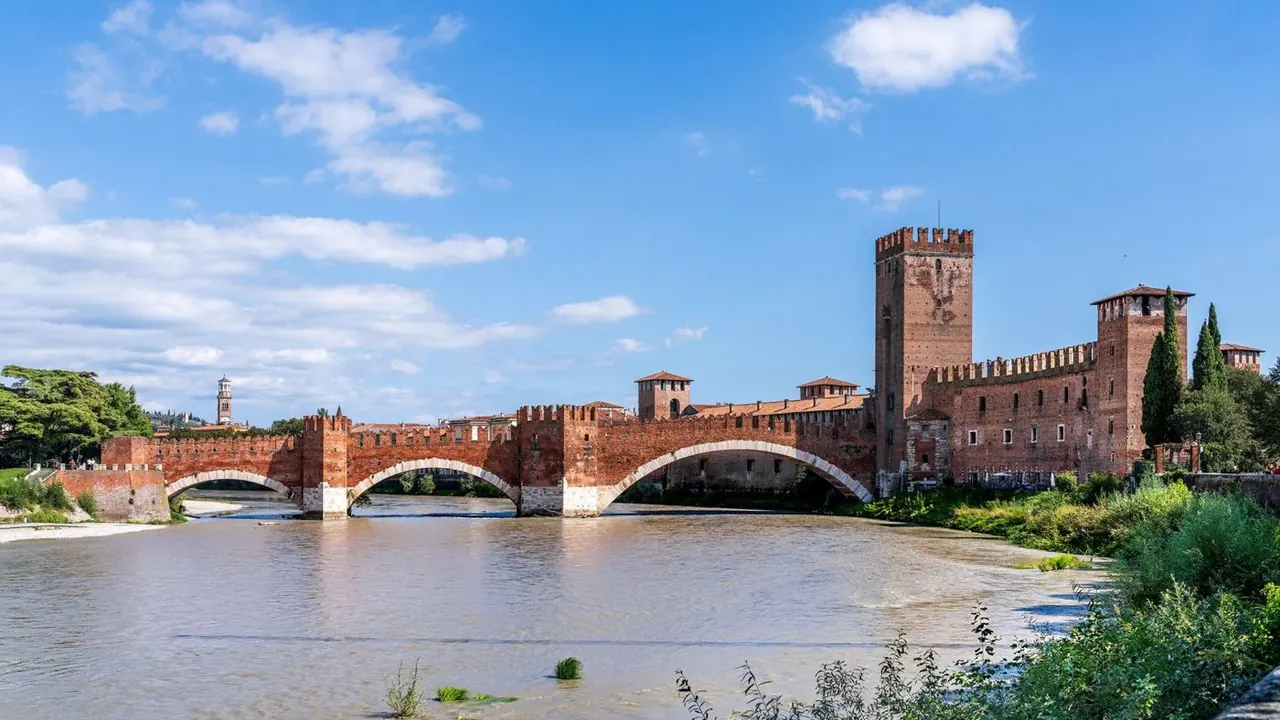
Photos: Bergamo by Steffen Schmitz, CC BY-SA 4.0, cropped; Verona by NorbertNagel, CC BY-SA 4.0, cropped.
Bergamo or Verona?
Our verdict in twelve categories, each scored against the same fixed benchmark cities, and the climate month by month, so you can choose for your trip.
Choose Bergamo for
- nature and the outdoors
- prices
- wellness
Bergamo suits travellers who want a compact walled hilltop town with real mountains at its back. The Città Alta and the Accademia Carrara fill a day or two. After that the Orobie valleys, Lake Iseo and Milan are all close, and rooms in the lower town cost a little less. Walkers, cyclists and anyone happier with casoncelli and Taleggio than with a big night at the theatre will feel at home.
Choose Verona for
- live music and the arts
- beaches
- families
Verona is the better pick for a longer, richer stay in the city itself. It has the Roman Arena and San Zeno, opera under the stars on summer nights and Amarone made a short drive away. Venice, Padua and Vicenza are on one rail line, which makes it the stronger choice for art, music and wine lovers. Gardaland and the shores of Lake Garda also give families more to do. Expect to pay more for a central room.
Scoreboard
Twelve categories on one fixed scale from 0 to 100. The shaded stretch is the gap between the two.
Your match
Pick a travel style or drag the sliders, and both match scores follow your weighting.
Wins on nature and the outdoors and prices with your weighting.
Wins on live music and the arts and beaches with your weighting.
What matters to you?
Category by category
What the scores mean for a trip.
Beaches & swimming
Neither city is on the coast, so swimming means a lake in both. Verona has the easier summer dip. The southern shore of Lake Garda at Peschiera, Lazise and Sirmione is reachable by train, and its lidos, lawns and Sirmione's flat limestone shelves make a proper day by the water.
From Bergamo, the choices are Lake Iseo around Sarnico and Lovere or the Lecco arm of Lake Como. You swim from grass, pebbles or concrete platforms, and it is more of an outing to arrange. Both lakes are pleasantly warm by July.
Food & drink
Verona has the edge, and wine is the main reason. Amarone, Valpolicella, Soave and Bardolino are all made within a short drive, and the osterie around Piazza delle Erbe and in Veronetta serve Amarone risotto, bigoli with duck and bollito with peppery pearà.
Bergamo's cooking is heartier mountain food: casoncelli with butter and sage, and polenta with game and mushrooms. Its cheese counters in the Città Alta, stocked with Taleggio, Branzi and Strachitunt, are something Verona cannot match. In both cities, food from outside Italy is hard to find.
Culture & sights
Bergamo's appeal is a single, almost complete walled hilltop town. Piazza Vecchia leads straight to Santa Maria Maggiore and the marble front of the Cappella Colleoni. Down the hill, the Accademia Carrara holds Raphael, Bellini and Mantegna. It is a gallery Verona has nothing quite equal to, and a day or two covers the whole city.
Verona has more layers and more of everything. The Roman Arena and the Roman theatre, the Scaliger tombs, San Zeno's bronze doors and Castelvecchio in its Scarpa setting need two or three unhurried days. It is the better city for anyone who wants Roman and medieval history at every turn.
Nightlife
Verona's evenings run a little later, though neither city keeps much going past midnight. In Bergamo, the night is a long aperitivo followed by wine bars, with summer drinks in the squares of the Città Alta and along the Venetian walls, or around Borgo Santa Caterina in the lower town. For real clubbing, Milan is under an hour away.
In Verona, tables spill into Piazza delle Erbe, and across the Ponte Pietra the student wine bars of Veronetta stay busy later in term time. On summer nights the opera crowd leaving the Arena gives the centre a late second wind, but there is no dance scene in the old town.
Nature & outdoors
Bergamo is the better place for serious time outdoors. Wooded paths climb from the upper town to San Vigilio, and to the north Val Brembana and Val Seriana lead into the Orobie Alps, with rifugi, high lakes and the Serio waterfall. There is even small-scale skiing at Foppolo in winter.
Verona's countryside is gentler: Valpolicella vineyards, the Adige cycle route and the Lessinia plateau. Its strongest outdoor draw is an hour away at Lake Garda, where Monte Baldo offers ridge walks and the northern shore has reliable wind for sailing and windsurfing.
Day trips
Both cities make outstanding bases, but Verona's choice of trips is a shade richer. Venice, Padua, Vicenza and Mantua all lie on short rail hops, and the Garda towns and the cellars of Valpolicella and Soave are closer still.
From Bergamo, days out lean towards Lombardy. Milan is under an hour away, Lake Como and Lake Iseo with car-free Monte Isola are closer still, and Crespi d'Adda and Brescia are both easy trips. The two cities are linked to each other, so either can serve as a day trip from the other.
Good for families
Verona gives children more to look forward to. Gardaland, Italy's biggest theme park, and the Parco Natura Viva drive-through safari are both about half an hour away. The Arena tends to grab young imaginations, and the flat centre suits a pushchair, though summer afternoons get very hot.
Bergamo is calmer and smaller, and its funicular rides are an easy win with children. Leolandia suits younger children and Le Cornelle wildlife park makes a half day out, but the steep cobbles of the upper town are hard going with a buggy.
Getting around
Both are easy to get around, but in different ways. Bergamo is built on two levels. Funiculars link the lower town to the Città Alta and continue up to San Vigilio, a light-rail line runs into Val Seriana, and the airport is a short bus ride away.
Verona is flat and made for walking. Almost everything sits inside the river loop, there is no tram or metro, and buses mainly serve the station and the airport. In both cities a car makes the hills and lake shores far easier to reach.
Shopping & style
Verona is the more rewarding place to browse. Marble-paved Via Mazzini carries Italian fashion labels, and Corso Porta Borsari has smaller boutiques and jewellers, all smart in a provincial way. Bergamo's Via XX Settembre and the Sentierone are mostly chains and mid-range fashion.
The best things to take home differ: cheese, salumi and Valcalepio from the delicatessens of the Città Alta, or Amarone and pandoro from Verona. Serious fashion shoppers from either city end up in Milan, which is closer to Bergamo.
Affordability
Bergamo is the easier city on the wallet, mainly because rooms in the lower town are fairly priced. That is why many travellers use it as a base for Lombardy, though the Città Alta costs more.
In Verona, rooms in the historic centre are expensive for a city of its size and become scarce on summer opera nights and during trade fairs. Eating cheaply is easy enough in Veronetta's student osterie, and local wine is good value. Staying near the station or across the river helps.
Live music & performing arts
Verona is far ahead, mainly because of opera in the Roman Arena. Thousands sit on the stone tiers for grand productions of Verdi and Puccini on most summer evenings, and the Roman theatre adds Shakespeare, dance and jazz outdoors.
Bergamo's stage life centres on Donizetti, who was born there. The Teatro Donizetti stages an autumn festival of his works, and Bergamo Jazz runs in spring. So its best season is the cooler months, when Verona's programme is at its quietest.
Wellness & relaxation
Both cities have thermal springs nearby rather than spas in town, but the springs are quite different in character. From Bergamo you can visit San Pellegrino Terme, a Belle Époque resort in Val Brembana, or Trescore's sulphur springs. From Verona there are Sirmione's lake-facing thermal pools, a spring-fed lake in a villa garden near Lazise, and Caldiero's Roman-era springs. For quiet in town, Bergamo has early mornings on the walls of the Città Alta, while Verona has the terraces of the Giardino Giusti, away from the summer crowds around the Arena.
When should you go?
Pick your month. The climate figures are measured averages, not a forecast.
Bergamo in July
Verona in July
Daytime high, °C
Rainfall in the month, mm
Where the figures come from
Bergamo has no rain gauge within 25 km of the centre, so its rainfall comes from a gridded climate dataset read at the city rather than from a gauge further away.
Bergamo's sunshine is measured 64 km from the centre, at Lugano.
Temperature and rainfall are climate normals, averaged over the years shown. Bergamo: 1991-2020 normals, Bergamo / Orio Al Serio (3.9 km from centre). Verona: 1991-2020 normals, Verona / Villafranca (11.6 km from centre).
Both cities follow the same Po plain pattern of cold winters with highs in single figures, mild springs and hot summers. Bergamo, pressed against the Alps, is the wetter of the two. May and June, and again September to November, often bring more than 100mm a month, so its most reliable spells are April and high summer. April is mild and fairly dry, good for walking the Città Alta. July and August are the sunniest months and a little drier, and with highs of 29°C they suit the lakes for swimming and the Orobie valleys for cooler air.
Verona is drier all year and sunnier from spring through September. May is its best month for the streets, with highs around 24°C, long sunny days and modest rain, and June is nearly as good. July and August reach 30°C, which makes long afternoons in town tiring but is right for a swim in Lake Garda. Autumn is when Verona's rain arrives, peaking at about 85mm in September, though that is still well below Bergamo's autumn rainfall. In winter the roles reverse slightly, and Bergamo sees a little more sun.
Which traveller are you?
For a culture and arts trip, Verona is the clear choice. Roman Arena opera on summer evenings, the Roman theatre, San Zeno and Castelvecchio give two or three full days. Padua's Giotto frescoes and Palladio's Vicenza are both an easy train ride away.
On an outdoors trip, Bergamo wins. The Colli park climbs straight from the upper town, and Val Brembana and Val Seriana lead into the Orobie Alps, with rifugi and high lakes. Verona's surroundings are gentler vineyard hills unless you travel up to Monte Baldo.
On a family trip with children, Verona has more to offer. Gardaland, Italy's biggest theme park, and the Parco Natura Viva safari zoo are both near Lake Garda. The flat, largely pedestrian centre is easy with a pushchair, unlike Bergamo's steep cobbled lanes.
Before you go
| Measure | Bergamo | Verona |
|---|---|---|
| Official language | Italian | Italian |
| Currency | Euro (EUR) | Euro (EUR) |
| Sockets | CFL230 V, 50 Hz | CFL230 V, 50 Hz |
| Driving side | Right | Right |
| Time zone | UTC+1, UTC+2 in summer | UTC+1, UTC+2 in summer |
| Emergency number | 112 | 112 |
| Elevation | 249 m | 59 m |
| Main airport | Il Caravaggio International Airport (BGY)4 km from centre146 non-stop destinations | Verona Villafranca Valerio Catullo Airport (VRN)10 km from centre96 non-stop destinations |
| Public holidays this year | 13 days | 13 days |
By the numbers
| Measure | Bergamo | Verona |
|---|---|---|
| City population | 119,534 | 255,588 |
| People per km² | 2,973 | 1,285 |
| Museums within 10 km | 21 | 18 |
| UNESCO World Heritage sites within 50 km | 6 | 5 |
Where else could you go?
Every comparison below shares a destination with this one, so you can follow Bergamo or Verona somewhere new.