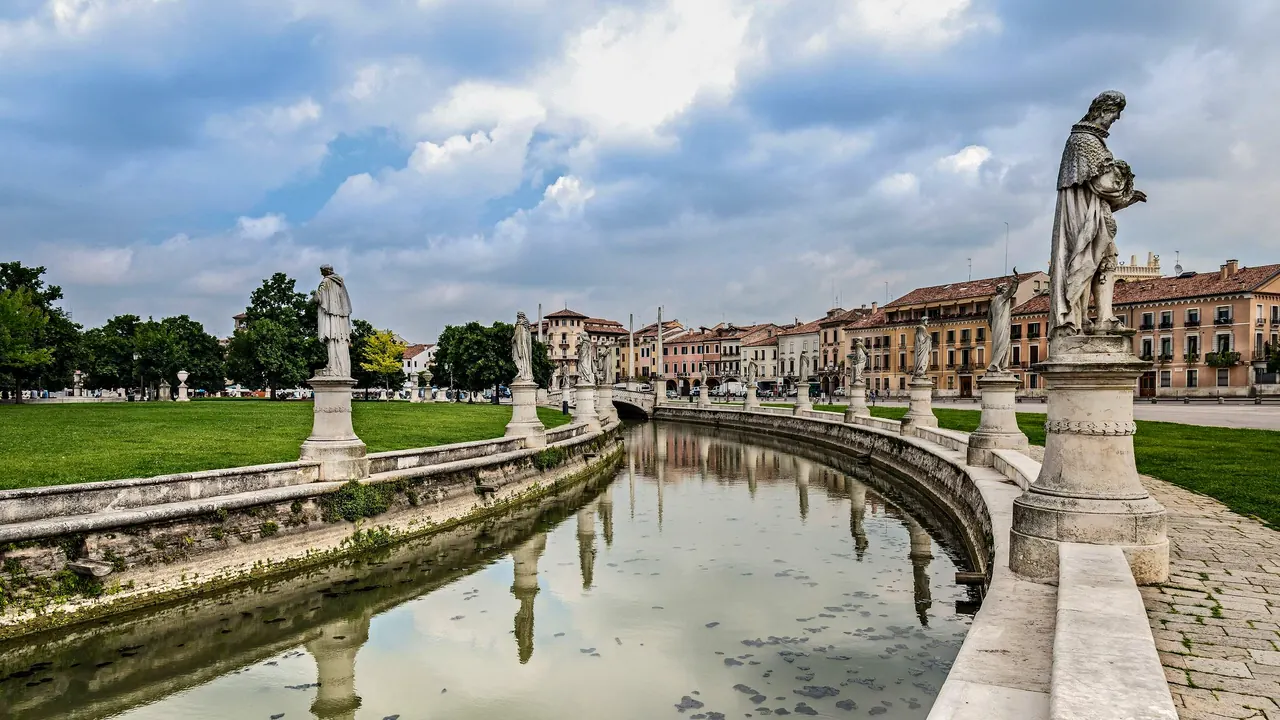
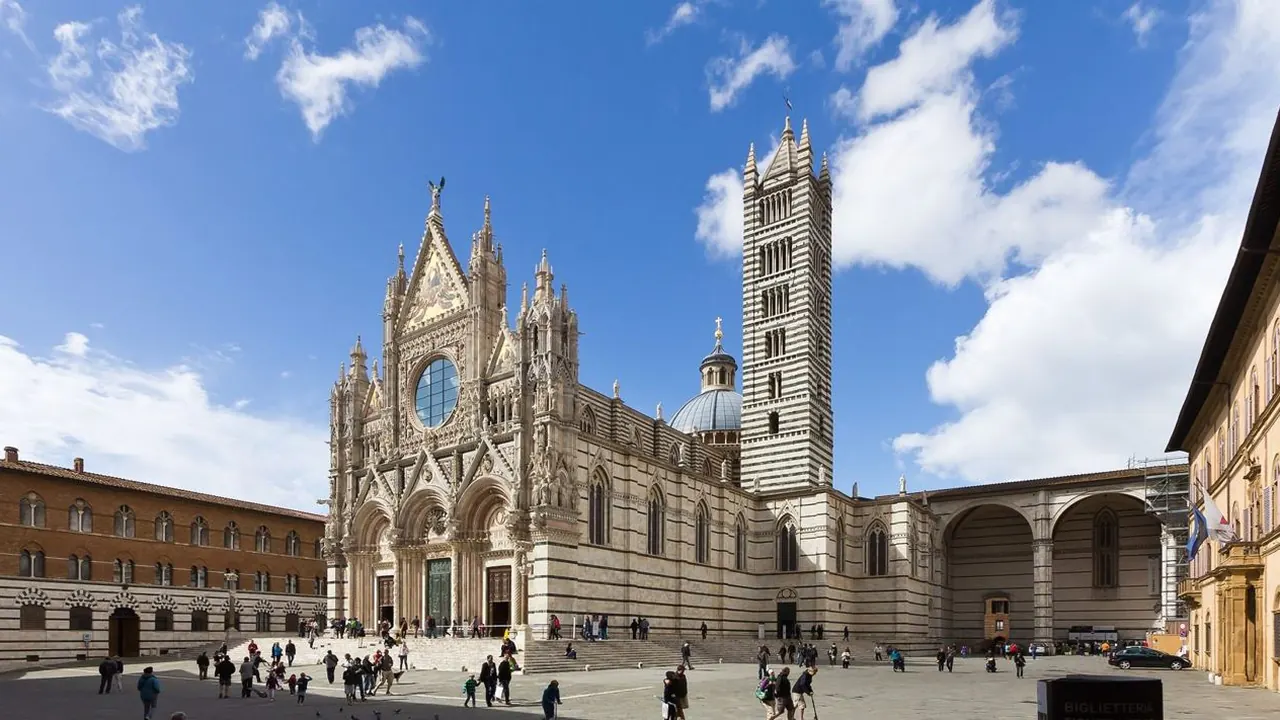
Photos: Padua by Didier Descouens, CC BY-SA 4.0, cropped; Siena by Raimond Spekking, CC BY-SA 4.0, cropped.
Padua or Siena?
Our verdict in twelve categories, each scored against the same fixed benchmark cities, and the climate month by month, so you can choose for your trip.
Choose Padua for
- nightlife
- beaches
- getting around
Padua suits travellers who want an easy, well-connected base in the Veneto. It has a flat, walkable centre and a railway station that puts Venice, Vicenza, Verona and Bologna within easy reach. Rooms are more reasonably priced, the student aperitivo crowd keeps evenings sociable, and the thermal pools of Abano are a short ride away. Choose it if you want to see a lot without a car and still sleep somewhere calm and affordable.
Choose Siena for
- nature and the outdoors
- culture and sights
For a slower vacation built around landscape, Siena is the better pick. It is a complete medieval town set among the clay hills of the Crete Senesi, the Val d'Orcia and the Chianti vineyards. The streets are steep and the nights are quiet, and the hill towns, abbeys and wine cellars are best reached by hire car. It rewards people who want long dinners, cycling on gravel roads and a countryside that looks like a Renaissance painting.
Scoreboard
Twelve categories on one fixed scale from 0 to 100. The shaded stretch is the gap between the two.
Your match
Pick a travel style or drag the sliders, and both match scores follow your weighting.
Wins on nightlife and beaches with your weighting.
Wins on nature and the outdoors and culture and sights with your weighting.
What matters to you?
Category by category
What the scores mean for a trip.
Beaches & swimming
Neither city is a place for a beach vacation, but Padua at least makes a day at the sea simple. Sottomarina and the Lido of Venice are about an hour away by car or by train and boat, and the shallow, calm Adriatic suits small children, even if the beaches are flat rows of umbrellas.
Siena is further from the water. The Maremma coast is well over an hour away by car, so a swim takes the whole day, and most visitors settle for a hotel or agriturismo pool.
Food & drink
The two cities eat equally well, and in both the best meals are regional home cooking. Padua's food is Venetian: bigoli with duck or sardine sauce, baccalà and spring risotto. Its daily life centres on the twin markets under the Palazzo della Ragione and the spritz taken standing in the squares, with Caffè Pedrocchi as its grand coffee house.
Siena eats Tuscan: hand-rolled pici, cinta senese pork and wild boar. It adds a baking tradition of panforte and ricciarelli, and it has the stronger wine country, with Chianti Classico to the north and Brunello and Vino Nobile to the south. Neither city offers much international food or fine dining.
Culture & sights
The two are closely matched, but they reward different kinds of sightseeing. Padua's great sights are individual works spread across the city: Giotto's Scrovegni Chapel, which needs a timed visit, the UNESCO-listed fresco cycles, Donatello's work at the Basilica of Saint Anthony, the anatomical theatre at Palazzo Bo and the Orto Botanico, the oldest university botanical garden still on its original site. The centre is rich but quickly covered.
In Siena the town itself is the sight. The sloping Campo, the striped Duomo with its inlaid marble floor, Lorenzetti's Good and Bad Government and Duccio's Maestà all sit inside one intact medieval centre, and the seventeen contrade still give each quarter its own identity. Allow two or three days to see it properly.
Nightlife
Padua has more going on after dark, thanks to its large university. Students and locals fill Piazza delle Erbe and Piazza dei Signori over spritz from early evening, and small wine bars and pubs in the old ghetto stay open into the night during term. Clubs are few, and the city empties in high summer.
In Siena an evening usually means dinner, a glass of wine on the Campo and a walk, and the centre is quiet before midnight for most of the year. The nights around the Palio are the one time its streets stay full late.
Nature & outdoors
Siena has the better countryside right on its doorstep. The bare clay hills of the Crete Senesi and the UNESCO-listed Val d'Orcia are classic Tuscan landscape, and the gravel strade bianche start at the edge of town for road and gravel riders. Walkers have sections of the Via Francigena and the Montagnola woods.
Padua stands on flat plain, so its outdoors starts with the volcanic Euganean Hills about 15km away and the level towpaths along the Brenta. It does have one thing Siena lacks: real mountain walking in the pre-Alps around Monte Grappa and Asiago, about an hour and a half away by car.
Day trips
Both are outstanding bases, and the difference lies in how you travel. From Padua nearly everything goes by train: Venice in under half an hour, Vicenza in a quarter of an hour, and Verona, Treviso, Bologna and Ferrara in about an hour, with the Brenta villas and the walled towns of the Euganean Hills close by.
From Siena, Florence is a fast bus ride, but the real riches are San Gimignano, Montalcino, Pienza, the Chianti villages and abbeys such as Sant'Antimo and San Galgano. These are far easier to reach with a hire car.
Good for families
Both are safe, mostly car-free towns where children are welcome in every trattoria, and neither has much built for them. Padua is the easier walk with a pushchair, being flat, and Prato della Valle gives children room to run. Gardaland and the Adriatic are both within a day trip.
Siena's steep, stepped streets are hard going for small children. Older ones, though, tend to enjoy climbing the Torre del Mangia and watching the contrada drummers. Families there often stay at a farmhouse with a pool and come into town for half days.
Getting around
Padua is the easier city to get around. The centre is flat and arcaded, the main sights are within a 20-minute walk, a tram runs from the station to Prato della Valle, and cycling is normal. Its station on main lines in every direction means you don't need a car.
Siena's centre is compact but built across three ridges, so expect steep climbs. The station in the valley below connects to the upper town by escalators. Trains are slow and infrequent, and most visitors end up hiring a car for the countryside.
Shopping & style
Padua has a little more to offer a shopper. The arcaded streets between the station and the squares hold Italian fashion and shoe shops, independent boutiques and university bookshops. A large antiques market fills Prato della Valle one Sunday a month.
Siena's Banchi di Sopra has clothing and leather, but the local buys are hand-painted majolica, contrada scarves and panforte from the bakeries. The lanes near the Campo are mostly souvenir shops. In both cities, food to take home is the best purchase.
Affordability
Padua is the cheaper of the two, and many visitors use it as a lower-cost base for Venice and the rest of the Veneto. Its moderate hotels, cheap standing spritz and walkable centre keep daily spending down, though rooms cost more during trade fairs and graduation season.
Siena has few rooms inside its walls, and prices rise steeply in summer and around the Palio. Osteria lunches are fair value, but separate entry charges for the cathedral and civic museums add up. Staying at an agriturismo outside town usually cuts the bill.
Live music & performing arts
Both have modest but real programmes, with different strengths. Padua offers plays and some opera at Teatro Verdi, chamber concerts in the frescoed Sala dei Giganti and the Basilica of Saint Anthony, and easy evening trips to the Fenice in Venice or the summer Arena in Verona.
Siena's strength is its music schools. The Accademia Chigiana fills palaces and churches with classical concerts in summer, and Siena Jazz adds performances by its teachers and students. For opera, though, you have to go to Florence.
Wellness & relaxation
Padua has the stronger spa offer. Abano Terme and Montegrotto Terme, about 12km away, form one of Europe's largest thermal districts, with mud treatments and dozens of spa hotels that welcome day visitors. A soak after a morning in the frescoed churches takes only a short bus or train ride.
Siena's hot springs are wilder and more scattered. Rapolano is half an hour east, and further south lie the medieval pool at Bagno Vignoni and the free limestone pools of Bagni San Filippo in the woods. They suit a slow farmhouse stay with a car better than a quick dip between sights.
When should you go?
Pick your month. The climate figures are measured averages, not a forecast.
Padua in July
Siena in July
Daytime high, °C
Rainfall in the month, mm
Where the figures come from
Padua's temperatures are measured 35 km from the centre, at Treviso / Istrana.
Padua has no rain gauge within 25 km of the centre, so its rainfall comes from a gridded climate dataset read at the city rather than from a gauge further away.
Padua's sunshine is measured 36 km from the centre, at Treviso / S. Angelo.
Siena's temperatures are measured 45 km from the centre, at Arezzo.
Siena has no rain gauge within 25 km of the centre, so its rainfall comes from a gridded climate dataset read at the city rather than from a gauge further away.
Temperature and rainfall are climate normals, averaged over the years shown. Padua: 1991-2020 normals, Treviso / Istrana (35.4 km from centre). Siena: 2006-2017 (rainfall 1991-2020) normals, Arezzo (45 km from centre).
The two cities follow almost the same temperature curve. Highs reach 31°C in July and August, which makes midday sightseeing hard work in both, and the pleasant walking months are May, June, September and early October. Padua is the one with a beach season. The nearby Adriatic warms to 26°C in August, and July is its sunniest month. Its rain is spread fairly evenly through the year, though, so summer showers are normal there.
Siena's year is more uneven. Summer is clearly dry, with only about 27mm of rain in July, so days out in the countryside are rarely spoilt by weather, although the heat matches Padua's. Autumn then turns wet quickly, and November, at 127mm, is the rainiest month in either city. That makes late spring and September the safest time for a Tuscan trip.
Which traveller are you?
On a trip on a tight budget, Padua is the better choice. Its hotels cost less than rooms inside Siena's walls, a standing spritz and market food are cheap, and the walkable centre and fast trains to Venice keep transport costs low.
For a food and nightlife trip, Padua comes out ahead on the evenings. The two kitchens are equally good, but students fill Padua's squares with aperitivo crowds until late, and the side streets have wine bars. Siena goes quiet before midnight except around the Palio.
On an outdoors trip, Siena is the stronger base. Gravel strade bianche start at the edge of town, the Crete Senesi and Val d'Orcia make classic cycling and walking country, and the Via Francigena passes nearby. Padua's countryside begins with flat plain.
Before you go
| Measure | Padua | Siena |
|---|---|---|
| Official language | Italian | Italian |
| Currency | Euro (EUR) | Euro (EUR) |
| Sockets | CFL230 V, 50 Hz | CFL230 V, 50 Hz |
| Driving side | Right | Right |
| Time zone | UTC+1, UTC+2 in summer | UTC+1, UTC+2 in summer |
| Emergency number | 112 | 112 |
| Elevation | 12 m | 322 m |
| Main airport | Venice Marco Polo Airport (VCE)39 km from centre103 non-stop destinations | Florence Airport, Peretola (FLR)55 km from centre46 non-stop destinations |
| Public holidays this year | 13 days | 13 days |
By the numbers
| Measure | Padua | Siena |
|---|---|---|
| City population | 206,496 | 52,812 |
| People per km² | 2,220 | 446 |
| Museums within 10 km | 29 | 30 |
| UNESCO World Heritage sites within 50 km | 5 | 5 |
| Swim season, months above 21 °C | 4 months | - |
Where else could you go?
Every comparison below shares a destination with this one, so you can follow Padua or Siena somewhere new.