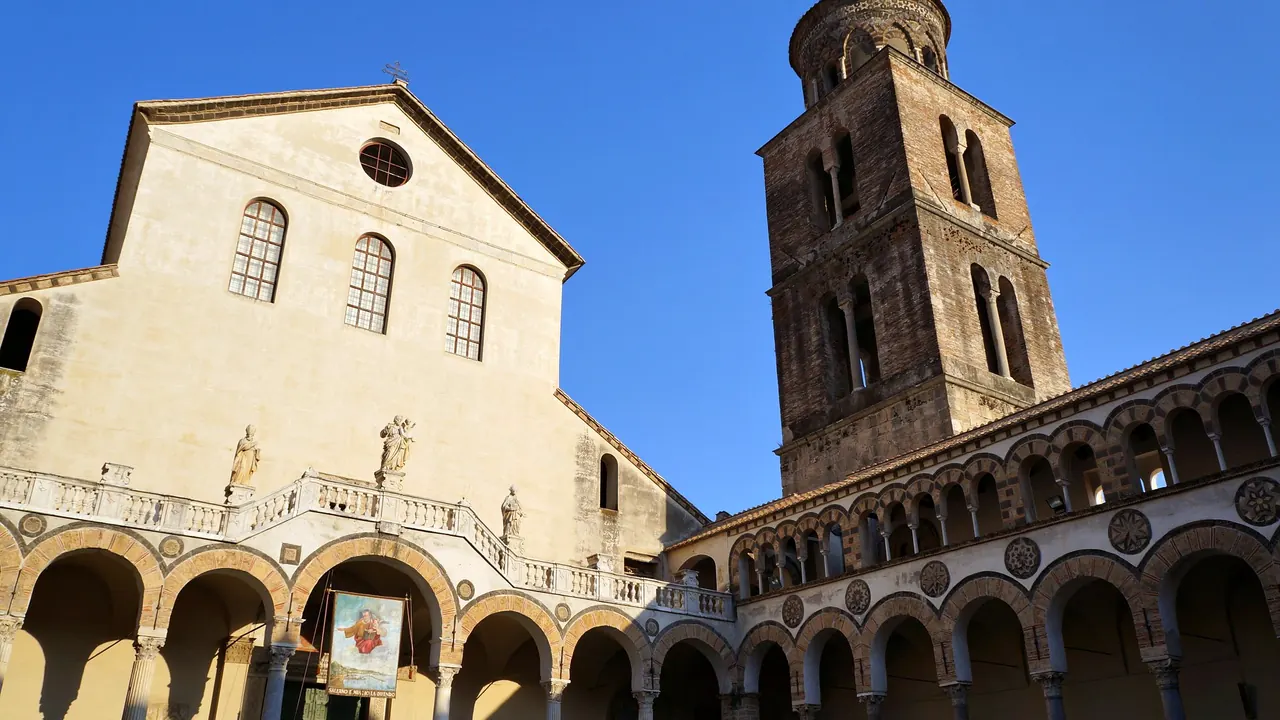
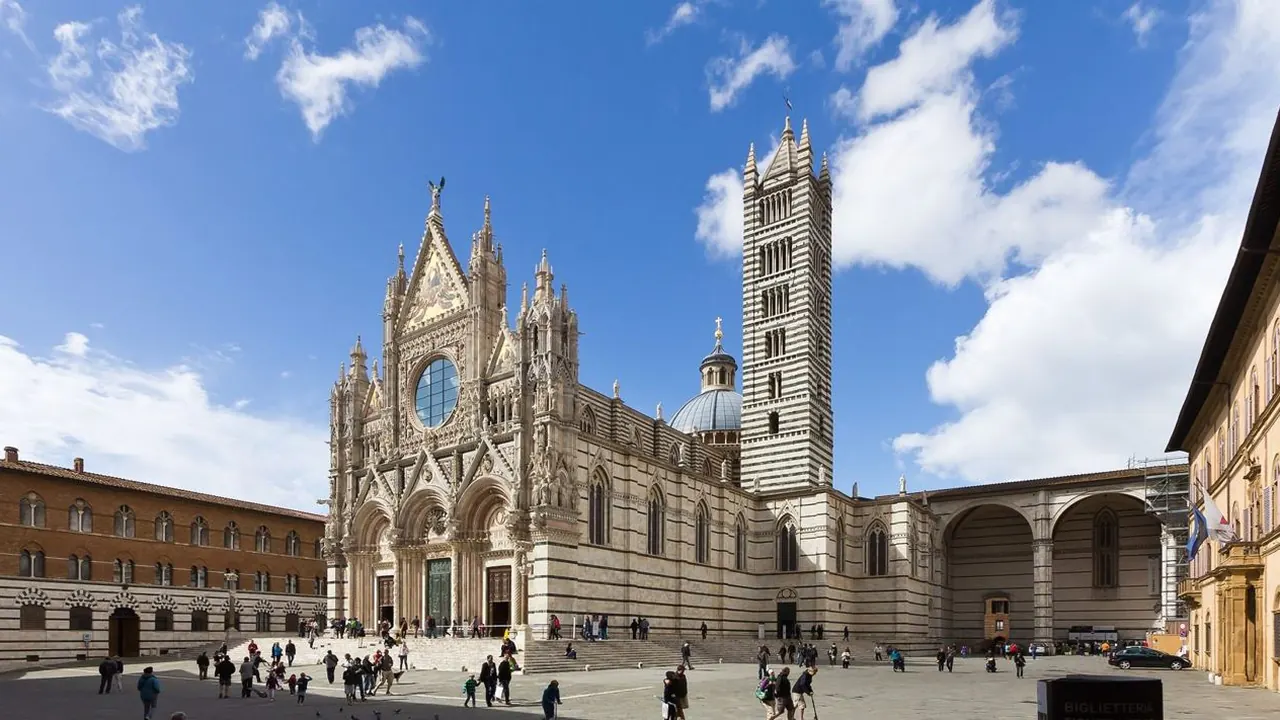
Photos: Salerno by Leandro Neumann Ciuffo, CC BY 2.0, cropped; Siena by Raimond Spekking, CC BY-SA 4.0, cropped.
Salerno or Siena?
Our verdict in twelve categories, each scored against the same fixed benchmark cities, and the climate month by month, so you can choose for your trip.
Choose Salerno for
- beaches
- prices
- families
Salerno is the pick for travellers who want the sea in the same trip as the sights. It has its own seafront and swimming close by, ferries to the Amalfi Coast, trains to Pompeii and Paestum, and the cliff paths of the Lattari mountains above the coast. Everyday prices are those of a working port city, so it is a sensible base for one of Italy's costliest coastlines. It also copes better with children and with a night out.
Choose Siena for
- culture and sights
- wellness
- day trips
Siena belongs to people who come for art, architecture and countryside. The Campo, the Duomo and the Sienese painters in the city's museums make a richer two or three days than anything inside Salerno. Around it lie the Crete Senesi, the Val d'Orcia, the wine towns and several hot springs. It suits a slower trip with a hire car, long dinners and quiet evenings, and it has no beach at all.
Scoreboard
Twelve categories on one fixed scale from 0 to 100. The shaded stretch is the gap between the two.
Your match
Pick a travel style or drag the sliders, and both match scores follow your weighting.
Wins on beaches and prices with your weighting.
Wins on culture and sights and wellness with your weighting.
What matters to you?
Category by category
What the scores mean for a trip.
Beaches & swimming
Salerno is a seaside city and Siena is not. Salerno's own grey-sand beaches are fine for a quick dip. A short trip south brings the wide sandy lidos and pine woods towards Paestum, and a ferry west reaches the clear pebbly coves of the Amalfi Coast.
From Siena, the nearest decent sea is on the Maremma coast, well over an hour's drive, so a swim takes up the whole day. Otherwise swimming means a hotel or agriturismo pool.
Food & drink
The two cities eat about equally well, but the food is very different. Salerno cooks from the sea and the plain: fried fish, pasta with clams, wood-fired pizza, buffalo mozzarella made that morning near Paestum and colatura from Cetara, with lemon pastries to finish.
Siena's cooking is inland and hearty: hand-rolled pici with duck ragù, ribollita, cinta senese pork and wild boar, and old-fashioned panforte and ricciarelli. Wine is where it pulls ahead, with Chianti Classico, Brunello and Vino Nobile all grown close by and poured by the glass across town.
Culture & sights
Siena is a far richer city for art and history. It is one of Europe's most complete medieval cities. The Palazzo Pubblico holds Lorenzetti's Good and Bad Government, the Duomo has its inlaid floor and the Piccolomini Library, and Duccio's Maestà, Santa Maria della Scala and the Pinacoteca add plenty more for a second and third day.
Salerno's heritage is real but compact: the Norman cathedral with Saint Matthew's crypt, the Giardino della Minerva and its link to Europe's first medical school, and the Arechi Castle above the gulf. Its great ancient sites, Paestum and Pompeii, lie outside the city.
Nightlife
Neither is a clubbing destination, but Salerno has more life after dark. On summer nights and at weekends, young locals fill Largo Campo and Via dei Mercanti outside wine bars and pubs until late, and the seafront passeggiata keeps the evening going.
Siena's evenings centre on dinner and a glass on the Campo, and outside the Palio nights the centre is usually quiet before midnight. There are a few student pubs, and that is about all.
Nature & outdoors
Salerno is closer to wilder, more dramatic scenery. Limestone cliffs drop into the sea, mule tracks such as the Path of the Gods cross the Lattari mountains, and the Cilento's gorges and headlands lie to the south. Boat trips and kayaking add the water.
Siena's countryside is gentler and pastoral, with the clay hills of the Crete Senesi and the rolling Val d'Orcia. It is best seen by bike on the gravel strade bianche or on foot along the Via Francigena. It has no coastline and no high mountains.
Day trips
Both are superb bases, so the difference is in how you get about. From Salerno, most of the big names are reached without a car: Paestum and Pompeii by train, Amalfi and Positano by ferry, Naples on a fast train in about half an hour.
Siena's day trips are more numerous and closer together, from San Gimignano and Volterra to Montalcino, Pienza and the abbeys of Sant'Antimo and San Galgano. Apart from Florence and a few towns, though, you will want a hire car for the hill towns and wineries.
Good for families
Salerno is the easier city with children. Its long, flat, car-free seafront has playgrounds and gelato, and the shallow sandy beaches south of town suit young swimmers. The Luci d'Artista lights give families a reason to come in winter too.
Siena is safe and mostly free of cars, and older children enjoy climbing the Torre del Mangia. But its steep streets are hard with a pushchair and there is nowhere to swim, which is why many families stay at a countryside farmhouse with a pool.
Getting around
Both centres are best on foot, but the ground differs. In Salerno the walk from the station along the Corso to the seafront is level and easy. The old town above it climbs in steps and steep lanes, and the castle is best reached by bus, while regional trains and summer ferries handle the longer journeys.
Siena spreads over three steep ridges, with escalators climbing from the station in the valley. Regional trains are slow and few, so buses or a hire car left outside the walls take you further.
Shopping & style
Salerno has a little more choice, mainly along Corso Vittorio Emanuele, a long pedestrian street of Italian chains that comes alive at passeggiata time. Its best buys come from close by: Vietri majolica, limoncello and Cetara's colatura.
Siena's Banchi di Sopra and Via di Città are smaller in range, but leather goods, contrada scarves, panforte, pecorino and wine make good things to take home, and the weekly market by the Fortezza is worth a browse.
Affordability
Salerno is clearly cheaper to stay in. As a working port city it charges what locals pay for pizza and trains, and its rooms cost much less than in the cliff villages along the coast. The costs build up in summer through ferries and sunbeds.
In Siena, rooms inside the walls are scarce and get expensive in summer and around the Palio, and the cathedral and civic museums each charge for entry. Osteria lunches are reasonable, and sleeping in an agriturismo outside town saves money.
Live music & performing arts
Salerno has a proper opera house and Siena does not. The gilded Teatro Verdi, modelled on the San Carlo in Naples, stages opera, concerts and ballet, and in summer the cliff-top concerts of the Ravello Festival are within reach.
Siena's music comes from its schools and is chamber-scale: the Accademia Chigiana's summer concerts in palaces and churches, performances by Siena Jazz's teachers and students, and winter drama at the Rinnovati and the Rozzi. For opera, you have to go to Florence.
Wellness & relaxation
Siena is the better choice for unwinding, thanks to the thermal water around it. Rapolano's travertine pools are half an hour away, and further south are the steaming medieval bath at Bagno Vignoni, the free limestone pools of Bagni San Filippo and Petriolo's hot river.
Salerno's calm comes from sunset walks along its palm-lined promenade and long lunches. Spa treatments mean hotel spas, and the nearest springs are an hour inland at Contursi Terme.
When should you go?
Pick your month. The climate figures are measured averages, not a forecast.
Salerno in July
Siena in July
Daytime high, °C
Rainfall in the month, mm
Where the figures come from
Salerno's temperatures are measured 71 km from the centre, at Grazzanise.
Salerno has no rain gauge within 25 km of the centre, so its rainfall comes from a gridded climate dataset read at the city rather than from a gauge further away.
Siena's temperatures are measured 45 km from the centre, at Arezzo.
Siena has no rain gauge within 25 km of the centre, so its rainfall comes from a gridded climate dataset read at the city rather than from a gauge further away.
Temperature and rainfall are climate normals, averaged over the years shown. Salerno: 1991-2020 normals, Grazzanise (71.3 km from centre). Siena: 2006-2017 (rainfall 1991-2020) normals, Arezzo (45 km from centre).
Salerno has a long beach season. From June to September the sea is warm enough for proper swimming, peaking at about 26°C in August, and these are also its sunniest months. Midsummer days reach 31°C, which makes Pompeii and the coastal paths hard going around midday, so May and late September are the gentler times for walking and sightseeing. The rain sets in from October and peaks in November at about 154mm, though even in January the days stay mild.
Siena is just as hot in July and August, but its winters are clearly colder, with January highs around 9°C. It is also wettest in November, at about 127mm, yet from autumn through spring it gets noticeably less rain than Salerno. In early summer it is the other way round. May, June and September are its best months, warm enough for long days in the hill towns without the full summer heat. In winter, Salerno is the milder of the two and Siena the drier.
Which traveller are you?
For a beach and sun trip, Salerno is the obvious choice. It has city beaches on its doorstep, the long sandy shore towards Paestum and the clear coves of the Amalfi Coast by ferry. Siena is more than an hour from the nearest sea.
On a culture and arts trip, Siena is the stronger choice. The whole medieval centre is UNESCO-listed, and Lorenzetti's frescoes, Duccio's Maestà and the Duomo's marble floor are all within a short walk of one another. Salerno's cathedral and old town fill a day or two at most.
For a relaxing and wellness trip, choose Siena. Rapolano Terme is half an hour away, and the warm pools of Bagno Vignoni and Bagni San Filippo lie among the southern hills, where a farmhouse stay is easy. Salerno offers seafront strolls but has little thermal water nearby.
Before you go
| Measure | Salerno | Siena |
|---|---|---|
| Official language | Italian | Italian |
| Currency | Euro (EUR) | Euro (EUR) |
| Sockets | CFL230 V, 50 Hz | CFL230 V, 50 Hz |
| Driving side | Right | Right |
| Time zone | UTC+1, UTC+2 in summer | UTC+1, UTC+2 in summer |
| Emergency number | 112 | 112 |
| Elevation | 4 m | 322 m |
| Main airport | Naples International Airport (NAP)46 km from centre131 non-stop destinations | Florence Airport, Peretola (FLR)55 km from centre46 non-stop destinations |
| Public holidays this year | 13 days | 13 days |
By the numbers
| Measure | Salerno | Siena |
|---|---|---|
| City population | 127,186 | 52,812 |
| People per km² | 2,123 | 446 |
| Museums within 10 km | 9 | 30 |
| UNESCO World Heritage sites within 50 km | 5 | 5 |
| Swim season, months above 21 °C | 5 months | - |
Where else could you go?
Every comparison below shares a destination with this one, so you can follow Salerno or Siena somewhere new.