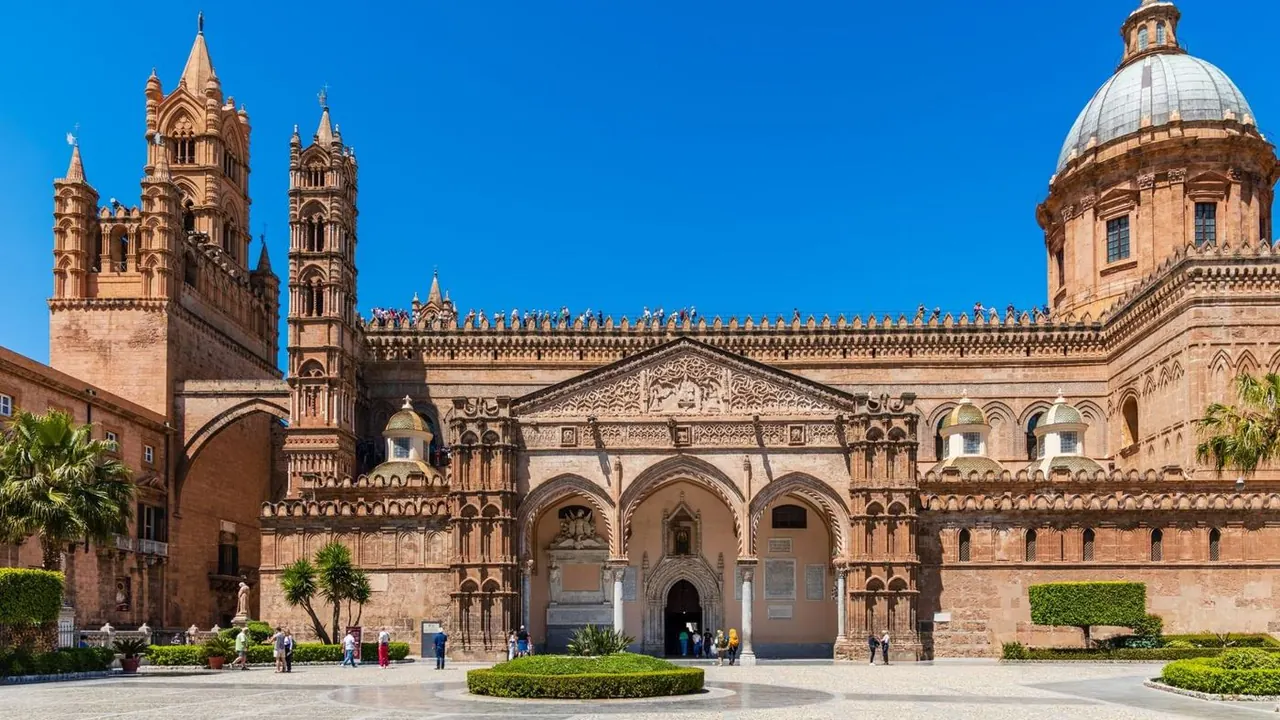
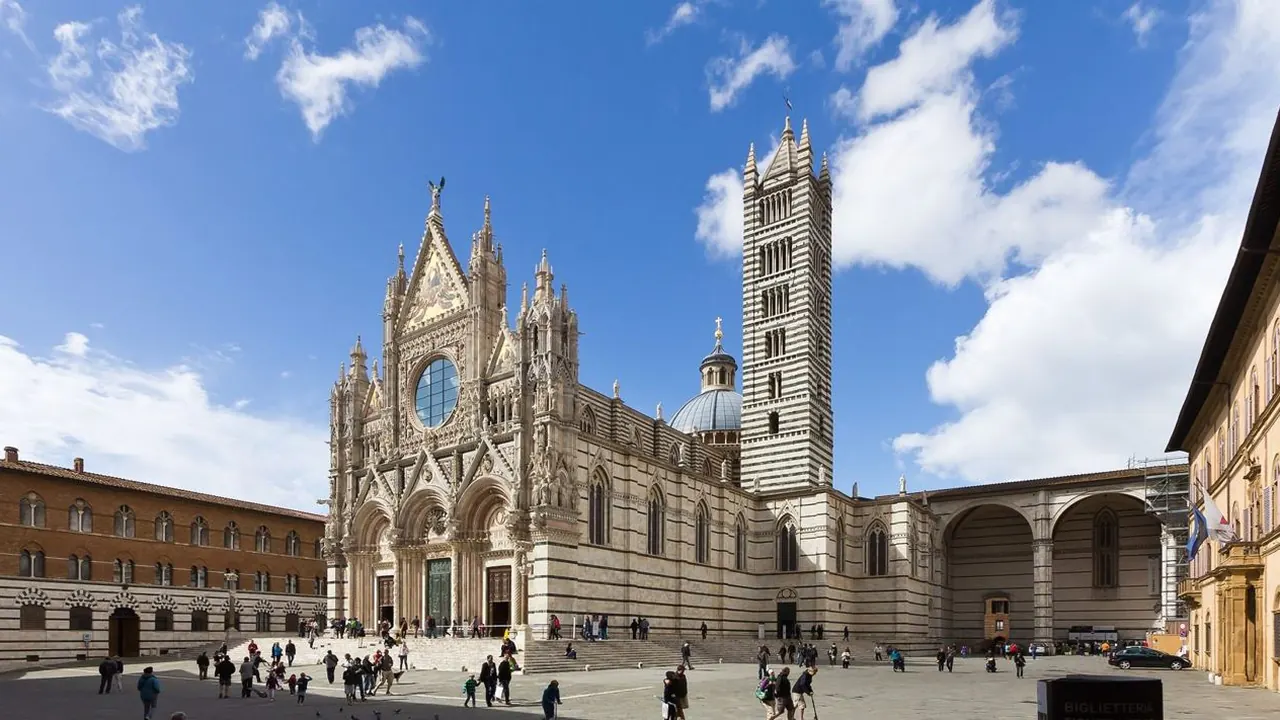
Photos: Palermo by Antonino Giangrasso, Pexels License; Siena by Raimond Spekking, CC BY-SA 4.0, cropped.
Palermo or Siena?
Our verdict in twelve categories, each scored against the same fixed benchmark cities, and the climate month by month, so you can choose for your trip.
Choose Palermo for
- beaches
- nightlife
- live music and the arts
Palermo is the better choice for a trip that mixes sightseeing with the sea and the street. Mondello's sandy bay is a short bus ride from the Arab-Norman mosaics, the markets double as the best places to eat, and evenings carry on outdoors well past midnight. It is also the cheaper of the two. You have to be able to put up with traffic, noise and a centre that is visibly crumbling in places.
Choose Siena for
- wellness
- day trips
- getting around
Siena rewards a slower, quieter trip through the Tuscan countryside. The walled centre is calm and largely free of cars, nights end early, and the town is an excellent base for reaching Florence, San Gimignano, the Chianti villages, the Val d'Orcia and the hot springs further south. It suits couples, wine lovers and anyone who would rather soak in a thermal pool than go out dancing, though it costs more and has no sea.
Scoreboard
Twelve categories on one fixed scale from 0 to 100. The shaded stretch is the gap between the two.
Your match
Pick a travel style or drag the sliders, and both match scores follow your weighting.
Wins on beaches and nightlife with your weighting.
Wins on wellness and day trips with your weighting.
What matters to you?
Category by category
What the scores mean for a trip.
Beaches & swimming
Palermo has a real beach within easy reach, and Siena does not. From central Palermo, a bus gets you to Mondello in about half an hour. Its pale sandy bay has shallow, clear water, so you can swim in the morning and still spend the afternoon sightseeing. If you prefer deep water and fewer people, head up the coast to the rocks at Sferracavallo and Capo Gallo, and Cefalù has a longer town beach a train ride away. You cannot swim at the harbour itself, so every swim means a short trip out.
From Siena, getting to the sea is a day out in itself. The nearest good sand is on the Maremma coast near Castiglione della Pescaia and Follonica, more than an hour's drive away, so a swim takes the whole day. Most visitors make do with the pool at their hotel or agriturismo, or spend a few nights by the sea.
Food & drink
In Palermo, eating is one of the main reasons to go. The markets fry panelle and arancine all day, sfincione is sold from vans, and the cooking keeps the Arab flavours of raisins, saffron and pine nuts in dishes such as pasta con le sarde. The pastry tradition, from cannoli to convent almond sweets, is just as strong.
Siena eats well, but more simply: hand-rolled pici, ribollita, cinta senese pork and the panforte and ricciarelli of its bakeries. Its real strength is wine, with Chianti Classico, Brunello and Vino Nobile all grown close by. Neither city offers much fine dining or food from outside Italy.
Culture & sights
The two are level, but their heritage is very different. Palermo is a layered, rough-edged city where Byzantine gold mosaics sit under Islamic wooden ceilings in the Palatine Chapel, and Serpotta's stucco fills the baroque oratories. The Salinas and Palazzo Abatellis museums add depth, though parts of the old centre are falling apart.
Siena is the more complete and better-kept picture of a single age. It is a whole medieval town built around the Campo, with Lorenzetti's Good and Bad Government frescoes, the inlaid floor of the Duomo, Duccio's Maestà and the seventeen contrade still running their own neighbourhoods. Its main sights fit comfortably into two or three days.
Nightlife
Palermo has much more going on after dark. The Vucciria turns into an open-air drinking spot with grills and small bars, the Kalsa and the streets off Via Maqueda fill after a late dinner, and in summer the dancing moves to beach venues near Mondello. Clubs are few, and winter weeknights can be quiet.
Siena's evenings are a long dinner, a glass of wine on the Campo and a stroll home. Apart from a few student pubs and the nights around the Palio, the centre goes quiet before midnight.
Nature & outdoors
Palermo's outdoors is wilder and more varied, because the mountains meet the sea right at the edge of the city. You can climb Monte Pellegrino from town for the view over the bay, snorkel or dive off the rocks at Capo Gallo, follow the Zingaro trail past coves and dwarf palms, or walk in the beech woods of the Madonie, where peaks rise to almost 2,000m and winter sometimes brings snow.
Siena's landscape is gentler and farmed: the bare clay hills of the Crete Senesi and the cypress lanes of the Val d'Orcia. It is best seen by bike on the white gravel strade bianche that start just outside the walls, and it has no coast and no high peaks. Around both cities, spring and autumn are the times to be outdoors, when the Tuscan hills turn green or gold and Sicilian walks escape the summer heat.
Day trips
Siena has the advantage, because so much lies so close. Florence, San Gimignano, Monteriggioni, the Chianti villages, Volterra, Pienza, Montalcino and Montepulciano are all near, along with abbeys such as Sant'Antimo and the roofless San Galgano. You could fill a fortnight without repeating a trip.
Palermo's day trips are excellent too, but more spread out. Monreale and Bagheria are close, Cefalù and Segesta take longer, and Agrigento's Valley of the Temples is about two hours each way. From either base, a hire car makes the smaller places far easier to reach.
Good for families
Palermo comes out slightly ahead, mostly because of Mondello's shallow, sandy bay and the short puppet shows of knights and Saracens. Against that, the old town has scooters in lanes without pavements, uneven stone underfoot and long hot summers.
Siena is safer and quieter, and older children enjoy climbing the Torre del Mangia. But it has nothing built for children and no beach, and its steep streets are hard with a pushchair. In both places, families usually do best staying outside the centre, at the seaside near Palermo or on a farm with a pool near Siena.
Getting around
Siena is the easier town on foot. The centre is largely closed to traffic, the Campo and the Duomo are minutes apart, and escalators lift you from the station to the upper town. The catch is the steep climbs over its three ridges. Buses run to Florence.
Palermo's centre is flatter, and the main sights line up along Via Maqueda and Corso Vittorio Emanuele. But side lanes full of scooters, slow buses and stressful driving make getting around more tiring. In both places, the countryside is really a job for a hire car.
Shopping & style
Neither is a shopping destination, but Palermo has a bit more choice. Italian fashion lines Via Libertà, the markets sell capers, pistachio pesto and spices, and the crafts include moor's-head ceramics, puppet-workshop marionettes, coral jewellery and a flea market near the cathedral.
Siena's shopping centres on Banchi di Sopra and Via di Città, with leather and stationers, majolica, contrada scarves and the weekly market by the Fortezza Medicea. Most of what is worth taking home is edible: panforte, pecorino and wine.
Affordability
Palermo goes noticeably further for the money. A market crawl of street food makes a cheap meal, trattorie and local wine cost less than in the north, and old-town guesthouses are fairly priced for most of the year, although rates rise at Mondello in high summer.
Siena has few rooms inside its walls, and they get more expensive through the summer and around the Palio. The separate entry fees for the cathedral and the civic museums add up. An osteria lunch is still good value, and staying in an agriturismo saves money.
Live music & performing arts
Palermo has a big-city stage. The Teatro Massimo runs a full season of opera and ballet, the Politeama is home to the Sicilian symphony orchestra, and the hour-long Opera dei Pupi puppet shows are a tradition worth seeing in their own right.
Siena's music is serious for a small town, but limited. The Accademia Chigiana gives summer concerts in palaces and churches, Siena Jazz adds performances, and the Rinnovati and Rozzi theatres stage drama in winter. For opera or a major orchestra you would need to go to Florence.
Wellness & relaxation
Siena is much the better place to unwind. Rapolano Terme is about half an hour away, and further south you will find the medieval bath at Bagno Vignoni, the white limestone pools of Bagni San Filippo and Petriolo's hot river. Many visitors pair these with a quiet farmhouse stay.
Palermo is loud and has no bathing tradition. Rest there means a hotel spa, the thermal town of Termini Imerese by train, or a quiet hour in the cloisters and the Orto Botanico.
When should you go?
Pick your month. The climate figures are measured averages, not a forecast.
Palermo in July
Siena in July
Daytime high, °C
Rainfall in the month, mm
Where the figures come from
Palermo has no rain gauge within 25 km of the centre, so its rainfall comes from a gridded climate dataset read at the city rather than from a gauge further away.
Palermo's sunshine is measured 67 km from the centre, at Ustica.
Siena's temperatures are measured 45 km from the centre, at Arezzo.
Siena has no rain gauge within 25 km of the centre, so its rainfall comes from a gridded climate dataset read at the city rather than from a gauge further away.
Temperature and rainfall are climate normals, averaged over the years shown. Palermo: 1991-2020 (sunshine 1961-1990) normals, Palermo / Punta Raisi (24.1 km from centre). Siena: 2006-2017 (rainfall 1991-2020) normals, Arezzo (45 km from centre).
Palermo has a true beach season. From June to October the sea is warm enough for a long swim, peaking at about 27°C in August. Summer is almost rainless, with only 2mm in July, and it is the sunniest time of year. Highs stay in the upper twenties rather than climbing much further. Rain arrives in October and lasts through the winter, but daytime temperatures stay mild, so a winter city break works well.
Siena has more extreme seasons and more rain. July and August reach about 31°C, which makes the steep streets tiring at midday. Winter is cold, with highs around 9°C, and November is the wettest month at 127mm. The best months for walking the town and touring the hills are May, June, September and early October. Rain is spread across the whole year, so a dry spell is never as reliable as in Palermo.
Which traveller are you?
On a beach and sun trip, Palermo is the clear pick. Mondello's shallow turquoise bay is half an hour away, the rocks at Capo Gallo offer deep-water swimming, and Cefalù is an easy train ride. From Siena, the sea is a full day out.
For a relaxing and wellness trip, Siena suits far better. Rapolano's travertine pools, the steaming square at Bagno Vignoni and the free pools at Bagni San Filippo are all within reach, and the town falls quiet in the evening. Palermo is noisy and has little bathing culture.
On a food and nightlife trip, choose Palermo. You can graze on panelle, arancine and cannoli across Ballarò and the Capo, then drink outdoors at the Vucciria or in the Kalsa until late. Siena's osterie are good, but its nights end early.
Before you go
| Measure | Palermo | Siena |
|---|---|---|
| Official language | Italian | Italian |
| Currency | Euro (EUR) | Euro (EUR) |
| Sockets | CFL230 V, 50 Hz | CFL230 V, 50 Hz |
| Driving side | Right | Right |
| Time zone | UTC+1, UTC+2 in summer | UTC+1, UTC+2 in summer |
| Emergency number | 112 | 112 |
| Elevation | 14 m | 322 m |
| Main airport | Falcone–Borsellino Airport (PMO)25 km from centre106 non-stop destinations | Florence Airport, Peretola (FLR)55 km from centre46 non-stop destinations |
| Public holidays this year | 13 days | 13 days |
By the numbers
| Measure | Palermo | Siena |
|---|---|---|
| City population | 630,167 | 52,812 |
| People per km² | 3,924 | 446 |
| Museums within 10 km | 42 | 30 |
| UNESCO World Heritage sites within 50 km | 1 | 5 |
| Swim season, months above 21 °C | 5 months | - |
Where else could you go?
Every comparison below shares a destination with this one, so you can follow Palermo or Siena somewhere new.