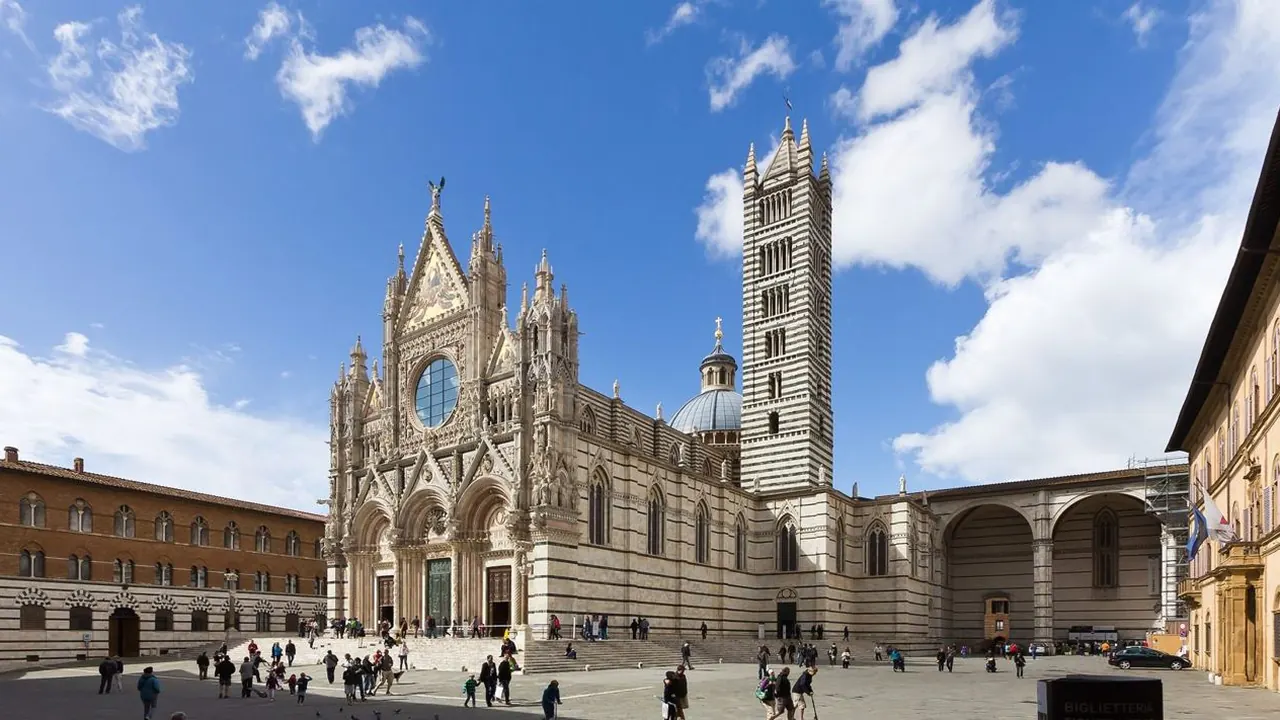
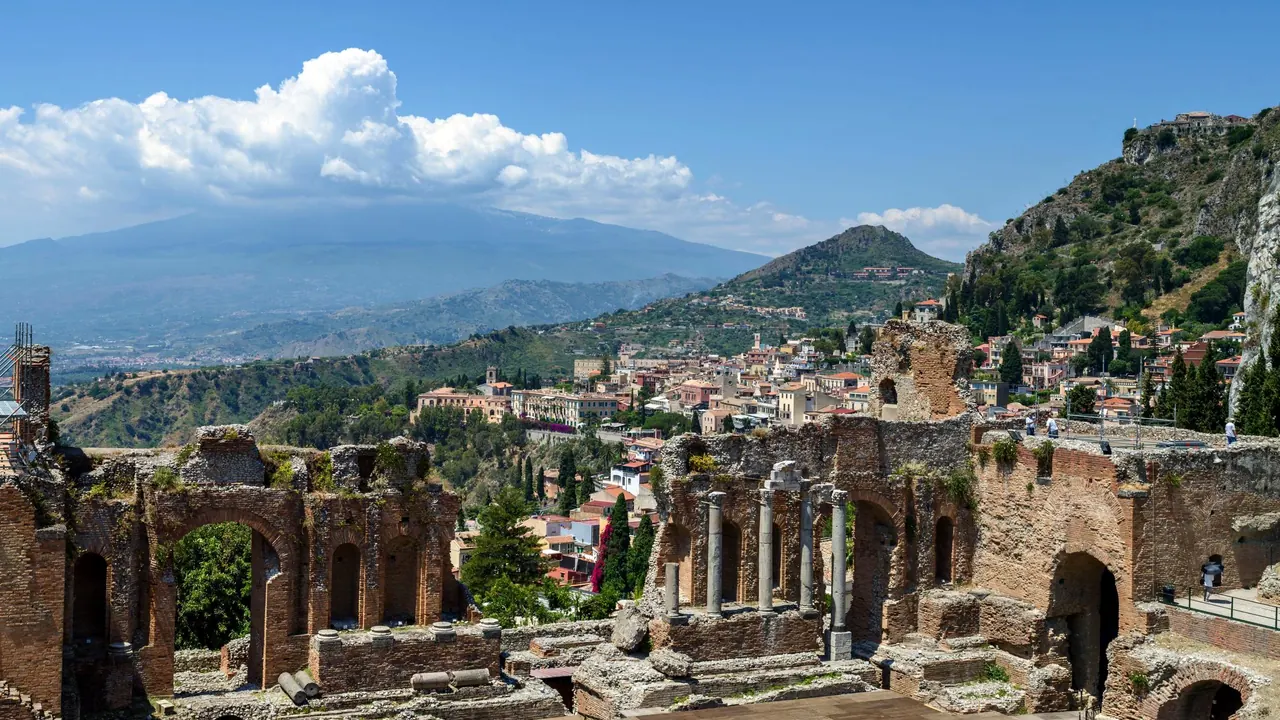
Photos: Siena by Raimond Spekking, CC BY-SA 4.0, cropped; Taormina by Reinhard Bruckner, Pexels License.
Siena or Taormina?
Our verdict in twelve categories, each scored against the same fixed benchmark cities, and the climate month by month, so you can choose for your trip.
Choose Siena for
- culture and sights
- day trips
- prices
Siena is the better choice for travellers who want art, history and the Tuscan countryside within easy reach. Its medieval centre, the Duomo and the Sienese painters give it real depth for a two- or three-day stay. Around it lie hill towns, wine villages, abbeys and Florence, more than enough to fill a week. It also costs less to stay, and the thermal pools to the south make it a calm base for slow days.
Choose Taormina for
- beaches
- nature and the outdoors
- shopping
Taormina suits a summer vacation by the sea with a dramatic view thrown in. Clear water in the coves below town, the Greek theatre framing Etna and the volcano itself as a walking and touring ground make it an outdoors-and-swimming place first. Sightseeing comes second. Expect to pay resort prices for that terrace above the Ionian.
Scoreboard
Twelve categories on one fixed scale from 0 to 100. The shaded stretch is the gap between the two.
Your match
Pick a travel style or drag the sliders, and both match scores follow your weighting.
Too close to call, 1 point apart
Wins on culture and sights and day trips with your weighting.
Wins on beaches and nature and the outdoors with your weighting.
What matters to you?
Category by category
What the scores mean for a trip.
Beaches & swimming
Taormina is a place to swim and Siena is not. Below Taormina's terrace the cable car reaches the glassy coves at Mazzarò and Isola Bella, good for snorkelling though narrow and pebbly. Giardini Naxos and Letojanni have longer stretches of sand and shingle a short bus ride away.
From Siena the Maremma coast around Castiglione della Pescaia is well over an hour's drive, so a swim takes a full day. On a Tuscan stay, swimming usually means the pool at an agriturismo.
Food & drink
Both eat well, and the difference is land against sea. Siena cooks from the hills: hand-rolled pici with duck ragù, cinta senese pork, wild boar and a baking tradition of panforte and ricciarelli. Chianti Classico, Brunello and Vino Nobile are poured by the glass, and the family osterie in the contrada side streets give it a slight edge for everyday eating.
Taormina brings swordfish, raw red prawns, pasta alla Norma and the granita-and-brioche breakfast, with Etna's volcanic wines on every list. It also has a refined upper tier with sea views that Siena lacks, but the Corso is full of tourist menus. Neither offers much beyond its own regional cooking.
Culture & sights
Siena is in another league. Its whole centre is a UNESCO-listed medieval city, from the sloping Campo and the Palazzo Pubblico with Lorenzetti's Good and Bad Government to the Duomo's inlaid floor, Duccio's Maestà and the large museum complex at Santa Maria della Scala. The seventeen contrade give each quarter its own identity, and the main sights fill two or three days.
Taormina has one great monument, the Greek theatre with Etna framed behind its broken stage. There is also an attractive stretch of Arab-Norman and Gothic palaces along Corso Umberto. With no major museums, a slow day covers it.
Nightlife
Neither town is for clubbing, and evenings in both revolve around dinner and a stroll. Siena has a student edge, with a handful of pubs and wine bars from the university, and the streets come alive only on the nights around the Palio. Taormina's evenings are more polished: aperitivo in Piazza IX Aprile, piano bars on terraces over the sea and a few summer beach clubs near Mazzarò, mostly for couples.
Nature & outdoors
Taormina has the more dramatic outdoors, because Etna is within about an hour. You can walk the Silvestri craters, go towards the summit with a guide, ski in winter or tour vineyards and chestnut woods on its flanks. Add the basalt Alcantara gorges and snorkelling and diving in the Isola Bella marine reserve, and land and sea are both covered.
Siena's countryside is gentler and more pastoral. It has the bare clay hills of the Crete Senesi and the rolling Val d'Orcia, and the white gravel strade bianche make it a serious cycling base. There are no mountains or coastline to match Sicily's.
Day trips
Siena has more within easy reach. Florence, San Gimignano, Monteriggioni, the Chianti villages, Volterra, Pienza, Montalcino and Montepulciano all lie close together. The abbeys of Monte Oliveto Maggiore, Sant'Antimo and San Galgano add to the list, and a car makes the most of them.
Taormina's outings are fewer and spread further apart. Catania is about an hour away, Syracuse and Ortigia about two, and Noto needs an early start. Nearer at hand are Castelmola, the film villages of Savoca and Forza d'Agrò, and the Etna wine towns.
Good for families
Neither is designed for children, and both are built on steep slopes that are hard with a pushchair. The difference is what fills the day. In Siena it is climbing the Torre del Mangia and watching contrada drummers, with a countryside farmhouse pool as the usual base. In Taormina it is the cable car to the sea, snorkelling and a trip to Etna's craters, and Giardini Naxos below offers flatter streets and sandier beaches for small children.
Getting around
Both centres are small, pedestrian and steep, so you walk everywhere and climb a lot. Siena links its valley station to the upper town by escalator, with buses the better link to Florence. Taormina's cable car runs down to the beaches, and its seaside station sits on the coastal line to Catania airport, Messina and Syracuse. In both places, the wine country inland really needs a car or a tour.
Shopping & style
Siena's shopping is on Banchi di Sopra and Via di Città: Italian shoes and clothing, leather goods, stationers, hand-painted majolica and the scarves and flags of the contrade. A large weekly market spreads around the Fortezza Medicea. Panforte, ricciarelli and pecorino are the things to carry home.
Taormina puts almost everything on Corso Umberto, which has coral and cameo dealers, linen and lace, resort-wear boutiques and painted moor's-head vases. The edible things to take home are Bronte pistachio cream and Etna wines. Neither town has luxury streets or department stores, so this is shopping to browse rather than a reason to travel, and for bigger stores Taormina sends you down to Catania.
Affordability
Siena is the easier stay on the wallet. Rooms inside the walls are tight in summer and around the Palio, but simple osteria lunches with house wine keep meals reasonable, though the museum entries add up.
Taormina is the priciest base in eastern Sicily, set by grand sea-view hotels and resort prices on the Corso. Granita and buses stay cheap. In both places, sleeping outside the centre saves the most: an agriturismo near Siena, or Giardini Naxos or Letojanni below Taormina.
Live music & performing arts
Siena's music comes from its schools. The Accademia Chigiana holds summer concerts and masterclasses in palaces and churches, and Siena Jazz adds performances by its teachers and students. Through the winter, the Teatro dei Rinnovati and the Teatro dei Rozzi stage drama and music.
Taormina's moment is the summer stage. Opera, ballet and international pop and rock play in the Greek theatre, with Etna rising behind the performers. Once the season ends, there is little beyond the odd chamber concert. For major opera, Siena looks to Florence and Taormina to Catania's Teatro Massimo Bellini.
Wellness & relaxation
Siena wins because of the warm water around it. Rapolano Terme's travertine pools are half an hour away, and Bagno Vignoni's steaming medieval bath, the free limestone pools of Bagni San Filippo and Petriolo's sulphur river lie further south. Rural spa farmhouses make a slow stay easy.
Taormina has no public bathing tradition, so restoring yourself means a hotel spa with volcanic mud treatments and a terrace pool. The rest is long lunches in the Villa Comunale shade, best in May, June or late September.
When should you go?
Pick your month. The climate figures are measured averages, not a forecast.
Siena in July
Taormina in July
Daytime high, °C
Rainfall in the month, mm
Where the figures come from
Siena's temperatures are measured 45 km from the centre, at Arezzo.
Siena has no rain gauge within 25 km of the centre, so its rainfall comes from a gridded climate dataset read at the city rather than from a gauge further away.
Taormina's temperatures are measured 45 km from the centre, at Messina.
Taormina has no rain gauge within 25 km of the centre, so its rainfall comes from a gridded climate dataset read at the city rather than from a gauge further away.
Temperature and rainfall are climate normals, averaged over the years shown. Siena: 2006-2017 (rainfall 1991-2020) normals, Arezzo (45 km from centre). Taormina: 1991-2020 normals, Messina (45.1 km from centre).
Siena has a hill-country climate of real seasons. Late spring and September are the best months for walking its steep streets and the countryside around. July and August reach 31°C, which makes afternoons on the climbs tiring, and from October the rain builds to a wet November of about 127mm. Winter days are cool, around 9°C in January, but often clear.
Taormina is milder at both ends of the year. Winter days stay near 15°C, and from May to August the town is almost dry and very sunny. The sea warms to 26°C in August and is pleasant for swimming from June to October, so the beach season runs well into autumn, long after Siena has turned cool and damp. Its own rain arrives in October and lasts through the winter. For a sightseeing trip in spring both work well. For high summer Taormina has the sea to cool off in and Siena does not.
Which traveller are you?
On a beach and sun trip, Taormina wins easily. The cable car drops to clear coves at Mazzarò and Isola Bella, sandier beaches lie a bus ride away, and the sea stays warm into October. Siena has no coast within easy reach.
For a culture and arts trip, Siena is the stronger base. Lorenzetti's frescoes, Duccio's Maestà, the Duomo floor and the Pinacoteca sit inside an intact medieval city, while Taormina's Greek theatre and short Corso are seen in a day.
On an outdoors trip, Taormina offers more drama: guided walks over Etna's lava fields and craters, the basalt Alcantara gorges and snorkelling or diving in the Isola Bella reserve. Siena's gentler hills reward cyclists on the strade bianche, but the landscape is softer.
Before you go
| Measure | Siena | Taormina |
|---|---|---|
| Official language | Italian | Italian |
| Currency | Euro (EUR) | Euro (EUR) |
| Sockets | CFL230 V, 50 Hz | CFL230 V, 50 Hz |
| Driving side | Right | Right |
| Time zone | UTC+1, UTC+2 in summer | UTC+1, UTC+2 in summer |
| Emergency number | 112 | 112 |
| Elevation | 322 m | 204 m |
| Main airport | Florence Airport, Peretola (FLR)55 km from centre46 non-stop destinations | Catania-Fontanarossa Airport (CTA)47 km from centre96 non-stop destinations |
| Public holidays this year | 13 days | 13 days |
By the numbers
| Measure | Siena | Taormina |
|---|---|---|
| City population | 52,812 | 10,471 |
| People per km² | 446 | 799 |
| Museums within 10 km | 30 | 5 |
| UNESCO World Heritage sites within 50 km | 5 | 2 |
| Swim season, months above 21 °C | - | 5 months |
Where else could you go?
Every comparison below shares a destination with this one, so you can follow Siena or Taormina somewhere new.
- Cataniavs Taormina
- Florencevs Siena
- Syracuse, Sicilyvs Taormina
- Pisavs Siena
- Luccavs Siena
- Bolognavs Siena