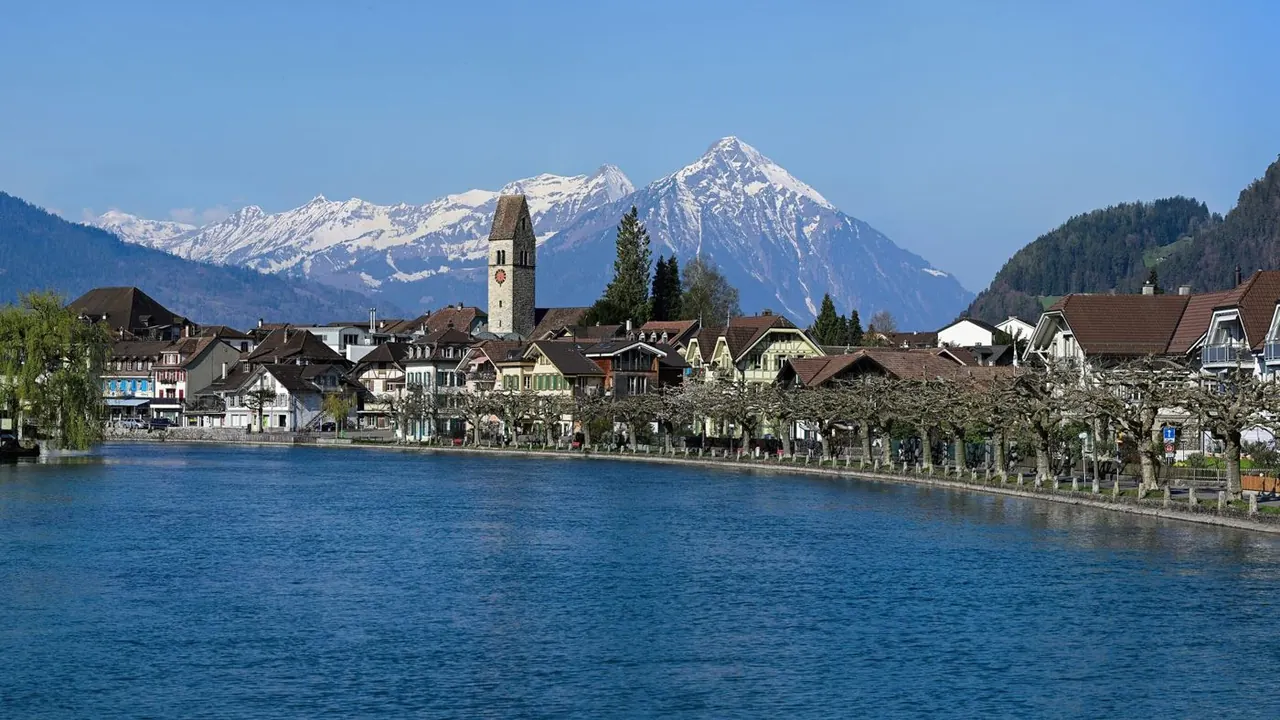
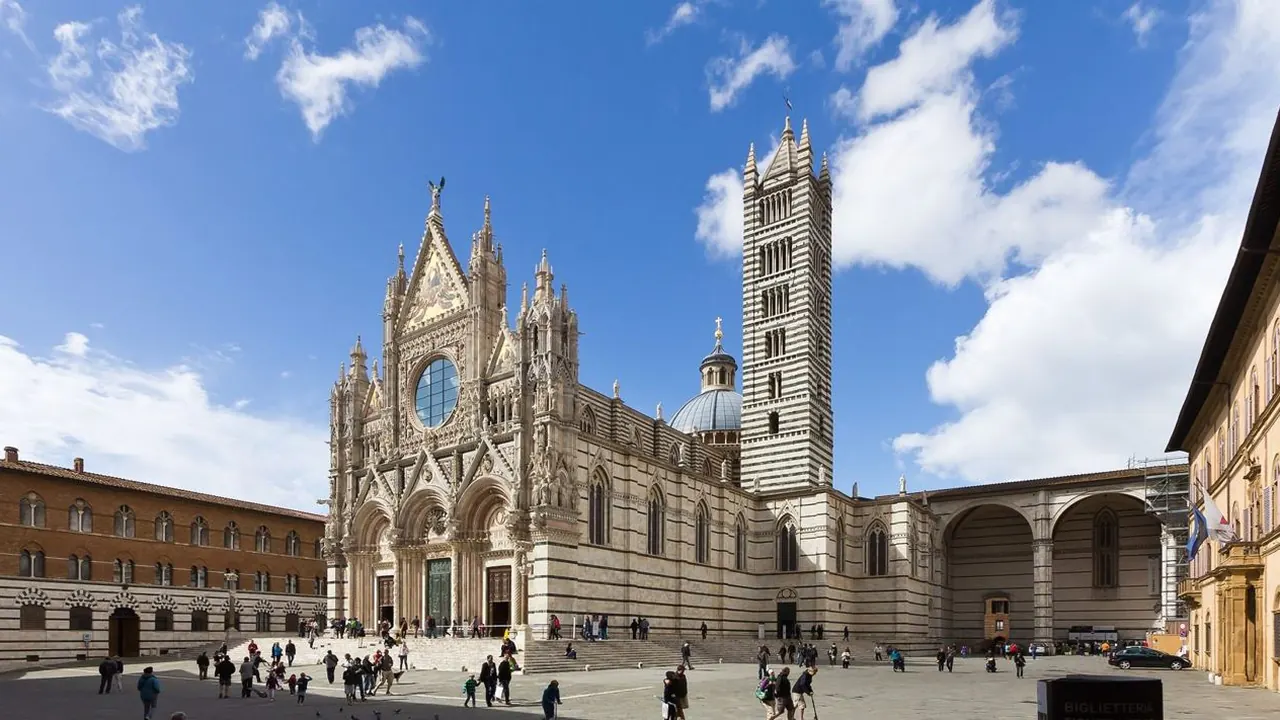
Photos: Interlaken by Roy Egloff, CC BY-SA 4.0, cropped; Siena by Raimond Spekking, CC BY-SA 4.0, cropped.
Interlaken or Siena?
Our verdict in twelve categories, each scored against the same fixed benchmark cities, and the climate month by month, so you can choose for your trip.
Choose Interlaken for
- families
- nature and the outdoors
- getting around
Choose Interlaken if the mountains are the whole point of the trip. Trains, cable cars and trails into the Jungfrau region start at the station. The town is easy with children, and you can do all of it without a car. It costs a great deal, though, and nobody comes here for dinners, museums or late nights.
Choose Siena for
- culture and sights
- food and drink
- prices
Siena is the better pick for travellers who come for art, history and good food. The medieval centre around the Duomo and the Campo, honest Tuscan cooking and wine, and a ring of hill towns, abbeys and hot springs give you several days of variety, at a clearly lower cost than the Alps. Active travellers should know that a car helps a lot, summer is hot and there are no real mountains.
Scoreboard
Twelve categories on one fixed scale from 0 to 100. The shaded stretch is the gap between the two.
Your match
Pick a travel style or drag the sliders, and both match scores follow your weighting.
Wins on families and nature and the outdoors with your weighting.
Wins on culture and sights and food and drink with your weighting.
What matters to you?
Category by category
What the scores mean for a trip.
Beaches & swimming
Neither is a beach destination, but Interlaken at least has water on its doorstep. In July and August Lake Thun is warm enough to swim from the lidos at Neuhaus or along the shore towards Spiez. The colder, turquoise Lake Brienz has a bathing area at Bönigen.
Siena has no water of its own beyond hotel and agriturismo pools. The Maremma coast around Castiglione della Pescaia is warmer than either Swiss lake, but it is well over an hour away by car, so a swim takes the whole day.
Food & drink
Siena is the place to eat well. Hand-rolled pici, cinta senese pork, wild boar stews and a long baking tradition of panforte and ricciarelli all come from a living local kitchen. Chianti Classico, Brunello and Vino Nobile are poured by the glass, and the best meals are in the family osterie on the side streets of the contrade.
Interlaken's restaurants feed visitors reliably with fondue, rösti and a spread of Indian and Asian places, though little stands out. Its best food is up at hut terraces above Grindelwald or Mürren, or cheese bought from a mountain dairy. Its one advantage is the broader choice of foreign cooking, which Siena largely lacks.
Culture & sights
This is the widest gap between the two. Siena's whole medieval centre is UNESCO-listed. The Campo, the Palazzo Pubblico with Lorenzetti's Good and Bad Government frescoes, the Duomo with its inlaid marble floor, and Duccio's Maestà in the Museo dell'Opera fill two or three full days.
Interlaken offers the grand hotels and the Kursaal on the Höheweg and a few old timber houses in Unterseen, which you can see in an hour. For architecture and museums, you take the train to Bern or Lucerne.
Nightlife
In Interlaken the evening is over soon after dinner, because most visitors are catching the first mountain trains next morning. Your options are a few backpacker pubs and sports bars near the hostels, a couple of basement clubs and the casino in the Kursaal. They get livelier in summer and the ski season, and those clubs at least offer the dancing that Siena barely has.
Siena's evenings are slower and longer, and more rewarding for it. Dinner runs late, a glass of wine on the Campo is an occasion in itself, and the university keeps a handful of pubs and wine bars going. Around the Palio the contrade eat at long outdoor tables and the streets stay full until late. For a proper night out, though, you would go to Florence.
Nature & outdoors
Interlaken is one of the great Alpine bases. The Eiger, Mönch and Jungfrau, the waterfalls of the Lauterbrunnen valley and the Jungfraujoch above the Aletsch glacier are all within an hour by rail. Cable cars lift you straight onto high trails, and paragliding, canyoning, rafting and winter skiing are all run from town.
Siena's countryside is gentler: the bare clay hills of the Crete Senesi, the rolling Val d'Orcia and the white gravel strade bianche that draw serious cyclists. It is lovely in spring and autumn, but there are no high peaks and no real wilderness.
Day trips
Siena has the richer choice of day trips. Florence, San Gimignano, Volterra, the Chianti villages, Montalcino, Pienza and abbeys such as Sant'Antimo and San Galgano are all within reach. The hill towns and wineries are much easier with a car.
Interlaken's strength is that its trips all work by public transport. Bern's arcaded old town is under an hour away, and lake steamers stop at castle towns such as Thun, Spiez and Oberhofen. Ballenberg's open-air museum and Lucerne round out a shorter list, but none of it needs a car.
Good for families
Interlaken suits children far better. The trains, gondolas and steamers are outings in themselves, and the summit stations above Grindelwald and on the Harder Kulm have playgrounds, cliff walks and toboggan runs. The St Beatus caves and the farm animals at Ballenberg add variety, though wet days and the highest summits are harder.
Siena is safe and welcoming but has nothing built for children, and its steep streets are hard work with a pushchair. Older children enjoy climbing the Torre del Mangia. Younger ones usually do better at a countryside farmhouse with a pool.
Getting around
You can cross Interlaken's flat centre on foot in about twenty minutes. Beyond it, mainline trains, cog railways, gondolas and steamers connect so well that you never need a car, though the popular mountain trains get crowded in summer.
Siena's centre is walkable and largely closed to traffic, but its three ridges mean steep climbs and stepped lanes, and escalators carry you up from the station below. Trains are slow and few, so seeing the countryside properly usually means hiring a car.
Shopping & style
Interlaken's shops are set up for tour groups with an hour to spare. The big watch and jewellery stores on the Höheweg sit beside counters of army knives, cuckoo clocks and chocolate, and the outdoor gear shops are mostly useful if you turn up without boots. Carved woodwork from Brienz is the one thing actually made in the region.
Siena gives you more reason to browse. Its main streets have the ordinary Italian clothes, shoe and leather shops that locals use, not stores aimed at coach parties. Most of what you take home comes from the town or its hills: painted ceramics, the flag of a contrada, or cheese and wine from the surrounding countryside. Even so, it is a modest place to shop, with no luxury streets, and the lanes nearest the Campo sell mostly souvenirs.
Affordability
Siena is the much cheaper stay. Rooms inside the walls are in demand, especially around the Palio. Still, an osteria lunch with house wine is good value, the centre costs nothing to walk, and an agriturismo outside town cuts costs further.
Interlaken charges full Swiss prices for beds, meals and drinks, and the mountain railways, above all to the Jungfraujoch, are the biggest single expense. Transport passes, hostels and supermarket picnics help, but there is no cheap way to see the region properly.
Live music & performing arts
Siena has a real, if provincial, music scene. The Accademia Chigiana fills palaces and churches with classical concerts in summer, Siena Jazz adds concerts by its teachers and students, and two historic theatres stage drama and music through the winter.
Interlaken's highlight is the open-air William Tell, performed every summer in the woods by local amateurs since the early twentieth century. Beyond that there are folklore evenings with yodelling and alphorns. For a fuller programme, both towns send you elsewhere: Siena to Florence, Interlaken to Bern.
Wellness & relaxation
Siena wins on thermal water. Rapolano Terme's travertine pools are about half an hour away. Further south are the medieval bath at Bagno Vignoni, the free woodland pools of Bagni San Filippo and Petriolo's hot sulphur river, and many visitors pair a spa day with a farmhouse stay.
Interlaken has no hot springs, so relaxing means the spas in the grand Höheweg hotels or the town's public wellness area. Its restful side is the scenery: slow steamer crossings and quiet mornings up in Wengen or Mürren, away from the busy, activity-driven centre.
When should you go?
Pick your month. The climate figures are measured averages, not a forecast.
Interlaken in July
Siena in July
Daytime high, °C
Rainfall in the month, mm
Where the figures come from
Interlaken has no rain gauge within 25 km of the centre, so its rainfall comes from a gridded climate dataset read at the city rather than from a gauge further away.
Siena's temperatures are measured 45 km from the centre, at Arezzo.
Siena has no rain gauge within 25 km of the centre, so its rainfall comes from a gridded climate dataset read at the city rather than from a gauge further away.
Temperature and rainfall are climate normals, averaged over the years shown. Interlaken: 2005-2020 (rainfall 1991-2020) normals, Meiringen / Unterbach (19.3 km from centre). Siena: 2006-2017 (rainfall 1991-2020) normals, Arezzo (45 km from centre).
Interlaken has a short, mild summer. From June to August highs reach the low twenties, around 24°C in July. That is warm enough for a lake swim after a day on the trails, and September is still pleasant for walking. Winter is cold, with highs of 3°C in January, which suits the ski areas better than strolling around town. Rain is spread fairly evenly through the year, a little heavier in high summer and December.
Siena is much warmer. July and August reach 31°C, which makes its steep streets hard going in the afternoon. May and October are the best months for sightseeing. Rain is heaviest in autumn and winter, peaking at 127mm in November, and high summer is the driest stretch. Winters are cool but milder than in the Alps, with highs around 10°C.
Which traveller are you?
For an outdoors trip, Interlaken is the clear choice. High Alpine trails, glaciers, paragliding, canyoning and skiing all start in town or a short train ride away. Siena's gentle clay hills mostly reward cyclists on the strade bianche.
On a culture and arts trip, Siena wins easily. Its UNESCO-listed medieval centre, the paintings of Lorenzetti and Duccio, the Duomo and a ring of hill towns and abbeys fill days. Interlaken's own sights take a short stroll, and its real museums are in Bern.
On a family trip with children, Interlaken is the easier base. Mountain trains, gondolas, summit playgrounds and toboggan runs keep children busy, and the flat centre suits pushchairs. Siena's steep lanes and lack of children's attractions usually send families out to countryside pools.
Before you go
| Measure | Interlaken | Siena |
|---|---|---|
| Official language | French, German, Italian, Romansh | Italian |
| Currency | Swiss Franc (CHF) | Euro (EUR) |
| Sockets | CJ230 V, 50 Hz | CFL230 V, 50 Hz |
| Driving side | Right | Right |
| Time zone | UTC+1, UTC+2 in summer | UTC+1, UTC+2 in summer |
| Emergency number | 112 | 112 |
| Elevation | 571 m | 322 m |
| Main airport | Zürich Airport (ZRH)100 km from centre226 non-stop destinations | Florence Airport, Peretola (FLR)55 km from centre46 non-stop destinations |
| Public holidays this year | 10 days | 13 days |
By the numbers
| Measure | Interlaken | Siena |
|---|---|---|
| City population | 6,123 | 52,812 |
| People per km² | 1,424 | 446 |
| Museums within 10 km | 3 | 30 |
| UNESCO World Heritage sites within 50 km | 2 | 5 |
Where else could you go?
Every comparison below shares a destination with this one, so you can follow Interlaken or Siena somewhere new.